Unit 4 Review: Innovation and Society in DACH Countries
Technology and Daily Life (Technologie im Alltag)
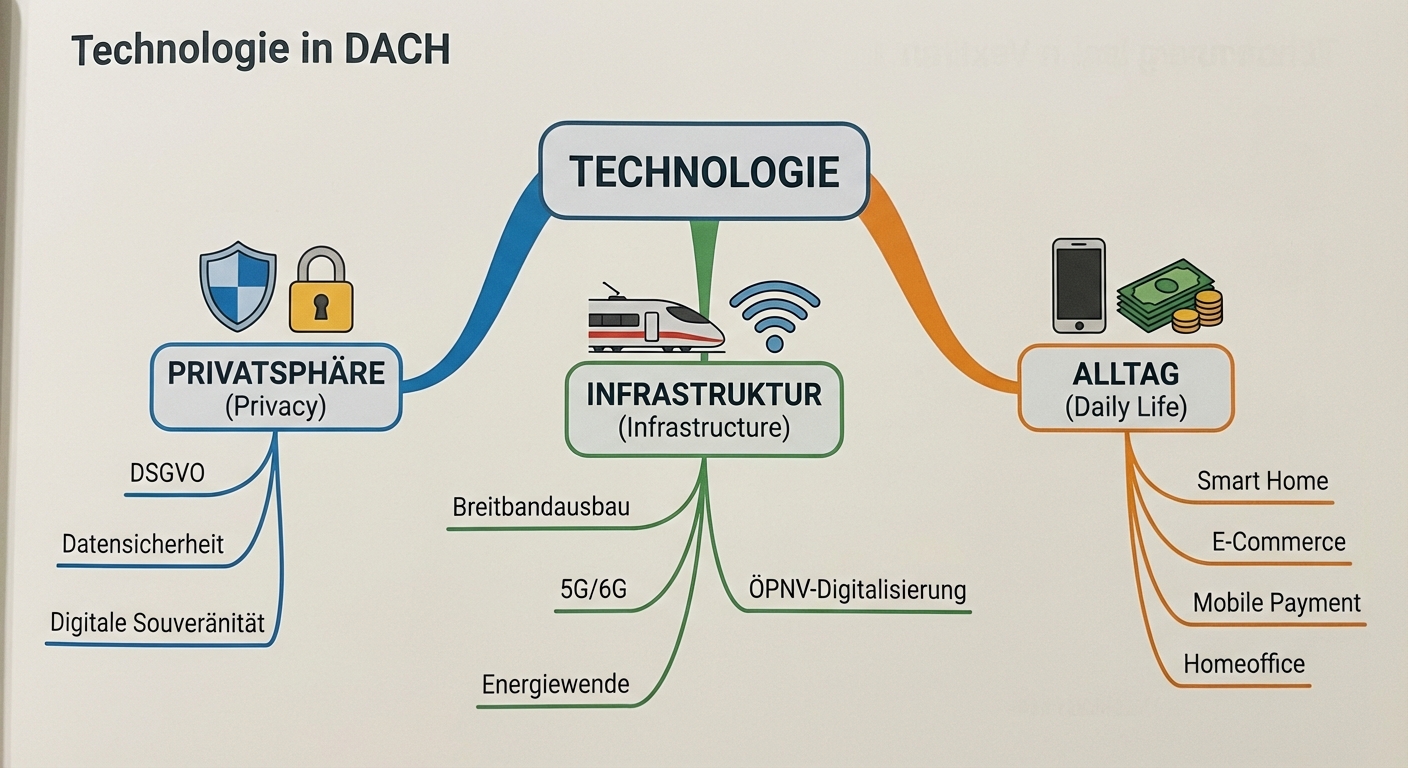
In the AP German Language and Culture exam, specifically Unit 4, you are expected to discuss how technology integrates into daily routines, not just by listing devices, but by analyzing the cultural attitudes toward these tools in the DACH region (Germany, Austria, Switzerland).
The Role of Digitalization (Die Digitalisierung)
Germany is famously known as a land of engineering, but it often struggles with Digitalisierung (digitization) within public infrastructure and schools compared to other nations.
- Internet Access: While improving, concepts like High-Speed-Internet (Breitbandausbau) are frequent political talking points because rural areas (
ländliche Gebiete) often lag behind. - Cash vs. Card: Although changing post-pandemic, the German-speaking world is culturally cash-heavy (bargeldorientiert). While apps like Apple Pay are growing, many small businesses (kleine Betriebe) still prefer cash.
- Social Mdia: Use of Soziale Medien is widespread, but there is a strong cultural discourse regarding Reizüberflutung (sensory overload) and Handysucht (cell phone addiction).
Data Privacy (Der Datenschutz)
This is perhaps the most critical cultural differentiator between the US and Germany in this unit.
- Cultural Context: Due to historical experiences (surveillance states in the 20th century), Germans are extremely protective of their private data.
- Key Term: Die Privatsphäre (privacy/private sphere).
- Legal Framework: The GDPR (General Data Protection Regulation), known in German as DSGVO (Datenschutz-Grundverordnung), is strictly enforced.
- Exam Tip: If discussing social media in a Cultural Comparison, mentioning Datenschutz is an excellent way to show cultural competency.
Essential Vocabulary: Daily Tech
| German | English | Context Example |
|---|---|---|
| Das Gerät | Device/Appliance | Mein Gerät ist kaputt. |
| Herunterladen | To download | Ich lade die Datei herunter. |
| Das Netzwerk | Network | Soziale Netzwerke verbinden uns. |
| Der Zugang | Access | Der Zugang zum Internet ist langsam. |
| Abhängig von | Dependent on/Addicted to | Viele Jugendliche sind vom Handy abhängig. |
New Discoveries and Inventions (Neue Entdeckungen und Erfindungen)
The German-speaking world prides itself on being a "Land of Ideas" (Land der Ideen). This section covers scientific advancements and the infrastructure that supports them.
Renewable Energy and Environment
The Energiewende (energy transition) is a central topic in German society. It refers to the planned transition from nuclear and fossil fuels to renewables.
- Wind and Solar: You will see wind turbines (Windkraftanlagen) all over Northern Germany and solar panels (Solarzellen) on roofs in the South.
- Electric Mobility (E-Mobilität): The German auto industry (VW, BMW, Mercedes) is pivoting toward electric vehicles (Elektroautos). This creates a tension between the tradition of the combustion engine (Verbrennungsmotor) and the need for climate protection (Klimaschutz).
- Hydroelectric Power: In Austria and Switzerland (Österreich und die Schweiz), Wasserkraft (hydroelectric power) is a primary energy source.
Medicine and Research (Medizin und Forschung)
The DACH region, particularly Switzerland (Basel), is a global hub for the pharmaceutical industry (Pharmaindustrie).
- mRNA Technology: Note that the technology for the Pfizer COVID-19 vaccine was developed by BioNTech, a German company.
- Stance on GMOs: There is significant public skepticism regarding Gentechnik (genetic engineering) in food (gentechnisch veränderte Lebensmittel). Most supermarkets label products as "Ohne Gentechnik."
Important Grammar for Science: The Passive Voice
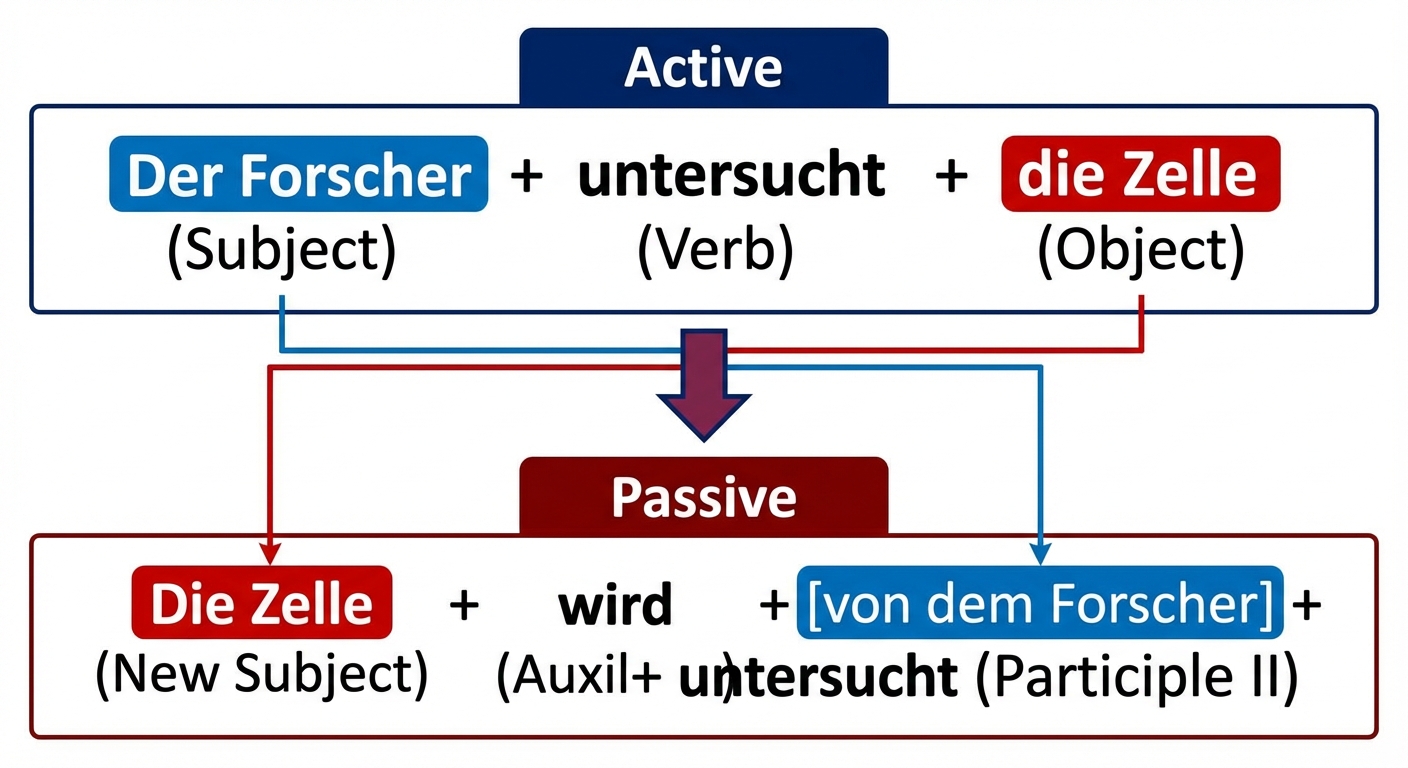
Scientific texts usually prefer the Passive Voice to emphasize the action rather than the actor.
Formula:
- Active: Der Wissenschaftler erfindet das Gerät. (The scientist invents the device.)
- Passive: Das Gerät wird (von dem Wissenschaftler) erfunden. (The device is being invented.)
Ethical Questions in Science and Technology
This section is highly likely to appear in the Persuasive Essay section of the AP exam. You usually have to weigh the benefits of progress against moral concerns.
Artificial Intelligence (Künstliche Intelligenz - KI)
The debate involves efficiency vs. humanity.
- Pro: KI can analyze medical data faster than doctors and automate dangerous jobs.
- Con: Fear of job loss (Arbeitsplatzverlust) and lack of human empathy (menschliches Mitgefühl).
- Key Phrase: Ist die KI ein Fluch oder ein Segen? (Is AI a curse or a blessing?)
Bioethics (Bioethik)
Since the cloning of Dolly the sheep, questions about Klonen (cloning) and stem cell research (Stammzellenforschung) are debated hotly, especially given Germany's historical sensitivity to eugenics.
- Embryonic Protection: German laws regarding embryo research are among the strictest in Europe.
- Argumentation: When writing about this, focus on the conflict between medizinischer Fortschritt (medical progress) and Menschenwürde (human dignity).
Structuring an Argument
When discussing ethics, use specific conjunctions to show complexity:
- Zwar … aber (Indeed … but)
- Ex: Zwar bringt die Technik Vorteile, aber sie birgt auch Risiken. (Indeed tech brings advantages, but it also harbors risks.)
- Einerseits … andererseits (On one hand … on the other hand)
- Im Gegensatz zu (In contrast to)
Common Mistakes & Pitfalls
1. False Friends: Technique vs. Tech
- Mistake: Using "Technologie" for everything.
- Correction:
- Die Technik: Refers to the machinery, the device, or the method/skill (e.g., Die Technik funktioniert nicht - The equipment isn't working).
- Die Technologie: Refers to the branch of knowledge or high-level systems (e.g., Nanotechnologie).
- Tip: When in doubt, strictly referring to a gadget, use das Gerät or die Technik.
2. Genetic Engineering Vocabulary
- Mistake: Using English terms like "Genetic Engineering."
- Correction: Use die Gentechnik. A Genetically Modified Organism is usually referred to in the context of food as Genfood (slang) or gentechnisch veränderte Organismen.
3. Prepositions with "Internet"
- Mistake: In das Internet.
- Correction: Germans usually say im Internet (dative) when stating where something is found.
- Incorrect: Ich habe das in das Internet gelesen.
- Correct: Ich habe das im Internet gelesen.
4. Overusing "Leute" (People)
- Mistake: Using "Leute" in formal scientific essays.
- Correction: Use die Menschen (humans/people), die Bevölkerung (the population), or die Nutzer (the users).
- Weak: Die Leute benutzen Handys.
- Strong: Die Mehrheit der Bevölkerung nutzt Smartphones.