Unit 6 Review: Traditions and Transformations in West and Central African Art
Courtly Art and Dynastic History in West Africa
Introduction to the Region
West African art is frequently associated with dynastic history, heavy political centralization, and the sophisticated use of enduring materials like bronze, brass, and gold. Unlike Western art, which was historically viewed in museums as static objects, African art is often active, performative, and integral to the functioning of society.
The Lineage of Ife and Benin
While the AP curriculum focuses on 1100–1980 CE, understanding the continuity of style is essential.
- Nok Culture (c. 500 BCE–200 CE): The likely ancestors of the Yoruba/Ife tradition, known for expressive terracotta figures with pierced eyes.
- Ife (Yoruba): Famous for idealized naturalism in casting. They portrayed the Ooni (king) with calm, dignified expressions.
- Benin Kingdom (Edo peoples): Succeeded Ife traditions but moved toward more stylized iconography to emphasize the divine power of the Oba (king).
W03: Wall Plaque, from Oba’s Palace (Benin)
- Context: Created in the 16th century by the Edo peoples (modern Nigeria).
- Material: Cast brass (using the lost-wax casting technique). Brass was a restricted material, controlled by the Oba.
- Visual Analysis:
- Hierarchy of Scale: The Oba is the largest figure, seated side-saddle on a horse, flanked by smaller attendants.
- horror vacui: The artist fills all negative space with rosettes (referencing the sun/river god Olokun).
- Function: Decorated the wooden pillars of the palace to recount dynastic history and court etiquette.
- Cross-Cultural Connection: The coral beads worn by the Oba were obtained via trade with Portugal. Often, rosettes or background figures in Benin art depict Portuguese traders (identifiable by hooked noses/long hair), highlighting the wealth derived from trade.

W04: Sika dwa kofi (Golden Stool)
Ashanti Peoples (Ghana)
- Concept: The stool is the literal soul of the Ashanti nation.
- Rules:
- It fell from the sky onto the lap of Osei Tutu (the first king).
- It is never allowed to touch the ground (placed on its own chair).
- It is never sat upon, not even by the King (Asantehene).
- The War of the Golden Stool: In 1900, the British governor demanded to sit on it, sparking a war led by Queen Mother Yaa Asantewaa. This highlights the misunderstanding between European "furniture" and African "spirit vessels."
W14: Veranda Post of Enthroned King and Senior Wife
Yoruba Peoples (Nigeria), carved by Olowe of Ise
This is one of the few works where we know the specific artist, Olowe of Ise, a master carver.
- Structural Function: It is a caryatid (a sculpted column supporting a roof).
- Iconography:
- Senior Wife: Standing tall behind the seated king. Her large scale and hands on the throne indicate that while the king rules politically, he relies on women for spiritual and structural support (matrilineal strength).
- The King: Seated, smaller, with a bird on his crown (symbolizing the distinct power of women, "our mothers").
Spiritual Power and Historical Memory in Central Africa
Central African art (Kongo, Luba, Kuba) often focuses on the container of spiritual forces and the navigation of memory.
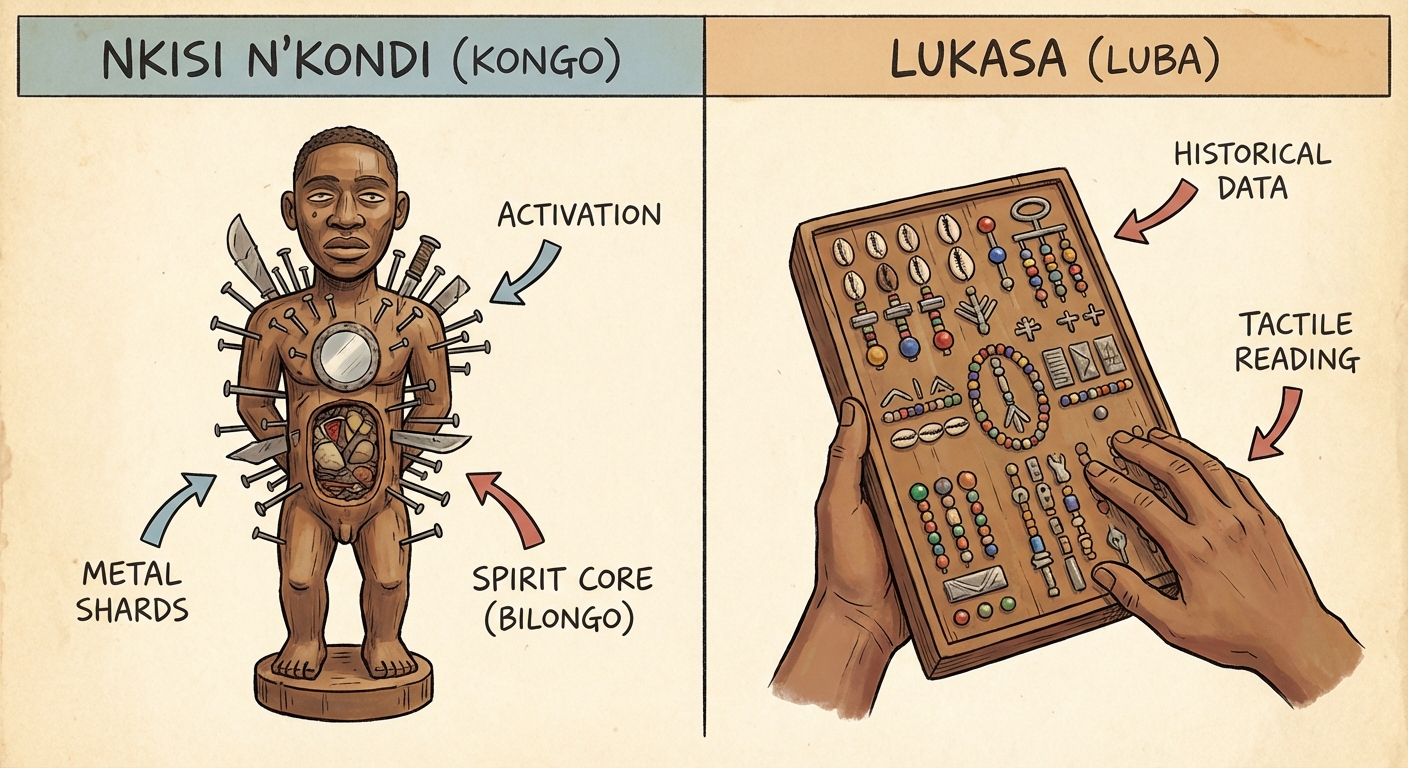
W06: Power Figure (Nkisi n’kondi)
Kongo Peoples (DRC)
- Concept: A collaborative object created by a carver and a ritual specialist (nganga).
- Function: It is a distinct example of active art. It acts as a judge, healer, or keeper of contracts.
- Mechanism:
- The nganga places medicinal matter (bilongo) in the figure's belly cavity (the moyo or soul), usually sealed with glass/mirror (representing the watery realm of the dead).
- Clients drive nails or blades into the wood to "wake up" the spirit to hunt down a wrongdoer or seal an oath.
- The object is not "complete" until it is used; its appearance changes over time.
W05: Ndop (Portrait Figure)
Kuba Peoples (DRC)
- Context: A commemorative portrait of the King (Nyim).
- Style: Idealized, not realistic. All Ndop figures look similar (large head = seat of wisdom; cross-legged; calm expression).
- Identification: Each king is identified by a specific geometric motif and a personal emblem (ibol) carved at the base (e.g., a drum, a severed head, a game board).
- Purpose: Served as a surrogate for the king's spirit; kept with the king's wives to assist in fertility and succession.
W11: Lukasa (Memory Board)
Luba Peoples (DRC)
- User: Used exclusively by the Mbudye Society (men of memory).
- Function: A mnemonic device (memory aid) used to recount royal history, migration routes, and genealogy.
- Usage: The reader holds the board in their left hand and traces the beads/shells with their right forefinger. The configuration of beads dictates the narrative.
- Concept: History is not written and static; it is performed and interpreted dynamically.
W13: Reliquary Figure (Byeri)
Fang Peoples (Cameroon)
- Context: The Fang were migratory; they needed portable ancestral shrines, not heavy permanent tombs.
- Function: The wooden figure sat on top of a bark box containing the skulls of ancestors. It guarded the bones against evil.
- Duality/Balance: The figure combines opposites to represent the cycle of life:
- Infant qualities: Large head, herniated belly button.
- Adult qualities: Muscular limbs, composed expression.
- Meaning: Ancestors are vital to the birth of new lineage.
Masquerade (Mas) and Ritual Performance
In African art, a "mask" is not just the wooden face covering. The primary art form is the Masquerade—the total effect of the costume, music, dance, and the spirit possessing the wearer.
Gender and Beauty: Bundu vs. Pwo
This is a critical comparison for the exam.
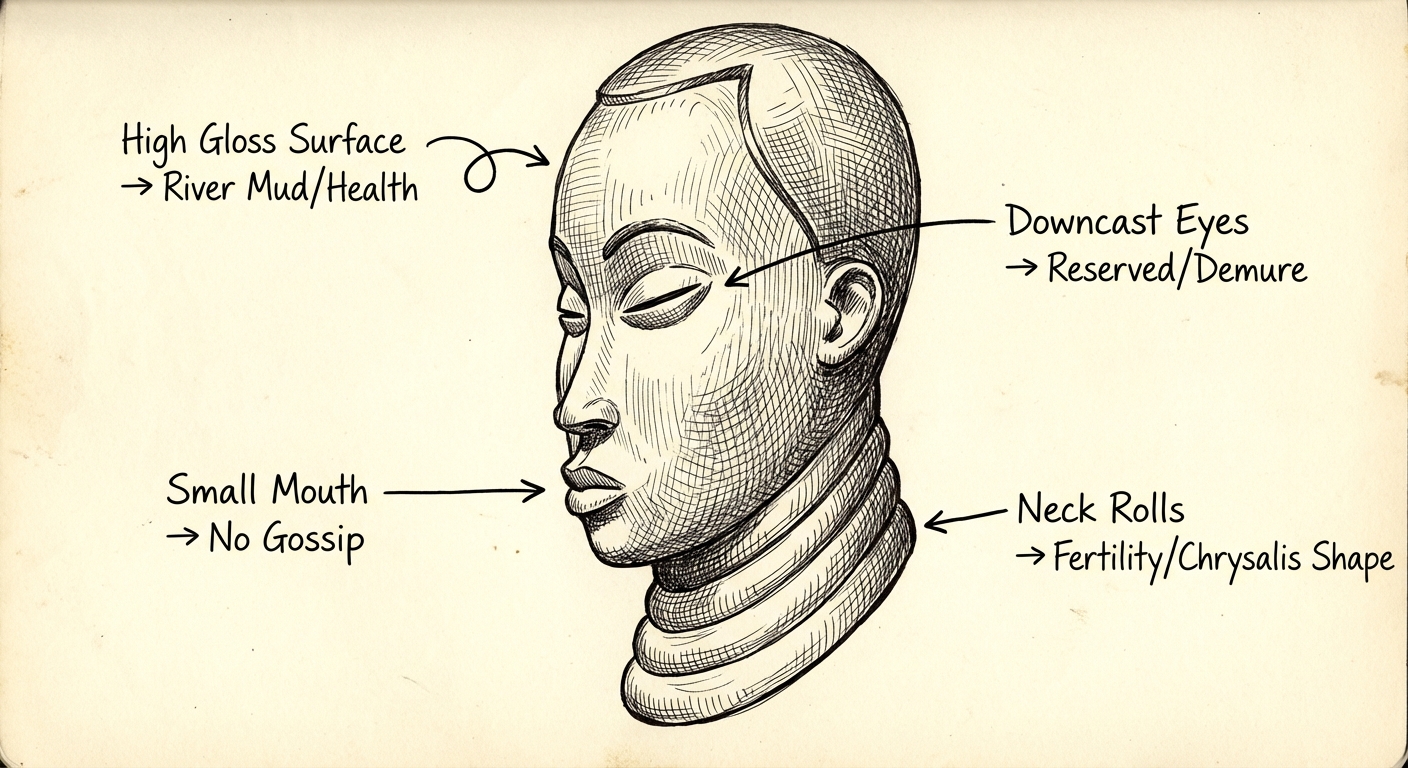
| Feature | W09: Bundu Mask (Mende) | W07: Pwo Mask (Chokwe) |
|---|---|---|
| Region | Sierra Leone (West Africa) | DRC (Central Africa) |
| Wearer | Women (Sande Society) | Men |
| Honors | Female initiation/transition to womanhood | Founding female ancestors/mothers |
| Aesthetics | Shiny black (water spirit/mud), Small mouth (no gossip), Fat rolls (fertility/wealth), Downcast eyes (demure) | Deep red earth tones, White kaolin around eyes (spiritual realm), Symmetrical features |
| Key Fact | The only mask in African art history worn by women. | A man dances like a woman to honor matrilineal lineage. |
W08: Portrait Mask (Mblo)
Baule Peoples (Ivory Coast)
- Function: Part of a secular (entertainment) masquerade to honor a specific, respected member of the community.
- Subject: Often a portrait of a specific woman (e.g., Moya Yanso), but worn by a male relative.
- Aesthetics: High forehead (intellect), downcast eyes (respect), triangular brass additions (health/sunlight).
W12: Aka Elephant Mask
Bamileke (Cameroon)
- Materials: Cloth base with thousands of imported glass beads.
- Symbolism:
- Elephant: Strength/Power.
- Leopard: (represented by bead patterns) Stealth/Power.
- Only the Kuosi society (warriors/elite) and the King (Fon) could wear these.
- Performance: Dancers whirl, causing the "trunk" and large ears to flap, embodying the power of the animal.
Common Mistakes & Pitfalls
- "Primitive" vs. "Stylized": Never describe African art as primitive. The abstraction (large heads, exaggerated features) is a deliberate conceptual choice to show inner power or specific attributes, not a lack of skill (proven by the realism of Ife).
- Static vs. Active: Do not analyze these works as you would a Greek statue. A mask hanging on a wall is "dead." You must discuss it in the context of dance, costume, and music. An Nkisi figure without nails is just a piece of wood—it needs the ritual action to be art.
- The "Artist": Students often assume African art is anonymous. While many names are lost, artists like Olowe of Ise were famous celebrities in their time. Also, art was often collaborative (Karver + Priest).
- Patrilineal vs. Matrilineal: Many societies (like the Chokwe and Ashanti) are matrilineal. Don't assume kingship passes from father to son or that power is exclusively male. The Veranda Post shows the king relies on the wife.
- Totemism: Do not call animals "totems" without specific evidence. In the Aka Elephant mask, the wearer is not "worshipping" the elephant; he is appropriating the elephant's power to enforce royal authority.
Mnemonics
- Bundu is Beautiful: Bundu masks represent the ideal woman (fat neck rings, small mouth), and are worn by women.
- Nkisi N-ails: The Nkisi figure gets nails driven into it.
- Luba-Lukasa-Library: The Lukasa is a library of history held in the hand.