Unit 2 Comprehensive Review: The Influence of Language and Culture on Identity
Unit 2: The Influence of Language and Culture on Identity
2.1 Foundations of Personal and Public Identity
Defining Identity (Identität)
Identity is the core essence of a person—what makes an individual unique among billions of others. In the context of AP German, we look at identity through two lenses: Personal Identity (how you see yourself) and Public Identity (how society sees you).
- Etymology: From Latin idem meaning "the same."
- The Paradox: Identity is about what makes us unique (Individuum = indivisible), yet it is also about belonging to a group (collective identity).
- Key Questions for the AP Exam:
- Wie sehe ich mich selbst? (Self-image)
- Wie werde ich von anderen gesehen? (External perception)
- Wie verändert sich meine Identität im Laufe der Zeit? (Identity development/crisis)
Aspects of German Identity (Die Deutsche Identität)
To understand the German-speaking world (DACH: D-Deutschland, A-Österreich, CH-Schweiz), one must look beyond stereotypes (beer, punctuality) to modern demographics and values.
1. Integration of Tradition and Modernity
- Bürokratie vs. Lebensfreude: Germany is famous for strict bureaucracy and efficiency, yet this contrasts with a vibrant festival culture (e.g., Karneval/Fasching, Oktoberfest).
- Work-Life Balance: Unlike the "live to work" mentality often found in the US, the German professional identity protects personal time.
- Feierabend: The strictly observed end of the working day.
- Vacation: 20–30 paid vacation days are standard. Long family trips (often to the Mediterranean or Baltic Sea) are a key part of the annual rhythm.
- Separation: Business emails after hours are frowned upon; there have even been political proposals to ban after-hour work communication to protect mental health.
2. Religion and Society
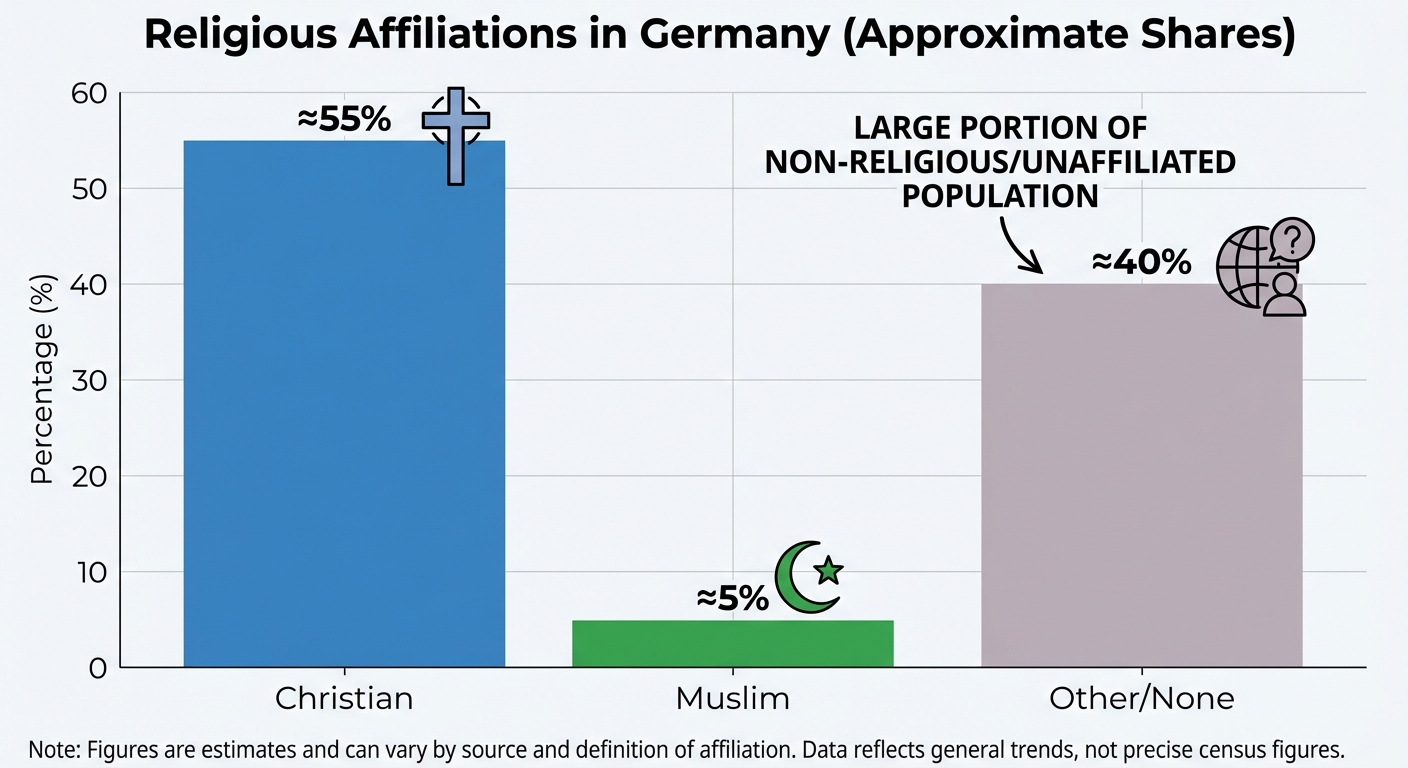
Germany is historically Christian but increasingly secular and diverse.
- Christianity: Approx. 55-60% identify as Christian (split between Catholic and Protestant/Evangelisch).
- Islam: The largest minority religion (approx. 4-5%), largely due to historical guest worker programs and recent migration.
- Konfessionslos (Non-religious): A rapidly growing group (over 30-40%), particularly high in the former East Germany (GDR), where religion was suppressed by the state.
3. Cultural Achievements and "Kulturnation"
Identity is strongly linked to being a "nation of poets and thinkers" (Das Land der Dichter und Denker).
- Literature: The Frankfurt Book Fair (Frankfurter Buchmesse) is the most important book trade fair in the world. Reading is a high-status hobby; ~45% of Germans read weekly.
- Music: From classical giants (Bach, Beethoven) to modern electronic music and festivals like Rock am Ring.
- Vereinswesen (Club Culture): A massive part of public identity. over 27 million Germans belong to a sports club (Sportverein). It is where community happens.
- Football (Fußball): More than just a sport; a religion. The Nationalelf (National Team) winning 4 World Cups (1954, 1974, 1990, 2014) are key moments of collective national pride.
2.2 Language and Cultural Identity in a Multicultural Society
Language is the primary carrier of culture (Kulturträger). In the German-speaking world, migration has transformed language, creating a tension between maintaining tradition and embracing a "Multi-Culti" reality.
Migration and Demographics
Germany has transformed from a homogenous society to a modern country of immigration (Einwanderungsland).
- The Concept of "Migrationshintergrund": A person has a migration background if they or at least one parent were not born with German citizenship. In 2019, this applied to 1 in 4 people in Germany.
- The Need for Migration: With a low birth rate and an aging population, Germany relies on skilled immigration to maintain its economy.
- EU Blue Card: Germany issues approx. 85% of all EU Blue Cards (work permits for highly skilled non-EU citizens), acting as a European counterpart to the US Green Card.
Language as an Integration Tool
- Integration Initiatives: Programs like "Geh Deinen Weg" (Go Your Own Way) by the German Immigration Foundation (DSI) use mentorships to help young migrants enter the workforce.
- Language Requirements: Proficiency in German is the main key to the labor market and social acceptance. However, the definition of "German" is evolving.
Linguistic Evolution: Denglisch and Kiezdeutsch
1. Kiezdeutsch (Neighborhood German)
Originally dismissed as "broken German," linguists now recognize Kiezdeutsch as a valid multi-ethnic dialect, similar to African American Vernacular English (AAVE) in the US.
- Characteristics: Dropping prepositions or articles (e.g., "Ich geh Bahnhof" instead of "Ich gehe zum Bahnhof").
- New Words: Words from Turkish (e.g., Lan = dude/bro) or Arabic (Yalla = hurry/let's go) have entered youth slang.
2. Influence of Globalization (Anglicisms)
English has heavily influenced German, creating "Denglisch."
- Direct Borrowing: Words like Computer, downloaden, cool, Meeting are standard.
- "False Friends" & Structural Changes:
- "Sinn machen": Traditionally incorrect (German is "Sinn ergeben" or "Sinn haben"), but widely used now due to the English "to make sense."
- "Realisieren": Traditionally meant "to implement/build," now often used to mean "to become aware of" (like the English "realize").
- Resistance: The Verein Deutsche Sprache keeps an Anglizismen-INDEX to track and often criticize the overuse of English, arguing it erodes cultural identity.
Culinary Identity
Food is a marker of cultural blending. The Döner Kebab, introduced by Turkish guest workers in Berlin, is now arguably more popular than the traditional Bratwurst. It symbolizes successful cultural adaptation—a Turkish dish adapted for German tastes, now exported globally as a "German" product.
2.3 Technology and Identity
The Digital Divide and Education
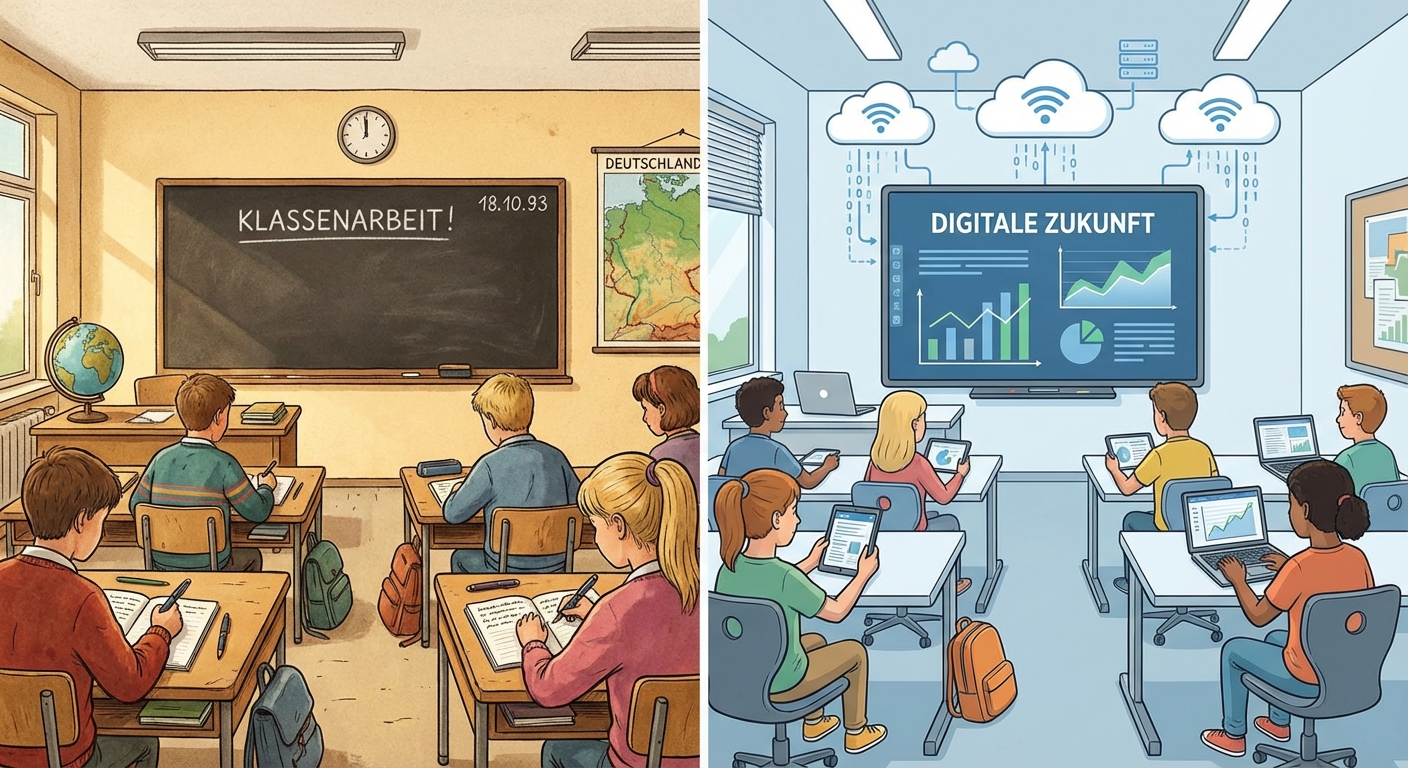
Germany has historically lagged behind other European nations in digitizing schools, a deficit highlighted by the COVID-19 pandemic.
- DigitalPakt Schule: A federal initiative started in 2018/2019 to better equip schools with fast internet, tablets, and software. Investments are high to catch up.
- HPI School Cloud: A standardized cloud platform developed to allow secure, remote access to learning materials, replacing heavy textbooks and expensive local computer labs.
- Chalk-Free Schools: Pilot projects (e.g., in Berlin) have used interactive whiteboards exclusively since 2012, aiming to modernize the "teacher-centric" German classroom model.
Social Media and Globalization
- Global Homogenization: German youth consume the same media (Netflix, TikTok, Instagram) as American youth. This creates a global youth culture that sometimes supersedes local traditions.
- Cultural Convergence: Brands like Nike, Apple, and McDonald's are ubiquitous. McDonald's in Germany, however, adapts distinctively (serving beer, offering "McCafé" with stronger coffee culture).
Data Privacy (Datenschutz)
- Cultural Difference: Germans value privacy (Privatsphäre) much more highly than Americans. Google Street View, for example, is severely restricted in Germany because many citizens opted to have their houses blurred. This cautious attitude toward data is a key part of modern German public identity.
2.4 Subcultures and Art as Resistance
Art often serves as a mirror to society and a way to form distinct identities, especially under oppressive regimes or against political extremism.
Historic Case Study: Punk in the GDR (East Germany)
In the socialist German Democratic Republic (DDR), the state demanded a uniform socialist personality. Subcultures, especially Punks, became enemies of the state.
- Identity as Resistance: To be a Punk in the GDR was not just fashion; it was a political crime. Punks were labeled "decadent" and "asocial."
- The Cost of Non-Conformity: Punks faced interrogation by the Stasi (Secret Police), arrest, job loss, and social exclusion.
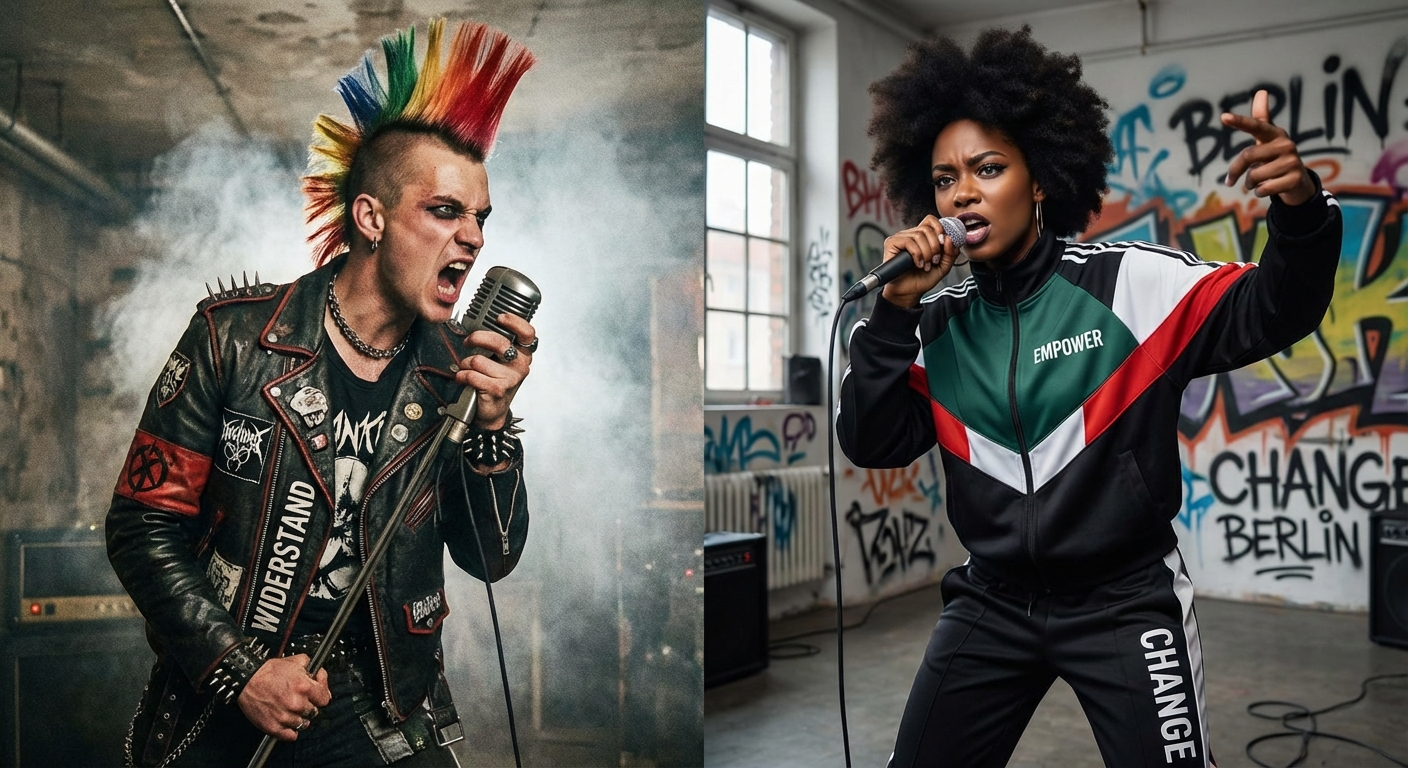
- Visual Rebellion: Mohawks (Irokesenschnitt), dog collars, and torn clothes were direct affronts to the grey, orderly socialist aesthetic.
- Music: Bands like Schleim-Keim, Wutanfall, and Namenlos played in secret locations (often churches, which offered sanctuary). Their lyrics mocked the police and the concept of the "Fatherland."
Contemporary Music and Antiracism
Modern German identity is currently grappling with rising right-wing extremism (e.g., the AfD party, anti-refugee sentiments). Musicians are at the forefront of the counter-movement.
- #wirsindmehr (We are more): After neo-Nazi riots in Chemnitz (2018), 65,000 people attended a free concert featuring bands like Die Toten Hosen and Kraftklub. It was a massive statement that the "silent majority" supports tolerance.
- Samy Deluxe: A prominent Afro-German rapper. His song "I Can't Breathe" (released after George Floyd's death) connects the US Black Lives Matter movement to the German experience of racism. He uses hip-hop to articulate the identity of Black Germans (Afrodeutsche).
- "Bridges" Project: Connects musicians with refugee backgrounds and native German musicians to create fusion orchestras—literally sounding out a new, shared identity.
Key Vocabulary for Unit 2
| German Term | Definition | Context/Usage |
|---|---|---|
| Die Identität | Identity | persönliche (personal) vs. nationale (national) |
| Der Migrationshintergrund | Migration background | Standard demographic term in Germany. |
| Die Leitkultur | Leading/Dominant culture | Controversial term: Should immigrants adapt to a "German leading culture"? |
| Die Vielfalt / Die Diversität | Diversity | Describes modern German society. |
| Das Vorurteil | Prejudice | Vorurteile abbauen (to break down prejudices). |
| Die Entfremdung | Alienation | Feeling isolated from one's culture or society. |
| Die Überwachung | Surveillance | Relevant for GDR history (Stasi) and modern data privacy discussions. |
| Sich integrieren | To integrate | Er hat sich gut integriert. (He integrated well.) |
| Heimat | Home / Homeland | deeply emotional term; where one feels they belong. |
| Spießig | Narrow-minded / Bourgeois | Describe traditional, rule-obsessed German behaviors. |
Common Mistakes & Exam Pitfalls
Confusing Integration with Assimilation:
- Mistake: Thinking migrants must give up their old culture entirely.
- Correction: Modern German discourse prefers Integration (keeping some roots while joining society) over Assimilation (complete absorption).
Over-generalizing "Germans":
- Mistake: "Germans love beer and wear Lederhosen."
- Correction: Specify regions (Bavaria vs. Berlin) or eras. Use phrases like "Ein Klischee besagt, dass…" (A cliché states that…) to show you understand nuance.
Mixing up GDR (DDR) and FRG (BRD):
- Mistake: Assuming all of Germany was democratic post-WWII.
- Correction: Always distinguish between West Germany (Bundesrepublik) and East Germany (DDR) when discussing history before 1990.
Misusing "Heimat":
- Mistake: Using it just to mean "house."
- Correction: Heimat is an emotional concept of belonging, region, and origin, not just the building you live in (Zuhause).