ACT English: Mastering Stylistic Strategy and Usage
ACT English: Mastering Stylistic Strategy and Usage
Precision and Clarity in Word Choice
In the ACT English section, Knowledge of Language questions test your ability to select words that convey the author's meaning with exactness. The test makers value specific, descriptive vocabulary over vague or generic terms. This is often referred to as Diction.
Denotation vs. Connotation
To answer these questions correctly, you must understand the difference between a word's dictionary definition and its implied meaning.
- Denotation: The literal definition of a word.
- Connotation: The emotional or cultural association a word carries (positive, negative, or neutral).
Example Scenario: A passage describes a scientist who is very careful with details.
- Option A: The scientist was picky about the data.
- Option B: The scientist was meticulous about the data.
Analysis: Both words mean "paying attention to detail." However, "picky" has a negative connotation (suggesting annoyance), while "meticulous" has a positive/professional connotation. Since the passage is about a successful experiment, meticulous is the precise choice.
Frequently Confused Words (Homophones and Lookalikes)
The ACT loves to test words that sound or look similar but have different meanings. You must memorize specific pairings.
| Word Pair | Definition & Function | Example |
|---|---|---|
| Effect / Affect | Effect (noun) = result; Affect (verb) = to influence. | The effect of the rain was ruinous. The rain affected my mood. |
| Then / Than | Then = time/sequence; Than = comparison. | We went to the store, then home. Your score is higher than mine. |
| Its / It's | Its = possession; It's = "it is" (contraction). | The dog lost its bone. It's going to rain. |
| Lead / Led | Lead (noun) = metal / (verb) = to guide; Led (verb) = past tense of lead. | He led the team to victory yesterday. |
| Allude / Elude | Allude = to reference indirectly; Elude = to escape. | He alluded to the problem without stating it. The criminal eluded the police. |
Idiomatic Expressions
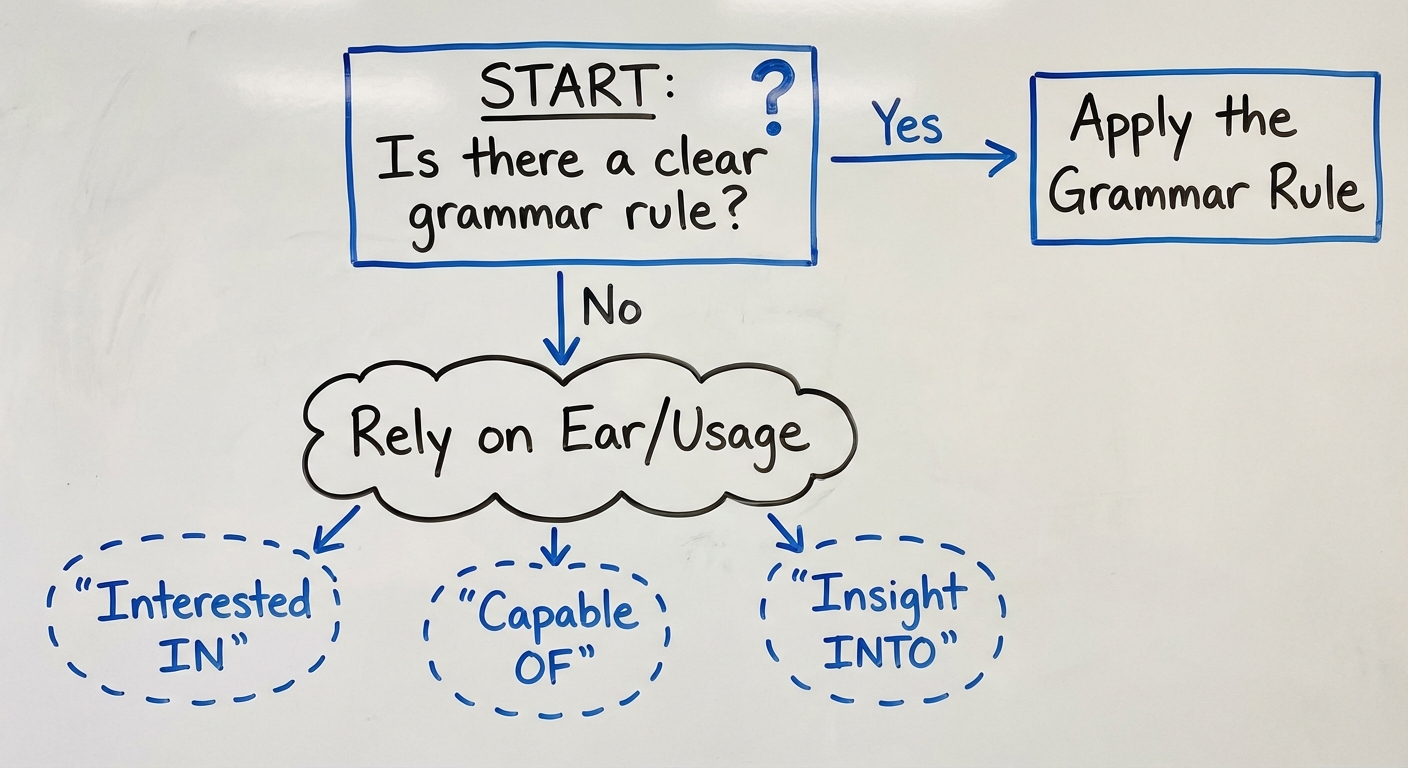
Idioms are phrases where the meaning is established by usage rather than logic. On the ACT, this usually manifests as Prepositional Errors. You cannot rely on grammar rules here; you must rely on your "ear" for English.
- Incorrect: He is capable to do the job.
- Correct: He is capable of doing the job.
- Incorrect: I am preoccupied at math.
- Correct: I am preoccupied with math.
Concision and Eliminating Redundancy
One of the most important rules on the ACT English section is the principle of Economy: The shortest grammatically correct answer that retains the meaning is usually the right one.
Redundancy
Redundancy occurs when a sentence uses multiple words to describe the same concept. If a word is implied by another word in the sentence, cut it out.
Redundant: The inexpensive gift was free to all attendees.
- Analysis: A gift is by definition free.
- Better: The gift was given to all attendees.
Redundant: The reason he failed was because he didn't study.
- Analysis: "Reason" and "because" serve the same grammatical function here.
- Better: The reason he failed was that he didn't study.
Common Redundant Phrases to Watch For:
- "Past history" (History is always past)
- "End result" (Results are always at the end)
- "Cooperate together" (Cooperating implies togetherness)
- "Annual meeting every year" (Annual means every year)
Wordiness and Verbosity
Even if you aren't repeating a definition, you might be using too many words. The ACT penalizes Verbosity—using complex phrases when a simple word will do.
Formula for Concision:
Simplicity + Clarity > Complexity
Examples:
- Wordy: In the event that the weather is rainy…
- Concise: If it rains…
- Wordy: He made a decision to utilize the option of running…
- Concise: He decided to run…
Strategy Tip: If you see an answer choice that says DELETE the underlined portion (or OMIT), check it first. If the sentence makes sense without the underlined text, DELETE is almost always the correct answer.
Consistency in Style and Tone
ACT passages generally follow a specific "voice." Most passages are written in an expository, academic, or journalistic style. Your goal is to ensure the underlined portion matches the rest of the paragraph.
Formal vs. Informal Language
Avoid slang, colloquialisms, or overly casual language unless the passage is explicitly a dialogue or a casual narrative (which is rare).
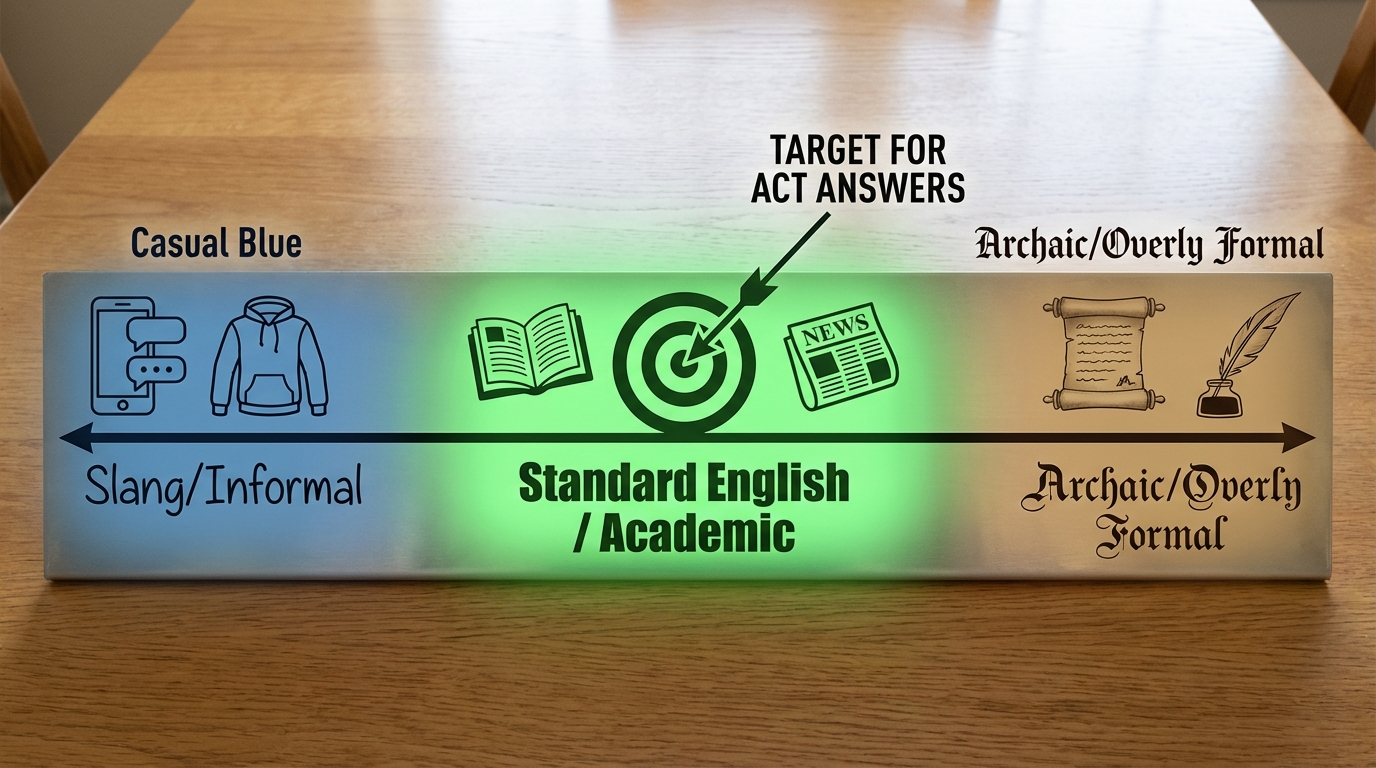
- Too Informal: The researchers thought the results were totally bogus.
- Too Formal/Archaic: The researchers deemed the results spurious and of ill repute.
- Just Right: The researchers believed the results were unreliable.
Consistency of Point of View (POV)
Do not switch pronouns halfway through a sentence or paragraph. If the writer starts with "one" (general), they cannot switch to "you" (direct address).
- Inconsistent: If one wants to succeed, you must study hard.
- Consistent: If one wants to succeed, one must study hard.
- Consistent: If you want to succeed, you must study hard.
Warning features often include switching between I/we (first person), you (second person), and he/she/it/they (third person).
Rhetorical Effectiveness
These questions ask you to act as an editor. You aren't just fixing errors; you are improving the flow and logic of the passage.
Ambiguity
Clear writing requires that every pronoun clearly refers to a specific noun (the antecedent). If it is unclear who or what is being discussed, the sentence is rhetorically ineffective.
- Ambiguous: Sarah and Jane went to the store, but she forgot her wallet.
- Problem: Who is "she"? Sarah or Jane?
- Clear: Sarah and Jane went to the store, but Sarah forgot her wallet.
Transitional Logic
Transitions act as bridges between ideas. Choosing the right transition word relies on understanding the relationship between two sentences.
Types of Transitions:
- Continuation/Addition: Furthermore, Moreover, Additionally, And.
- Contrast: However, Although, Despite, On the other hand, But.
- Causation: Therefore, Consequently, As a result, Thus.
- Sequence: First, Subsequently, Finally.
Test Strategy: Read the sentence before and the sentence after the transition. Determine if the ideas agree (continue) or disagree (contrast) before looking at the confusing answer choices.
Adding or Deleting Information
Some questions ask: "Should the writer make this addition here?"
To answer this:
- Identify the Main Idea of the paragraph.
- Ask: Does this new information provide necessary definitions or specific evidence related to that Main Idea?
- Yes: Add it for clarity/specificity.
- No: Don't add it (it creates a tangent/distraction).
Common Mistakes to Avoid
- Choosing the "Smartest" Sounding Word: Students often pick the longest, most complex word (e.g., "utilize" instead of "use"), thinking it sounds more academic. The ACT prefers the simpler, clearer word.
- Missing the "DELETE" Option: Students often feel they must replace text with something. If the "OMIT/DELETE" option is available, give it serious consideration. It is correct roughly 50% of the time it appears.
- Ignoring Context: You cannot answer "Knowledge of Language" questions by reading only the sentence containing the underline. You must read the surrounding sentences to determine Tone and Consistency.
- Redundancy Blindness: Watch out for acronyms and definitions. "The ATM machine" is redundant because M stands for Machine. "The PIN number" is redundant because N stands for Number.
Memory Reference: The 3 C's of ACT English
When in doubt, check if your answer satisfies the 3 C's:
- Clear (Is the meaning exact?)
- Concise (Is it the shortest way to say it?)
- Consistent (Does it match the tone?)