Unit 5: Economic Transformation and Political Response
5.1 Impact of Global Economic and Technological Forces
Globalization and Economic Liberalization
Globalization is the intensifying process of interaction and integration among the people, companies, and governments of different nations, driven by international trade, investment, and information technology. In AP Comparative Government, you must understand how this challenges state sovereignty.
Economic Liberalization refers to the policy direction of reducing state intervention in the economy. This is often associated with Neoliberalism.
- Key Components of Liberalization:
- Removing trade barriers (tariffs, subsidies).
- Privatizing government-owned industries.
- Reducing government regulation of the economy.
- Opening the market to Foreign Direct Investment (FDI).
Note: While economic liberalization often leads to economic growth, it creates political tension regarding inequality and loss of state control.
Case Studies in Liberalization
| Country | Liberalization Actions | Outcome/Tension |
|---|---|---|
| China | Creation of Special Economic Zones (SEZs); joining the WTO. | Massive GDP growth but increased rural-urban inequality. |
| Mexico | Signing NAFTA (now USMCA); moving away from Import Substitution Industrialization (ISI). | Industrial growth in the north (Maquiladoras) vs. agricultural struggles in the south (Zapatista uprising). |
| Nigeria | Structural Adjustment Programs (SAPs) mandated by the IMF. | Attempted privatization of oil, but corruption remains high. |
| Russia | "Shock Therapy" in the 1990s (rapid privatization). | Created a class of Oligarchs who seized state assets; Putin later re-nationalized key energy sectors. |
The Debate: Pros vs. Cons
- Proponents argue: It increases global wealth, lowers consumer prices through efficiency, and creates jobs in developing nations.
- Critics argue: It leads to the "Race to the Bottom" (lowering labor/environmental standards to attract business), erodes cultural distinctiveness, and increases the gap between rich and poor.
5.2 Political Responses to Global Market Forces
Governments must balance the benefits of global trade with the need to maintain domestic stability and sovereignty.
Strategies of Response
Privatization vs. Nationalization
- Privatization: Selling State-Owned Enterprises (SOEs) to private investors to increase efficiency (e.g., Mexico selling state banks and telecommunications; UK under Thatcher).
- Nationalization: The government taking control of private assets. Russia under Putin has effectively re-nationalized the oil/gas industry (Gazprom, Rosneft) to consolidate political power.
Protectionism
- Policies designed to protect domestic industries from foreign competition (tariffs, quotas).
- Example: The UK leaving the EU (Brexit) was partly driven by a desire to protect domestic labor markets and sovereignty.
Supranational Integration
- Joining organizations that standardize rules, even if it costs some sovereignty (e.g., European Union, ECOWAS).
Common Mistakes
- Mistake: Thinking authoritarian regimes always oppose foreign investment.
- Correction: China is authoritarian but aggressively pursues foreign investment. The difference is that the CCP maintains strict political control while allowing economic freedom (this is often called State Capitalism).
5.3 Challenges from Globalization
Erosion of Sovereignty
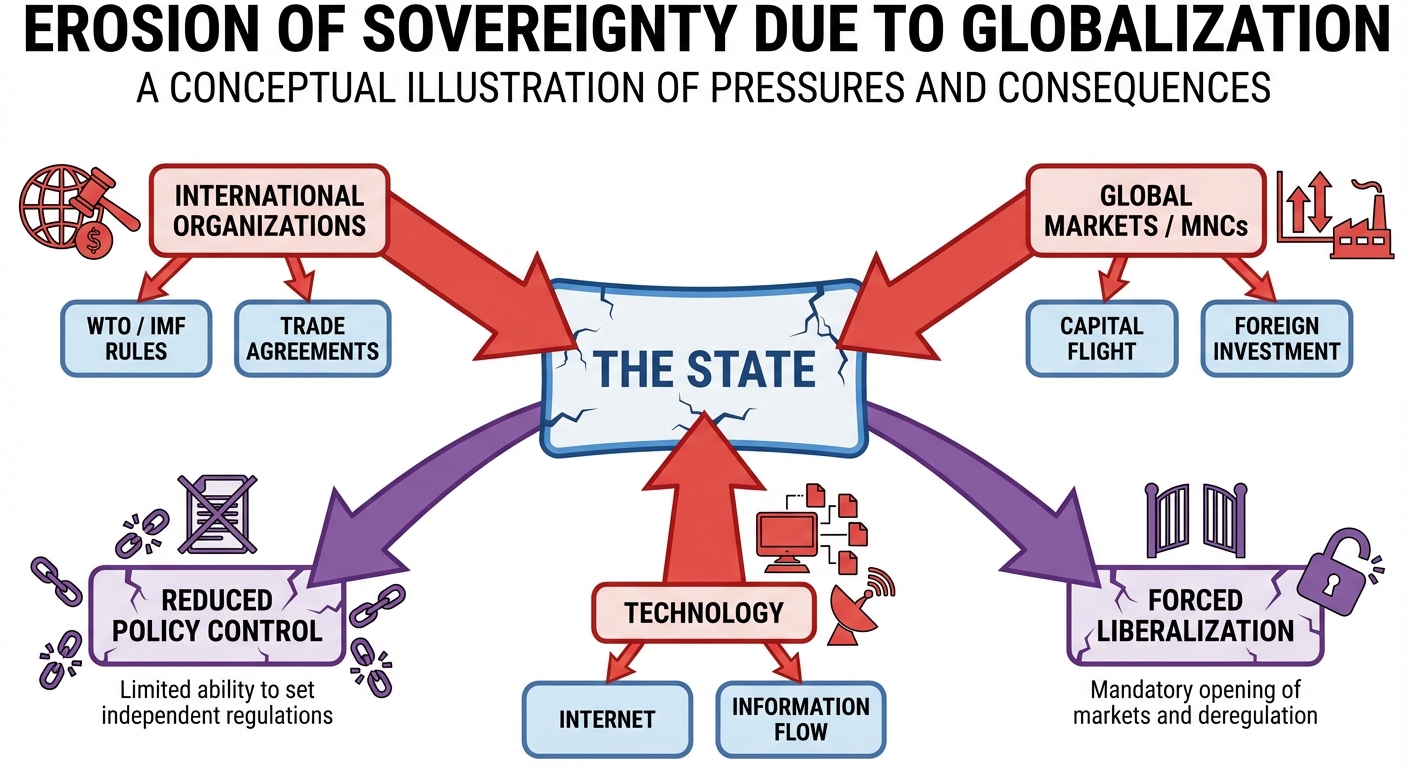
Globalization frequently challenges state sovereignty (the supreme power and authority of a state to govern itself).
- Economic Control: Multinational Corporations (MNCs) can pressure governments to change labor laws or tax codes.
- International Laws: Membership in the WTO requires adhering to trade rules that might hurt local businesses.
- Border Control: The free flow of information (internet/social media) challenges authoritarian censorship (e.g., China's "Great Firewall," Russia's "Sovereign Internet" law).
Environmental and Social Pressures
Rapid economic growth driven by global demand involves heavy costs:
- China: Heavy industrialization led to air/water pollution. The government is now pivoting to "Green Development" to maintain legitimacy.
- Nigeria: Oil extraction in the Niger Delta by foreign companies (Shell, etc.) has caused environmental devastation, leading to local conflict (MEND militants).
5.4 Sustainable Development and Economic Policies
Neoliberalism and Austerity
- Neoliberalism: An ideology favoring free-market capitalism, deregulation, and reduction in government spending.
- Austerity: Severe cuts to government spending (social services, benefits) to reduce national debt.
- UK Example: Following the 2008 financial crisis, the Conservative government implemented austerity measures, cutting funding to the NHS and welfare, which became a major political controversy.
Import Substitution vs. Structural Adjustment
- Import Substitution Industrialization (ISI): An economic policy (used historically by Mexico and Nigeria) to reduce foreign dependency by raising tariffs and subsidizing local manufacturing. It largely failed due to inefficiency.
- Structural Adjustment Programs (SAPs): Loans provided by the IMF/World Bank to struggling nations (like Nigeria and Mexico in the 80s/90s) in exchange for adopting neoliberal reforms (privatization, cutting subsidies). These are often unpopular because they reduce social safety nets.
5.5 International and Supranational Organizations
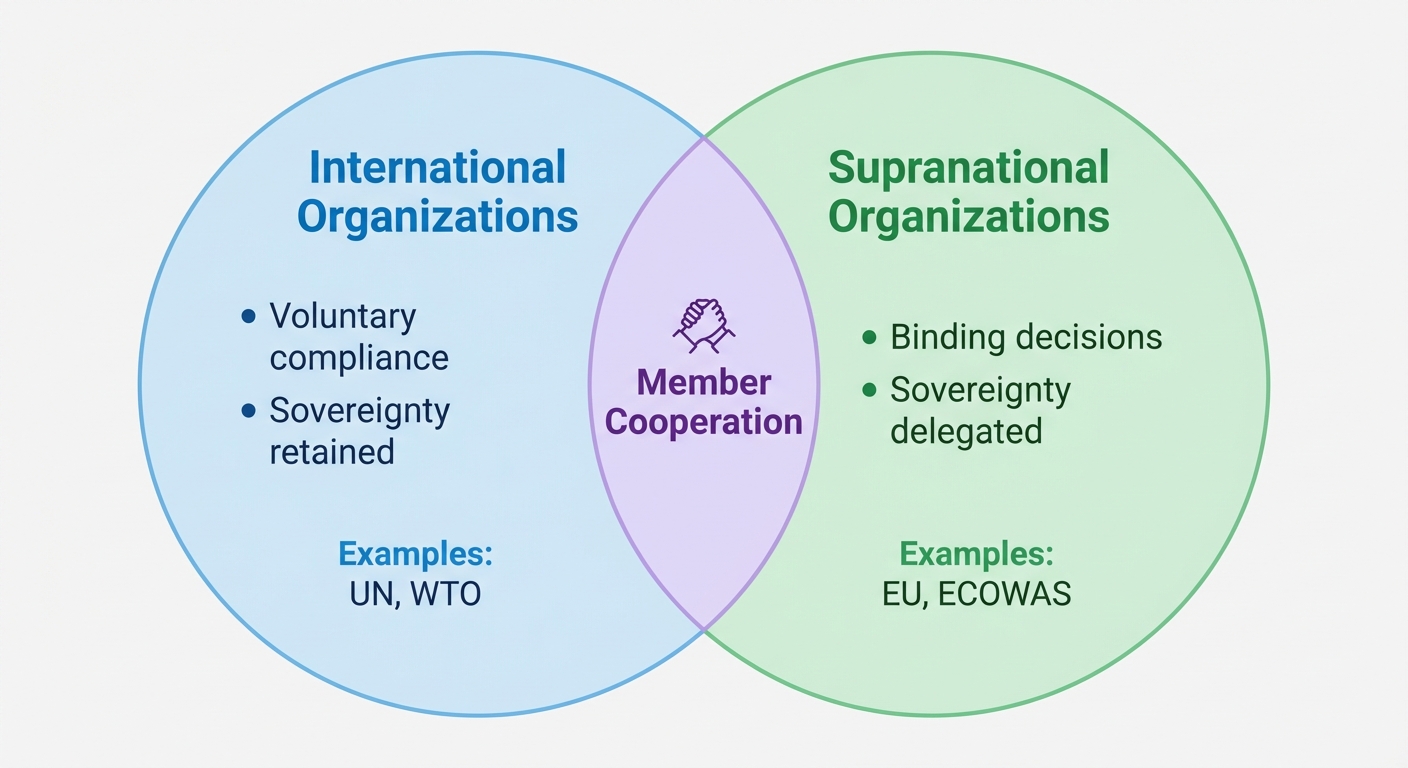
It is vital to distinguish between these two types of organizations for the AP exam.
Supranational Organizations
Organizations where member states give up significant sovereign powers to the organization. Decisions made by the organization are binding.
European Union (EU):
- Member: United Kingdom (formerly, until Brexit).
- Power: Controls trade policy, monetary policy (for Eurozone members), and some legal standards.
- Tension: The "Democratic Deficit" — perceived lack of accountability of EU bureaucrats to citizens.
Economic Community of West African States (ECOWAS):
- Member: Nigeria.
- Function: Promotes economic integration and peacekeeping in West Africa. Nigeria is the dominant hegemon here.
International (Intergovernmental) Organizations
Organizations where member states cooperate but retain full sovereignty. Resolutions are usually voluntary or lack enforcement mechanisms.
- United Nations (UN): All 6 Comp Gov countries are members. China, Russia, and the UK have veto power in the Security Council.
- World Trade Organization (WTO): Sets rules for global trade. China's entry in 2001 was a pivotal moment for its economy.
- International Monetary Fund (IMF) / World Bank: Provide loans and economic assistance.
5.6 Adaptation of Social Policies
Governments use social policies to maintain political legitimacy and stability.
United Kingdom: The Welfare State
- NHS (National Health Service): A state-funded healthcare system. Protecting the NHS is a "sacred" political duty; austerity cuts here are politically dangerous.
- Challenge: An aging population puts massive strain on NHS funding.
China: From Iron Rice Bowl to Modernization
- Iron Rice Bowl: The Mao-era guarantee of lifetime employment and healthcare (largely dismantled).
- Hukou System: A household registration system that ties social benefits to place of birth. It limits rural migrants in cities from accessing education and healthcare, creating a "floating population."
Iran: The Bonyads
- Bonyads: Religious charitable foundations. They control huge sectors of the economy (est. 20% of GDP), are exempt from taxes, and provide social services to the poor/veterans to build support for the regime.
Mexico: Conditional Cash Transfers
- Oportunidades / Prospera: Programs that gave money to poor families if they kept children in school and attended health checkups. (Recently replaced by the Lopez Obrador administration with direct transfers).
5.7 Impact of Industrialization
Industrialization shifts valid political cleavages from Rural vs. Urban and creates new demands for environmental protection.
- Urbanization: In China, Mexico, Nigeria, and Iran, people are flooding into cities. This creates slums/shantytowns where infrastructure (water/electricity) fails, leading to political unrest.
- Environmental Activism:
- China: The government is aggressively promoting green energy (solar/EVs) to combat smog, realizing that pollution threatens party legitimacy.
- Russia: Typically ignores environmental concerns in favor of resource extraction (e.g., Arctic drilling), sparking small-scale local protests.
5.8 Causes and Effects of Demographic Change
Demographic shifts are a major threat to stability in all six countries.
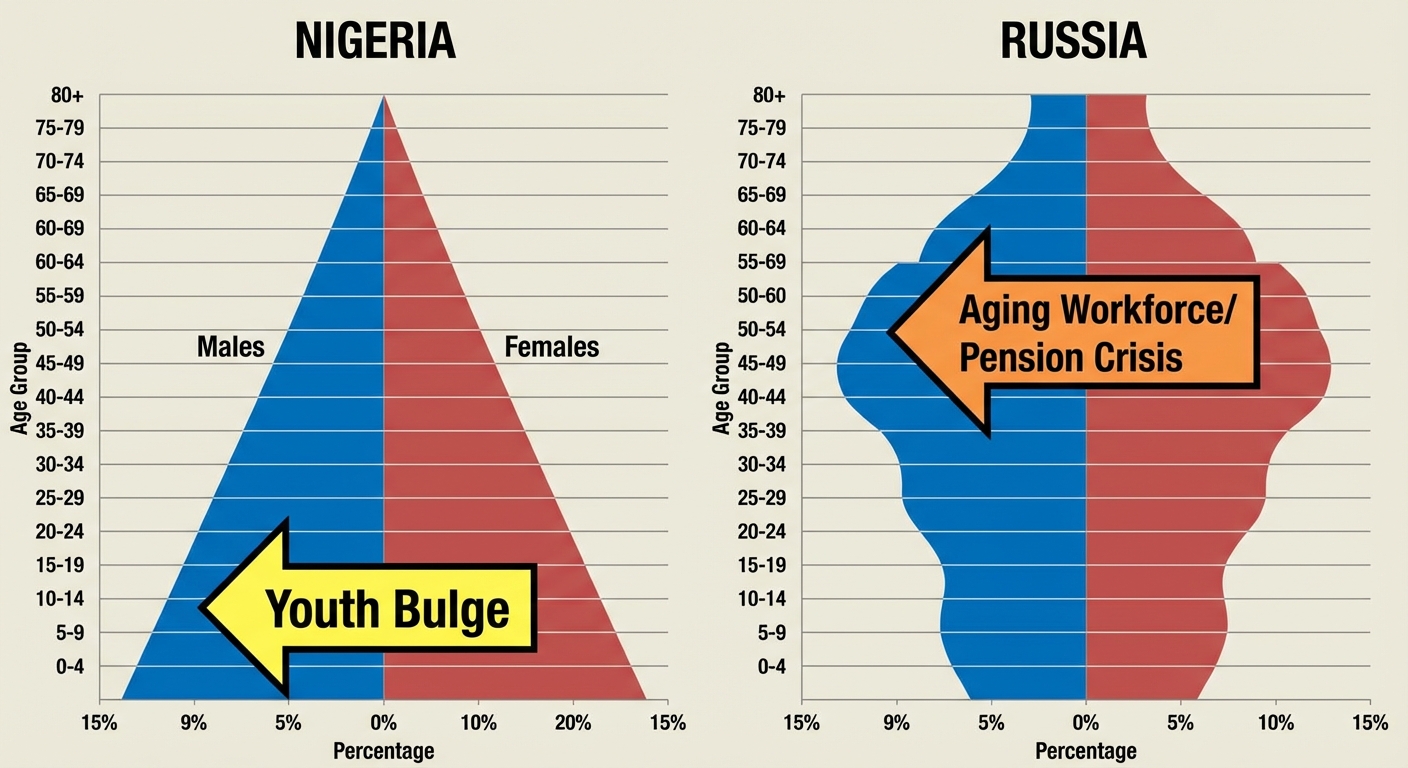
The Aging Populations (UK, Russia, China)
- The Problem: Low birth rates + high life expectancy = shrinking workforce and rising pension/healthcare costs.
- China: The One-Child Policy created a rapidly aging society. The government has shifted to a Two/Three-Child policy, but birth rates remain low due to high living costs.
- Russia: Combats population decline with pro-natalist policies (cash bonuses for babies) but faces a health crisis (alcoholism) and low male life expectancy.
The Youth Bulge (Nigeria, Iran, Mexico)
- The Problem: High birth rates = massive young population entering the workforce. If there are no jobs, this leads to political instability and radicalization.
- Nigeria: The median age is ~18. The government cannot create jobs fast enough, leading to youth unrest (e.g., #EndSARS protests).
- Iran: Highly educated youth with no job prospects suffer from "brain drain" (emigrating for better lives).
Brain Drain and Migration
- Brain Drain: The departure of educated or professional people is a major issue for Nigeria, Iran, and Mexico.
- Migration: Movement from South-to-North (Mexico to US) or Rural-to-Urban (China) defines the labor market.
5.9 Impact of Natural Resources
The Resource Curse
Also known as the "Paradox of Plenty." Countries with substantial natural resources (oil, gas) often have less economic growth, less democracy, and worse development outcomes than countries with fewer resources.
The Rentier State
A Rentier State is a country that obtains a significant portion of its revenue from the "rent" of indigenous natural resources to external clients (foreign countries/companies) rather than from taxing its own citizens.
- Key Examples: Iran, Nigeria, Russia.
- Political Consequences:
- No Representation without Taxation: Since the government doesn't rely on taxes from citizens, it feels no need to differ to their wishes or be accountable.
- Corruption: Wealth is concentrated in the state; controlling the government becomes the only way to get rich (leading to "prebendalism" in Nigeria).
- Vulnerability: The economy crashes whenever global oil prices drop (e.g., Russia and Nigeria suffer when oil prices fall).
Comparison of Resource Management
| Country | Resource | State Control Method | Impact |
|---|---|---|---|
| Nigeria | Oil | NNPC (state corporation) partners with foreign firms (Shell). | Gov receives huge rents; corruption is rampant; Niger Delta is polluted; little infrastructure developed. |
| Russia | Oil/Gas | State-controlled giants (Gazprom, Rosneft). | Used as a geopolitical weapon (threatening to cut gas to Europe). High dependency on prices. |
| Iran | Oil | Nationalized oil industry. | Revenues support the theocracy and Bonyads. Sanctions on oil severely hurt the economy. |
| Mexico | Oil | PEMEX (state-owned). | historically a rentier state, but the economy is now diversified (manufacturing). PEMEX is heavily indebted. |
Common Mistakes
- Mistake: Assuming the UK and China have no natural resources.
- Correction: They do (UK has North Sea oil; China has coal/rare earths), but their economies are diversified, so they are not Rentier States.
- Mistake: Thinking "Rentier State" refers to people renting houses.
- Correction: It refers to the state renting out its resources to foreign buyers.