Study Notes: Tangent Line Approximations and Indeterminate Limits
Local Linearity and Approximation
Calculus allows us to simplify complex functions by zooming in on specific points. This concept, known as Local Linearity, suggests that if a function is differentiable at a point, it behaves like a straight line (the tangent line) in the immediate vicinity of that point.
The Linearization Formula
The goal of linearization is to approximate the value of a function $f(x)$ near a specific value $x=a$ using the equation of the tangent line. This is often easier to compute than the function itself without a calculator.
Using the point-slope form $y - y1 = m(x - x1)$, where:
- The point is $(a, f(a))$
- The slope $m$ is the derivative $f'(a)$
We derive the Linearization function, denoted as $L(x)$:
Here, $L(x) \approx f(x)$ provided that $x$ is close to $a$.
Concavity and Error Analysis
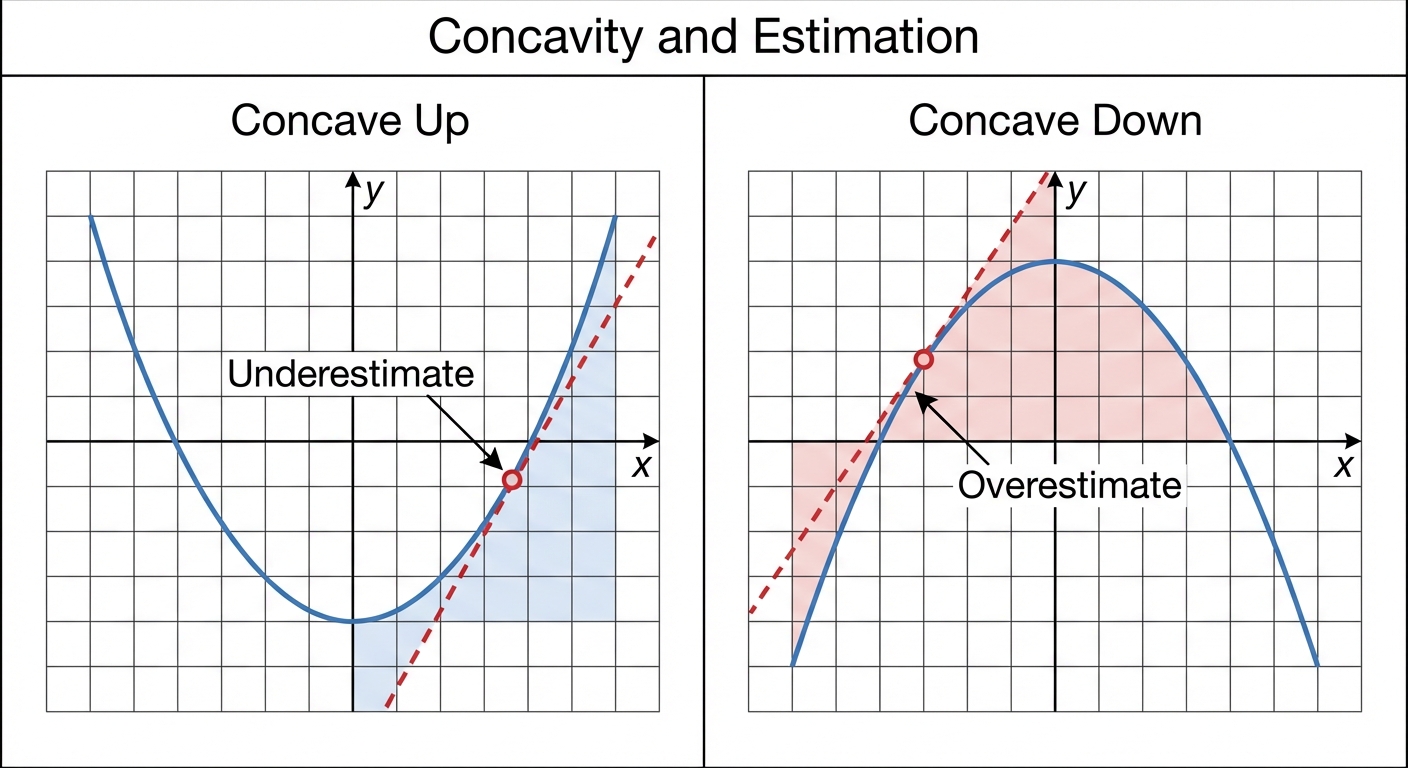
A critical component of the AP Calculus curriculum—often appearing in multiple-choice and Free Response Questions (FRQs)—is determining whether the tangent line approximation is an overestimate or an underestimate.
This depends entirely on the concavity of $f(x)$, determined by the second derivative $f''(x)$.
| Second Derivative | Concavity | Position of Tangent Line | Type of Approximation |
|---|---|---|---|
| $f''(a) > 0$ | Concave Up $\cup$ | Below the curve | Underestimate ($L(x) < f(x)$) |
| $f''(a) < 0$ | Concave Down $\cap$ | Above the curve | Overestimate ($L(x) > f(x)$) |
Worked Example: Estimating Square Roots
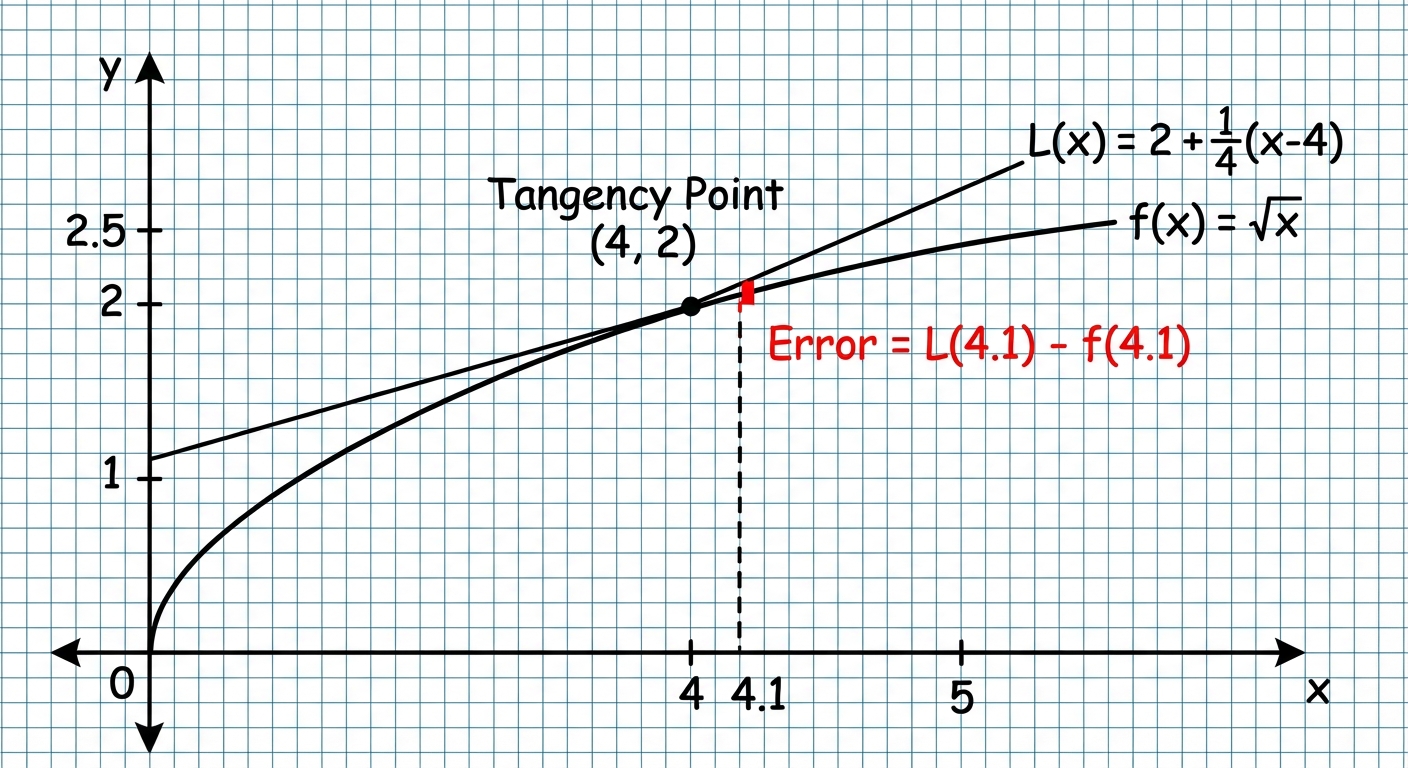
Problem: Estimate $\sqrt{4.1}$ using local linearization.
1. Identify function and center:
Let $f(x) = \sqrt{x}$. Choose a "nice" number close to 4.1. Let $a = 4$.
2. Find Point and Slope:
- $f(4) = \sqrt{4} = 2$
- $f'(x) = \frac{1}{2\sqrt{x}} \rightarrow f'(4) = \frac{1}{2\sqrt{4}} = \frac{1}{4} = 0.25$
3. Build Linearization:
4. Evaluate at $x = 4.1$:
5. Error Analysis:
Find $f''(x)$. $f'(x) = \frac{1}{2}x^{-1/2} \rightarrow f''(x) = -\frac{1}{4}x^{-3/2}$.
Since $f''(4)$ is negative, $f$ is concave down. Therefore, $2.025$ is a slight overestimate.
L'Hôpital's Rule
L'Hôpital's Rule provides a method for evaluating limits that result in indeterminate forms. While often introduced in AB Calculus, AP Calculus BC requires mastery of more complex indeterminate forms, including exponentials.
The Standard Forms: $0/0$ and $\infty/\infty$
Theorem: Suppose that $\lim{x \to c} f(x)$ and $\lim{x \to c} g(x)$ are both zero or both $\pm \infty$, and that the limit of their derivatives exists.
Note: This is not the Quotient Rule. You differentiate the numerator and denominator independently.
Advanced Indeterminate Forms (BC Focus)
In BC Calculus, you will encounter forms that must be algebraically manipulated before applying L'Hôpital's Rule.
1. Indeterminate Products ($0 \cdot \infty$)
If $\lim f(x) = 0$ and $\lim g(x) = \infty$, their product is indeterminate. Strategy: Move one term to the denominator.
Example: $\lim_{x \to 0^+} x \ln x$
- Make it a fraction: $\lim_{x \to 0^+} \frac{\ln x}{1/x}$ (Form: $\infty / \infty$).
- Apply L'Hôpital's: $\lim{x \to 0^+} \frac{1/x}{-1/x^2} = \lim{x \to 0^+} (-x) = 0$.
2. Indeterminate Differences ($\infty -
\infty$)
Usually involves fractions or trig functions. Strategy: Find a common denominator or use conjugates to combine into a single quotient fraction $\frac{0}{0}$ or $\frac{\infty}{\infty}$.
3. Indeterminate Powers ($1^\infty, 0^0, \infty^0$)
These are the most complex forms. Steps:
- Set the limit equal to $y$.
- Take the natural log ($\ln$) of both sides to bring the exponent down.
- Evaluate the new limit using L'Hôpital's.
- Exponentiate the result ($e^{\text{result}}$) to solve for $y$.
Worked Example: Limit of $(1 + \frac{1}{x})^x$ as $x \to \infty$
- Check Form: Base approaches 1, exponent approaches $\infty$. This is $1^\infty$.
- Logarithms: Let $y = \lim{x \to \infty} (1 + \frac{1}{x})^x$. Then $\ln y = \lim{x \to \infty} x \ln(1 + \frac{1}{x})$.
- Transform: This is $\infty \cdot 0$. Rewrite as fraction: $\frac{\ln(1 + x^{-1})}{x^{-1}}$.
- L'Hôpital's: Derive top and bottom.
- Evaluate: As $x \to \infty$, $1/x \to 0$. The limit is $1$.
- Final Step: We found $\ln y = 1$, so $y = e^1 = e$.
Mnemonics & Summary
- "Check Before You Wreck": Never apply L'Hôpital's Rule blindly. If you apply it to a limit like $\lim_{x \to 1} \frac{x+2}{x+3}$ (which is $3/4$), L'Hôpital gives you $\frac{1}{1}=1$, which is wrong. Always verify $0/0$ or $\infty/\infty$ first.
- Linearization Concavity: Think of a generic parabola $y=x^2$ (Concave Up). The tangent is on the bottom. Concave Up = Underestimate.
Common Mistakes & Pitfalls
Notation Errors (The "Floating Lim"):
- The Mistake: Exploring the derivative but dropping the $\lim$ notation in intermediate steps.
- The Fix: Keep writing $\lim_{x \to c}$ until the very step where you plug in $c$. AP graders penalize "linkage errors" where mathematical statements are not actually equal.
Confusing Quotient Rule with L'Hôpital's:
- The Mistake: Attempting to find the derivative of the fraction $\left(\frac{f}{g}\right)'$ instead of the ratio of derivatives $\frac{f'}{g'}$.
- The Fix: Remember L'Hôpital deals with limits of ratios, not derivatives of quotients. Differentiate top and bottom separately.
Forgetting Chain Rule:
- The Mistake: When differentiating terms like $\sin(3x)$ for L'Hôpital's, writing $\cos(3x)$ instead of $3\cos(3x)$.
- The Fix: Always apply the Chain Rule meticulously when taking derivatives for L'Hôpital.
Stopping Too Early:
- The Mistake: Applying L'Hôpital's Rule once, getting another $0/0$, and assuming the limit doesn't exist.
- The Fix: You can apply the rule multiple times as long as the indeterminate form persists.