Endurance and Global Power: United States History 1929–1945
The Great Depression and the New Deal
This era marks a fundamental shift in the relationship between the federal government and the American people. The Great Depression was not just a stock market crash; it was a systemic failure of the economy characterized by overproduction, underconsumption, and banking collapses.
FDR and the Three R's
When Franklin Delano Roosevelt (FDR) took office in 1933, he replaced Herbert Hoover's philosophy of "rugged individualism" with New Deal Liberalism. This ideology held that the government had a duty to provide a safety net for citizens and actively manage the economy.
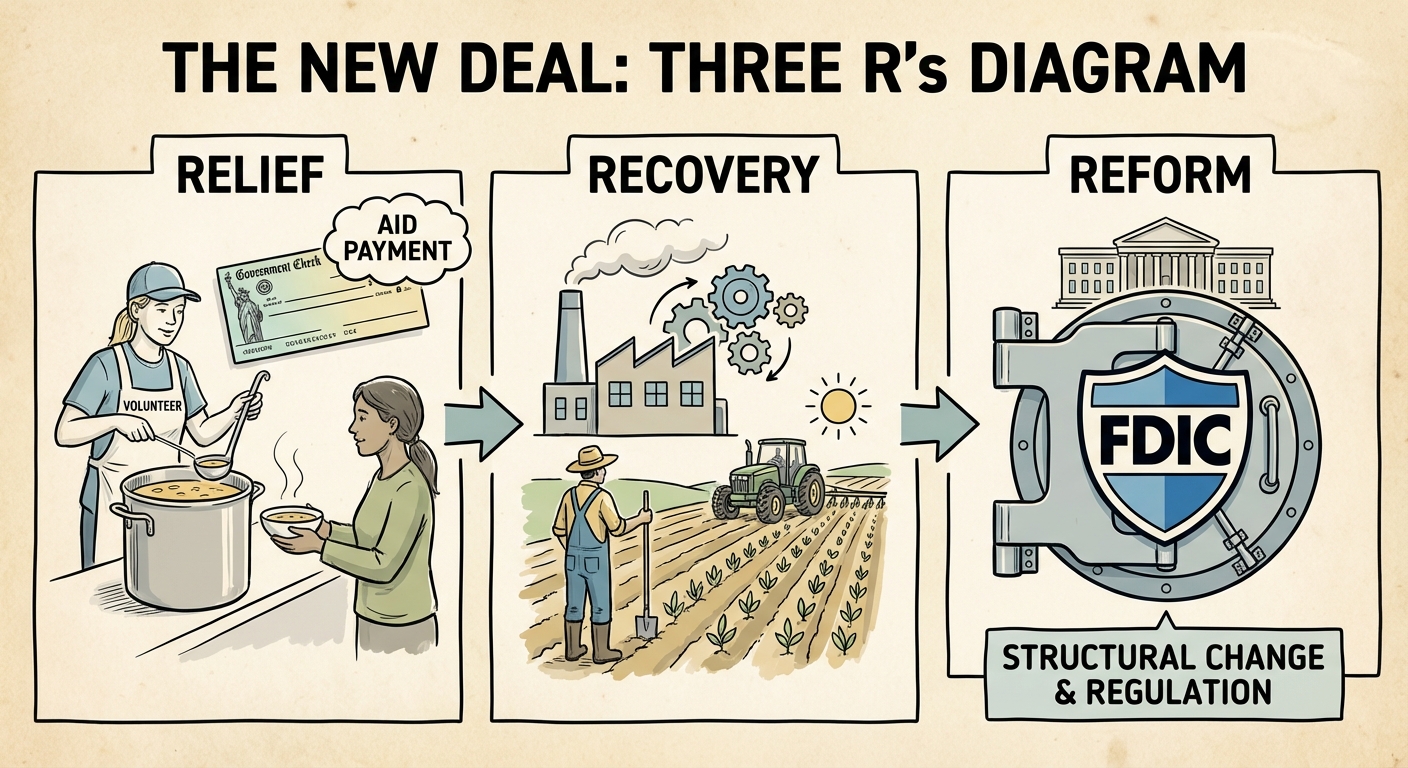
FDR's strategy is best remembered by the mnemonic The Three R's:
- Relief: Immediate help for the unemployed and poor (e.g., getting food and money to people).
- Recovery: Programs to restart the flow of consumer demand (e.g., helping agriculture and housing).
- Reform: Permanent changes to the economic system to prevent future depressions (e.g., banking regulations).
The "Alphabet Soup" Agencies
The New Deal created a vast array of agencies. For the AP exam, you don't need to know every single one, but you must categorize the major ones:
| Agency | Full Name | Purpose | R Category | Impact today? |
|---|---|---|---|---|
| CCC | Civilian Conservation Corps | Employed young men in environmental projects. | Relief | No |
| TVA | Tennessee Valley Authority | Built dams to provide electricity to the rural South. | Recovery | Yes |
| AAA | Agricultural Adjustment Act | Paid farmers not to grow crops to raise prices. | Recovery | No (ruled unconstitutional in part) |
| FDIC | Federal Deposit Insurance Corp. | Insured bank deposits to prevention runs on banks. | Reform | Yes (Crucial) |
| SSA | Social Security Administration | Provided old-age pensions and unemployment insurance. | Reform | Yes |
Political Realignment and Criticisms
The New Deal created the New Deal Coalition, a political alignment that kept the Democratic Party in power for decades. This coalition brought together:
- Urban working-class people
- Ethnic minorities and Catholics
- African Americans (shifting away from the "Party of Lincoln")
- White Southerners
- Labor unions
Critics:
- The Right (Conservatives): Argued the New Deal gave the government too much power (socialism) and increased national debt.
- The Left (Popuists/Progressives): Figures like Huey Long ("Share Our Wealth") and Dr. Francis Townsend argued FDR didn't go far enough to redistribute wealth.
- The Supreme Court: Initially struck down key legislation (like the NRA and AAA). FDR responded with the failed Court Packing Plan, which hurt his political capital but eventually pushed the Court to be more lenient.
World War II: Mobilization and Society
While the New Deal alleviated suffering, it was World War II that actually ended the Great Depression through massive industrial mobilization.
From Isolationism to Intervention
Americans were deeply disillusionment after WWI, leading to a strong Isolationist sentiment in the 1930s (demonstrated by the Neutrality Acts). However, FDR slowly nudged the US toward involvement as fascism rose in Europe and Asia.
The Path to War Flowchart:
- Neutrality Acts (1930s): No arms sales to belligerents.
- Cash and Carry (1939): Allies can buy arms if they pay cash and use their own ships.
- Lend-Lease Act (1941): The US becomes the "Arsenal of Democracy," lending arms to Britain and later the USSR/China.
- Pearl Harbor (Dec 7, 1941): Japan attacks; US enters the war completely.
The Home Front: A Society Transformed
Total war required the mobilization of the entire US economy and society. The War Production Board managed the economy, ending unemployment.
Women in the Workforce
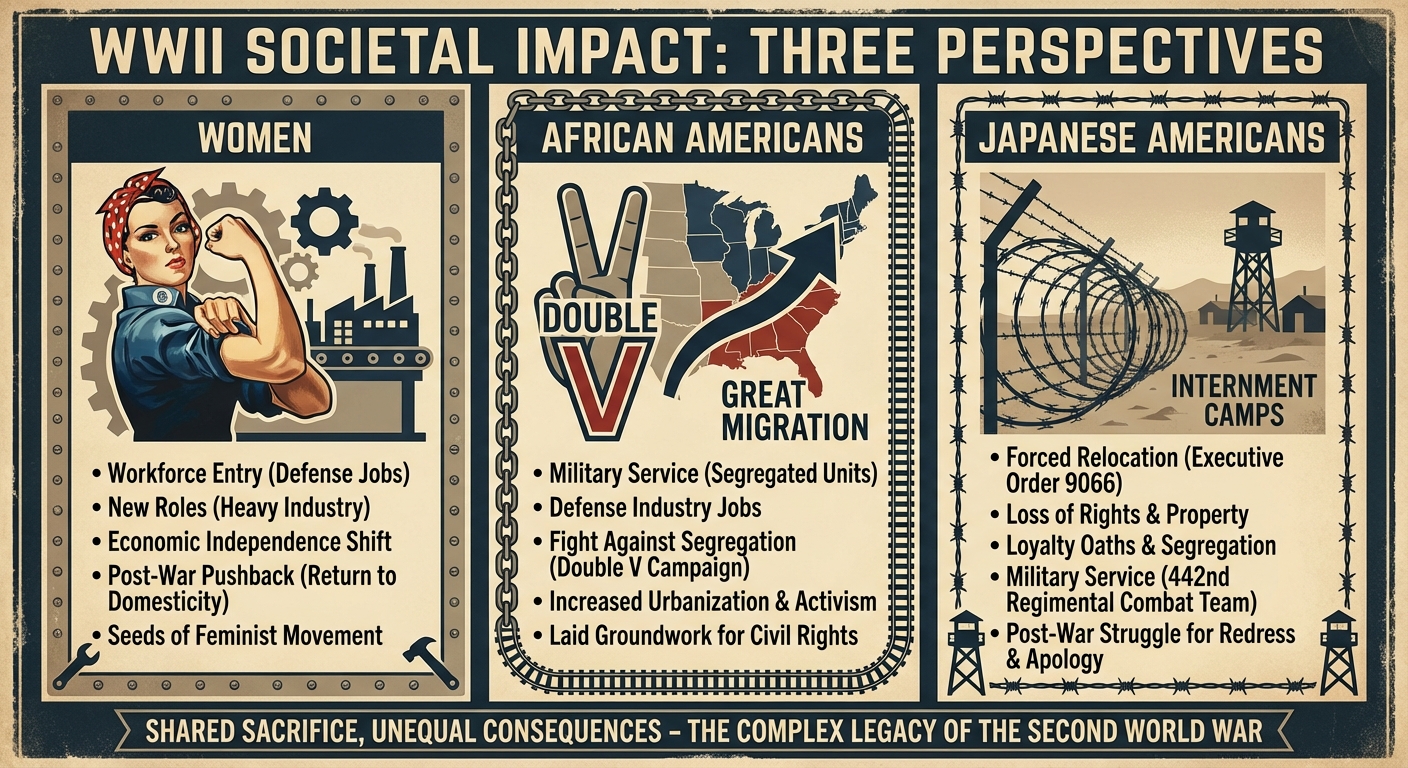
With men overseas, women filled industrial jobs. The icon Rosie the Riveter symbolized the millions of women working in factories.
- AP Note: While this challenged gender roles, society largely expected women to return to domestic life after the war (which leads into the 1950s cult of domesticity).
African Americans and the "Double V"
Black Americans rallied around the Double V Campaign: Victory against fascism abroad and victory against racism at home.
- A. Philip Randolph threatened a march on Washington, leading FDR to issue Executive Order 8802, which banned discrimination in defense industries.
- This era saw the continuation of the Great Migration to Northern and Western industrial cities.
Civil Liberties Restrictions
The darkest chapter of the home front was Executive Order 9066, which authorized the internment of over 100,000 Japanese Americans (mostly citizens) on the West Coast due to unfounded fears of espionage.
Case Law: Korematsu v. United States (1944)
The Supreme Court upheld the internment camps as a "military necessity," proving that civil liberties are often restricted during wartime (similar to Schenck v. US in WWI).
Postwar Diplomacy and the Atomic Age
Victory in WWII elevated the US to global superpower status, ending its history of isolationism permanently.
Military Strategy
- Europe: The US and Britain opened a second front with D-Day (Operation Overlord) in 1944 to squeeze Germany between the Western Allies and the Soviet Union.
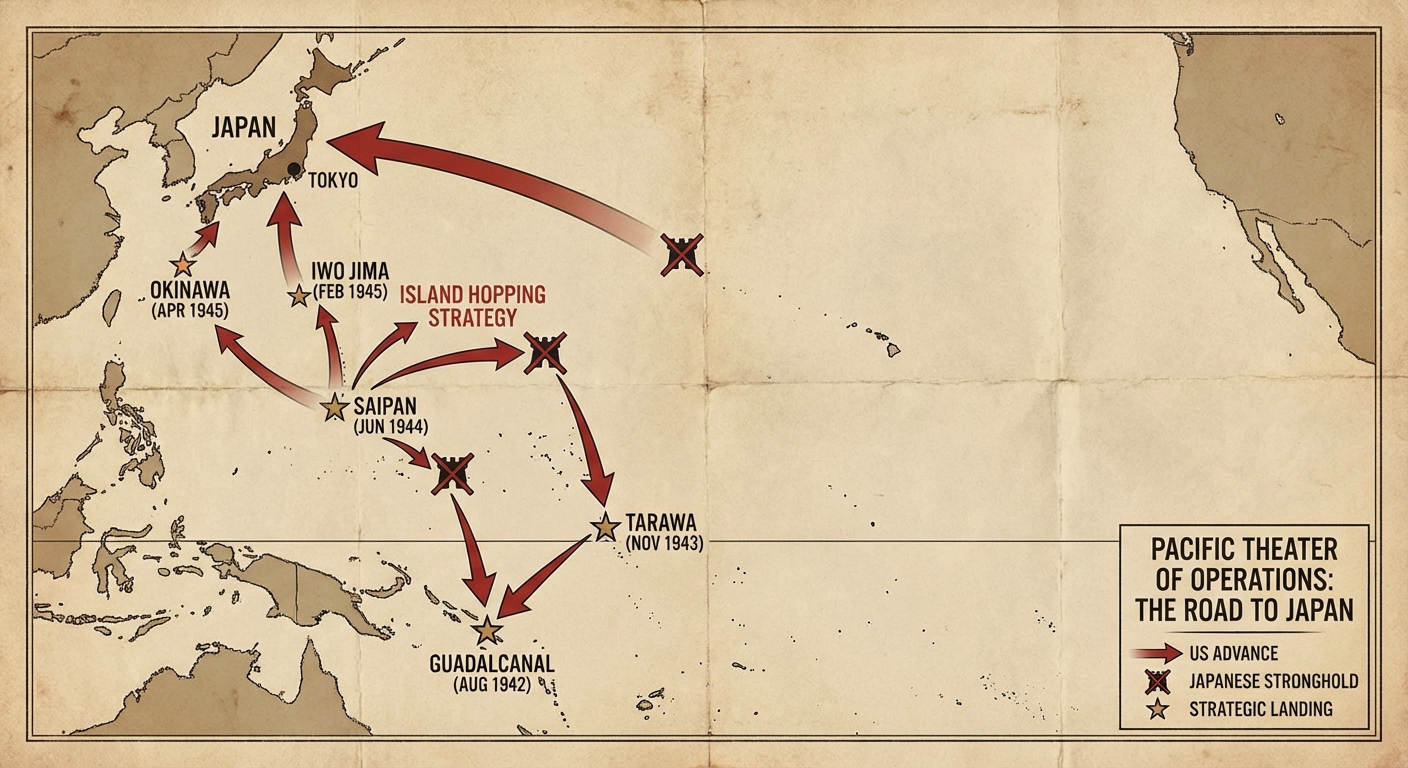
- Pacific: The US utilized Island Hopping—bypassing heavily fortified Japanese islands to capture strategic locations closer to Japan.
The Big Three Conferences
Wartime diplomacy settled the fate of the post-war world. The "Big Three" were FDR (later Truman), Churchill, and Stalin.
- Tehran (1943): Agreed to open a second front (D-Day).
- Yalta (Feb 1945): Stalin agreed to free elections in Eastern Europe (a promise he broke) and to help fight Japan. The United Nations was planned.
- Potsdam (July 1945): Truman (now President) hinted at the atomic bomb; tensions with Stalin rose. This is often viewed as the true start of the Cold War.
The Atomic Bomb
The Manhattan Project successfully developed nuclear weapons. Truman authorized dropping bombs on Hiroshima and Nagasaki in August 1945.
Arguments for use:
- Shorten the war and save American lives (estimates of invasion casualties were high).
- Force unconditional surrender.
Arguments against/Historical Debate:
- Japan was already near collapse.
- It was a display of power to intimidate the Soviet Union.
Common Mistakes & Pitfalls
- Misconception: Thinking the New Deal ended the Great Depression.
- Correction: The New Deal provided relief and structural reform, but unemployment remained high until WWII mobilization created millions of defense jobs.
- Misconception: Confusing the League of Nations with the United Nations.
- Correction: The US rejected the League (after WWI) but was the primary architect and joined the United Nations (after WWII).
- Misconception: Assuming all women kept their factory jobs after 1945.
- Correction: Most women were pushed out of industrial jobs to make room for returning veterans, though the seed for the future feminist movement was planted.
- Misconception: Thinking the US entered WWII immediately after Germany invaded Poland.
- Correction: The invasion of Poland started the war in Europe (1939), but the US remained officially neutral (though helpful to the Allies) until Pearl Harbor (1941).