Mastering the Heart of Algebra: SAT Math Structure and Strategy
Linear Equations in One Variable
The most fundamental skill in the SAT Algebra section is manipulating linear equations in one variable. These equations express a relationship where a single variable moves at a constant rate.
Core Concepts & The Three Outcome Types
A standard linear equation looks like $ax + b = c$. Your goal is usually to isolate $x$. However, the SAT frequently tests your ability to recognize how many solutions an equation has before typical solving is completed.
- One Solution: If the variable terms on both sides have different coefficients, there is exactly one solution. Use inverse operations to find it.
- Example: $3x + 5 = 2x - 10$ ($3x$ and $2x$ differ).
- No Solution: If the variable terms are identical but the constant terms are different, the lines are parallel and never intersect.
- Example: $4x + 7 = 4x + 3$. Subtracting $4x$ leaves $7 = 3$, which is false.
- Infinite Solutions: If both the variable terms and the constants are identical (sometimes disguised by distribution), the equation is an identity. Every real number is a solution.
- Example: $2(x + 3) = 2x + 6$. Simplifying gives $2x + 6 = 2x + 6$.
Word Problem Translation
The SAT often presents these in real-world contexts. You must translate text into algebra.
- Total $\rightarrow$ Result of the equation ($=$)
- Initial value / Flat fee / Starting amount $\rightarrow$ Constant ($b$)
- Rate / Cost per item / Monthly increase $\rightarrow$ Coefficient ($m$ in $mx$)
Linear Functions and Equations in Two Variables
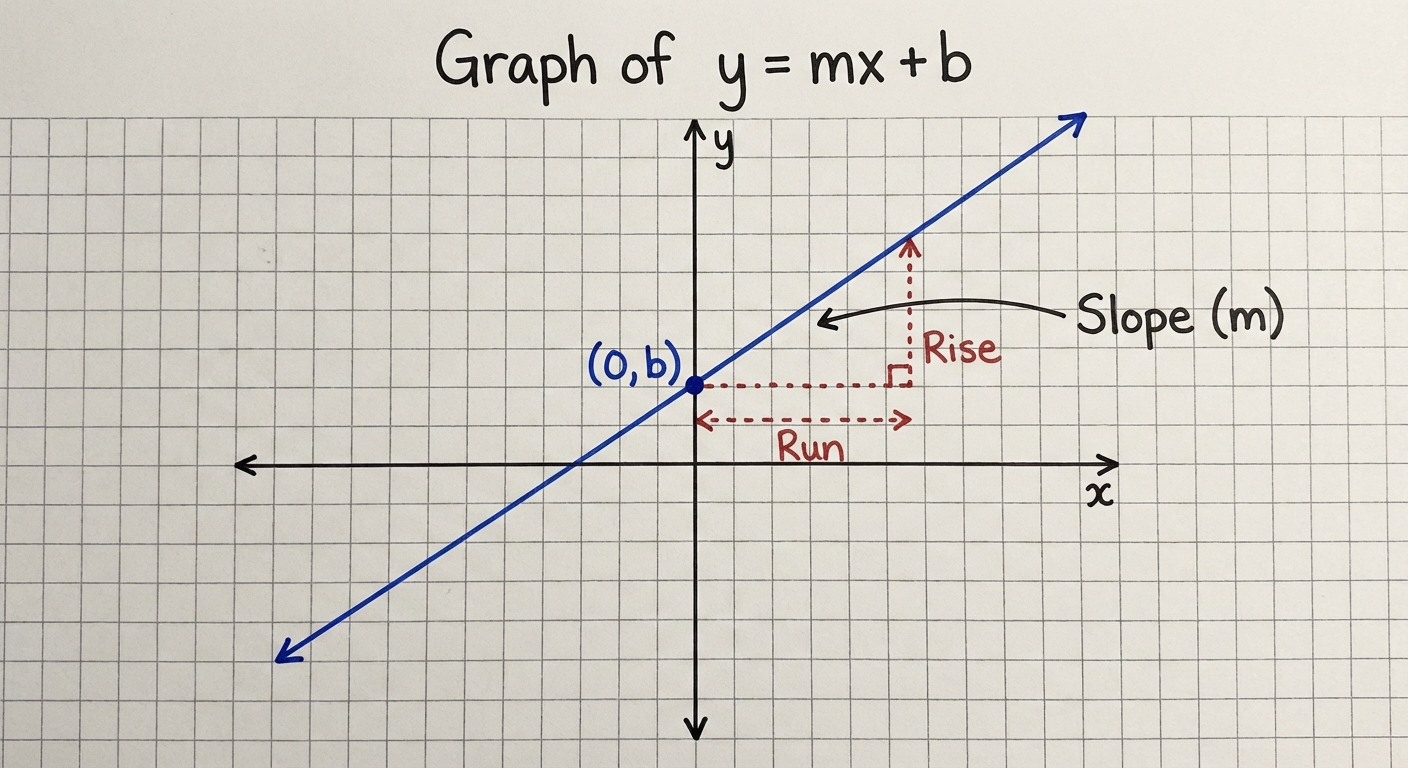
When we introduce a second variable (usually $y$), we move from a point on a number line to a line on a coordinate plane. These questions test your ability to connect algebraic forms to graphical features.
Essential Forms
| Form Name | Formula | Key Usage |
|---|---|---|
| Slope-Intercept | Best for graphing. $m$ is slope, $b$ is y-intercept. | |
| Standard Form | Common in word problems involving two different types of items (e.g., tickets for adults vs. children). | |
| Point-Slope | Useful when given a slope and a random point $(x1, y1)$ rather than the y-intercept. |
Interpreting Slope and Intercepts
In context-based questions, do not just calculate; interpret.
- Slope ($m$): The Rate of Change. Look for keywords like "per," "each," or "every."
- $y$-intercept ($b$): The Initial Value or value when $x=0$. Look for keywords like "flat fee," "starting height," or "registration cost."
- $x$-intercept: The value when $y=0$. often represents when a total reaches zero (e.g., when a tank is empty or a loan is paid off).
Vertical and Horizontal Lines (Mnemonic: HOY VUX)
- HOY: Horizontal lines have 0 slope and are written as Y = #.
- VUX: Vertical lines have Undefined slope and are written as X = #.
Systems of Two Linear Equations
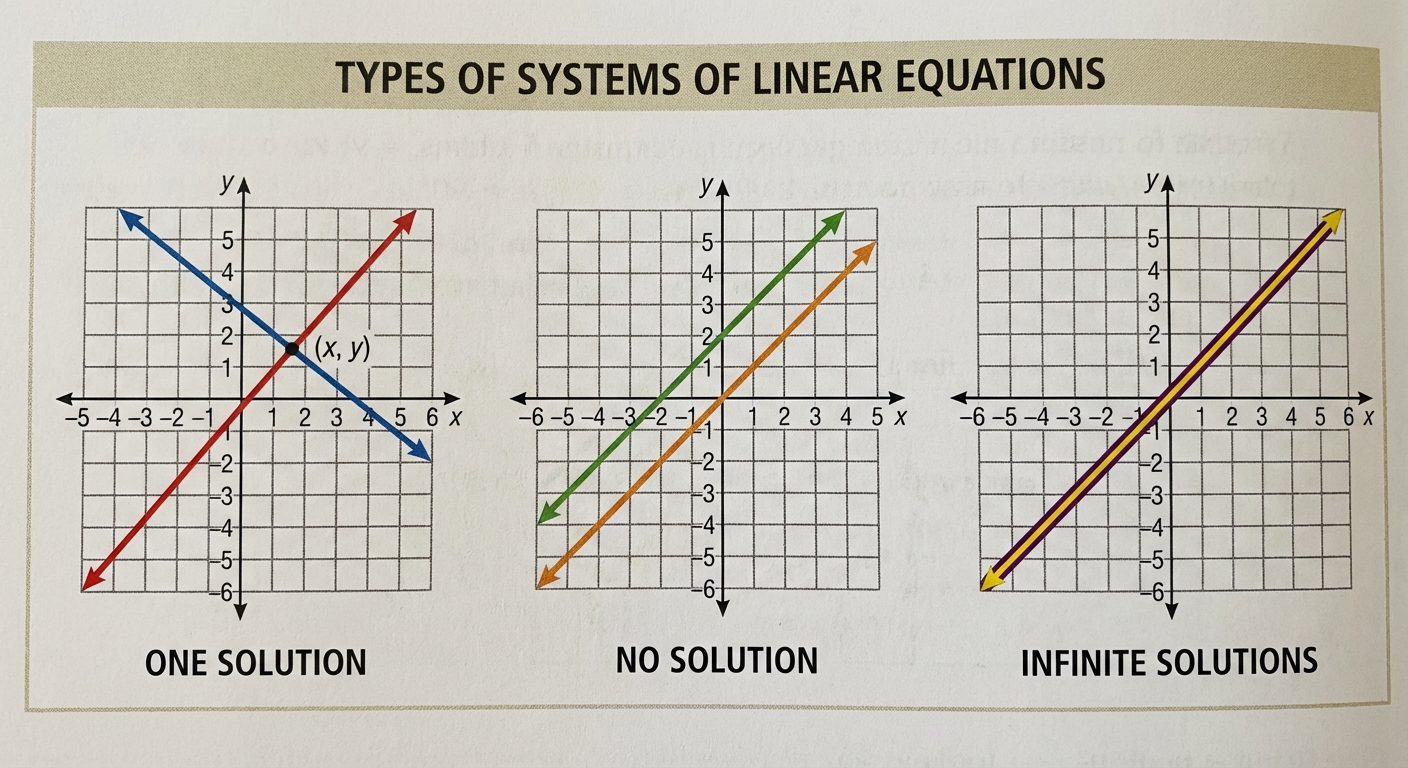
A system consists of two linear equations looked at simultaneously. The solution is the ordered pair $(x, y)$ that makes both equations true. Geometrically, this is where the two lines intersect.
Methods of Solving
- Substitution: Isolate a variable in one equation and plug it into the other. Best when one coefficient is 1 or -1.
- Elimination: Add or subtract entire equations to cancel out a variable. Best when equations are in Standard Form ($Ax + By = C$).
Worked Example (Elimination):
Add the equations vertically:
Plug $x$ back in:
Determining the Number of Solutions
The SAT loves to ask "For what value of $k$ does the system have no solution?" without asking you to solve for $x$ or $y$. Use the slope ($m$) and intercept ($b$) comparison:
- One Solution: Slopes are different ($m1 \neq m2$). Lines intersect once.
- No Solution: Slopes are equal, but intercepts are different ($m1 = m2, b1 \neq b2$). Lines are parallel.
- Infinite Solutions: Slopes are equal and intercepts are equal ($m1 = m2, b1 = b2$). Lines are identical.
Linear Inequalities
Inequalities differ from equations because they represent a range of solutions rather than specific values.
Inequalities in One Variable
Treat these like equations, with one vital exception: When you multiply or divide by a negative number, you MUST flip the inequality symbol.
- Example: $-2x > 10$
- Divide by -2: $x < -5$
Inequalities in Two Variables & Systems
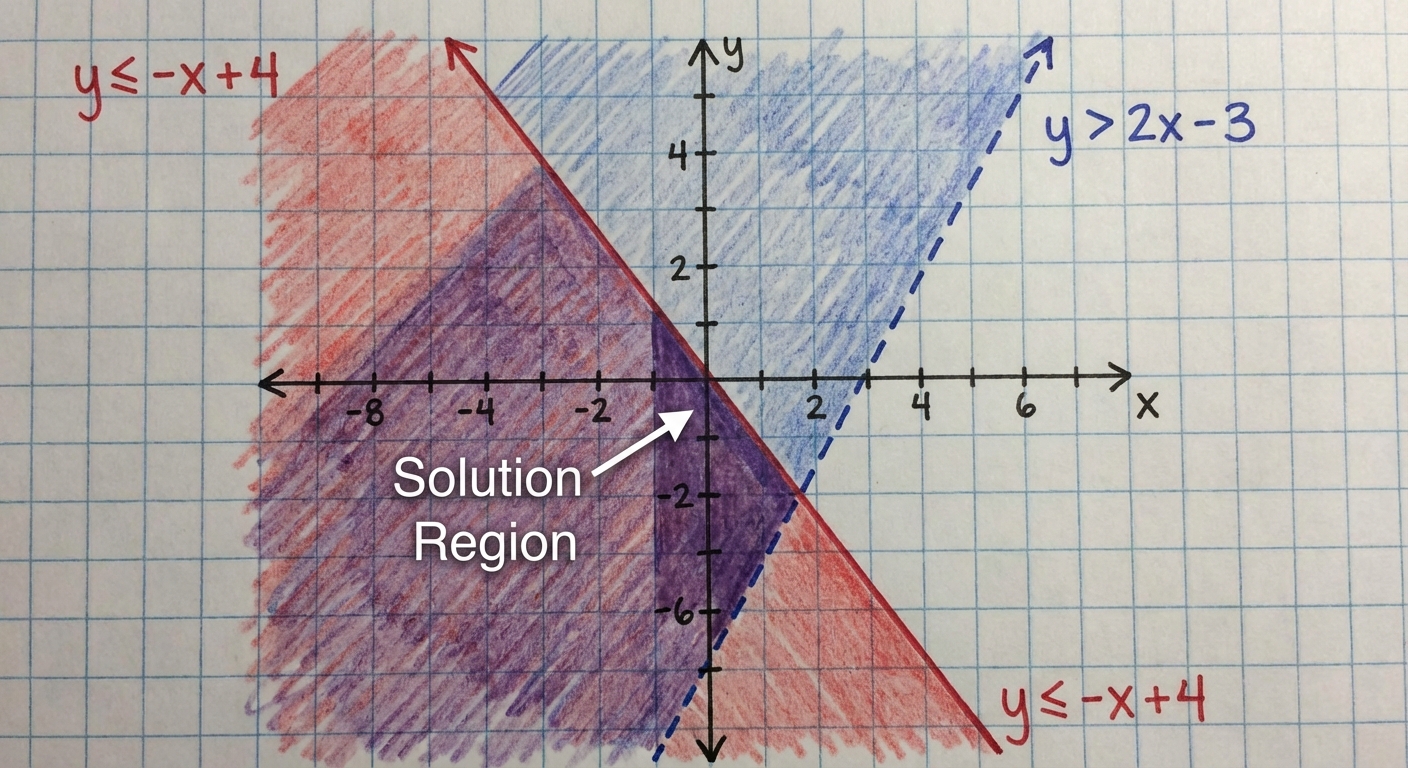
The solution to a linear inequality like $y > 2x + 1$ is a shaded region on the coordinate plane.
- The Line:
- Use a dashed line for strict inequalities ($
- Use a solid line for inclusive inequalities ($\leq, \geq$).
- The Shade:
- If $y >$ or $y \geq$, shade above the line.
- If $y <$ or $y \leq$, shade below the line.
- Systems: The solution is the region where the shading of both inequalities overlaps.
Common Mistakes & Pitfalls
- The Negative Flip: Students frequently forget to flip the inequality sign when dividing by a negative number. This is the most common mechanical error in this section.
- Misinterpreting "Zero": In a system of equations, confusing $(0,0)$ as a solution versus having "0 solutions" (parallel lines). They are very different concepts.
- Standard Form Slope: If given $Ax + By = C$, do not assume the slope is $A$. You must rearrange to $y = mx+b$ or remember that $m = -A/B$.
- Example: In $2x + 3y = 6$, the slope is $-2/3$, not $2$.
- Distribution Errors: In equations like $3x - 2(x - 5) = 10$, a common error is distributing the negative to the $x$ but failing to distribute it to the $-5$. This should become $+10$.
- Perpendicular Slope: Remember that perpendicular slopes are negative reciprocals, not just reciprocals. If $m = 2$, the perpendicular slope is $-1/2$, not $1/2$.