Mastering Integration of Knowledge and Ideas in ACT Reading
Understanding and Evaluating Arguments
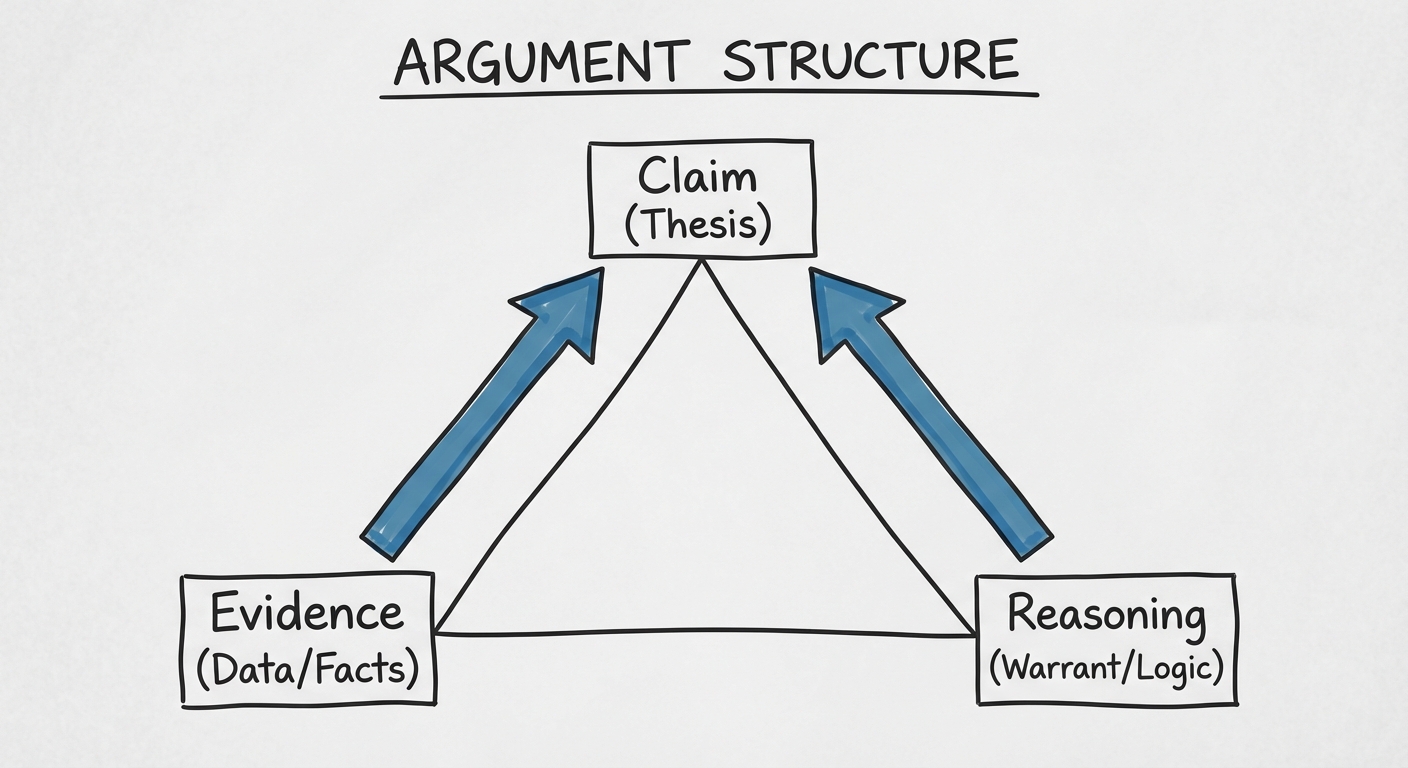
In the Integration of Knowledge and Ideas category (accounting for approximately 13–18% of the ACT Reading section), you are asked to go beyond simply retrieving details. You must analyze how an author makes an argument, evaluate the validity of their reasoning, and synthesize information from multiple sources (paired passages or visual data).
Authors' Claims
At the heart of every arguments is a claim—a statement the author implies or explicitly states as true. Identifying the claim is the first step in successful analysis.
- The Central Claim (Thesis): This is the primary point the author is trying to prove. It often appears in the introduction or conclusion.
- Secondary Claims: These are smaller points that support the main thesis. They often serve as topic sentences for body paragraphs.
Key Strategy: Ask yourself, "What does the author want me to believe by the end of this passage?" If a sentence summarizes that belief, it is the central claim.
Differentiating Between Facts and Opinions
To evaluate an argument, you must distinguish between objective evidence and subjective interpretation.
| Feature | Fact | Opinion |
|---|---|---|
| Definition | A statement that can be proven true or false with evidence. | A statement reflecting a belief, judgment, or feeling. |
| Keywords | Dates, statistics (numbers), historical events, scientific terms. | Adjectives (best, worst, important), modal verbs (should, must), qualifiers (likely, possibly). |
| Example | "The bridge spans 1,200 meters." | "The bridge is a breathtaking masterwork of engineering." |
Note: Authors often blend these. "The devastating hurricane hit in 2005." Here, "hit in 2005" is fact; "devastating" is an opinion/judgment, even if widely accepted.
Structure and Reasoning
Analyzing How Authors Construct Arguments
ACT questions often ask how an argument is built. Authors use specific rhetorical structures to persuade readers.
- Cause and Effect: Showing that one event leads to another to highlight consequences.
- Comparison/Contrast: Highlighting similarities or differences to show why one option is superior.
- Problem-Solution: Introducing a conflict and proposing a specific resolution.
- Anecdotal Evidence: Using a personal story to make an abstract concept relatable.
- Counterarguments: Anticipating opposing views and refuting them. This strengthens credibility by showing the author has considered multiple angles.
Evaluating Reasoning and Evidence
Once you identify the claim, you must judge if the evidence supports it. This is often framed as: "Which of the following, if true, would most weaken the author's argument?"
- Relevance: Does the evidence directly relate to the claim? (e.g., Cited rainfall data is relevant to a claim about drought, but irrelevant to a claim about tourism revenue).
- Sufficiency: Is there enough evidence? One anecdote is rarely enough to prove a universal scientific trend.
- Logical Fallacies: Watch for gaps in logic.
- Ad Hominem: Attacking the person rather than the argument.
- Correlation vs. Causation: Assuming that because B followed A, A caused B.
Visual and Quantitative Information
In recent years, the ACT has introduced visual elements (graphs, tables, or charts) into the Reading section. These questions act similarly to Science questions but focus on how the data relates to the text.
Integrating Information from Graphs, Tables, and Figures
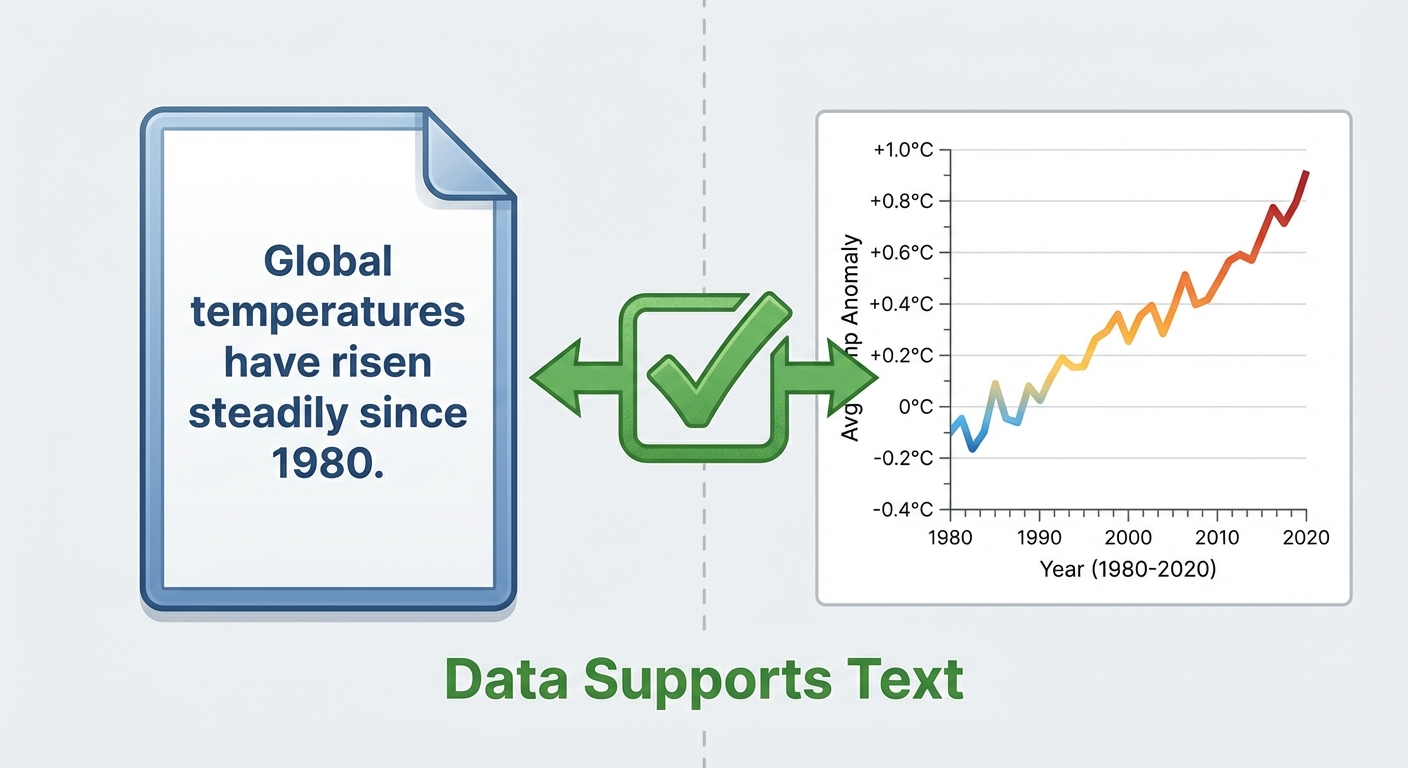
You will be asked to determine if the data in a figure supports, refutes, or expands upon the information in the written passage.
Steps for Analysis:
- Read the Labels: Check the Title, X-axis (independent variable), Y-axis (dependent variable), and Legend/Key. Do not skip this.
- Identify Trends: Is the line going up, down, or fluctuating? Is there a direct or inverse relationship?
- Connect to Text: Find the specific paragraph in the passage that discusses the same topic. Does the author say "profits rose"? Does the graph show profits rising?
Example Scenario:
- Text Claim: "Despite the introduction of the new pesticide, crop yields have stagnated over the last decade."
- Graph Data: A bar chart showing crop yields flatlining from 2010 to 2020.
- Synthesis: The graph supports the author's claim regarding effectiveness.
Paired Passages (Using Evidence to Connect Texts)
The ACT Reading section always contains one set of Paired Passages (Passage A and Passage B). Integration questions here ask you to analyze the relationship between the two authors.
Types of Relationships
- Conflicting Viewpoints: Passage A argues for a policy; Passage B argues against it.
- Specific vs. General: Passage A discusses the history of jazz music (general); Passage B discusses the life of Louis Armstrong (specific example).
- Chronological/Evolutionary: Passage A represents an old theory; Passage B presents new research that updates or corrects the old theory.
Synthesis Questions
A common question type asks: "Which of the following statements best describes how Passage B relates to Passage A?"
- Strategy: Summarize the "Main Idea" of A and B separately before looking at the choices. Then, look for the "bridge" between them.
Comparison Table for Paired Passages
| Aspect | Passage A (Example) | Passage B (Example) |
|---|---|---|
| Topic | The benefits of remote work. | The social isolation caused by remote work. |
| Tone | Optimistic, progressive. | Cautionary, concerned. |
| Relationship | Passage B complicates the argument in Passage A by introducing negative side effects. |
Common Mistakes & Pitfalls
- Confusing "Fact" with "True": In the context of Reading questions, a "fact" is something presented as objective data. An "opinion" is a belief. A statement can be a "fact" grammatically even if false (e.g., "The moon is made of cheese" is stated as a fact, not an opinion, though it is factually incorrect). Focus on presentation, not just external truth.
- Ignoring the Axes: On graph questions, students often rush to look at the shape of the line without checking the units (e.g., millions vs. billions, or years vs. months). This leads to scale errors.
- Projecting Outside Knowledge: Do not use what you learned in history class to answer a question about a history passage. Only use the evidence provided in the text/graph. If the text says the sky is green, for the purpose of the test, the sky is green.
- Misinterpreting "Suggests": When a question asks what a passage "suggests," it requires an inference based on evidence, not a wild guess. The answer is always paraphrased in the text adjacent to the relevant keywords.