Unit 8: Applications of Integration — Area Between Two Curves
Conceptual Foundation: The Geometry of Accumulation
In previous units, you learned that the definite integral $\int_a^b f(x) \, dx$ represents the net signed area between the curve and the x-axis. However, when we calculate the Area Between Curves, we are looking for the total geometric area of the region bounded by two functions. This area is always positive.
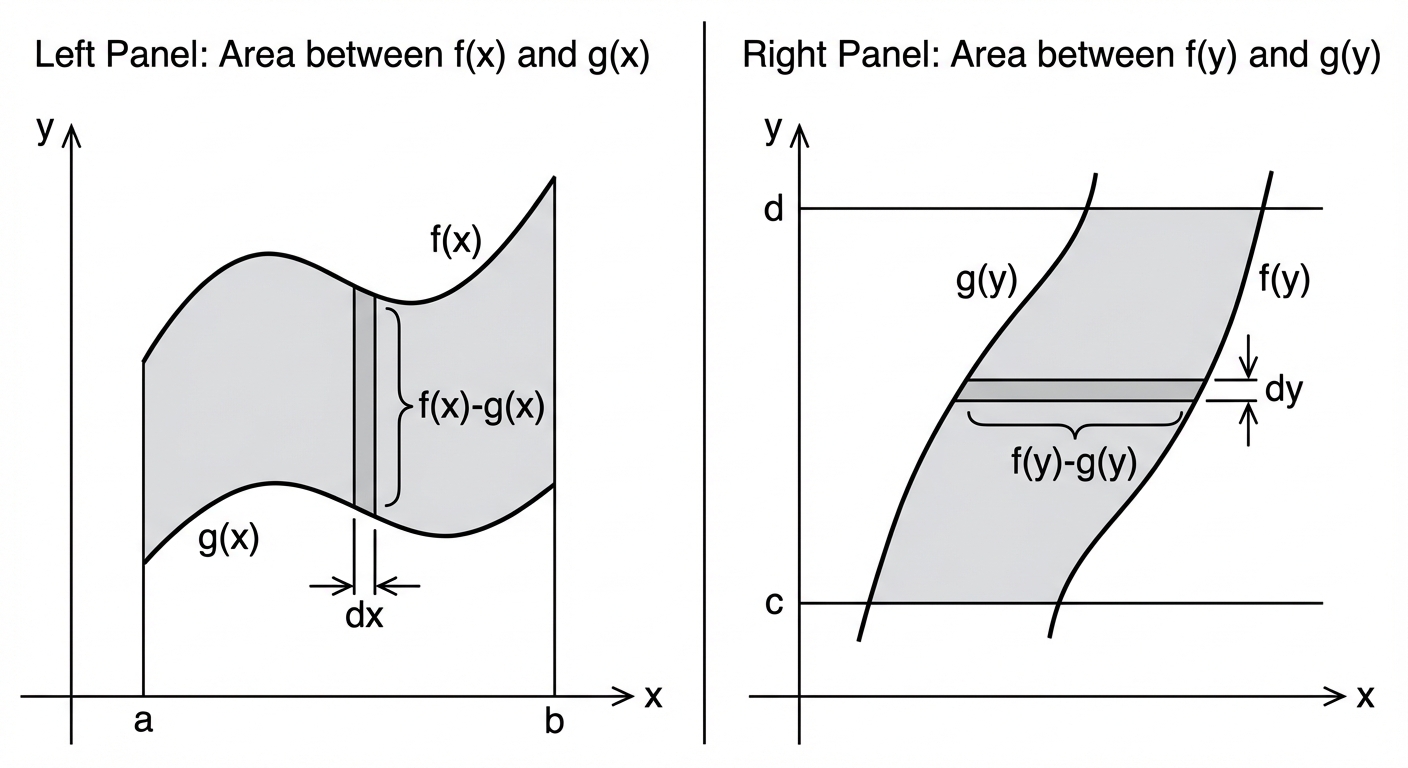
To find this area, we apply the concept of the Riemann Sum by slicing the region into infinitesimally thin rectangles. The strategy for setting up the integral depends on the orientation of these slices:
- Vertical Slicing (Functions of $x$): Rectangles stand upright. The width is $dx$.
- Horizontal Slicing (Functions of $y$): Rectangles lie sideways. The width is $dy$.
Vertical Slicing: Functions of $x$
This is the most common method used in AP Calculus AB. If a region is bounded above by $y = f(x)$ and below by $y = g(x)$, we calculate the height of a representative rectangle as the difference between the $y$-values.
The Formula
For a region bounded by graphs $f(x)$ and $g(x)$ and vertical lines $x = a$ and $x = b$, where $f(x) \ge g(x)$ on $[a, b]$:
Memory Aid: Top Minus Bottom
When performing vertical slicing with respect to $x$, always repeat the mantra:
"Area equals the integral of Top minus Bottom."
If you reverse this ($g(x) - f(x)$), you will get a negative result, which represents signed area rather than geometric area.
Step-by-Step Approach
- Sketch the graph: You must identify which function is on top and which is on the bottom.
- Find points of intersection: Set $f(x) = g(x)$ to find the limits of integration ($a$ and $b$) if they are not explicitly given.
- Set up the integral: Subtract the bottom function from the top function.
- Integrate: Evaluate the definite integral using the Fundamental Theorem of Calculus.
Worked Example: Basic Vertical Slicing
Problem: Find the area of the region enclosed by $y = x^2 + 2$ and $y = x$.
Solution:
- Sketch: $y = x^2 + 2$ is a parabola opening up (vertex at $(0,2)$). $y = x$ is a line through the origin.
- Correction/Reality Check: Wait, $x^2 + 2$ is always above $x$ (discriminant of $x^2-x+2$ is negative). They don't intersect. We need vertical boundaries. Let's add boundaries $x=0$ and $x=2$.
- Identify Top/Bottom: $f(x) = x^2 + 2$ (Top) and $g(x) = x$ (Bottom) on $[0, 2]$.
- Setup:
- Integrate:
Complex Regions: Intersecting Curves
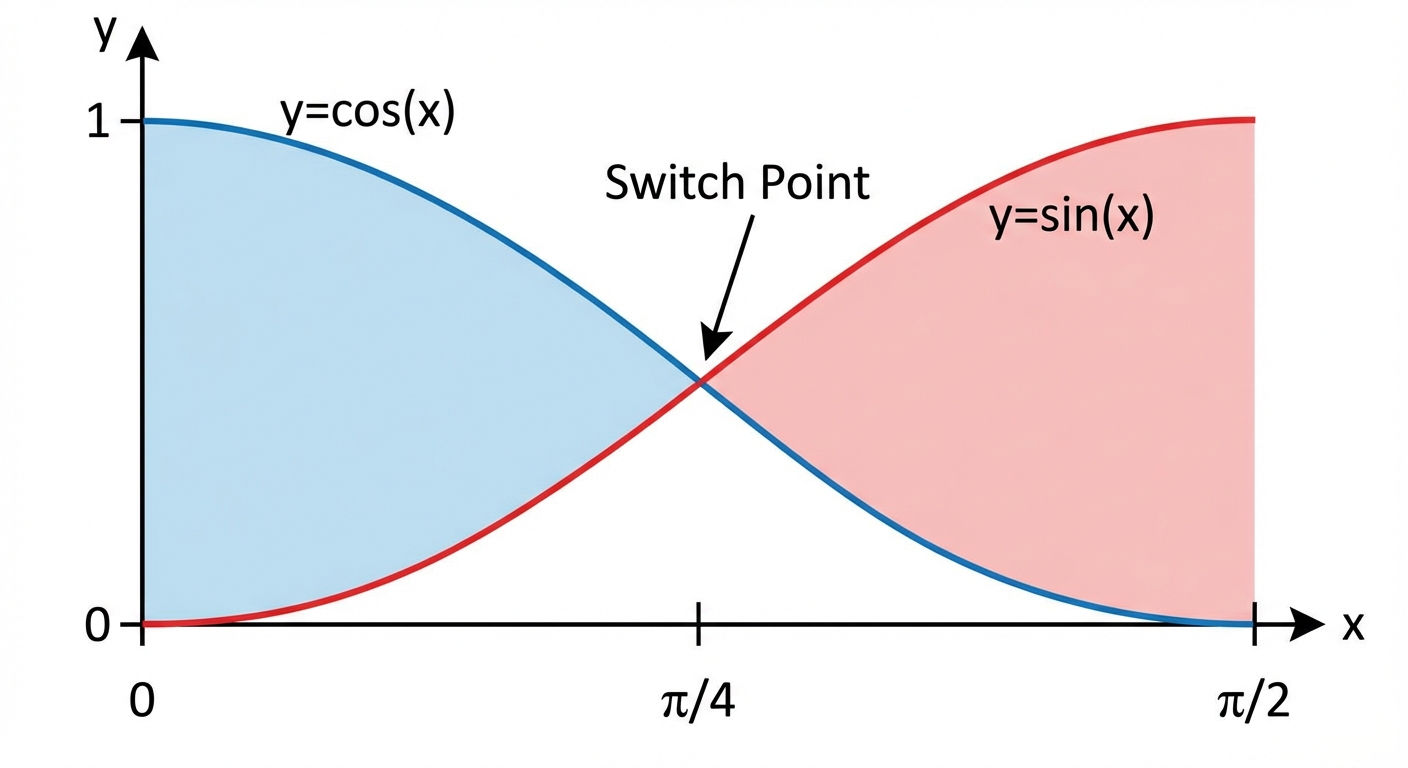
Sometimes, the curves cross each other within the interval. When this happens, the "Top" function becomes the "Bottom" function (and vice versa) after the intersection point.
The Strategy: Split the Integral
If $f(x)$ and $g(x)$ intersect at a point $c$ between $a$ and $b$, you cannot write a single integral (unless you use absolute values). You must split the region into two sub-regions.
Worked Example: Crossing Curves
Problem: Find the area bounded by $f(x) = \sin(x)$ and $g(x) = \cos(x)$ from $x=0$ to $x=\frac{\pi}{2}$.
- ** intersections:** $\sin(x) = \cos(x)$ at $x = \frac{\pi}{4}$.
- Analyze Intervals:
- On $[0, \frac{\pi}{4}]$: $\cos(x) > \sin(x)$ (Cosine is Top).
- On $[\frac{\pi}{4}, \frac{\pi}{2}]$: $\sin(x) > \cos(x)$ (Sine is Top).
- Setup:
Horizontal Slicing: Functions of $y$
Sometimes, vertical slicing requires breaking a region into multiple complex integrals because the "top" or "bottom" boundary changes. In these cases, it is often easier to slice horizontally and integrate with respect to $y$.
The Formula
For a region bounded by $x = f(y)$ (right) and $x = g(y)$ (left) between $y = c$ and $y = d$:
Memory Aid: Right Minus Left
When integrating with respect to $y$:
- The limits of integration ($c$ and $d$) are y-values.
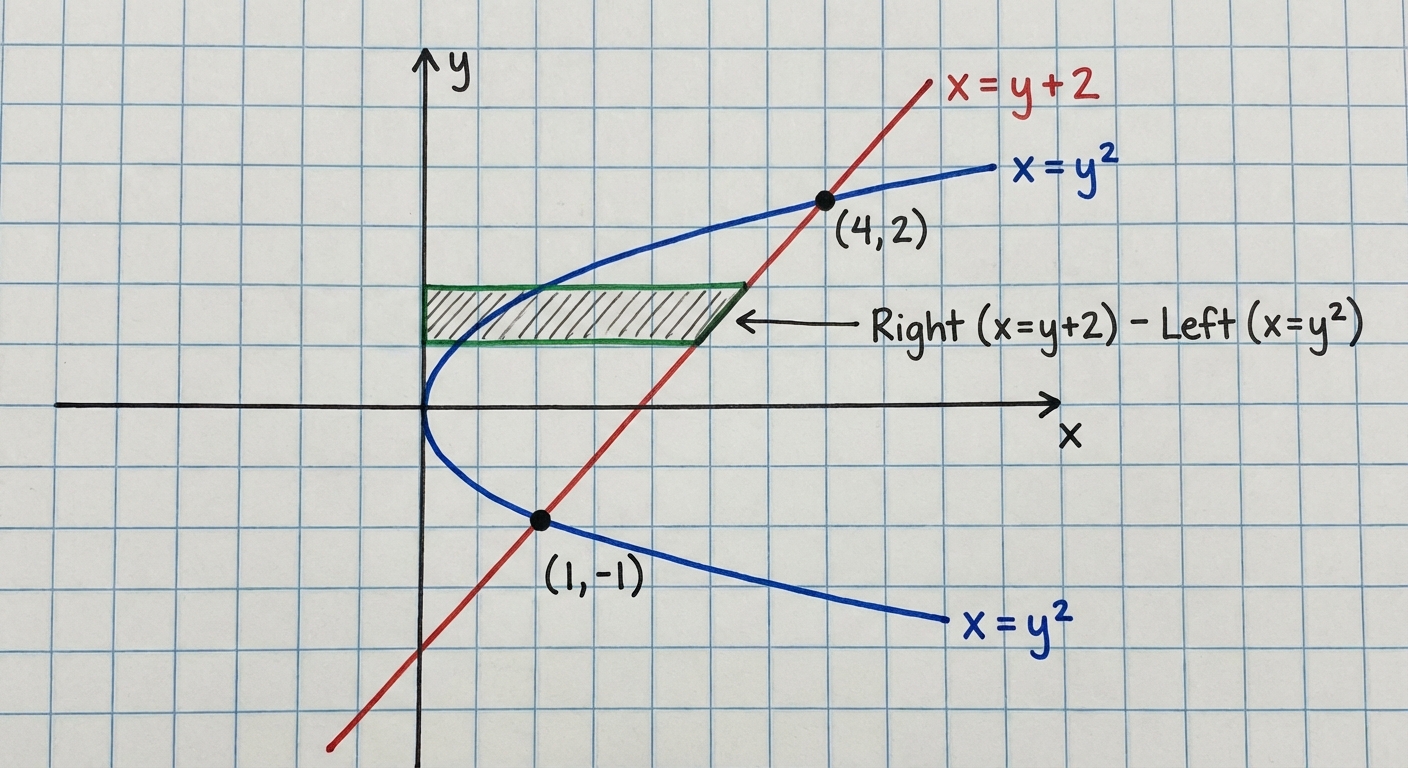
- The formula is "Right minus Left".
When to Use Terms of $y$
- The equations are given as $x = \dots$ (e.g., $x = y^2$).
- The "Right" and "Left" boundaries are consistent throughout the region, but the "Top" and "Bottom" boundaries change.
Worked Example: Functions of $y$
Problem: Find the area enclosed by $x = y^2$ and the line $x = y + 2$.
- Identify Orientation: These are functions of $y$. A parabola on its side ($x=y^2$) and a line.
- Find Intersections (Limits): Set $y^2 = y + 2$.
Intersection points are $y = -1$ and $y = 2$. - Identify Right/Left: Pick a test point in $(-1, 2)$, e.g., $y=0$.
- Curve 1: $x = 0^2 = 0$
- Curve 2: $x = 0 + 2 = 2$
- Since $2 > 0$, the line $x = y+2$ is on the Right.
- Setup & Integrate:
Comparison Table: x vs y
| Feature | Functions of $x$ | Functions of $y$ |
|---|---|---|
| Slicing | Vertical (Up/Down) | Horizontal (Left/Right) |
| Differential | $dx$ | $dy$ |
| Formula | $\int (Top - Bottom) dx$ | $\int (Right - Left) dy$ |
| Limits | $x$-values ($x1$ to $x2$) | $y$-values ($y1$ to $y2$) |
| Equations | $y = \dots$ | $x = \dots$ |
Common Mistakes & Pitfalls
Mismatched Limits and Variables:
- Mistake: Setting up an integral as $\int_a^b (Right - Left) \, dy$ but using $x$-values for the limits $a$ and $b$.
- Correction: If your differential is $dy$, your limits must be $y$-coordinates.
Order of Subtraction:
- Mistake: Calculating Bottom - Top or Left - Right.
- Correction: This yields a negative area. Area between curves is geometric and must be positive. If you get a negative answer, you likely swapped the functions.
Thinking Intersection Points are Always Limits:
- Mistake: Assuming integration always stops at intersection points.
- Correction: Intersection points define the enclosed region, but ensure you integrate across the entire shaded region requested.
Forgetting to Split:
- Mistake: Integrating straight from $a$ to $b$ when the curves cross in the middle.
- Correction: Always check if $f(x) - g(x)$ changes sign within the interval. If it does, split the integral.
Calculator Errors:
- Mistake: Entering $x$ variables when evaluating a function of $y$ numerically.
- Correction: The calculator doesn't care about the variable name. You can type $X$ for your independent variable even if the problem is in $y$, as long as limits and functions are consistent.