Study Notes: AP US Gov Unit 1 - Foundations of American Democracy
Ideals of Democracy
Enlightenment Roots and Key Principles
The United States government was not created in a vacuum; it was heavily influenced by the Enlightenment (18th century), a movement favoring reason over tradition. The Framers incorporated five fundamental ideals into the founding documents:
1. Limited Government
A political system where the finalized power of the government is restricted, usually by a written constitution.
- Key concept: The government is not all-powerful; it can only do what the people allow it to do.
2. Natural Rights
Rights that belong to all people from birth, often described as "god-given" and unalienable.
- John Locke: Argued broadly for Empiricism and specifically for natural rights to "Life, Liberty, and Property."
- Declaration of Independence: Thomas Jefferson adapted this to "Life, Liberty, and the pursuit of Happiness."
3. Popular Sovereignty
The principle that the authority of the government is created and sustained by the consent of its people.
- Example: "We the People" in the Preamble of the Constitution.
- Mechanism: Elections and voting.
4. Republicanism
A system in which the government's authority comes from the people, exercised through elected representatives.
- Distinction: It is different from a direct democracy (where people vote on laws directly). American Republicanism relies on representatives to make laws.
5. Social Contract
An implicit agreement among the members of a society to cooperate for social benefits.
- Thomas Hobbes (Leviathan): Believed humans were naturally chaotic and needed a strong absolute monarch to keep order. The trade-off is giving up freedom for safety.
- John Locke (Second Treatise): Agreed on the contract but argued that if the government breaks the contract (violates natural rights), the people have the right to revolution.
- Jean-Jacques Rousseau: Emphasized that the contract creates a community that should act for the "general will" (greater good).
The Declaration of Independence (1776)
Authored by Thomas Jefferson (influenced by Locke).
This document is strictly a philosophical defense of the breakup with Britain, not a governing constitution.
- Preamble: Establishes Natural Rights and Social Contract as the basis for government.
- List of Grievances: A list of accusations against King George III (taxation without representation, quartering troops, abolishing local laws). This serves as evidence the Social Contract was broken.
- Resolution: Declares the US a free and independent nation.
Types of Representative Democracy
Political scientists categorize the way American democracy functions into three models. These are not mutually exclusive; the US exhibits traits of all three.
1. Participatory Democracy
Emphasizes broad participation in politics and civil society by citizens at various levels of socioeconomic status.
- Example: Town Hall meetings, referendums, and initiatives where citizens vote directly on laws.
- Benefit: closely reflects the will of the people.
- Drawback: Can be inefficient or subject to mob rule.
2. Pluralist Democracy
Recognizes group-based activism by nongovernmental interests striving for impact on political decision-making.
- Theory: No single group dominates; policy is the result of bargaining and compromise between competing interest groups (e.g., NRA vs. Gun Control advocacy groups, Labor Unions vs. Corporate Lobbyists).
- Foundational Text: Federalist No. 10 (Madison argued that many factions competing prevents one from tyrannizing).
3. Elite Democracy
Emphasizes limited participation in politics and civil society, where a small number of people, usually those who are wealthy and willing to participate, influence political decision-making.
- Example: The Electoral College (originally intended to filter the public's vote), Supreme Court Justices (unelected).
- Argument: Elites are better educated and less prone to emotional, rash decisions.
The Articles of Confederation (1781-1789)
This was the first constitution of the US, created during the Revolutionary War. It established a "firm league of friendship" among states rather than a strong national union.
Structure and Weaknesses
The Articles created a confederation where states were supreme and the federal government was weak.
| Feature | Weakness | Consequence |
|---|---|---|
| Unicameral Legislature | One vote per state, regardless of size. | Disproportionate power to small states. |
| No Power to Tax | Congress could only request money. | Federal gov was broke; couldn't pay war debts. |
| No Standing Army | Congress couldn't draft soldiers. | Vulnerable to foreign threats and domestic rebellion. |
| No Interstate Commerce control | States placed tariffs on each other. | Economic chaos and trade wars between states. |
| Amendment Process | Required unanimous consent (13/13). | Impossible to change or improve the system. |
| No Executive/Judicial | No President or Supreme Court. | Laws couldn't be enforced or interpreted uniformly. |
Shays' Rebellion (1786)
Daniel Shays led farmers in Western Massachusetts to attack a federal arsenal to protest farm foreclosures and high taxes.
- The Problem: Massachusetts asked the federal government for help, but the Feds had no money and no army to send. Wealthy elites had to hire a private army to stop it.
- The Impact: It vividly demonstrated that the Articles were too weak to maintain order and liberty, leading directly to the Constitutional Convention.
The Constitutional Convention (1787)
Delegates met in Philadelphia to fix the Articles but ended up drafting a new Constitution. They agreed on a stronger central government but debated how to balance power.
The Great Compromise (Connecticut Compromise)
ADDRESSED: Representation in Congress
- Virginia Plan: Bicameral legislature; representation based on population. ( favored big states).
- New Jersey Plan: Unicameral legislature; equal representation. (favored small states).
- The Compromise: A Bicameral (two-house) Legislature:
- House of Representatives: Based on population (appealed to VA).
- Senate: Equal representation (2 per state) (appealed to NJ).
The Three-Fifths Compromise
ADDRESSED: Slavery and Representation
- South: Wanted enslaved people deemed "people" for representation (more seats in Congress) but "property" for taxes.
- North: Wanted the opposite.
- The Compromise: Enslaved people would count as 3/5ths of a person for both taxation and representation purposes.
The Electoral College
ADDRESSED: How to choose the President
- Some wanted direct election by the people; others wanted Congress to choose the President.
- Compromise: An Electoral College system where states decide how to choose electors, who then vote for President. It represents an Elite Democracy mechanism ensuring a check on the "uninformed" masses.
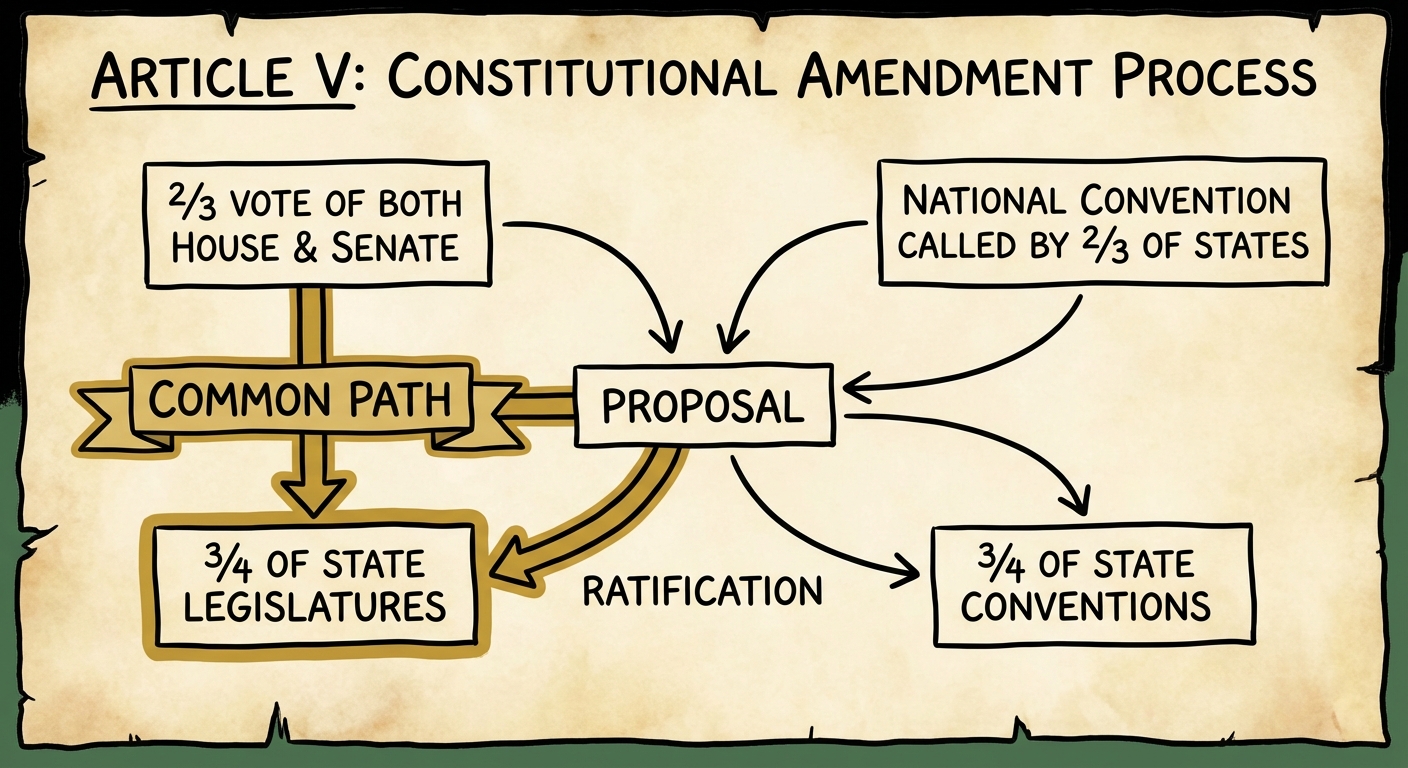
Amendment V: The Amendment Process
The Framers acknowledged the document wasn't perfect.
- Proposal: 2/3 of both houses of Congress OR 2/3 of State Legislatures (National Convention).
- Ratification: 3/4 of State Legislatures OR 3/4 of State Conventions.
- Significance: Large majorities are required implies Federalism (National proposes, States ratify).
The Ratification Debate: Federalists vs. Anti-Federalists
Once written, the Constitution had to be ratified by 9/13 states.
The Anti-Federalists (Brutus No. 1)
Arguments against the new Constitution.
- Primary Fear: The new central government would be too strong and threaten personal liberty and state sovereignty.
- Specific Concerns:
- The Necessary and Proper Clause and Supremacy Clause gave the federal government unlimited power.
- The power to tax would lead to tyranny.
- A standing army is dangerous.
- Required Doc: Brutus No. 1: Argued that a free republic cannot exist in such a large territory (the US). Representatives would be too distant from the people to understand their needs.
- Demands: They refused to ratify without a Bill of Rights.
The Federalists (Federalist No. 10 & 51)
Supporters of the Constitution (Madison, Hamilton, Jay).
Required Doc: Federalist No. 10 (Madison): Discusses Factions (groups with shared interests adverse to the rights of others).
- Problem: Factions are inevitable in a free society.
- Solution: You cannot remove the cause (liberty), so strictly control the effects. A large republic is better than a small one because it dilutes the power of bad factions—they have to compete with so many other interests (Pluralism) that no single tyrant can rise.
- Refutes Brutus: A large republic protects minorities better than specific small communities.
Required Doc: Federalist No. 51 (Madison): Discusses Checks and Balances.
- "Ambition must be made to counteract ambition."
- Explains that the structure of the government (Separation of Powers) is the best protection against tyranny.
Principles of American Government
Separation of Powers
Distinct responsibilities are assigned to each branch to prevent one group from holding all power (Montesquieu's idea).
- Legislative (Article I): Makes laws.
- Executive (Article II): Enforces laws.
- Judicial (Article III): Interprets laws.
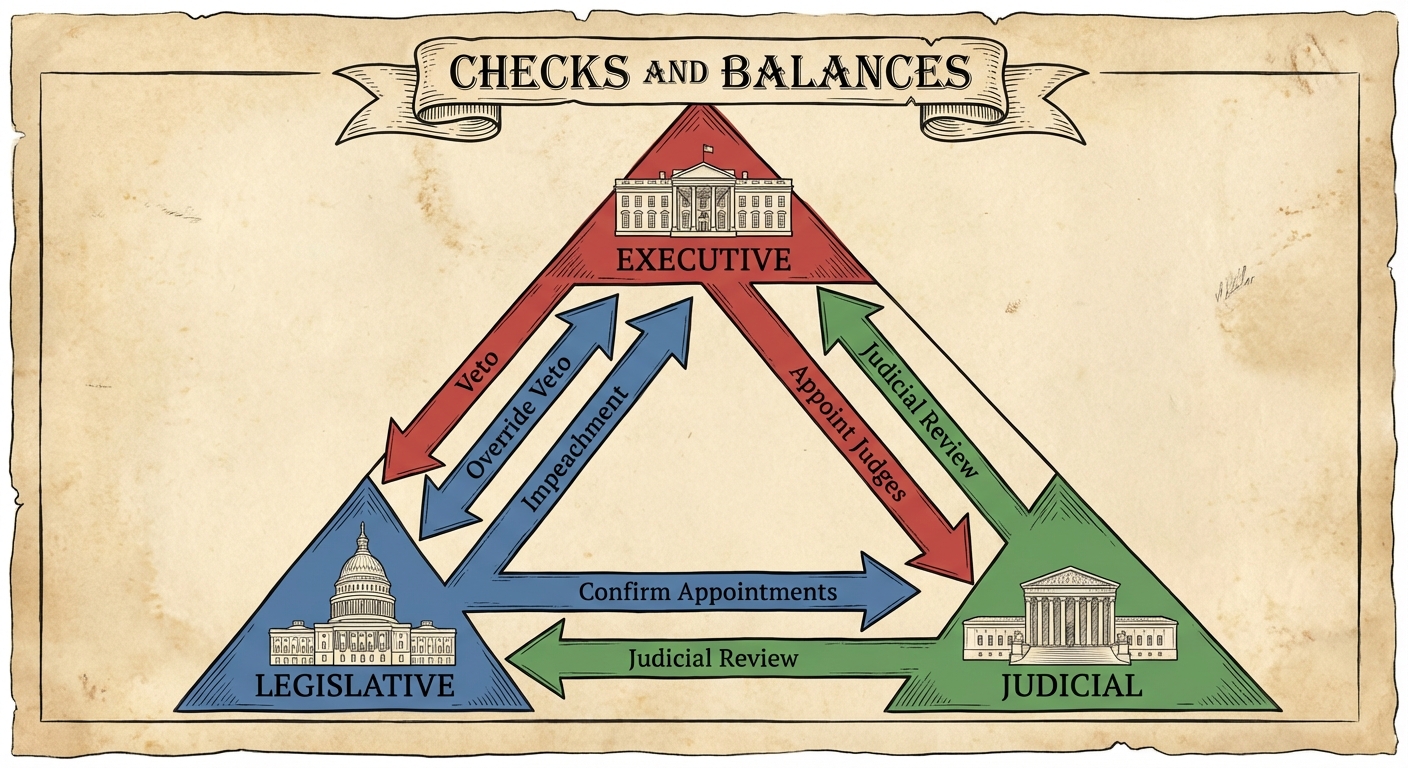
Checks and Balances
Each branch has the ability to block or influence the other branches.
Key Checks:
- Legislative on Executive: Impeachment, Advice & Consent (Senate confirms judge/cabinet noms), Override Veto (2/3 vote), Power of the Purse (budget).
- Executive on Legislative: Veto legislation.
- Judicial on Legislative/Executive: Judicial Review (declaring acts unconstitutional).
- Legislative on Judicial: Create lower courts, impeach judges, propose amendments to bypass court rulings.
Federalism
Definition: The constitutional division of power between the National (Federal) government and State governments.
Types of Federalism
- Dual Federalism (Layer Cake): Federal and state governments are distinct with little overlap. (Common pre-1930s).
- Cooperative Federalism (Marble Cake): Federal and state governments share responsibilities, costs, and administration of policies (e.g., building interstate highways).
Constitutional Clauses Defining Federalism
- Enumerated Powers (Article 1, Sec 8): Powers explicitly listed for Congress (Tax, War, Coin Money).
- Implied Powers (Necessary and Proper Clause / Elastic Clause): Grants Congress powers not explicitly listed but needed to carry out enumerated powers.
- Commerce Clause: Congress regulates interstate business. This has been the biggest source of expansion for federal power.
- Supremacy Clause (Article VI): The Constitution and Federal laws are superior to State laws.
- 10th Amendment (Reserved Powers): Powers not given to the Feds are reserved for the States (e.g., schools, marriage licenses, policing).
Financial Federalism (Fiscal Federalism)
The federal government uses money to influence state policies.
- Categorical Grants: Money for a specific purpose (e.g., "Build a bridge exactly here"). States have less freedom. often come with "strings attached."
- Block Grants: Money for broad purposes (e.g., "Improve transportation"). States have more freedom/discretion. Preferred by states and Republicans (Devolution).
- Mandates: Federal rules states must follow.
- Unfunded Mandate: Fed says "do this" but gives no money (e.g., Americans with Disabilities Act).
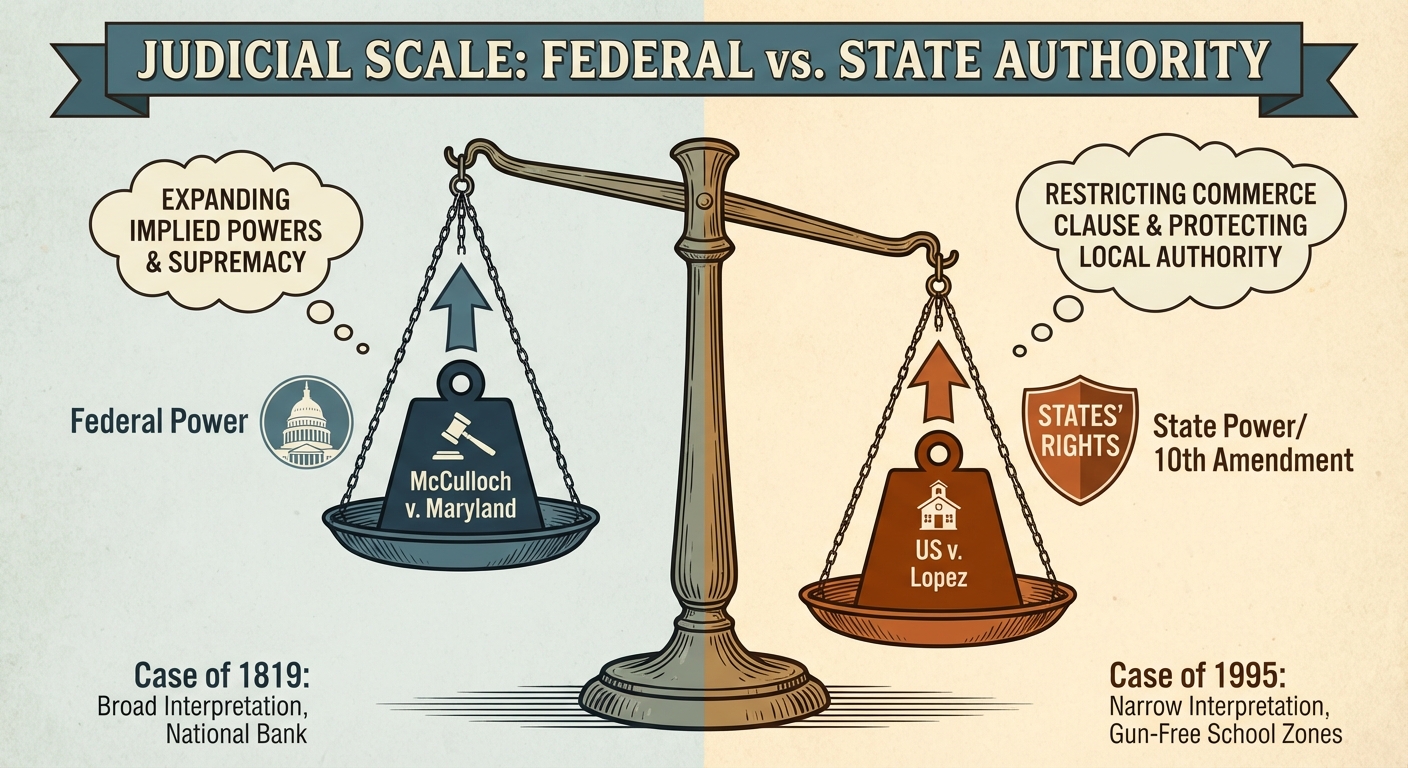
Required Supreme Court Cases (Federalism)
There are two critical cases regarding the balance of power between the Nation and the States.
1. McCulloch v. Maryland (1819)
Context: Maryland tried to tax the Second Bank of the United States. James McCulloch (bank cashier) refused to pay.
Holding: The Court ruled in favor of the Federal Government.
- Necessary and Proper Clause: Congress does have the implied power to create a national bank (even though the Constitution doesn't say "bank") because it helps manage money (an enumerated power).
- Supremacy Clause: States cannot tax a federal entity. "The power to tax is the power to destroy."
Lesson: Expanded Federal Power.
2. United States v. Lopez (1995)
Context: A student brought a gun to school. He was charged with violating the federal "Gun-Free School Zones Act." The government argued that guns in schools affect education, which affects the workforce, which affects the national economy, so they could regulate it under the Commerce Clause.
Holding: The Court ruled in favor of Lopez (and the States).
- The Court said carrying a gun is a non-economic activity. If Congress can regulate this using the Commerce Clause, they could regulate anything.
- The law was unconstitutional.
Lesson: Restricted Federal Power (checked the Commerce Clause) and protected the 10th Amendment.
Mnemonics & Memory Aids
- Powers of Congress: use M.R.E.
- Money (Tax, borrow, coin)
- Regulate (Interstate Commerce)
- External (War, Treaties)
- Checks and Balances: President Appoys (Appoints), Congress Approys (Approves).
- Federalist Papers:
- #10 = Fa10s (Factions)
- #51 = 5tructure (1nstitutions) / Separation of P.
- Grants:
- Block = Building Block (Flexible)
- Categorical = Catchy strings attached (Strict)
Common Mistakes & Pitfalls
- Declaration vs. Constitution: Students often quote "Life, Liberty, and Pursuit of Happiness" as part of the Constitution. It is not. The Constitution protects "Life, Liberty, and Property" (Due Process Clause).
- Federalism vs. Separation of Powers:
- Federalism = Vertical division (National vs. State).
- Separation of Powers = Horizontal division (Legislative vs. Executive vs. Judicial).
- Anti-Federalists vs. Federalism: Do not confuse the Anti-Federalist group (people who opposed the Constitution) with Federalism (the system of shared power).
- The Great Compromise: Students often forget this was about representation, not slavery. Slavery was the 3/5ths Compromise.
- Articles of Confederation: Remember the Feds could ask for taxes but couldn't force collection. They weren't "forbidden" from needing money, just powerless to get it.