Mastering Related Rates in AP Calculus BC
Introduction to Related Rates
Related Rates problems are among the most practical—and notorious—applications of derivatives in AP Calculus. At its core, a related rates problem asks for the rate at which one quantity is changing based on the known rate of change of another quantity, provided the two quantities are connected by an equation.
The fundamental principle relies on Implicit Differentiation with respect to time ($t$). Since real-world variables (distance, volume, angle) change over time, we treat every variable as a function of $t$.
The Core Concept
If two variables $x$ and $y$ are related by the equation $y = x^2$, and both change with time, their rates of change are related by the Chain Rule:
Notice that we didn't just write $2x$. Because we are differentiating with respect to $t$, not $x$, we must multiply by the derivative of the inside function ($\frac{dx}{dt}$). This simply means:
- $\frac{dy}{dt}$: How fast $y$ is changing per unit of time (e.g., meters/sec).
- $\frac{dx}{dt}$: How fast $x$ is changing per unit of time.
Solving Related Rates Problems
To tackle these problems systematically, use the G.E.D.S. method (Given, Equation, Derivative, Solve). This structure prevents the most common error: substituting numbers too early.
Step-by-Step Strategy
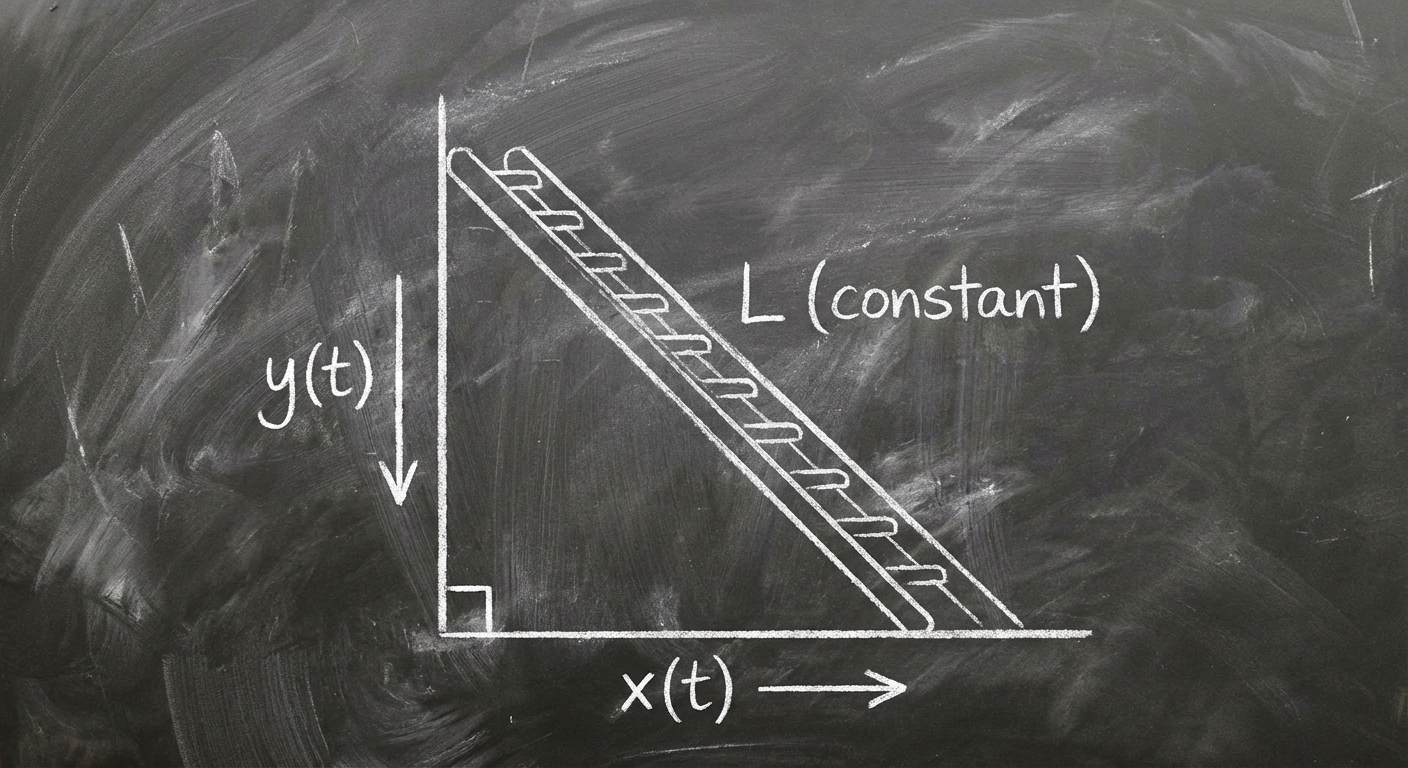
- Draw and Label: Sketch the situation. Assign variables to quantities that change (e.g., $x$, $h$, $\theta$). Assign numbers ONLY to quantities that remain constant throughout the entire process (e.g., the length of a ladder).
- Identify Given and Required Rates: Write down what you know and what you need to find.
- Example: Given $\frac{dx}{dt} = 2$, Find $\frac{dy}{dt}$ when $x=4$.
- Write the Relating Equation: Find a geometric formula or algebraic equation that relates the variables (Pythagorean theorem, Volume, Trig ratios).
- Differentiate Implicitly: Differentiate both sides of the equation with respect to time $t$. Do not plug in the "instantaneous" values yet!
- Substitute and Solve: Now, plug in the known values for the specific instant in time and solve for the unknown rate.
Common Types of Problems
1. The Pythagorean Theorem (Sliding Ladders & Moving Ships)
These problems involve right triangles where the side lengths change. The governing equation is usually $a^2 + b^2 = c^2$.
Example Application:
A 10-foot ladder leans against a wall. The bottom of the ladder slides away from the wall at $1 \text{ ft/sec}$. How fast is the top of the ladder sliding down when the bottom is 6 feet from the wall?
Solution:
- Variables: Let $x$ = distance from wall, $y$ = height on wall, $z$ = ladder length.
- Given: $\frac{dx}{dt} = 1$, $z = 10$ (constant). Find: $\frac{dy}{dt}$ when $x = 6$.
- Equation: $x^2 + y^2 = 10^2$ (Note: we plug in 10 immediately because the ladder length never changes).
- Differentiate:
- Solve: We need $y$. At the instant $x=6$, use Pythag: $6^2 + y^2 = 10^2 \implies y=8$.
(The negative sign indicates the height is decreasing.)
2. Area and Volume (Inflating Balloons & Cubes)
These problems use standard geometry formulas.
Key Formulas:
- Circle Area: $A = \pi r^2$
- Sphere Volume: $V = \frac{4}{3}\pi r^3$
- Sphere Surface Area: $S = 4\pi r^2$
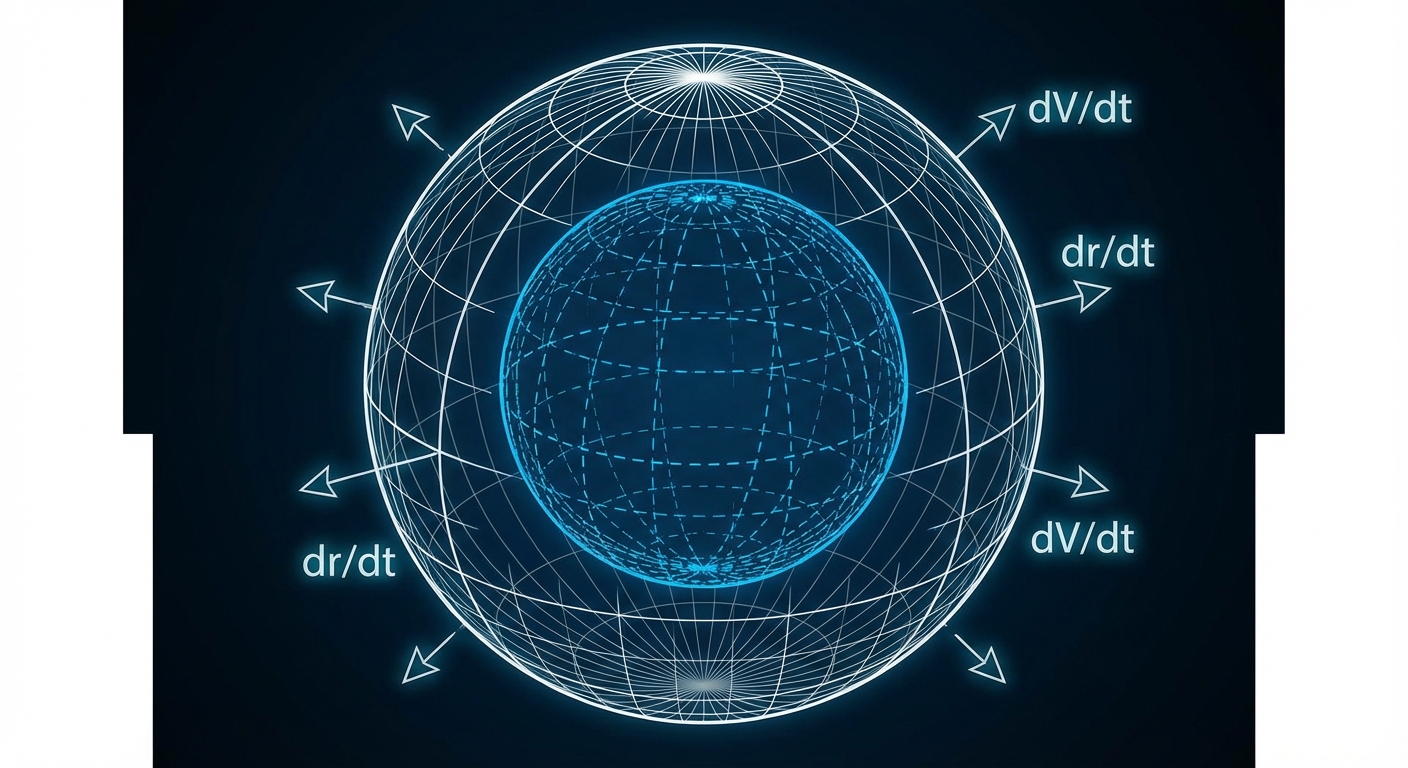
Common Notation Relationship: Note that the derivative of Volume with respect to radius often relates to Surface Area.
3. Similar Triangles (Conical Tanks)
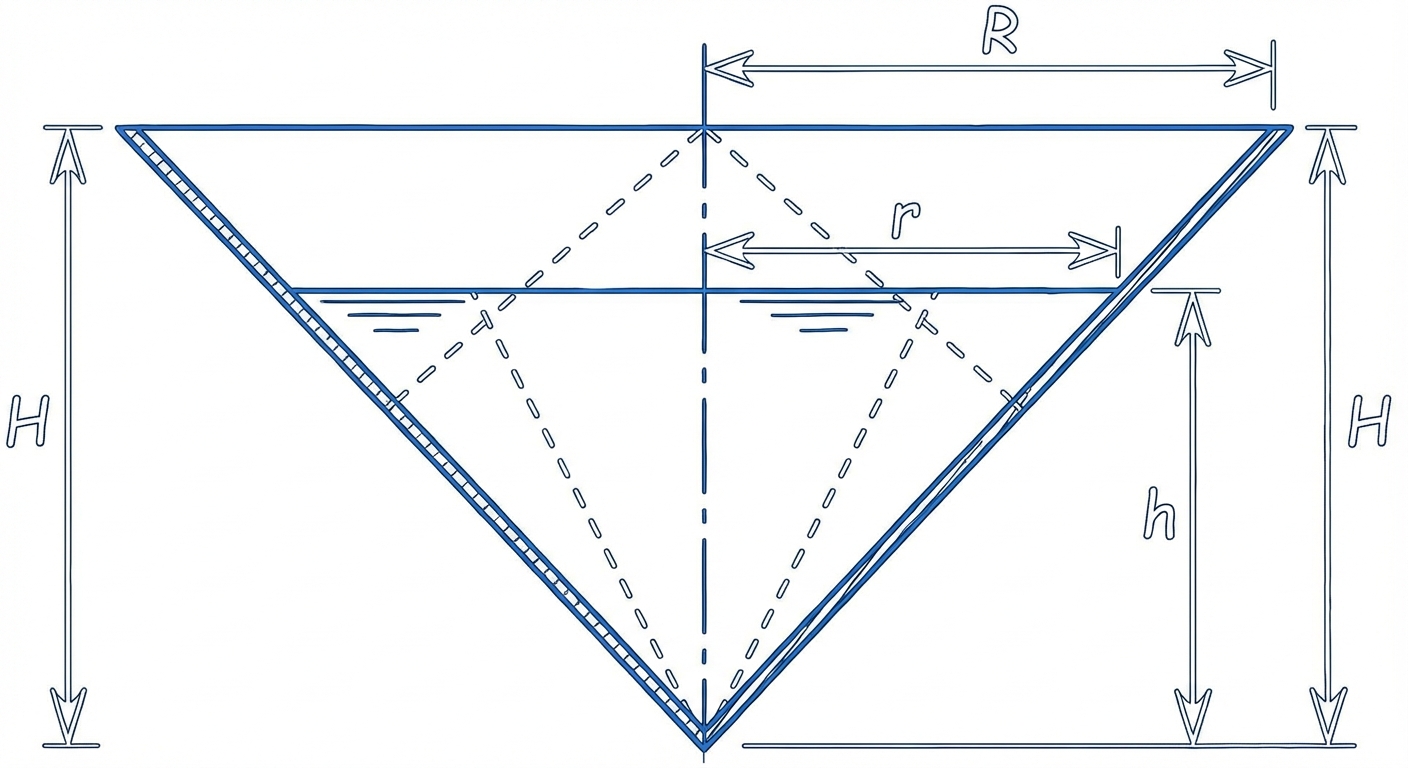
This is often the most difficult type for students. It typically involves a Conical Tank (vertex down) filling with or draining water.
The Challenge: The volume of a cone is $V = \frac{1}{3}\pi r^2 h$. This has two variables ($r$ and $h$). Differentiating this requires the Product Rule and creates a mess if you don't have rates for both $r$ and $h$.
The Fix: Use Similar Triangles to eliminate one variable before differentiating.
Example Setup:
A tank has height $H=10$ and radius $R=5$. Water fills it at $2 \text{ ft}^3/\text{min}$. Find $\frac{dh}{dt}$ when $h=4$.
- Similarity Ratio: The water's radius $r$ and height $h$ are always proportional to the tank's dimensions.
- Substitute: Replace $r$ in the Volume formula:
- Differentiate: Now we only have $V$ and $h$.
- Solve: Plug in $\frac{dV}{dt} = 2$ and $h=4$ to solve for $\frac{dh}{dt}$.
4. Trigonometric Rates (Rotating Cameras)
When a problem specifically asks about the change in an angle ($\theta$), use SOH CAH TOA.
- Advice: Try to use a trig function where the denominator is a constant (e.g., if adjacent side is constant distance, use $\tan(\theta) = \frac{y}{x_{const}}$), because differentiating $\tan(\theta)$ is easier than differentiating a quotient function.
- Remember Chain Rule: $\frac{d}{dt}[\tan(\theta)] = \sec^2(\theta) \cdot \frac{d\theta}{dt}$.
Common Mistakes & Pitfalls
"The Snapshot Error" (Freezing Time Too Early)
- Mistake: Plugging in $x=5$ before taking the derivative.
- Correction: If $x$ is changing per second, it is a variable. You must differentiate $x$ into $\frac{dx}{dt}$ first. Only substitute the specific value ($x=5$) into the resulting derivative equation.
Ignoring Negative Signs
- Mistake: Assuming all rates are positive.
- Correction: If a distance is shrinking, water is leaking out, or an angle is getting smaller, the rate MUST be negative (e.g., $\frac{dV}{dt} = -5$).
Linear Units vs. Volume Units
- Mistake: Confusing $\frac{dr}{dt}$ (cm/sec) with $\frac{dV}{dt}$ ($cm^3$/sec).
- Correction: Check your units. Power of 1 = length rate; Power of 2 = Area rate; Power of 3 = Volume rate.
Variable vs. Constant Confusion
- Mistake: Keeping the ladder length as variable $z$ in the derivative, or setting the water radius constant.
- Correction: Ask yourself: "Does this quantity physically change as time passes?" If NO, plug the number in immediately. If YES, it must be represented by a letter.