AP Biology Unit 5: Meiosis and Genetic Diversity
The Mechanics of Meiosis
Definitions & Core Concepts
Meiosis is a specialized type of cell division that reduces the number of chromosomes in the parent cell by half and produces four gamete cells. This process is required to produce egg and sperm cells for sexual reproduction.
To understand meiosis, you must master the following vocabulary:
- Gametes: Haploid reproductive cells (sperm and egg in animals) that carry one set of chromosomes ($n$).
- Somatic Cells: Diploid body cells that carry two sets of chromosomes ($2n$).
- Homologous Chromosomes: A pair of chromosomes (one from the mother, one from the father) that represent the same chromosome number. They carry genes for the same traits at the same loci, though the specific alleles may differ.
- Sister Chromatids: Identical copies of a chromosome attached at the centromere. These are formed during DNA replication (S phase) prior to cell division.
- Diploid ($2n$): A cell containing two full sets of chromosomes.
- Haploid ($n$): A cell containing only one single set of chromosomes.
Phases of Meiosis
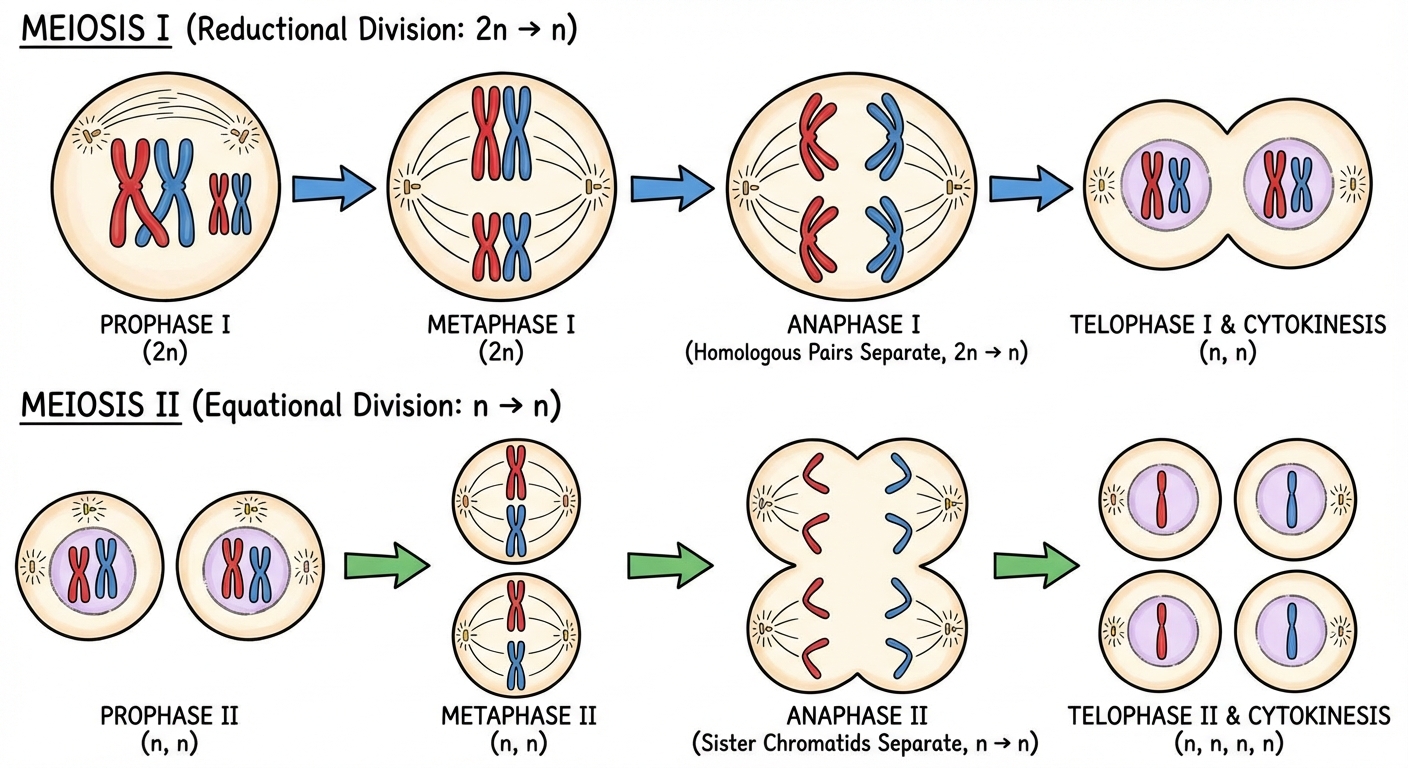
Meiosis involves one round of DNA replication followed by two consecutive rounds of nuclear division: Meiosis I and Meiosis II.
Interphase
Before meiosis begins, the cell undergoes Interphase (G1, S, G2). During the S Phase, DNA is implicated. Each chromosome now consists of two genetically identical sister chromatids.
Meiosis I: Permutations and Reduction
This is the Reductional Division. The goal is to separate homologous chromosomes, reducing the ploidy from diploid ($2n$) to haploid ($n$).
- Prophase I:
- Chromosomes condense.
- Synapsis occurs: Homologous chromosomes pair up generally to form a tetrad (structure containing 4 chromatids).
- Crossing Over occurs here (see Genetic Diversity section).
- The nuclear envelope breaks down.
- Metaphase I:
- Homologous pairs (tetrads) align at the metaphase plate.
- Crucial Distinction: Unlike mitosis, individual chromosomes do not line up; pairs do.
- Independent Assortment occurs here.
- Anaphase I:
- Homologous chromosomes separate and move toward opposite poles.
- Sister chromatids remain attached at the centromere.
- Telophase I & Cytokinesis:
- The cell divides into two daughter cells.
- Status Check: Each new cell is now haploid ($n$), but each chromosome still consists of two sister chromatids.
Meiosis II: Separation of Chromatids
This is the Equational Division. It functions mechanically like Mitosis but starts with haploid cells. The goal is to separate structural sister chromatids.
- Prophase II: Spindle apparatus forms; no DNA replication happens before this.
- Metaphase II: Individual chromosomes align at the metaphase plate.
- Anaphase II: Centromeres break; sister chromatids separate and are pulled to opposite poles.
- Telophase II & Cytokinesis: Nuclei reform, and chromosomes decondense.
- Final Result: Four genetically unique, haploid daughter cells.
Meiosis vs. Mitosis
Understanding the differences between these two processes is a frequent AP exam topic (Learning Objective IST-1.G).
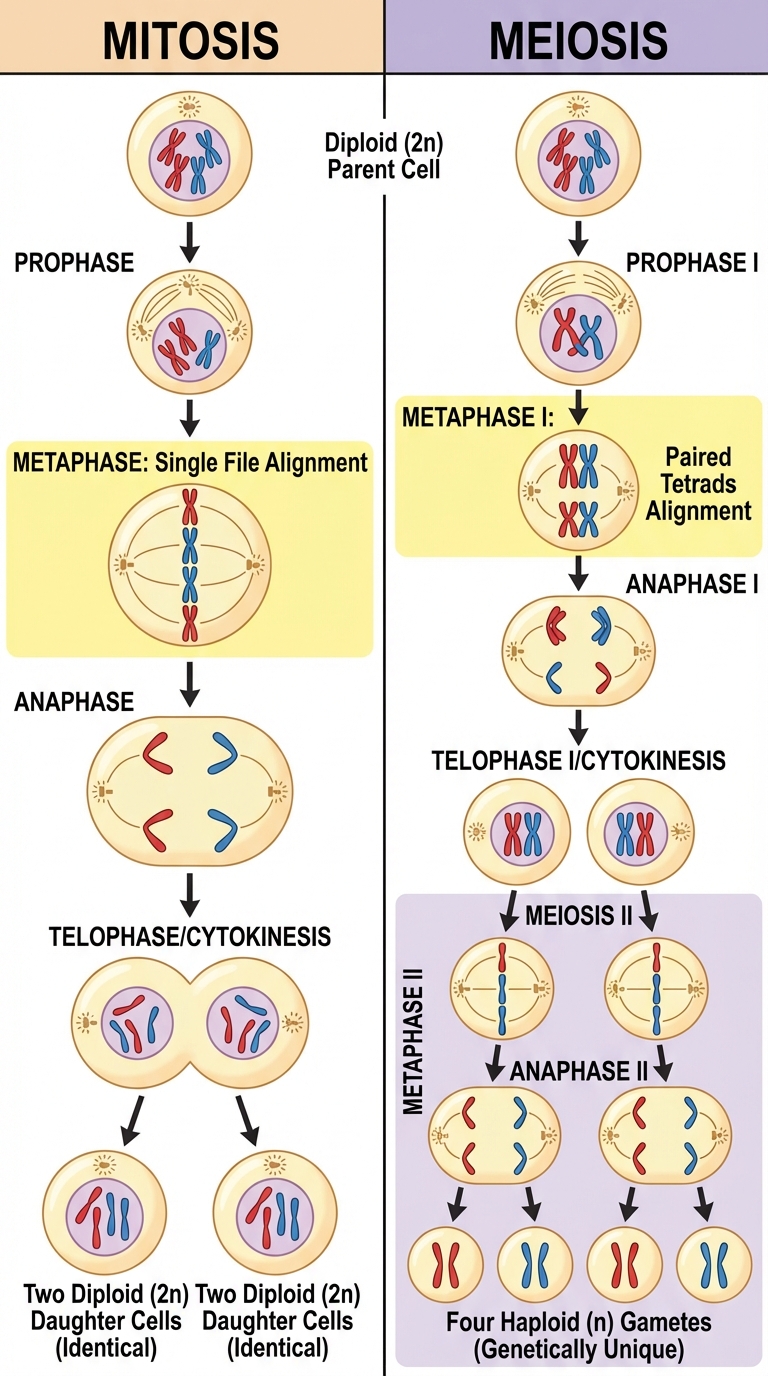
| Feature | Mitosis | Meiosis |
|---|---|---|
| Purpose | Growth, tissue repair, asexual reproduction | Sexual reproduction (gamete formation) |
| Rounds of Division | One | Two |
| Parent Cell | Diploid ($2n$) | Diploid ($2n$) |
| Daughter Cells | Two, genetically identical to parent | Four, genetically unique |
| Ploidy of Daughters | Diploid ($2n$) | Haploid ($n$) |
| Synapsis? | No | Yes (Prophase I) |
| Aligns at Metaphase | Individual Chromosomes | Homologous Pairs (Meta I), Individual (Meta II) |
| Separates in Anaphase | Sister Chromatids | Homologous Chromosomes (Ana I), Sister Chromatids (Ana II) |
Meiosis and Genetic Diversity
Genetic variation is the raw material for evolution. Meiosis introduces diversity through three primary mechanisms.
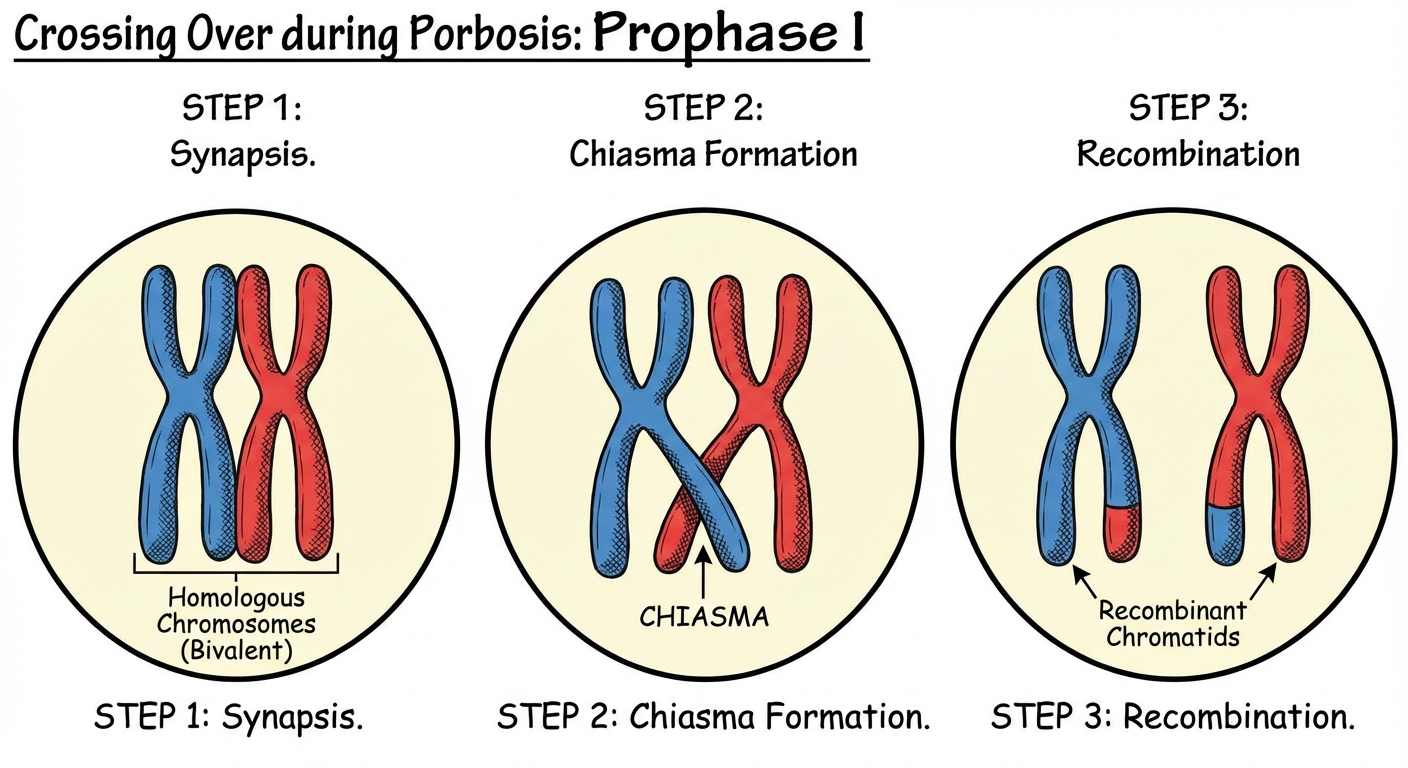
1. Crossing Over (Recombination)
Occurs during Prophase I.
- Process: Nonsister chromatids of a homologous pair exchange DNA segments at linkage points called chiasmata.
- Result: Creates recombinant chromosomes—chromosomes that carry DNA from two different parents on the same physical strand.
- This breaks old linkage groups and creates new allele combinations.
2. Independent Assortment
Occurs during Metaphase I.
- Process: When homologous pairs line up at the metaphase plate, the orientation of the maternal and paternal chromosomes is random. Does the maternal copy go left or right? It's a coin flip for every pair.
- Formula: The number of possible combinations is $2^n$, where $n$ is the haploid number.
- For humans ($n=23$):
- Note: This calculation does not strictly account for the additional variation added by crossing over.
3. Random Fertilization
While not part of meiosis itself, this is the inevitable conclusion of the process. Any sperm can fuse with any egg.
- Calculation: (Sperm possibilities) $\times$ (Egg possibilities).
- For humans: $8.4 \text{ million} \times 8.4 \text{ million} \approx 70 \text{ trillion}$ unique diploid combinations.
Mnemonics & Memory Aids
- PMAT: Prophase, Metaphase, Anaphase, Telophase.
- Use PMAT x 2 for Meiosis.
- "Pro" phase = Professional wrestlers (Homologous pairs) get together (synapsis) and wrestle (cross over).
- Metaphase = Middle. (Chromosomes meet in the middle).
- Anaphase = Apart. (Chromosomes are pulled apart).
Common Mistakes & Pitfalls
- Phase Identification: Students often confuse Metaphase I and Metaphase II.
- Correction: Look at the equator. If chromosomes are in pairs (tetrads), it is Metaphase I. If they are single file, it is Metaphase II (or Mitosis).
- Ploidy Confusion: A common error is thinking that cells are diploid at the end of Meiosis I because they still have "two sides" (sister chromatids).
- Correction: After Meiosis I, the homologous pairs are separated. Even though the chromosomes are double-stranded (sister chromatids attached), there is only one of each chromosome type. The cell is haploid.
- Sister Chromatids vs. Homologous Chromosomes:
- Correction: Sister chromatids are identical copies (created in S phase). Homologous chromosomes are similar (carrying same genes) but not identical (maternal vs. paternal origin).
- Interphase II:
- Correction: There is usually no Interphase II (or a very short interkinesis), and most importantly, there is NO DNA replication between Meiosis I and II.