AP African American Studies: Unit 1 - Origins of the African Diaspora
Topic 1.1: The Discipline of African American Studies
Definition and Scope
African American Studies is an interdisciplinary field that examines the history, culture, politics, and economics of people of African descent in the United States and the broader African diaspora.
Key Characteristics
- Interdisciplinary: It combines methods from history, literature, sociology, political science, and the arts.
- Community-Centered: It often bridges the gap between scholarly inquiry and community empowerment.
- Global Perspective: It challenges the notion that Black history begins with slavery in the Americas. Instead, it frames the experience within the long history of the African continent.
Evolution of perceptions of Africa
The field works to dismantle historical biases:
- Eurocentric Myths: Previously, Western scholars often depicted Africa as a "primitive" continent with no written history or civilization (e.g., the "Dark Continent" trophy).
- African American Studies Reality: It validates Africa as the birthplace of humanity and home to complex, globally connected empires long before European colonization.
Origins of Humanity
Modern Paleoanthropology confirms Africa as the cradle of human existence.
- Hominid Evolution: Early hominids appeared in the African savanna 5-10 million years ago.
- Homo Sapiens: Modern humans emerged in Africa approximately 200,000–300,000 years ago.
- Mitochondrial Eve: Genetic evidence suggests that all living humans descend from a woman who lived in Africa roughly 200,000 years ago.
The Black Campus Movement
The formalization of African American Studies as an academic discipline arose from the Black Campus Movement (1965–1972).
- Context: Following the Civil Rights Movement and during the Black Power Movement, a surge of Black students entered predominantly white universities.
- Demands: Students organized protests at over 1,000 colleges demanding culturally relevant curricula, more Black faculty, and increased support for Black students.
- Outcome: The establishment of the first Black Studies departments (San Francisco State University established the first one in 1968).
Topic 1.2: The Physical Geography of Africa
A Continent of Variety
Africa is the second-largest continent, characterized by extreme geographic diversity that influenced trade, settlement patterns, and cultural development.
Five Early Climate Zones
Understanding these zones is crucial for explaining how societies developed.
| Zone | Characteristics | Economic Impact |
|---|---|---|
| Mediterranean | Northern tip/Southern tip. Mild, fertile. | Supported intense agriculture and contact with Europe/Middle East. |
| Desert | Sahara (North) and Kalahari (South). Dry, extreme heat. | The Sahara acted as a barrier but was eventually crossed by trade routes using camels. |
| Sahel | Semiarid transition zone south of the Sahara. | "Shore of the desert." Center of livestock trading and the rise of great empires (Mali, Songhai). |
| Savanna | Grasslands with scattered trees. | Covers much of central/southern Africa. Supported grain cultivation and large animal herds. |
| Rainforest | Humid, dense vegetation in West/Central Africa. | Supported root crops (yams) and forestry but limited the spread of cattle (due to the tsetse fly). |
Waterways and Connectivity
- Rivers: The Nile, Niger, Congo, Zambezi, and Orange rivers served as highways for the movement of goods and people.
- Oceans: The proximity to the Red Sea and Indian Ocean facilitated early global trade with Arabia and Asia, long before the Atlantic slave trade.
Topic 1.3: Migration and Linguistic Diversity
The Bantu Expansion
Between 1500 BCE and 500 CE, a massive migration of Bantu-speaking peoples occurred, moving from the border of modern-day Nigeria and Cameroon throughout Central, Eastern, and Southern Africa.
Drivers of Migration
- Population Growth: Caused by the development of agriculture (yams, oil palms).
- Iron Metallurgy: Iron tools allowed for more efficient clearing of forests for farming.
Impact of the Expansion
- Linguistic Dominance: Today, hundreds of languages (e.g., Swahili, Zulu, Xhosa, Kikongo) belong to the Bantu language family.
- Cultural Diffusion: The migration spread iron-smelting technology, agricultural techniques, and pottery styles across the continent.
- Ancestry: A significant portion of the genetic ancestry of African Americans derives from these West and Central African Bantu-speaking communities.
Topic 1.4: Ancient Societies (Northeast & West Africa)
Egypt and Nubia (The Nile Valley)
Situated along the Nile River, these two civilizations had a complex relationship defined by both trade and warfare.
- Ancient Egypt: Known for hieroglyphs, pharaohs, and monumental architecture. A multicultural society that linked Africa to the Mediterranean.
- Nubia (Kush): Located south of Egypt (modern Sudan). Rich in gold.
- The 25th Dynasty: Around 750 BCE, Kushite kings (the "Black Pharaohs," such as Piankhi) conquered Egypt and ruled it for a century.
- Meroë: A later Nubian capital famous for its iron industry and distinctive alphabetic script.
The Aksumite Empire
Located in present-day Ethiopia and Eritrea (East Africa).
- Trade Hub: Dominated Red Sea trade, connecting the Roman Empire to India.
- Christianity: Under King Ezana (4th Century CE), Aksum became one of the first states in the world to adopt Christianity as its official religion.
- Legacy: The Ge'ez script is still used in the Ethiopian Orthodox Church.
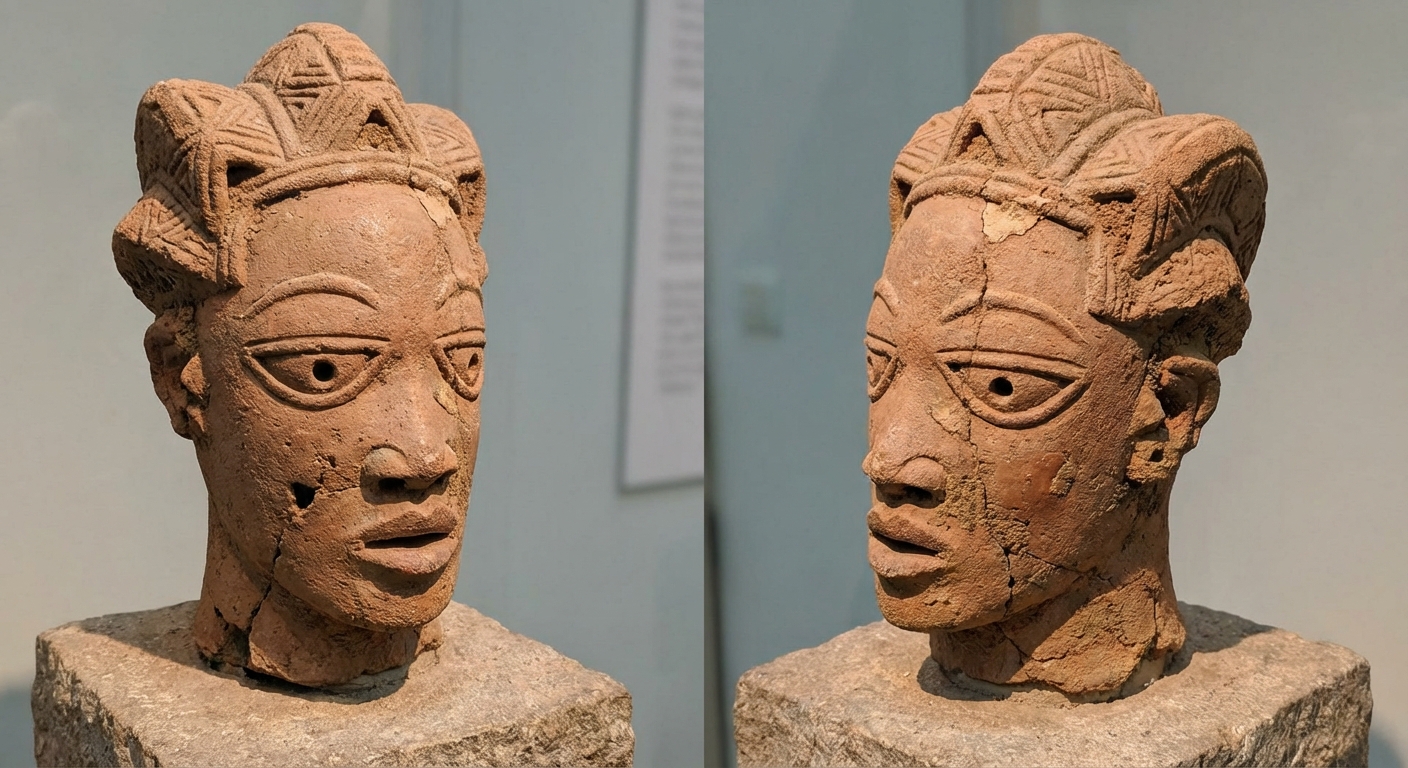
The Nok Society
Located in present-day Nigeria (West Africa), flourishing around 1000 BCE to 300 CE.
- Iron Technology: One of the earliest West African societies to smelt iron.
- Terracotta Sculpture: Famous for distinctive clay figures with elaborate hairstyles and jewelry, serving as evidence of a complex, stratified society.
Topic 1.5: The Sudanic Empires (West Africa)
Three major empires rose in the Sahel region, capitalizing on the trans-Saharan trade routes. They controlled the flow of Gold (from the south) and Salt (from the north).
1. Empire of Ghana (c. 300–1200 CE)
- "Land of Gold": Not geographically located in modern Ghana, but in modern Mali/Mauritania.
- wealth: Derived from taxing the gold-salt trade.
- Iron: Mastery of iron weapons allowed the Soninke people to dominate neighbors.
2. Empire of Mali (c. 1235–1670 CE)
founded by Sundiata Keita (the "Lion King"), who united the Mandinka people.
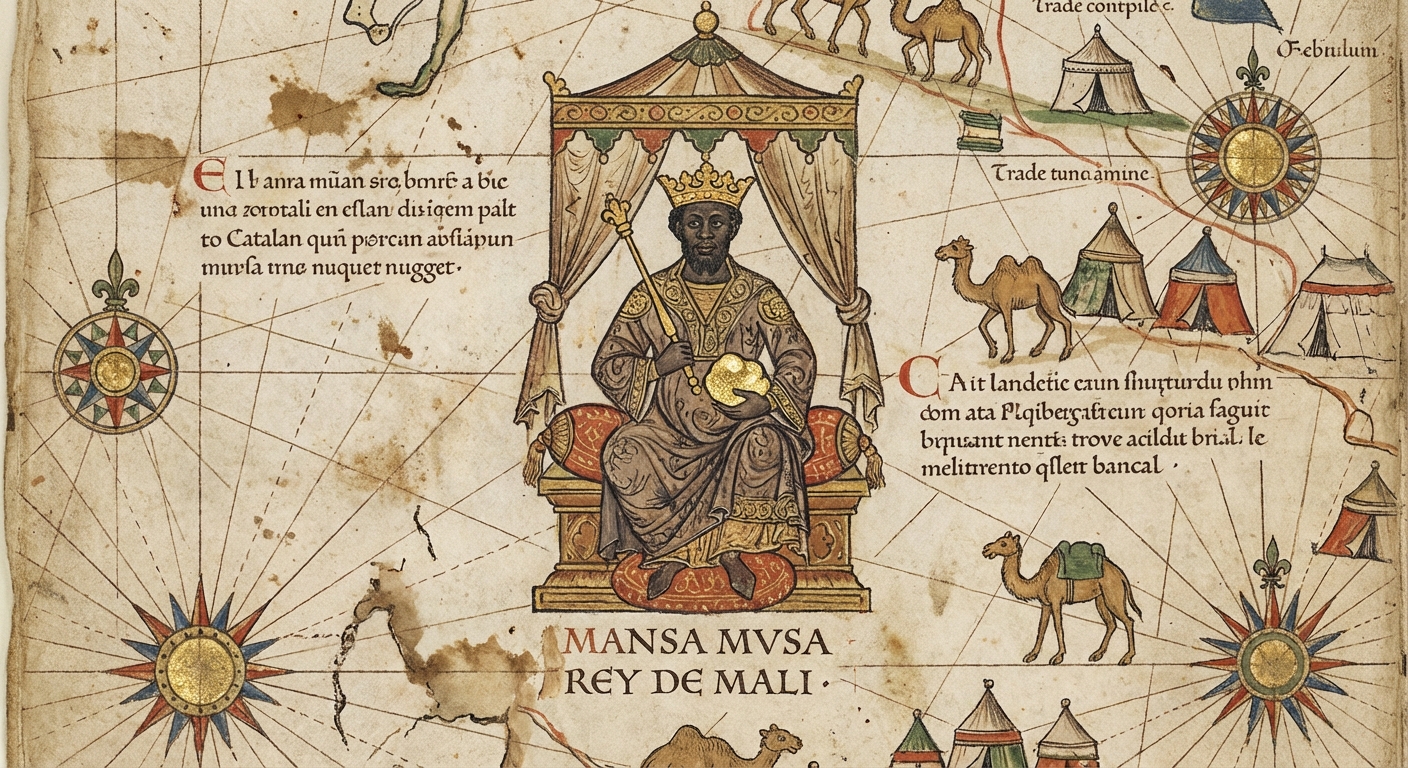
Mansa Musa (r. 1312–1337)
- Considered the wealthiest individual in history.
- The 1324 Hajj: His pilgrimage to Mecca displayed Mali's wealth to the world (distributing so much gold he devalued the metal in Cairo for a decade).
- The Catalan Atlas (1375): A European map featuring Mansa Musa holding a gold nugget, proving that Mali was a known global economic power.
3. Empire of Songhai (c. 1464–1591)
- The largest of the three empires.
- Sunni Ali: Expanded the empire using a powerful navy on the Niger River.
- Askia Muhammad: Strengthened Islam and administration.
- Decline: Fell to Moroccan invaders armed with muskets in 1591.
The Forest Empires
Further south in the rainforests (modern Nigeria/Ghana/Benin):
- Benin: Famous for bronze casting and the Oba (King).
- Yoruba (e.g., Oyo, Ife): Urbanized societies with spiritual centers.
- Asante (Akan): Rose to power later via gold and slave trading.
Topic 1.6: Centers of Learning & Oral Tradition
Timbuktu
A major city in the Mali and Songhai empires, Timbuktu was a global hub of Islamic scholarship.
- University of Sankore: Housed thousands of manuscripts on astronomy, law, mathematics, and theology.
- Manuscript Culture: Disproves the myth that pre-colonial Africa lacked written traditions.
Oral Tradition: The Griot
While writing existed, oral history was the primary legal and historical record in many West African societies.
- Griots (Djelis): Hereditary historians, musicians, and advisors to kings. They were "living libraries" who preserved genealogies and laws.
- Role of Women: Women also served as griottes, often singing at ceremonies and preserving domestic histories.
Topic 1.7: Religion and Syncretism
Indigenous Spiritual Practices
Before Abrahamic faiths, African societies practiced diverse religions with common elements:
- Supreme Creator: Belief in a distant, all-powerful creator.
- Lesser Deities/Spirits: Interaction with spirits associated with nature (animism) or specific domains (e.g., Shango for thunder).
- Ancestor Veneration: The belief that ancestors act as intermediaries between the living and the divine.
The Spread of Islam & Christianity
- Islam: Arrived via trans-Saharan trade (8th century). Adopted by elites (merchants/kings) in the Sahel (Mali/Songhai) to facilitate trade, while rural peasants often retained indigenous beliefs.
- Christianity: Established early in Northeast Africa (Egypt/Aksum) and later in the Kongo (via Portuguese).
Syncretism
The blending of different religious beliefs. When Africans adopted Islam or Christianity, they often retained indigenous practices (e.g., using amulets, ancestor veneration alongside prayer).
- Relevance to Diaspora: This syncretism persisted in the Americas (e.g., Vodou in Haiti, Santería in Cuba), where Catholic saints were identified with African deities (Orishas).
Topic 1.8: Southern and East Africa
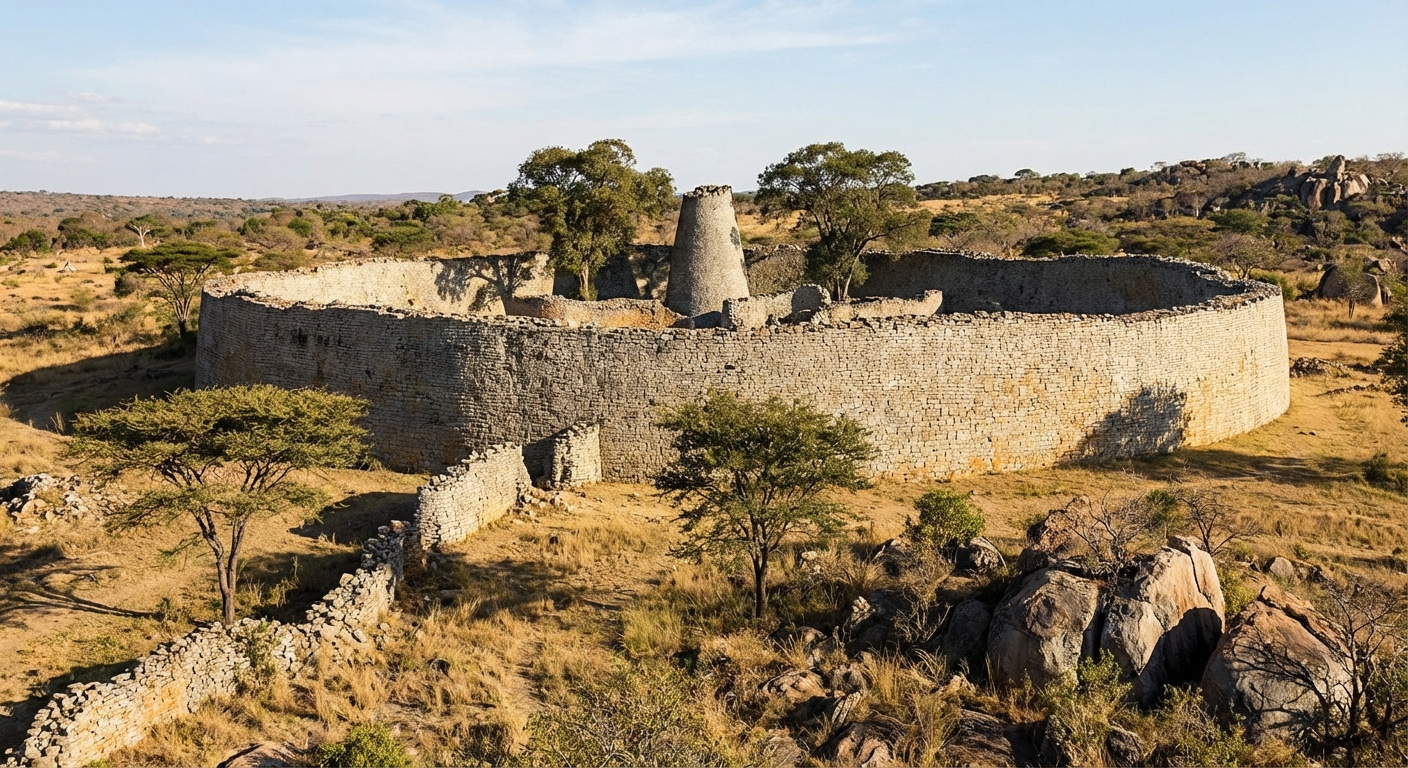
Great Zimbabwe
A powerful kingdom in Southern Africa (11th–15th century) built by the Shona people.
- Stone Architecture: Famous for the Great Enclosure, a massive mortarless stone wall structure.
- Economy: Wealth based on cattle herding and trading gold/ivory to the Indian Ocean coast.
The Swahili Coast
A string of city-states (e.g., Kilwa, Mogadishu, Zanzibar) along the East African coast.
- Culture: A unique blend of Bantu African roots and Arab/Persian influences.
- Language: Swahili developed as a lingua franca for trade (Bantu grammar + Arabic loanwords).
- Trade: Connected Africa to China, India, and Persia via the Indian Ocean monsoon winds.
Topic 1.9: West Central Africa (The Kingdom of Kongo)
The Kongo Kingdom
Located near the Congo River, this was a highly centralized state when the Portuguese arrived in the 1480s.
Conversion and Betrayal
- Manikongo Nzinga a Nkuwu: Voluntarily converted to Catholicism in 1491 to strengthen diplomatic ties with Portugal.
- Afonso I (King Nzinga Mbemba): A devout Christian king who made Catholicism the state religion. He learned Portuguese and envisioned a partnership of equals.
- The Breakdown: Portugal was interested in slaves, not partnership. Portuguese merchants ignored Kongo laws, kidnapping citizens and even noble family members.
- Afonso's Letters: He wrote desperate letters to the King of Portugal protesting the depopulation of his country by slave traders, but these were ignored.
Topic 1.10: Kinship, Gender, and Leadership
Kinship Structures
- Matrilineal Societies: In many Central/West African societies (e.g., the Akan), descent and inheritance were traced through the mother’s line. A man's heir was often his sister's son, not his own.
- Gender Roles: Women held significant roles as market traders, agriculturalists, and spiritual leaders.
Female Leadership: Case Studies
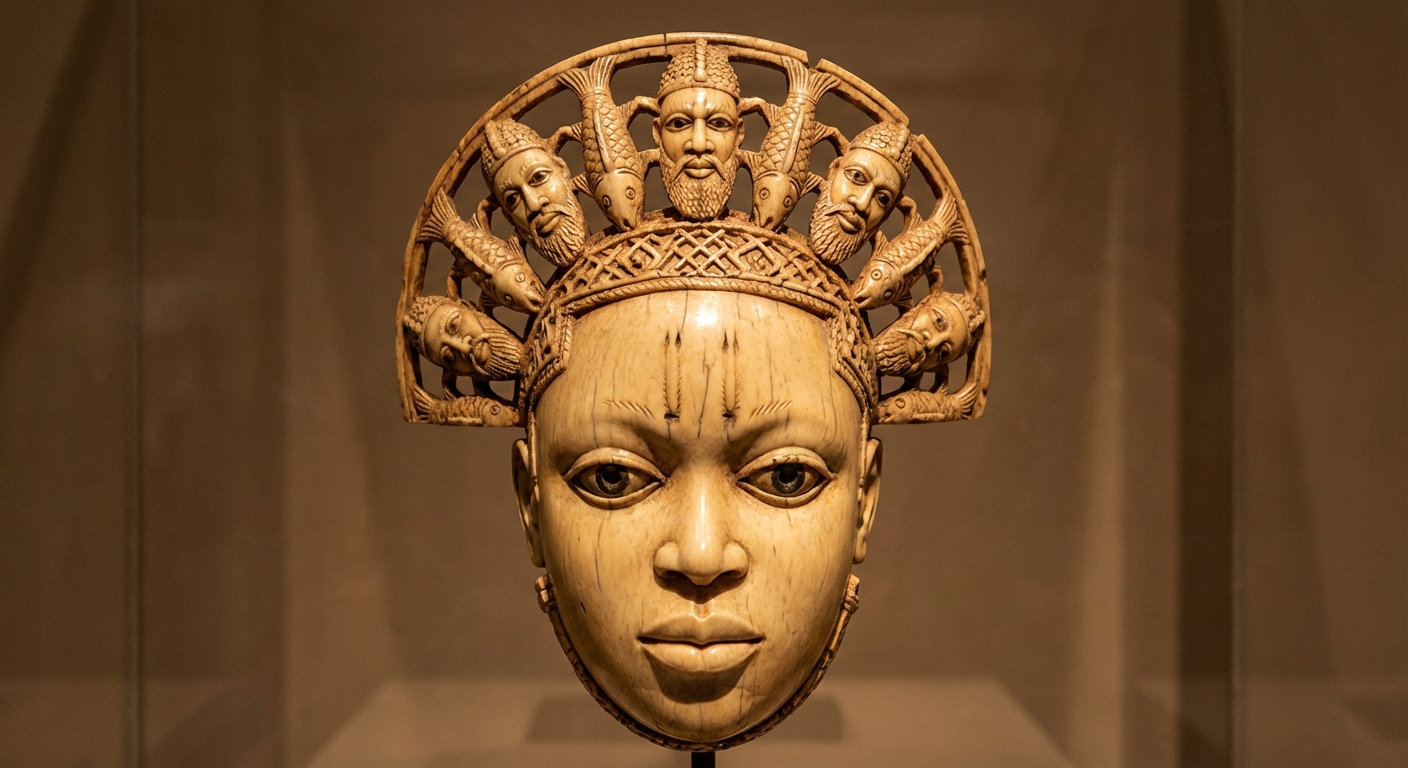
1. Queen Idia of Benin (16th Century)
- Role: The first Iyoba (Queen Mother) of the Benin Kingdom.
- Significance: A skilled politician and warrior who helped her son secure the throne. She is immortalized in the famous Benin Ivory Mask, a symbol of Pan-Africanism.
2. Queen Njinga (17th Century)
- Region: Ndongo and Matamba (modern Angola).
- Resistance: She fought a decades-long diplomatic and guerilla war against the Portuguese.
- Tactics: She famously refused to sit on the floor during negotiations with the Portuguese governor, using a servant as a human chair to assert her equality.
Topic 1.11: Global Africans (Pre-1619)
Before the English settled Jamestown, Africans were already present in Europe and the Atlantic world.
Africans in Europe
- By the 15th and 16th centuries, cities like Lisbon and Seville had significant Black populations (enslaved and free).
- Roles: They worked as splashing sailors, interpreters, knights, and royal servants.
- Chafariz d'El-Rei: A painting depicting 16th-century Lisbon showing a diverse Black population appearing in various social classes.
Crucibles of Slavery: The Atlantic Islands
Before reaching the Americas, the Portuguese tested the plantation model on islands off the African coast: Cabo Verde and São Tomé.
- The Plantation Complex: Here, Europeans first combined African slave labor, sugar cultivation, and a tropical environment. This brutal model was later exported to Brazil and the Caribbean.
Common Mistakes & Misconceptions
- Myth: "Africa was isolated until Europeans arrived."
- Fact: Africa was connected to global trade networks (Indian Ocean, Mediterrnean) via the Swahili Coast and Trans-Saharan routes for millennia.
- Myth: "Slavery in Africa was the same as Chatte Slavery in the Americas."
- Fact: While slavery existed in Africa, it was often distinct. Enslaved people in African societies often had rights, could marry, could inherit property, and were not enslaved for race/perpetuity. American Chattel Slavery reduced humans to permanent property without rights.
- Myth: "Mansa Musa is the only relevant West African leader."
- Correction: While Musa is famous for wealth, leaders like Sunni Ali (military expansion) and Askia Muhammad (administration/education) were equally vital to state-building.
- Mistake: Confusing Matrilineal with Matriarchal.
- Correction: Matrilineal means descent is traced through mothers. Matriarchal means women rule the society. Most African societies were matrilineal but still patriarchal (men held political power, though women had significant influence).