Impacts of Global Interaction (c. 1200 – c. 1450)
The Transformative Power of Trade
While the movement of goods is often the headline of history, the Networks of Exchange (Silk Roads, Indian Ocean, and Trans-Saharan routes) carried much more than silk and spices. Between 1200 and 1450, these networks acted as arteries for the circulation of religion, technology, crops, and disease, fundamentally altering the genetic and cultural makeup of the Afro-Eurasian world.
Cultural Consequences of Connectivity
When merchants traveled, they brought their gods and their gadgets with them. The primary AP World History concept here is Diffusion—the spread of cultural elements from one society to another—and Syncretism, the blending of those elements into something new.
1. Diffusion of Religion
Religious belief systems often served as a unifying force that facilitated trade. Merchandise typically flowed from the edges of empires, but religion often flowed from the centers.
- Buddhism in East Asia: Spread from India to China via the Silk Roads. It evolved rapidly:
- Chan (Zen) Buddhism: A syncretic blend of Buddhist doctrines with Daoist traditions in China.
- Neo-Confucianism: Emerged in the Song Dynasty; a rationalist ethical philosophy that incorporated Buddhist and Daoist metaphysics into traditional Confucianism. It heavily influenced Japan and Korea.
- Hinduism and Buddhism in Southeast Asia: The Srivijaya Empire (Sumatra) and the Majapahit Kingdom (Java) adopted these religions to solidify political power and trade relations with South Asia. The Khmer Empire constructed Angkor Wat, originally a Hindu temple that later transformed into a Buddhist center.
- Islam: The most rapidly expanding religion of this era.
- Africa: Spread by merchants across the Sahara (to Mali/Songhai) and the Indian Ocean (to the Swahili Coast). Timbuktu became a major center of Islamic learning.
- South Asia: Sufi missionaries played a crucial role in converting lower-caste Hindus by emphasizing personal devotion rather than rigid rituals.
2. Syncretism: Language and Culture
When cultures collide, they often create hybrids.
- Swahili Language: A prime example of syncretism. As Arab merchants settled on the East African coast, their Arabic vocabulary blended with the local Bantu grammatical structures to create Swahili.
- Urdu: Developed in South Asia, blending the grammatical base of Hindi with vocabulary from Arabic and Persian.
3. Science and Technology Transfer
New technologies reduced the "cost" of distance, making the world feel smaller.
| Technology | Origin | Impact |
|---|---|---|
| Paper Making | China | Reached Europe via the Abbasids; increased literacy and record-keeping. |
| Gunpowder | China | Spread via the Mongols; revolutionized warfare (eventually leading to the "Gunpowder Empires"). |
| Magnetic Compass | China | Allowed for safer deep-sea navigation; crucial for Indian Ocean trade. |
| Lateen Sail | Arab/Malay | Triangular sail allowed ships to tack against the wind. |
4. The Era of the Traveler
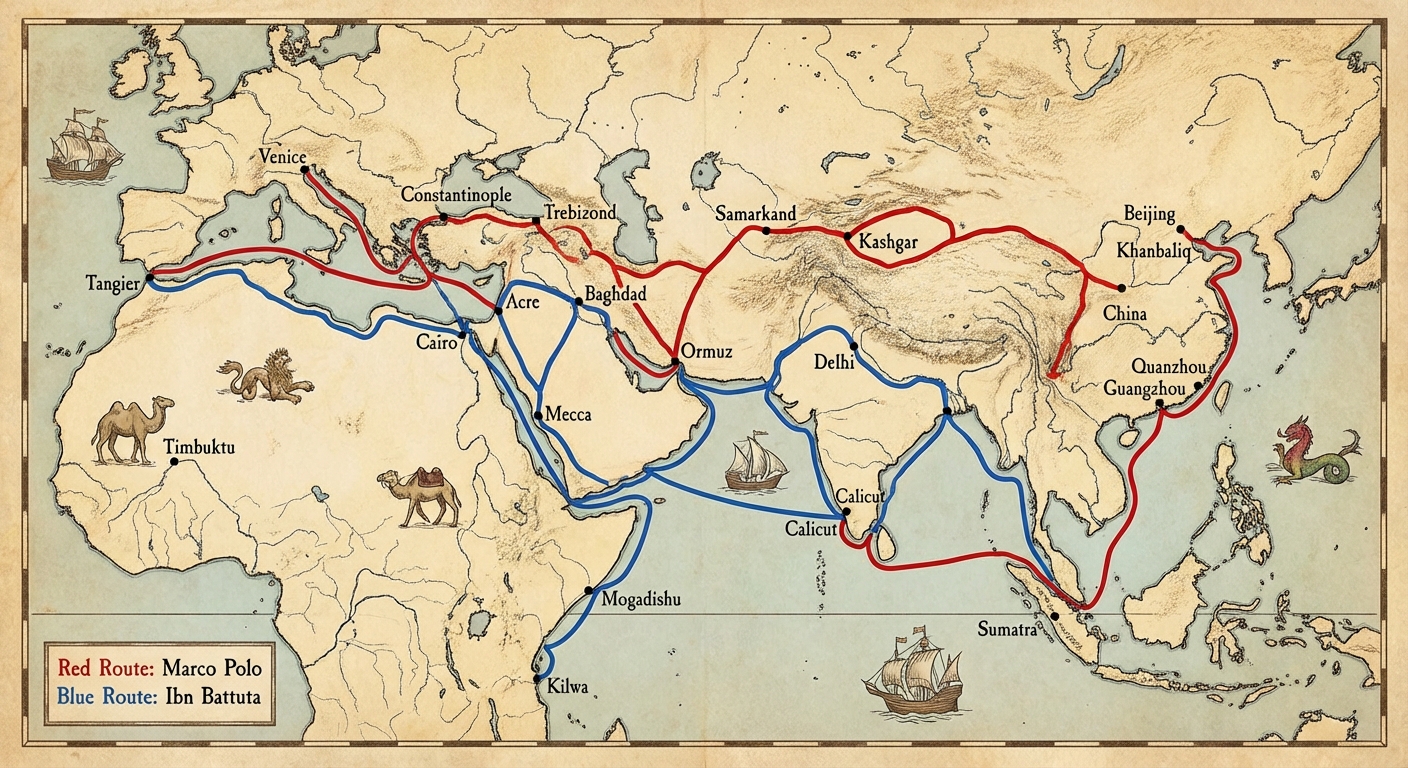
As routes became safer (thanks largely to the Pax Mongolica), people began to travel not just for profit, but for knowledge and pilgrimage. Their journals give historians vital primary sources.
- Marco Polo (Late 13th C.): An Italian merchant who served Kublai Khan in China. His writings introduced Europe to the wealth of East Asia, sparking intense European desire for Asian goods.
- Ibn Battuta (14th C.): A Moroccan Muslim scholar. He traveled over 75,000 miles through Dar al-Islam (from Spain to China to Mali). His point of view was strictly that of a devout Muslim, often critiquing societies that practiced Islam differently than he was used to.
- Margery Kempe: An English mystic. Her autobiography provides unique insight into the life of a middle-class medieval woman and the role of pilgrimage in Christianity.
Environmental Consequences of Connectivity
The environment shaped trade (e.g., monsoon winds), but trade also shaped the environment through the diffusion of crops and pathogens.
agricultural Exchange
New crops led to population spikes and changes in land use. We can conceptualize this relationship as:
- Champa Rice: Introduced to China from Vietnam. It was drought-resistant and quick-ripening, allowing for two harvests per season. This fueled a massive population boom and urbanization in Song China.
- Bananas: Indonesian seafarers introduced bananas to Sub-Saharan Africa. This nutrient-rich crop grew in areas where yams (the traditional staple) could not, enabling the Bantu-speaking peoples to migrate into heavily forested regions.
- Sugar, Cotton, and Citrus: Spread by the Caliphates through the Mediterranean. The European demand for sugar, ignited during the Crusades and trade interaction, would eventually drive the demand for slave labor in the Americas (in the next era).
Disease: The Black Death
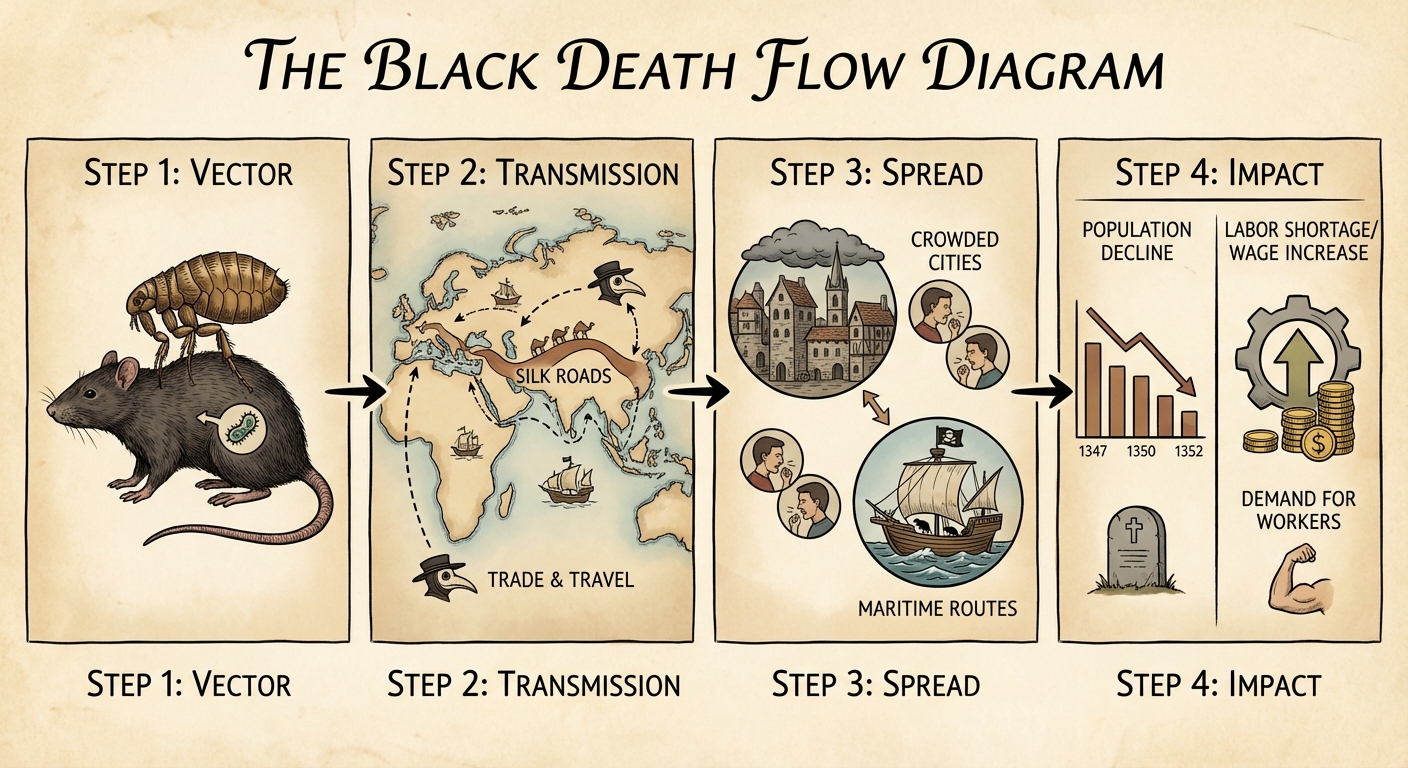
Disease was the dark shadow of the Silk Roads. The same stability that allowed merchants to travel safely allowed the bubonic plague (Yersinia pestis) to travel rapidly.
- Vector: Fleas on rats, carried in saddlebags and ship cargo.
- Transmission Route: Originated in Southwest China $\rightarrow$ Spread across the Mongol Empire $\rightarrow$ Reached the Black Sea (Kaffa) $\rightarrow$ Entered Europe via Italian merchant ships (1347).
- Consequences:
- Demographic: Killed 30-60% of Europe’s population; similar devastation in China and the Islamic world.
- Economic: Severe labor shortages led to a demand for higher wages.
- Social: In Europe, this contributed to the decline of Feudalism/Serfdom, as peasants gained bargaining power.
Comparison of Economic Exchange
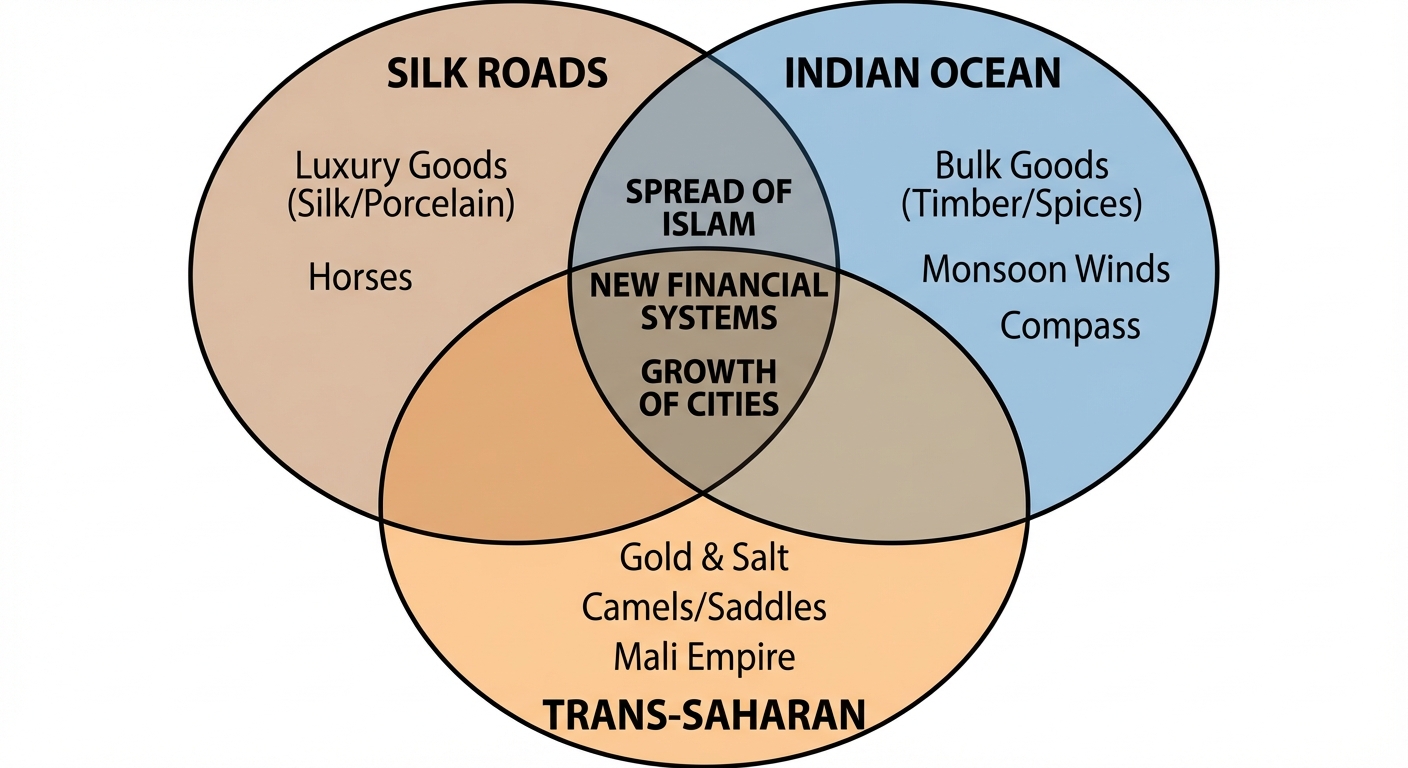
Comparing the three major networks (Silk, Sea, Sand) is a frequent exam task. You must be able to identify how they were similar and how they were different.
Similarities
- Origins: All expanded due to two factors: the consolidation of large empires (Mongols, Caliphates, Mali) providing safety, and innovations in technology.
- Function: All facilitated not just economic exchange, but cultural and biological exchange.
- Urbanization: All three networks birthed powerful trading cities that acted as nodes of exchange (e.g., Chang'an, Calicut, Timbuktu, Hangzhou).
- Commercial Financial Instruments: Merchants needed to carry value without carrying heavy coins.
- Bills of Exchange: Early checks.
- Banking Houses: Locations to exchange currency and store wealth.
- Paper Money: First popularized in China (Flying Cash).
Differences
| Feature | Silk Roads | Indian Ocean | Trans-Saharan |
|---|---|---|---|
| Primary Goods | Luxury Goods: Silk, porcelain, gunpowder, horses. (High value, low weight) | Bulk & Luxury: Spices, cotton, pepper, timber, sugar, ivory. (Ships can carry heavy loads) | Strategic Goods: Gold, salt, slaves, ivory. |
| Transportation | Horses, Camels (Caravans). | Dhows and Junks (Merchant ships). | Camel Caravans (using the camel saddle). |
| Primary Religion | Buddhism, Neo-Confucianism, Islam. | Islam, Hinduism, Buddhism. | Islam. |
| Geography | Arid steppes and deserts (Central Asia). | Maritime (Monsoon winds are key). | Desert (Sahara). |
Common Mistakes & Pitfalls
- Confusing Ibn Battuta with Mansa Musa:
- Correction: Mansa Musa was the King of Mali who made the famous pilgrimage (Hajj) showing off his gold. Ibn Battuta was the scholar who wrote about his travels visiting places like Mali later. They are different people.
- "The Silk Road" wasn't a road:
- Correction: Students often envision a paved highway. It was a shifting network of dirt trails and caravan tracks, not a single static road.
- Overlooking the Mongols in Disease:
- Correction: Students remember the rats, but forget the human element. The Pax Mongolica (Mongol Peace) made the trade routes so efficient that the plague traveled faster than ever before. Connectivity has a downside.
- Generalizing Goods:
- Correction: Do not say "They traded stuff." You must be specific. Silk Roads = Luxury (Silk). Indian Ocean = Bulk (Timber/Grain). Sand Roads = Gold/Salt.