Mechanisms of Biodiversity Decline and Strategies for Protection
Exotic and Invasive Species
Defining the Threat
Not all species moved by humans are harmful. To understand biodiversity loss, you must distinguish between introduced species and true invaders.
- Native Species: Species that live in their historical range, typically where they have evolved relevant adaptations.
- Exotic (Alien/Non-native) Species: Species living outside their historical range. Many are harmless (e.g., potatoes in Europe, honeybees in North America).
- Invasive Species: A non-native species that spreads rapidly and causes harm to the ecosystem, economy, or human health.
The Success of Invaders
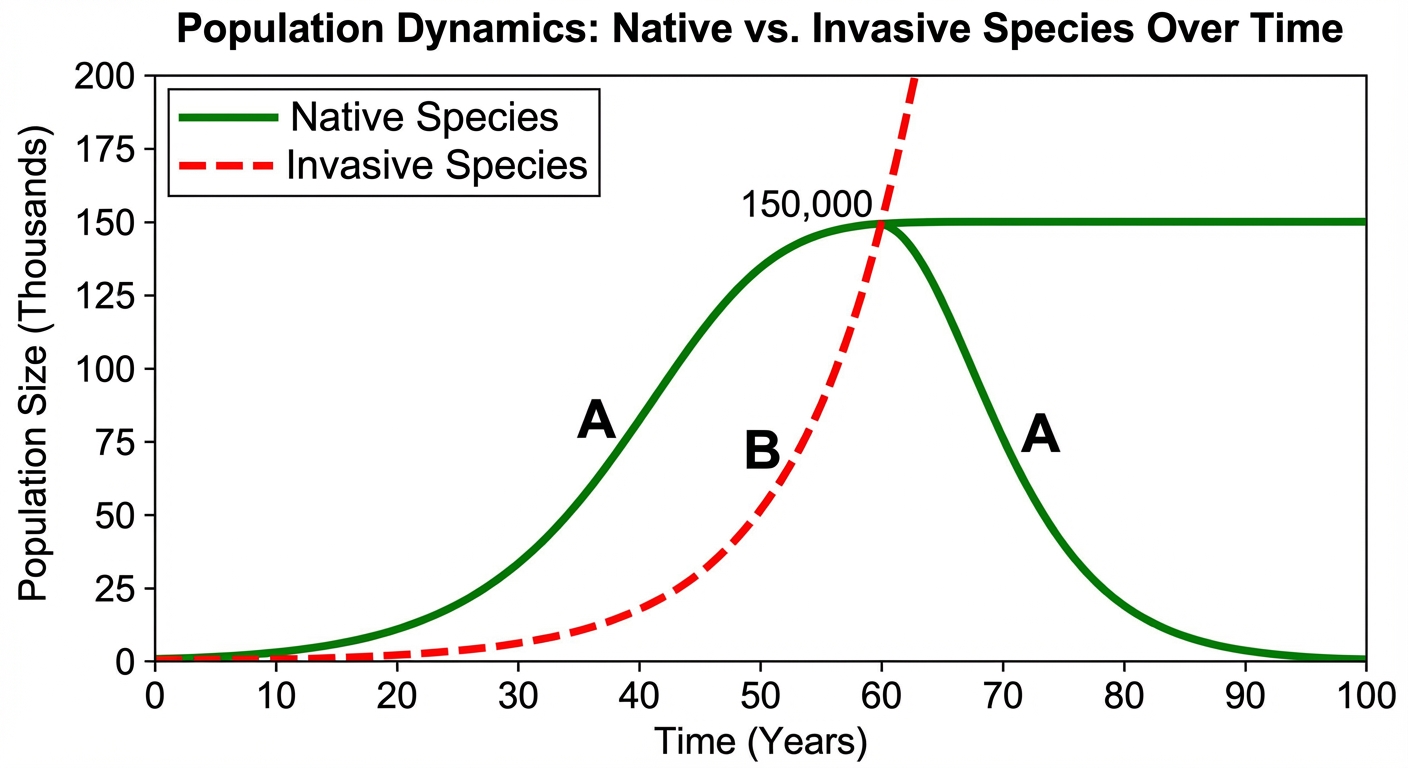
Why do some species take over while others fail? Invasive species generally possess r-selected traits and are generalists. They thrive because they leave their natural predators, diseases, and competitors behind in their native range.
Common Characteristics of Invasive Species:
- High Biotic Potential: Rapid reproduction and high number of offspring ($r$-strategists).
- Fast Maturation: Reach reproductive age quickly.
- Generalist Niche: Can eat a wide variety of foods and tolerate diverse environmental conditions.
- High Dispersal Rate: Seeds or larvae spread easily by wind, water, or animals.
Vectors of Invasion
Invasive species do not move themselves across oceans; humans operate the vectors (transport methods).
- Accidental Transport:
- Ballast Water: Ships take on water for stability in one port and dump it in another, transporting larvae (e.g., Zebra Mussels).
- Wood Packing Material: Transports insects like the Emerald Ash Borer.
- Intentional Introduction:
- Biological Control: Introducing a predator to control a pest (e.g., Cane Toads introduced in Australia to eat beetles).
- Agriculture/Ornamental: Plants introduced for erosion control (e.g., Kudzu in the Southern US) or decoration.
Case Studies
| Organism | Origin | Impact |
|---|---|---|
| Zebra Mussel | Eurasia | Clogs intake pipes; outcompetes native mussel species by filtering all available algae. |
| Kudzu | Japan | Vine that grows rapidly, smothering native trees and blocking sunlight ("The vine that ate the South"). |
| Asian Carp | Asia | Outcompetes native fish for plankton; dangerous to boaters (jump out of water). |
Endangered Species
Characteristics of Vulnerability
While invasive species are durable generalists, Endangered Species differ significantly. They are often K-selected species and specialists, making them slow to recover from population declines.
Risk Factors:
- Specialized Niche: Requires a specific habitat or food source (e.g., Giant Panda eats only bamboo).
- Low Biotic Potential: Few offspring, long gestation, slow maturation.
- High Trophic Level: Biological magnification of pollutants harms apex predators.
- Large Territory Requirements: Vulnerable to habitat fragmentation (e.g., Florida Panther).
- Commercial Value: Targeted for fur, tusks, or pets (e.g., Rhinos, Elephants).
Measuring Extinction
Biologists track the rate of species loss compared to historical norms.
- Background Extinction Rate: The standard rate of extinction ($1$ to $5$ species per year) that occurs naturally.
- Mass Extinction: A significant rise in extinction rates above the background level. Many scientists argue we are currently in the Sixth Mass Extinction, driven entirely by anthropogenic key factors.
Legal Protections
Two major pieces of legislation constitute the "rules of the road" for conservation. You must know the difference between them.
Endangered Species Act (ESA) - United States Law
- Passed in 1973.
- Prohibits the harm, harassment, or trade of listed species.
- Crucially: It authorizes the government to purchase critical habitat and restricts construction/development on land essential for the species' survival.
CITES (Convention on International Trade in Endangered Species) - International Treaty
- Focuses strictly on trade.
- Bans the international transport of body parts (ivory, tiger skins) or live organisms identified as threatened.
- Does not legislate habitat protection within countries.
Human Impacts on Biodiversity
HIPPCO: The Drivers of Loss
The acronym HIPPCO helps memorize the causes of decreasing biodiversity, listed roughly in order of impact magnitudes.
- H - Habitat Destruction: The #1 cause of species loss. Includes clearing forests for agriculture and urbanization.
- I - Invasive Species: (Covered above) displace native species.
- P - Population Growth: Human population expansion increases the demand for resources.
- P - Pollution: Pesticides, acid rain, and heavy metals degrade environments.
- C - Climate Change: Warmth and shifting precipitation patterns force species to migrate; those that cannot (e.g., polar bears, coral reefs) face extinction.
- O - Overexploitation: Hunting, fishing, and harvesting (e.g., overfishing Atlantic Cod, poaching).
Habitat Fragmentation and Edge Effects
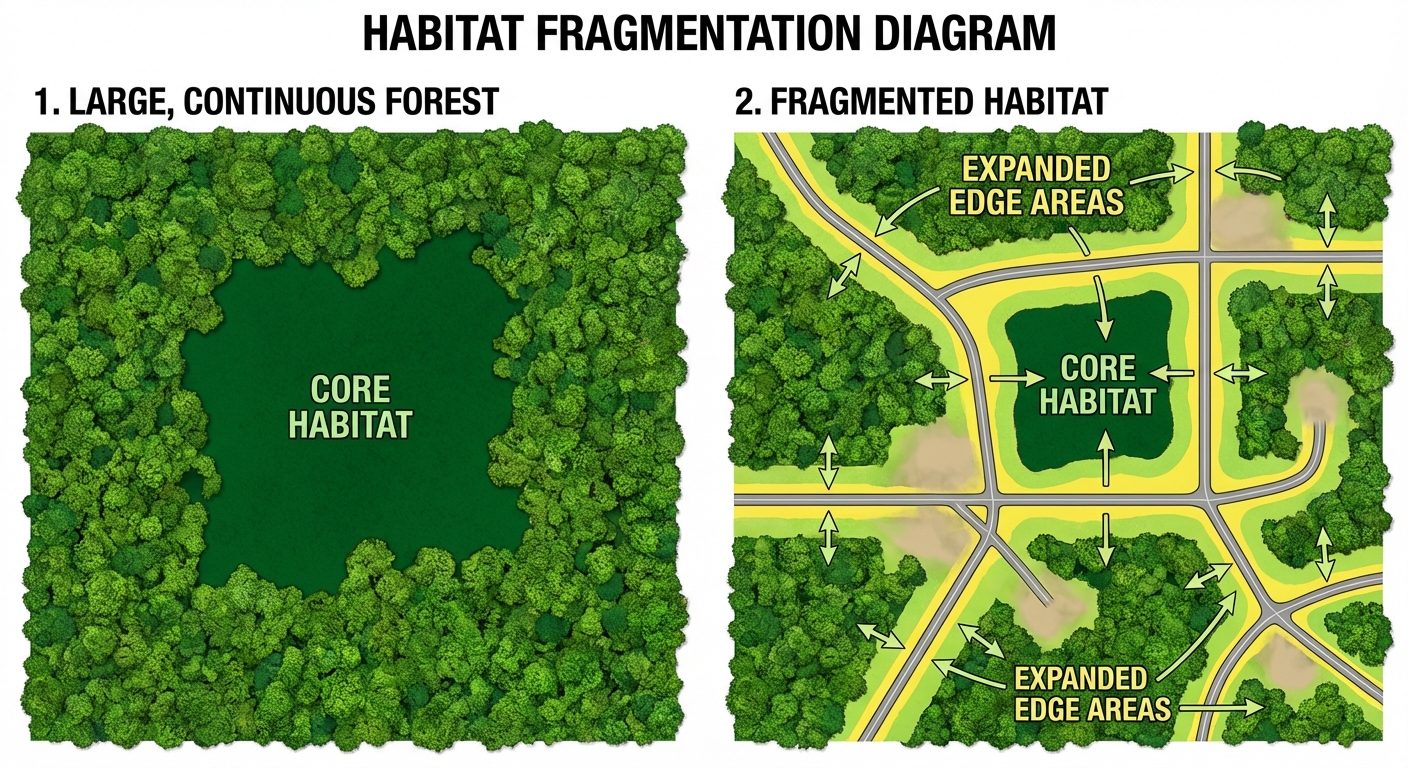
It is not just about how much habitat is lost, but the shape of what remains. When large ecosystems are broken into smaller patches:
- Core Habitat Decreases: Deep forest areas are lost.
- Edge Effect Increases: The boundary where two ecosystems meet (e.g., forest and road) increases.
- "Edge" habitats are windier, drier, and more accessible to predators and invasive species.
- Interior species (like many migratory songbirds) cannot survive on the edge.
Conservation Strategies
How do we mitigate these impacts?
- Wildlife Corridors: Strips of protected land connecting isolated habitat populations. This allows for gene flow (increasing genetic diversity) and safe migration.
- Metapopulation Management: Managing a group of spatially distinct populations that are connected by occasional movements of individuals.
- Restoration Ecology: Repairing damaged ecosystems (e.g., replanting mangroves, removing dams).
Common Mistakes & Pitfalls
- CITES vs. ESA Confusion: Students act like these are the same. Remember: CITES stops the border crossing of body parts; ESA stops the bulldozer on habitats (in the US).
- "Exotic" means "Bad": Not all non-natives are invasive. Wheat is exotic to North America, but it is not invasive. To be invasive, it must outcompete natives and cause harm.
- Lamarckian Evolution: Do not say animals "learn" to adapt to climate change. Species adapt over generations via natural selection. If the environment changes faster than their generation time allows them to adapt, they go extinct.
- Species Richness vs. Evenness: Biodiversity isn't just the number of species (richness); it also involves the relative abundance of each (evenness). A forest with 100 trees of 10 species is not diverse if 91 of them are the same species.