Unit 2: Analyzing the Function of Form
In AP English Literature, Unit 2 (Poetry I) shifts the focus from merely identifying literary elements to analyzing how those elements function to create meaning. The key question is never "What is this device?" but rather "Why did the poet use this structure to convey this specific idea?"
Structural Elements: The Skeleton of the Poem
Structure is the arrangement of words and lines to produce a desired effect. In poetry, structure dictates the pacing, creates emphasis, and mirrors the emotional state of the speaker.
Stanzas and Grouping
A stanza is a group of lines separated by a space from other stanzas, functioning much like a paragraph in prose. The way a poet groups ideas influences how you read them.
- Couplet: A two-line stanza (often rhyming). In Shakespearean sonnets, the final couplet usually provides a resolution or a twist.
- Quatrain: A four-line stanza. This is the most common stanza form in English poetry, often used to establish a steady narrative flow.
- Sestet & Octave: Six and eight-line stanzas, respectively. In Italian sonnets, the octave poses a problem, and the sestet proposes a solution.
Analysis Tip: If a poem consists of steady quatrains but suddenly ends with a single isolated line, ask yourself: Why the isolation? That broken structure usually indicates a broken emotion or a sudden realization.
Lineation, Syntax, and Pacing
How a line ends determines how the reader breathes and pauses. This control of time is unique to poetry.
- End-Stopped Line: A line that ends with a natural grammatical pause, usually marked by punctuation (period, comma, dash). It creates a sense of stability, order, or finality.
- Enjambment (Run-on Line): A line that carries its sense and grammatical structure over to the next line without a pause.
- Function: It creates momentum, mimics the flow of confused or rushing thought, or creates ambiguity by leaving weight on the last word of the line.
- Caesura: A strong pause within a line of verse, often marked by punctuation.
- Function: It fractures the rhythm, often symbolizing a fracture in the speaker's mindset or a sudden interruption.

Meter and Rhythm
Meter is the organized rhythm of a poem, determined by the pattern of stressed ($/$) and unstressed ($\breve{}$) syllables. Scansion is the act of marking these stresses.
The Foot: The basic unit of measurement.
- Iamb: Unstressed, Stressed (da-DUM). The sound of a heartbeat. (e.g., "To be or not to be")
- Trochee: Stressed, Unstressed (DA-dum). Sounds assertive or aggressive. (e.g., "Tyger Tyger burning bright")
Common Meters:
- Iambic Pentameter: Five iambs per line (10 syllables total). This is the standard for English verse (Shakespeare/Milton) because it closely mimics natural formal speech.
- Blank Verse: Unrhymed iambic pentameter.
- Free Verse: Poetry with no set meter or rhyme scheme. (Note: Free verse is not unstructured. It relies on line breaks and patterns of repetition for structure.)

Figurative Language: The Logic of Comparison
Figurative language invites the reader to see the world in a new way by comparing two unlike things. In AP Lit, you must identify the two things being compared and explain the implication of that comparison.
The Anatomy of Comparison (Metaphor and Simile)
To analyze a metaphor or simile deeply, use the terms Tenor and Vehicle.
- Tenor: The subject being described (the real-world object).
- Vehicle: The image or object used to describe the tenor.
Example: "My love is a red, red rose."
- Tenor: The speaker's love.
- Vehicle: A red rose.
- Analysis: The vehicle (rose) implies the love is beautiful and natural, but arguably implies it plays a prickly defense (thorns) or is temporary (wilting).
Types of Comparison:
- Simile: Comparison using "like" or "as."
- Metaphor: Direct comparison stating tone thing is another.
- Extended Metaphor (Conceit): A metaphor that is developed over several lines or the entire poem. Donne's "The Flea" is a famous conceit.
- Implied Metaphor: The comparison is not explicitly stated. (e.g., "He brayed his refusal at the meeting" implies the man is a donkey without saying "He was a donkey.")
Personification and Apostrophe
- Personification: Giving human qualities to inanimate objects or abstract concepts.
- Why use it? It usually reflects the speaker's projection of their own feelings onto the environment (the Pathetic Fallacy).
- Apostrophe: A direct address to an absent person, an abstract concept, or an inanimate object. (e.g., "O Death, where is thy sting?")
- Why use it? It elevates the tone to high drama or desperation.
Imagery: Evoking the Senses
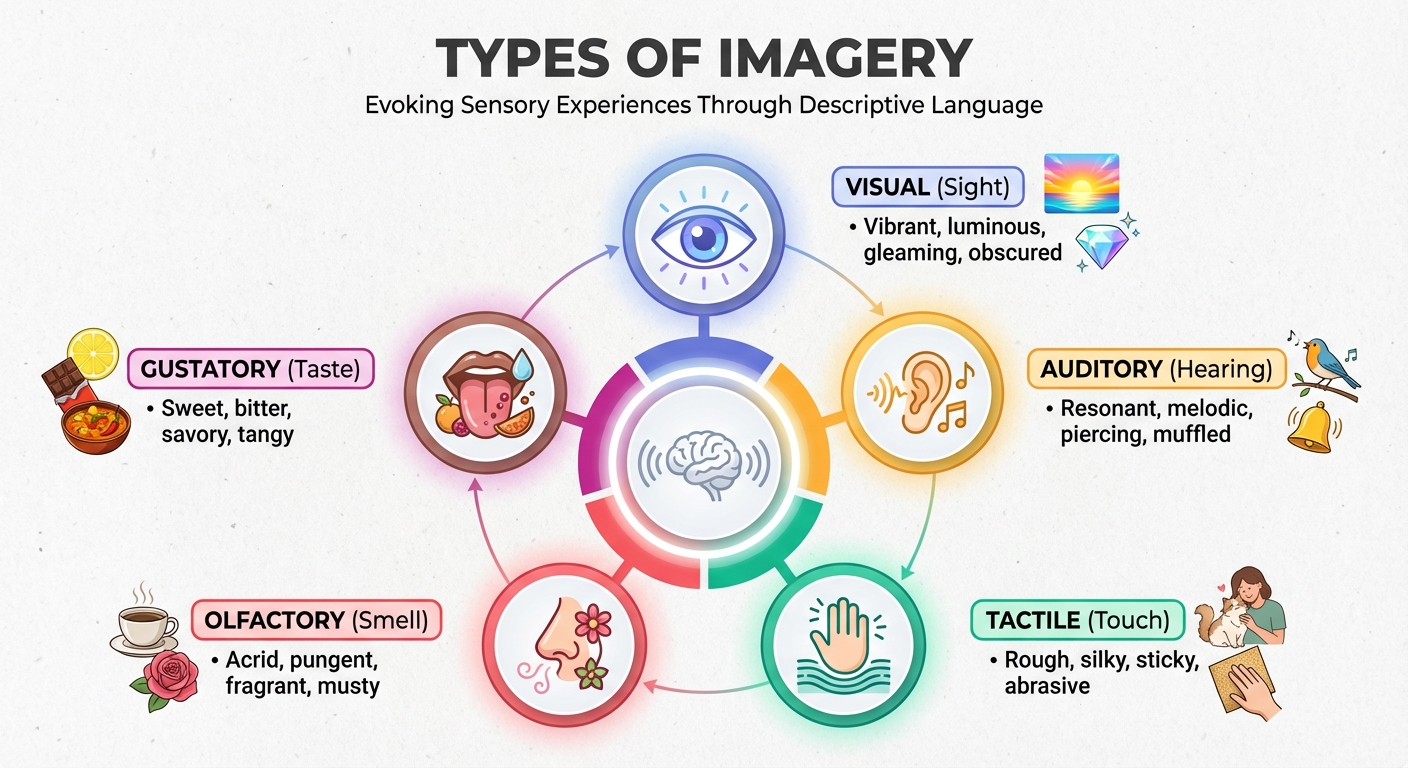
Imagery is not just visual. It is the use of language to evoke a sensory experience. Good analysis identifies which sense is triggered and what mood that sensory detail creates.
| Type of Imagery | Sense Evoked | Analysis Example |
|---|---|---|
| Visual | Sight | Colors, shapes, and light often symbolize emotional states (e.g., darkness = ignorance or despair). |
| Auditory | Sound | Clanking, buzzing, or whispering creates atmosphere (cacophony vs. euphony). |
| Tactile | Touch | Hard, soft, wet, heat, cold. Establish physical comfort or discomfort. |
| Olfactory | Smell | Scent is strongly linked to memory and nostalgia. |
| Gustatory | Taste | Bitterness or sweetness often parallels the "flavor" of life experiences. |
Mnemonic: TASTE
- Tactile
- Auditory
- Scent (Olfactory)
- Taste (Gustatory)
- Eyes (Visual)
Connecting Structure to Meaning: Contrast and Shifts
The most important structural element to find in any poem is the Shift (or Volta).
- The Shift: A distinct change in the speaker's tone, topic, or perspective.
- Where to look for shifts:
- Transition words (But, Yet, However).
- Changes in line length or stanza shape.
- Changes in verb tense (past to present).
- Changes in imagery (darkness to light).
Rule of Thumb: The meaning of the poem is usually found in the contrast between the first half (before the shift) and the second half (after the shift).
Common Mistakes & Pitfalls
"Hidden Meaning" Syndrome:
- Mistake: Thinking poetry is a riddle with a secret answer.
- Correction: Poetry is communication. Analyze what is actually on the page. Use the literal meaning as the foundation for the figurative meaning.
Listing Devices ( scavenger hunting):
- Mistake: Writing an essay that says, " The author uses alliteration, metaphor, and diction."
- Correction: Always connect the device to meaning. "The author uses jagged enjambment to mirror the speaker's anxiety."
Ignoring the Title:
- Mistake: Skipping the title to read the poem immediately.
- Correction: The title provides context, irony, or identifies the speaker/subject. Always analyze it first.
Confusing the Speaker with the Poet:
- Mistake: "Robert Frost is sad in this poem."
- Correction: Use "The Speaker." Poets often adopt personas distinct from themselves.