AP Calculus AB Unit 2 Study Guide: Derivatives by Definition, Interpretation, and Core Rules
Tangent Lines, Secant Lines, and the Big Idea of “Instantaneous Change”
When you first meet derivatives, it helps to start with a picture you already understand: the slope of a line. The slope tells you how much %%LATEX0%% changes when %%LATEX1%% changes. For a straight line, that “rate of change” is constant everywhere.
Most functions in calculus are not straight lines, they curve. On a curve, the slope is not the same at every point. Still, you often want to know how the function is changing right at a single input value. For example:
- If %%LATEX2%% is position, how fast are you moving at exactly %%LATEX3%% seconds?
- If %%LATEX4%% is the volume of water in a tank, how fast is it filling at exactly %%LATEX5%% minutes?
- If %%LATEX6%% is cost, how much does cost change per additional item right at %%LATEX7%% items?
Calculus is fundamentally the study of change. In Unit 2, we bridge the gap from Algebra (static slopes) to Calculus (dynamic slopes) by distinguishing between average and instantaneous variation.
Secant slope: average rate of change over an interval
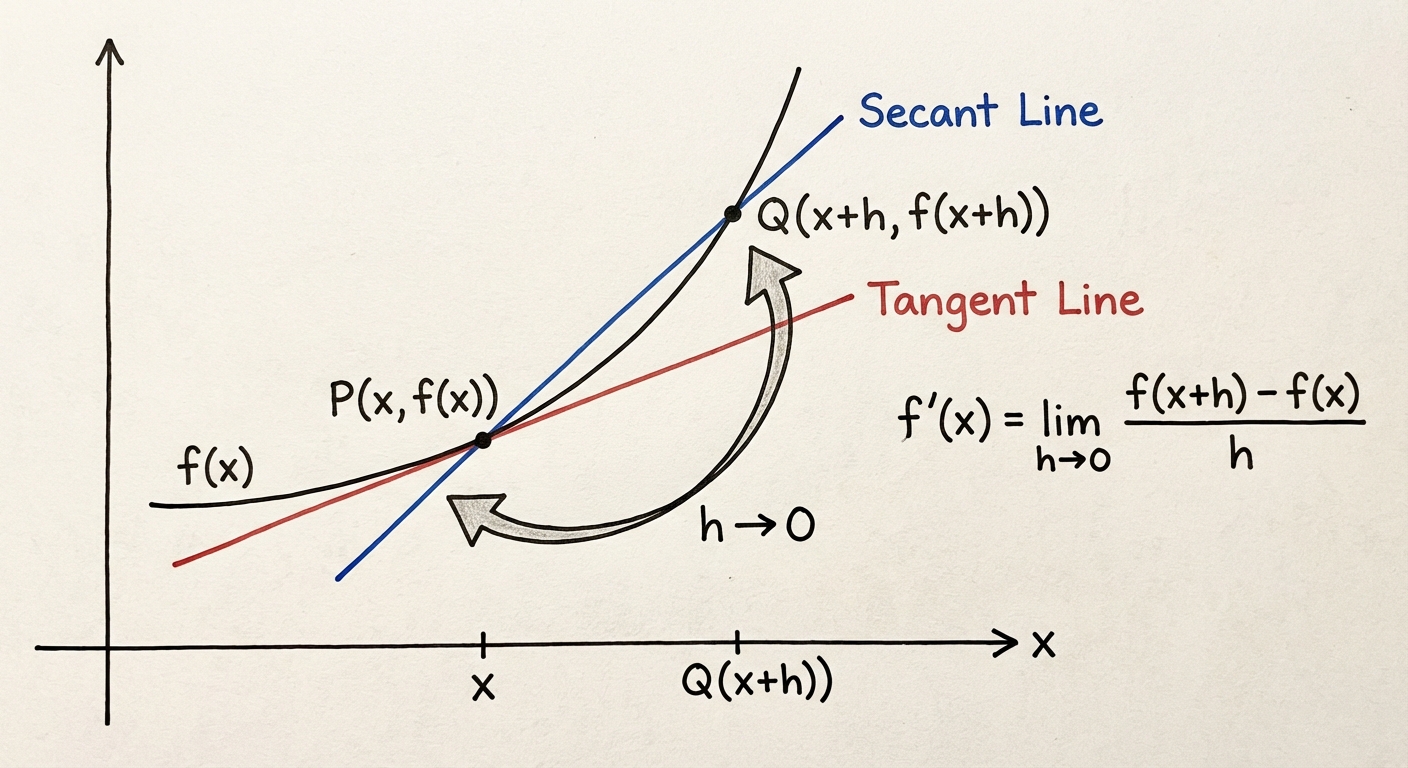
Suppose you have a function %%LATEX8%% and two points on the graph: %%LATEX9%% and %%LATEX10%%. The line through the points %%LATEX11%% and is called a secant line. Its slope is
Over a general interval , the average rate of change is the familiar difference quotient:
This is essential for approximating how a function behaves over a period of time. For example, if you drive 100 miles in 2 hours, your average velocity is 50 mph, even if your speedometer fluctuated during the trip.
Tangent slope: instantaneous rate of change at a point
A tangent line touches the curve at (typically) one point and matches the curve’s direction there. Its slope is the “instantaneous” rate of change.
How do you get a tangent slope if slope requires two points? The key idea is: use secant lines with the second point closer and closer to the first point. As %%LATEX16%% gets very small (approaches %%LATEX17%%), the secant line “turns into” the tangent line. So the tangent slope at %%LATEX18%% is the limit of secant slopes as %%LATEX19%%.
Worked example: average slopes approaching a tangent slope
Let %%LATEX20%% and consider %%LATEX21%%.
The secant slope from %%LATEX22%% to %%LATEX23%% is
Expand:
Now plug in small values of :
- If %%LATEX27%%, slope %%LATEX28%%
- If %%LATEX29%%, slope %%LATEX30%%
- If %%LATEX31%%, slope %%LATEX32%%
As %%LATEX33%%, these slopes approach %%LATEX34%%. That suggests the tangent slope at %%LATEX35%% is %%LATEX36%%.
A common misconception is thinking you can set %%LATEX37%% directly in the difference quotient. You cannot, because %%LATEX38%% would become division by zero. The derivative is defined by a limit, not by direct substitution.
Exam Focus
- Typical question patterns:
- “Find the slope of the tangent line to %%LATEX39%% at %%LATEX40%% using the limit definition.”
- “Compute the slope of the secant line over and take a limit.”
- “Estimate the tangent slope at a point from a graph by matching a tangent line.”
- Common mistakes:
- Plugging in too early instead of simplifying before taking the limit.
- Using or mixing up the order, leading to sign errors.
- Treating a tangent line as if it must cross the curve only once (it can intersect again elsewhere).
The Derivative Defined as a Limit
The derivative formalizes the tangent-slope idea with a precise limit. It is the mathematical tool that gives the instantaneous rate of change (the slope of the tangent line) at an input.
Definition of the derivative at a point
The derivative of %%LATEX44%% at %%LATEX45%% is
If this limit exists (as a finite number), %%LATEX47%% is differentiable at %%LATEX48%%.
This definition matters because it is the foundation behind every derivative rule you learn later. Even when you use shortcuts (like the power rule), they are justified by this limit definition.
Limit definition (the “ method”) for the derivative function
This is the general definition used to find the derivative function :
Interpreting the pieces:
- is the change in output (rise).
- is the change in input (run).
- is what turns a secant line slope into a tangent line slope.
Equivalent limit form (often used for “derivative at a point”)
You may also see the derivative written as
This is the same idea: instead of writing the second point as %%LATEX56%%, you call it %%LATEX57%% and let %%LATEX58%% approach %%LATEX59%%. This form is especially common in multiple-choice questions when checking whether a derivative exists at a specific point :
What it means for the limit to exist (one-sided derivatives)
For the derivative to exist at , the slopes of secant lines approaching from the left and from the right must approach the same value.
Right-hand derivative:
Left-hand derivative:
If these one-sided limits are not equal, the derivative does not exist.
Worked example: derivative from the definition (a polynomial)
Find %%LATEX65%% for %%LATEX66%% using the definition.
Start with
Compute :
Substitute:
Simplify the numerator:
Factor out :
Cancel (this is exactly why you simplify before taking the limit):
So .
Worked example: a point where the derivative fails
Consider %%LATEX77%% at %%LATEX78%%.
For %%LATEX79%%, %%LATEX80%%, which has slope %%LATEX81%%. For %%LATEX82%%, %%LATEX83%%, which has slope %%LATEX84%%. The left-hand slope approaching %%LATEX85%% is %%LATEX86%% and the right-hand slope is %%LATEX87%%, so they do not match. Therefore, %%LATEX88%% does not exist.
This illustrates a key idea: corners and sharp points often break differentiability because the function changes direction too abruptly.
Exam Focus
- Typical question patterns:
- “Use the limit definition to find for a given function and a given point.”
- “Show whether %%LATEX90%% is differentiable at %%LATEX91%% by comparing one-sided derivatives.”
- “Compute a derivative function from the definition for a simple function.”
- “Determine whether exists.”
- Common mistakes:
- Forgetting to simplify before taking the limit, causing division-by-zero issues.
- Mixing up the two equivalent limit forms and substituting incorrectly.
- Dropping the limit notation too early in work. On AP Free Response, keep writing until you actually evaluate the limit.
- Assuming continuity automatically implies differentiability (it does not).
Differentiability vs. Continuity: What Must Be True?
Students often confuse continuity and differentiability. They are related, but not the same.
Continuity (what it demands)
A function %%LATEX95%% is continuous at %%LATEX96%% if three things hold:
- is defined.
- exists.
- .
Continuity means you can draw the graph through without lifting your pencil (informally).
Differentiability (what it demands)
A function %%LATEX101%% is differentiable at %%LATEX102%% if
exists as a finite real number. Differentiability means the graph has a well-defined tangent slope at .
Key relationship (theorem + contrapositive)
- If %%LATEX105%% is differentiable at %%LATEX106%%, then %%LATEX107%% is continuous at %%LATEX108%%.
- Contrapositive: if %%LATEX109%% is not continuous at %%LATEX110%%, then it is not differentiable at . You cannot have a slope at a hole, jump, or asymptote.
- The converse is false: continuous does not necessarily mean differentiable.
Where differentiability commonly fails
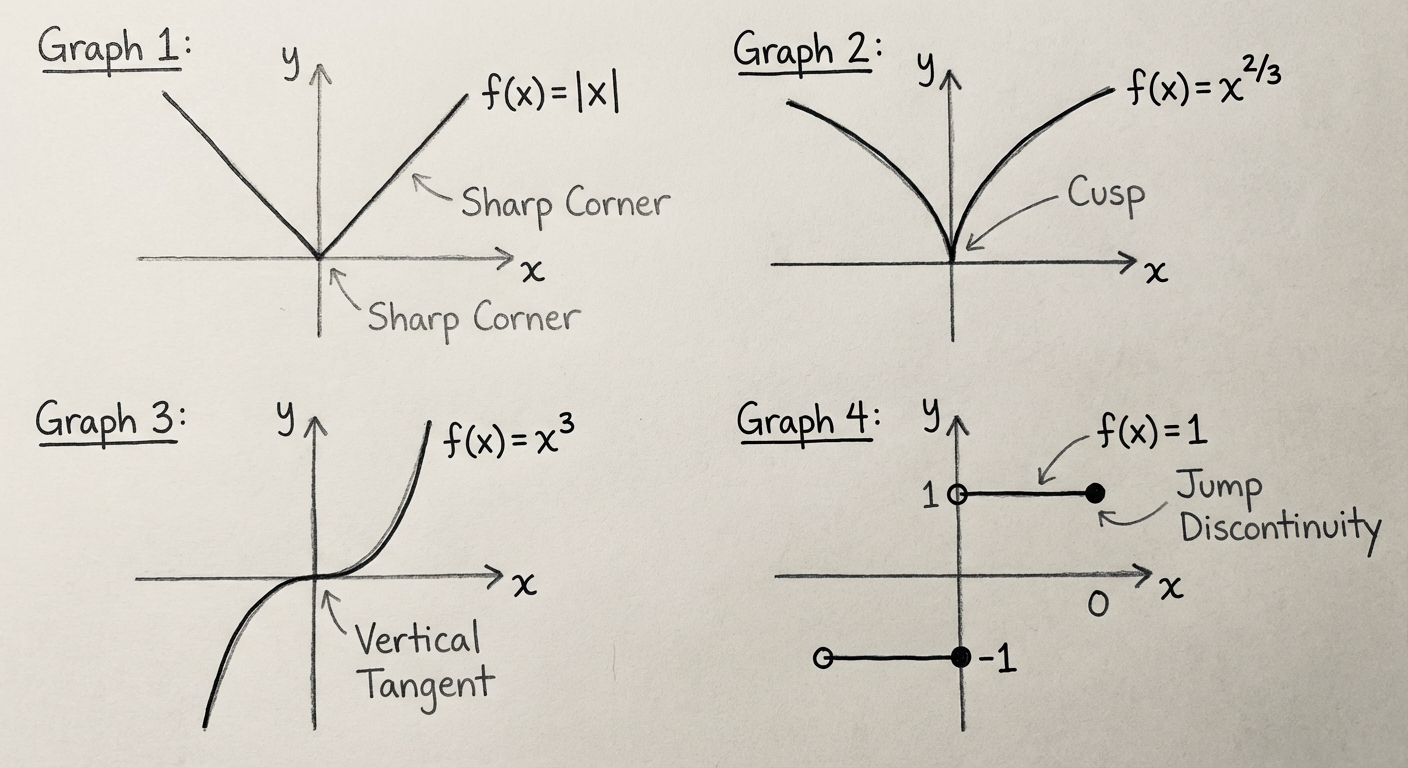
Even when a function is continuous, it may not be differentiable at a point. Common “failure shapes” include:
- Corner: slopes from left and right are different (like %%LATEX112%% at %%LATEX113%%).
- Cusp: slopes become infinitely steep in different ways (for example, ).
- Vertical tangent: slope blows up to infinity, so the derivative is not a finite number (for example, %%LATEX115%% at %%LATEX116%%).
- Discontinuity: if it’s not continuous, it cannot be differentiable.
Worked example: checking differentiability from a graph
If a graph has a sharp corner at , you can estimate the left-hand slope and right-hand slope by drawing tangent-ish lines on each side. If they don’t match, the derivative does not exist.
A subtle mistake: some students think a vertical tangent means the derivative is because the line “looks like it doesn’t run.” It’s the opposite: the slope is undefined (informally “infinite”), so the derivative does not exist as a finite number.
Exam Focus
- Typical question patterns:
- “Is %%LATEX119%% differentiable at %%LATEX120%%? Justify using continuity and one-sided slopes.”
- “From the graph, identify points where does not exist.”
- “Given a piecewise function, find conditions on constants so that is continuous/differentiable at a join.”
- Common mistakes:
- Claiming “continuous therefore differentiable.”
- Forgetting to check both sides at a corner/join.
- Treating a vertical tangent as having derivative instead of non-existent.
Derivative Notation and the Derivative as a Function
Once you understand %%LATEX124%% as “the slope at a point,” the next conceptual step is realizing that you can compute that slope for many values of %%LATEX125%%. That creates a new function: the derivative function.
The derivative at a point vs. the derivative function
- %%LATEX126%% is a number: the slope at %%LATEX127%%.
- %%LATEX128%% is a function: it takes an input %%LATEX129%% and outputs the slope of at that input.
Common notations (they mean the same derivative)
You must be fluent translating among notations.
| Meaning | Common notations |
|---|---|
| Derivative of | %%LATEX132%%, %%LATEX133%% |
| Derivative of | |
| Derivative evaluated at | %%LATEX137%%, %%LATEX138%% |
A common AP-style skill is translating: if you’re told %%LATEX139%% models temperature, then %%LATEX140%% and represent the same rate, just written differently.
Notation reference (including “operator” notation and origins)
Different textbooks and questions mix these freely:
| Notation | Meaning | Origin |
|---|---|---|
| Prime notation for the first derivative | Lagrange | |
| Shorthand prime notation | Lagrange | |
| Differential notation (change in %%LATEX145%% over change in %%LATEX146%%) | Leibniz | |
| Operator notation: “take the derivative of this” | Leibniz |
Interpreting derivative notation carefully (and using units)
The notation
suggests “change in %%LATEX149%% per change in %%LATEX150%%.” While it is defined via limits (not as a simple fraction), it is extremely helpful for interpreting units.
For example, if %%LATEX151%% is in hours and %%LATEX152%% is in miles, then has units “miles per hour.”
Getting a derivative function from first principles
If you use the definition
and simplify to a final expression in terms of , you have created the derivative function.
Worked example: interpreting values of the derivative function
Suppose %%LATEX156%%. That does not mean %%LATEX157%%. It means the tangent slope is zero at , so the tangent line is horizontal there.
Suppose %%LATEX159%%. That means at %%LATEX160%%, the function is decreasing at a rate of 2 units of %%LATEX161%% per 1 unit of %%LATEX162%%.
Exam Focus
- Typical question patterns:
- “Given %%LATEX163%%, find %%LATEX164%% and then evaluate .”
- “Interpret in context with units.”
- “Given a graph of %%LATEX167%%, sketch or describe the behavior of %%LATEX168%%.”
- “Translate between %%LATEX169%%, %%LATEX170%%, %%LATEX171%%, and %%LATEX172%%.”
- Common mistakes:
- Confusing %%LATEX173%% with %%LATEX174%%.
- Forgetting that is a function with its own graph and behavior.
- Dropping units in applied-rate questions (units often reveal the correct interpretation).
Estimating Derivatives from Tables and Graphs
On the AP exam, you are often asked to estimate derivatives numerically (from a table) or visually (from a graph). The goal is to show you understand derivatives as slopes and rates, not just as symbolic rules.
Estimating from a table: use a difference quotient
If you want to estimate %%LATEX176%% but only know a table of values, the best idea is to mimic the limit definition with small changes in %%LATEX177%%.
A basic estimate uses a forward difference:
A backward difference uses points to the left:
A central (symmetric) difference is often more accurate (when symmetric data is available):
Central difference is powerful because it balances left and right behavior.
Worked example: estimating from a table (symmetric data around the point)
Suppose you have
| 1.9 | 2.0 | 2.1 | |
|---|---|---|---|
| 3.61 | 4.00 | 4.41 |
Estimate .
Using central difference with :
That matches what you would get if .
Common error: using points too far away from %%LATEX187%% (large %%LATEX188%%). That produces an average rate of change over a wide interval, which may not reflect the instantaneous rate.
Worked example: estimating when the point is not in the table
Estimate given the table:
| 1 | 2 | 4 | 5 | |
|---|---|---|---|---|
| 2 | 5 | 9 | 14 |
Since %%LATEX192%% is not in the table, use the points surrounding 3, namely %%LATEX193%% and :
Estimating from a graph: slope of the tangent
To estimate from a graph:
- Locate the point at .
- Sketch the tangent line that just “kisses” the curve there (matching its local direction).
- Choose two convenient points on your tangent line (not necessarily points on the curve).
- Compute slope as rise over run.
A key skill is distinguishing the curve from the tangent. You are allowed to use the tangent line you draw to pick readable points.
Estimating a derivative when axes are scaled
On AP questions, graphs may have non-1 tick marks. Always read the scale:
- If each grid square is 2 units in , your run must reflect that.
- If each grid square is 5 units in , your rise must reflect that.
Exam Focus
- Typical question patterns:
- “Estimate from a table using a symmetric difference quotient.”
- “Estimate the slope of the tangent line from a graph and interpret it.”
- “Use estimates of %%LATEX201%% to decide where %%LATEX202%% is increasing/decreasing.”
- Common mistakes:
- Using non-symmetric points when symmetric points exist (reduces accuracy).
- Computing the slope using points on the curve rather than on the tangent line you drew.
- Ignoring axis scale and grid labeling.
The Derivative as a Rate of Change (and How to Interpret Units)
One of the most important conceptual meanings of the derivative is: it measures an instantaneous rate of change.
Connecting slope to real-world rates
If %%LATEX203%% models a real situation, then %%LATEX204%% tells you how fast %%LATEX205%% is changing with respect to %%LATEX206%% at the moment .
The derivative is not just “steepness.” In applications, it is often the quantity you actually care about: velocity, growth rate, marginal cost, current, and more.
Units: a built-in interpretation tool
If %%LATEX208%% has units U and %%LATEX209%% has units V, then the derivative has units “U per V.”
Examples:
- If %%LATEX210%% is measured in meters and %%LATEX211%% in seconds, then is meters per second.
- If %%LATEX213%% is dollars and %%LATEX214%% is items, then is dollars per item.
Units help you avoid misinterpretations. If your derivative has units “gallons,” you probably differentiated with respect to the wrong variable or misread what the function represents.
Average vs instantaneous rate of change
Average rate of change on is
Instantaneous rate at %%LATEX218%% is %%LATEX219%%. They are related: the derivative is the limit of average rates over smaller and smaller intervals around the point.
Worked example: interpreting a derivative value in context
Suppose %%LATEX220%% is the volume of water in a tank (in liters) at time %%LATEX221%% (in minutes). If %%LATEX222%%, then at %%LATEX223%% minutes the tank’s volume is increasing at 3.5 liters per minute.
A common misconception is to interpret %%LATEX224%% as “the tank has 3.5 liters at 12 minutes.” That would be %%LATEX225%%, not .
Worked example: building a rate from a model
Suppose a population is modeled by
where %%LATEX228%% is years. Then %%LATEX229%% represents population change per year at time .
Differentiate:
Then
At year 5, the population is increasing at 30 people per year.
Physics application: linear motion (position, velocity, acceleration)
Unit 2 often introduces the relationship between position, velocity, and acceleration for a particle moving along a line.
- Position function %%LATEX233%% or %%LATEX234%% gives location at time .
- Velocity is the first derivative of position:
If %%LATEX237%%, the particle is moving forward/right/up. If %%LATEX238%%, it is moving backward/left/down.
- Acceleration is the derivative of velocity (the second derivative of position):
Exam Focus
- Typical question patterns:
- “Interpret in words and include correct units.”
- “Given a context, decide whether should be positive/negative and what that means.”
- “Compare average rate of change to instantaneous rate at a point.”
- “Given %%LATEX242%%, find and interpret %%LATEX243%% and .”
- Common mistakes:
- Confusing function values with derivative values in context.
- Giving an interpretation without units (or with incorrect units).
- Treating the derivative as an average rate over a long interval.
Local Linearity and Linear Approximation (Using the Tangent Line)
A powerful consequence of differentiability is local linearity: near a point where a function is differentiable, the graph looks almost like a straight line.
What local linearity means
If %%LATEX245%% is differentiable at %%LATEX246%%, then near %%LATEX247%% you can approximate %%LATEX248%% by the tangent line at .
The tangent line at %%LATEX250%% has point %%LATEX251%% and slope , so its equation is
This is called the linearization of %%LATEX254%% at %%LATEX255%%.
Why linear approximation matters
Many complicated functions are hard to compute exactly in your head, but a linear function is easy. If %%LATEX256%% is close to %%LATEX257%%, then %%LATEX258%% can be a good approximation for %%LATEX259%%. In Unit 2, the key is recognizing that “tangent line” is not only geometric; it is also a numerical approximation tool.
Worked example: approximating a function value
Approximate %%LATEX260%% using linearization of %%LATEX261%% at .
Compute needed values:
Derivative:
So
Linearization:
Evaluate at :
So .
Common error: using a point that is not close to the target input. The approximation depends on closeness.
Exam Focus
- Typical question patterns:
- “Write the equation of the tangent line at %%LATEX271%% and use it to approximate %%LATEX272%% near .”
- “Use local linearity to estimate values from a graph.”
- “Interpret what the tangent line tells you about nearby behavior.”
- Common mistakes:
- Using %%LATEX274%% instead of %%LATEX275%% in the tangent line equation (slope must be a number).
- Forgetting the point-slope structure .
- Approximating far from and expecting high accuracy.
Fundamental Differentiation Rules (Constant, Power, and Linearity)
While the derivative is defined by limits, you rarely want to redo a limit from scratch for every function. Fortunately, derivatives follow patterns that let you compute them efficiently.
These are often called “fundamental properties” because they describe how derivatives behave under basic algebraic combinations.
Constant rule
If is a constant, then
A constant function is a horizontal line, so its slope is zero everywhere.
Constant multiple rule
If %%LATEX280%% is a constant and %%LATEX281%% is differentiable, then
Multiplying outputs by %%LATEX283%% stretches the graph vertically by factor %%LATEX284%%, and slopes scale the same way.
Sum and difference rules
If %%LATEX285%% and %%LATEX286%% are differentiable, then
and
Power rule
For any real number exponent ,
Phrase: “Bring the power down, subtract one from the power.”
Example: if , then
Example (roots): if
then
Derivatives of polynomials
A polynomial is a sum of constant multiples of powers of . You differentiate term-by-term using the constant multiple rule, sum/difference rules, and the power rule.
Example form:
Worked example: differentiate a polynomial
Differentiate
Apply the power rule to each term:
So
Worked example: a function written with negative exponents
Differentiate
Use the power rule:
You could rewrite with fractions if desired:
and
But the derivative is correct in either form.
Exam Focus
- Typical question patterns:
- “Differentiate a polynomial or power function and evaluate at a given .”
- “Use derivative rules to compute quickly without limits.”
- Common mistakes:
- Incorrect exponent decrease (students sometimes write %%LATEX306%% instead of %%LATEX307%%).
- Dropping negative signs when differentiating negative coefficients.
- Treating %%LATEX308%% as %%LATEX309%% (not a rule).
- Misusing the power rule on constants. For instance, %%LATEX310%% is just a number, so its derivative is %%LATEX311%% (not ).
Advanced Derivative Rules: Product and Quotient
When functions are multiplied or divided, you cannot simply take the derivatives “individually.” You must use structure-specific rules.
Product rule
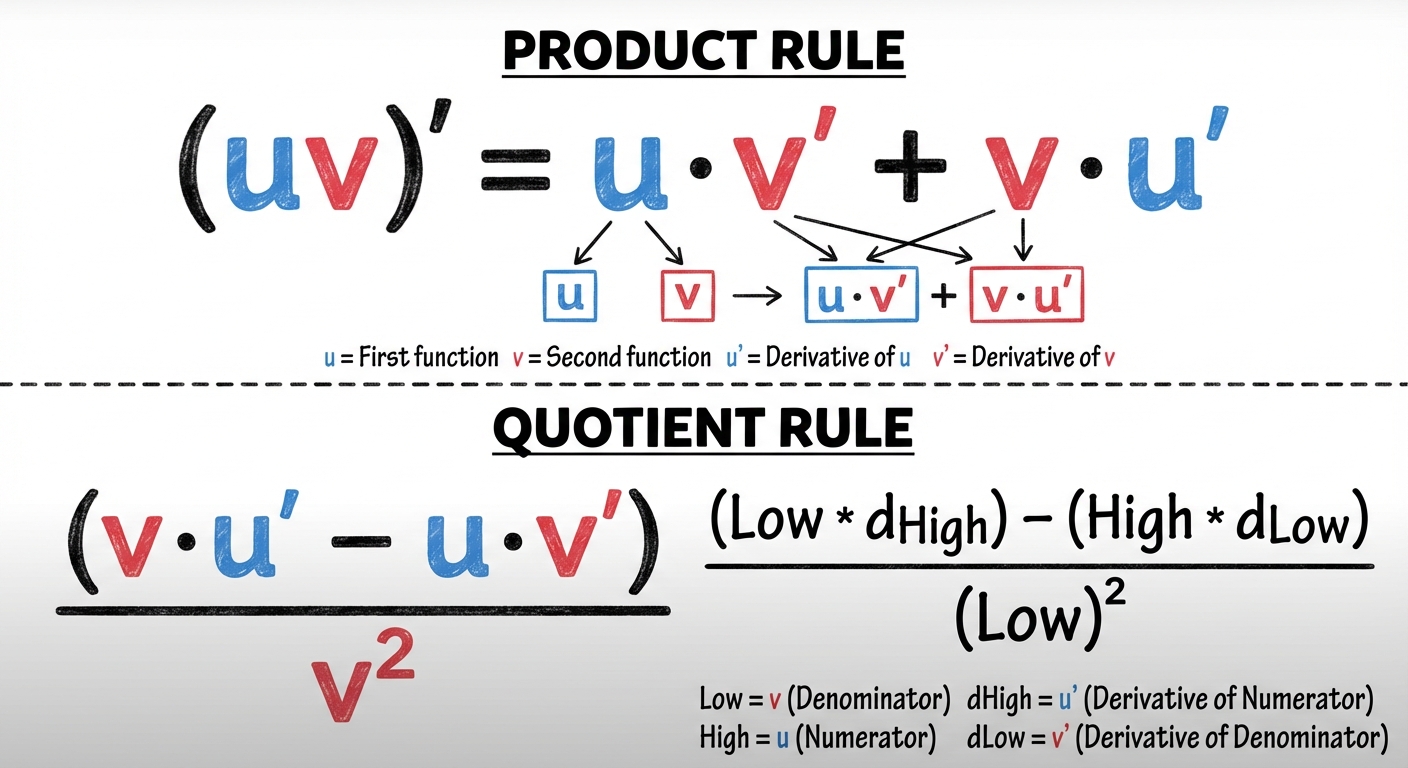
Used when differentiating the product of two functions:
Then
Mnemonic: “First d-Second plus Second d-First” (1d2 + 2d1).
Worked example (product rule)
Let
Identify pieces:
- %%LATEX316%% so %%LATEX317%%
- %%LATEX318%% so %%LATEX319%%
Apply product rule:
Quotient rule
Used when differentiating a fraction:
Then
Mnemonic: “Low d-High minus High d-Low, over Low Low.”
Warning: order matters because of the subtraction. Start with the denominator (“Low”) times the derivative of the numerator (“dHigh”).
Exam Focus
- Typical question patterns:
- “Differentiate a product or quotient and simplify.”
- “Use product/quotient rule inside a tangent line problem.”
- Common mistakes:
- Quotient rule order errors (swapping the numerator terms).
- Forgetting parentheses in product/quotient rule, especially failing to distribute a negative sign correctly.
Trigonometric Derivatives (Memory Derivatives + Meaning)
Trigonometric functions are central in calculus because they model periodic phenomena (sound waves, seasonal temperatures, circular motion) and because they have consistent derivative patterns.
Core sine and cosine derivative facts
The fundamental derivatives you use constantly are:
and
These results come from the limit definition plus key trig limits:
and
You typically do not need to re-derive trig derivatives on the exam, but you should know these derivatives and be able to use them fluently.
Full trig derivative table (you must memorize)
| Function | Derivative |
|---|---|
Memory tips:
- All “C” functions (Cos, Csc, Cot) have negative derivatives.
- Tan and Sec go together; Cot and Csc go together.
Interpreting trig derivatives conceptually
- The derivative of %%LATEX341%% is %%LATEX342%%, which is the same wave shifted by a quarter-period. That matches the idea that “rate of change of a wave is another wave.”
- The negative sign in %%LATEX343%% reflects the fact that cosine starts by decreasing at %%LATEX344%% (since and the graph initially slopes downward).
Worked example: differentiating a trig expression using linearity
Differentiate
Use constant multiple and sum/difference rules:
Worked example: slope at a specific point
Let . Find the slope at
Derivative:
Evaluate:
So the tangent slope is at that input.
Exam Focus
- Typical question patterns:
- “Differentiate combinations of trig functions using constant multiples and sums.”
- “Evaluate %%LATEX353%% at special angles like %%LATEX354%%, %%LATEX355%%, %%LATEX356%%.”
- “Interpret derivative sign for trig graphs (increasing/decreasing intervals).”
- Common mistakes:
- Missing the negative sign in .
- Mixing degree and radian thinking; derivatives of trig functions in calculus assume radian measure.
- Confusing the value of the function with the value of its derivative (for instance, %%LATEX358%% but %%LATEX359%%).
Derivatives of Exponential and Logarithmic Functions
Exponential and logarithmic functions are used to model growth/decay, compounding, population change, and many natural processes. Their derivatives are especially elegant.
Exponential functions and why is special
The number %%LATEX361%% is special because the exponential function %%LATEX362%% has the unique property that its rate of change is equal to its value.
Key derivative:
Note: this is the only function that is its own derivative.
For a more general exponential %%LATEX364%% (with %%LATEX365%% and %%LATEX366%%), the derivative involves %%LATEX367%%:
Natural logarithm derivative
The natural logarithm %%LATEX369%% is the inverse of %%LATEX370%%. Its derivative is
This reflects that %%LATEX372%% grows slowly: as %%LATEX373%% increases, %%LATEX374%% decreases toward %%LATEX375%%.
Worked example: exponential derivative
Differentiate
Apply rules:
Worked example: logarithm derivative
Differentiate
Then
Domain reminder: %%LATEX380%% is defined for %%LATEX381%%, so the original function (and its derivative in context) typically lives on .
A frequent conceptual pitfall: domain matters in log rules
A common algebra slip is to use log rules without checking domain. The identity
is only valid when %%LATEX384%% because %%LATEX385%% requires positive input.
Exam Focus
- Typical question patterns:
- “Differentiate expressions involving %%LATEX386%% or %%LATEX387%% using linearity.”
- “Evaluate the derivative at a point and interpret as a rate (growth models).”
- “Recognize that is its own derivative and use it in tangent line problems.”
- Common mistakes:
- Writing by incorrectly applying the power rule.
- Forgetting %%LATEX390%% (not %%LATEX391%%).
- Ignoring domain restrictions for in context.
Putting It Together: Tangent Lines, Rates, and Basic Differentiation in Typical AP Tasks
Unit 2 skills often appear in multi-part problems where you must connect definitions, interpretations, and rules.
Pattern 1: From a graph/table to a derivative interpretation
You might be given a graph of %%LATEX393%% and asked to estimate %%LATEX394%%, decide where %%LATEX395%% or %%LATEX396%%, or match a graph of %%LATEX397%% to %%LATEX398%%. To do this well, remember:
- %%LATEX399%% means %%LATEX400%% is increasing.
- %%LATEX401%% means %%LATEX402%% is decreasing.
- Large magnitude of means steepness.
- Places where %%LATEX404%% has corners/vertical tangents/discontinuities are places where %%LATEX405%% may not exist.
Pattern 2: From a formula to a tangent line approximation
A standard flow is:
- Differentiate .
- Evaluate %%LATEX407%% and %%LATEX408%%.
- Write .
- Use to approximate a nearby value.
Mistake to avoid: using a point far from the target value.
Pattern 3: Using the limit definition strategically
You are most likely to be asked to use the limit definition for functions where algebra is manageable (polynomials, simple radicals, sometimes rational expressions).
The winning strategy is almost always:
- Expand (or otherwise simplify) the numerator.
- Factor out .
- Cancel .
- Then take the limit.
If you cannot cancel the problematic factor causing division by zero, you have not finished the algebra.
Cumulative worked example: tangent line from a derivative
Let
1) Differentiate:
2) Find the tangent line at .
Compute:
and
So the tangent line is
You can simplify if desired:
Interpretation: at %%LATEX421%%, the function is increasing at 9 units of output per 1 unit of input, and near %%LATEX422%% the function behaves approximately like the line .
Exam Focus
- Typical question patterns:
- “Find the tangent line at and use it to approximate a value.”
- “Use a table to estimate and then interpret the meaning.”
- “Determine differentiability at a point and justify using one-sided behavior.”
- Common mistakes:
- Treating “estimate” as meaning “guess” rather than computing a difference quotient.
- Writing a tangent line with slope %%LATEX426%% instead of the numeric slope %%LATEX427%%.
- Forgetting that non-differentiability can happen even when the function is continuous.
- In limit-definition work, forgetting to carry the notation through the simplification steps until evaluation.