Unit 2: Political Institutions and Branch Relations
2.1 Parliamentary, Presidential, and Semi-Presidential Systems
Political scientists classify governments based on the relationship between the executive (enforcers of law) and the legislative (makers of law) branches. The three main models are distinct in how power is derived and how branches check one another.
Parliamentary System
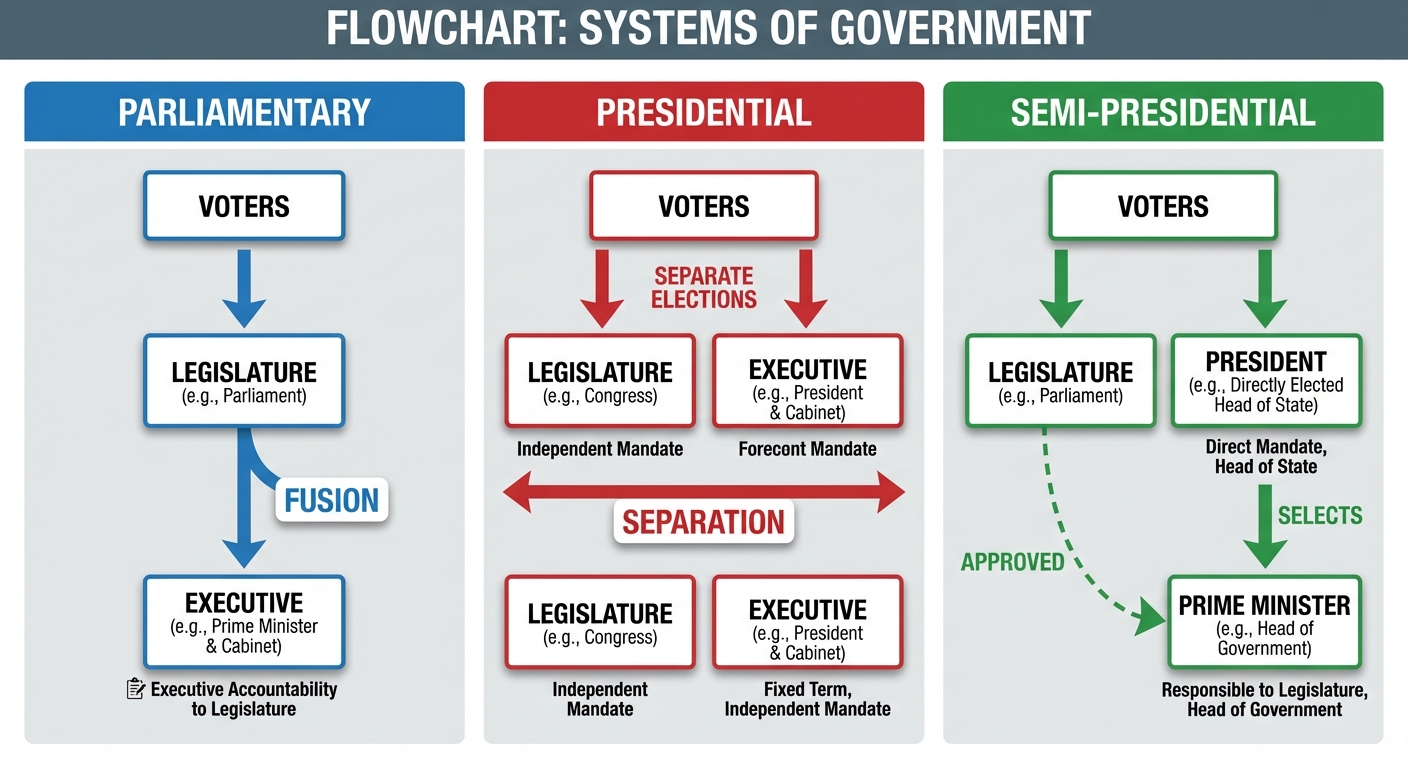
In a parliamentary system, the executive and legislative branches are fused.
- Definition: A system where the Chief Executive (Prime Minister) is selected by the majority party or coalition in the legislature, not directly by the voters.
- Fusion of Powers: The executive resides within the legislature.
- Accountability: The executive is directly accountable to the legislature and can be removed via a Vote of No Confidence.
- checks and Balances: Generally weaker than presidential systems due to the fusion of power, though the opposition party plays a vital role (e.g., "Shadow Cabinet" in the UK).
- Key AP Course Country: United Kingdom.
Presidential System
In a presidential system, the executive and legislative branches are separated.
- Definition: A system where the Chief Executive (President) is chosen by the voters (directly or via an electoral college) essentially independently of the legislature.
- Separation of Powers: The branches are co-equal and independent. Cabinet members usually cannot serve in the legislature simultaneously.
- Fixed Terms: Executives serve fixed terms and are difficult to remove (requires impeachment for illegal acts, not just political disagreement).
- Key AP Course Countries: Mexico, Nigeria.
Semi-Presidential System
A hybrid system that features dual executives.
- Definition: A system containing both a directly elected President and a Prime Minister responsible to the legislature.
- Division of Labor: usually, the President handles foreign policy and defense (Head of State + some policy), while the PM handles domestic policy and the legislature (Head of Government).
- Key AP Course Country: Russia.
Compare and Contrast Table
| Feature | Parliamentary (e.g., UK) | Presidential (e.g., Mexico, Nigeria) | Semi-Presidential (e.g., Russia) |
|---|---|---|---|
| Selection of Executive | Chosen by Legislature (Majority Party) | Elected by Voters | President elected by voters; PM appointed by President |
| Removal | Vote of No Confidence | Impeachment | President: Impeachment; PM: Vote of No Confidence |
| Relation to Legislature | Fused; PM is part of Parliament | Separated; President is outside Congress | Mixed; Dual Executive |
| Term Limits | No fixed terms (usually); elections called within max years | Fixed terms | Fixed terms for President |
Common Mistakes
- Mixing up Removal: Students often think Presidents can be removed by a "Vote of No Confidence." They cannot. Presidents face impeachment (a legal trial for misconduct). Prime Ministers face no confidence votes (a political removal for lack of support).
- Head of State vs. Gov: In Presidential systems, one person is both. In Parliamentary/Semi-Presidential, they are usually two different people.
2.2 Executive Institutions
The executive branch helps to formulate, implement, and enforce policy through different agencies and strategies. Understanding the distinction between the Head of State and the Head of Government is crucial for AP Comparative Government.
Head of State vs. Head of Government
- Head of State: The symbol/representative of the people, both nationally and internationally. Often ceremonial (e.g., Queen/King) but can have real power in some systems.
- Head of Government: The official responsible for running the day-to-day business of the state, managing the cabinet, and overseeing the bureaucracy.
Executive Structures in the "Big 6"
1. United Kingdom (Parliamentary)
- Head of State: Monarch (King Charles III). Strictly ceremonial; gives "Royal Assent" to laws but cannot reject them.
- Head of Government: Prime Minister. Holds the real power. Leader of the majority party in the House of Commons.
2. Russia (Semi-Presidential)
- Head of State: President (Vladimir Putin). Holds significant power; oversees foreign policy, security, and the "power ministries."
- Head of Government: Prime Minister. Appointed by the President; oversees domestic policy and the economy. technically can be fired by the President.
3. China (Authoritarian / Party-State)
- Structure: A triad of power (State, Party, Military).
- Head of State: President (Xi Jinping). Historically ceremonial, but currently holds the real power because he is also the General Secretary.
- Head of Government: Premier. Heads the State Council (cabinet/bureaucracy) and manages the economy.
- General Secretary: The head of the Communist Party (CCP). This is where the true executive power lies.
4. Nigeria & Mexico (Presidential)
- Head of State & Government: President. One person holds both titles. They are Commander-in-Chief and head of the civil service.
5. Iran (Theocratic Republic)
- Head of State: Supreme Leader. Holds ultimate power. Commander-in-Chief, appoints judges, vets candidates, determines the interests of Islam.
- Head of Government: President. Elected by voters but vetted by the Guardian Council. Oversees the budget and civil service but lacks control over the military or foreign policy foundation.
Executive Term Limits
Term limits are constitutional restrictions on how long an executive can serve. They are designed to check authoritarianism.
- Mexico: Single 6-year term (Sexenio). Strictly enforced to prevent dictatorship.
- Nigeria: Two 4-year terms (modeled on the US).
- Russia: Formerly two consecutive 4-year terms, then 6-year terms. Amendments in 2020 allowed Putin to "reset" his term count, effectively bypassing limits.
- China: Formerly two 5-year terms. Term limits were removed in 2018, allowing Xi Jinping to serve indefinitely.
- UK: No formal term limits. The PM serves as long as they maintain the confidence of Parliament.
2.3 Legislative Systems
Legislatures are responsible for making laws, authorizing government spending (budgets), and overseeing the executive (oversight).
Unicameral vs. Bicameral Legislatures
- Unicameral: One chamber. typical in unitary states to maximize efficiency.
- Examples: China (National People's Congress), Iran (Majlis).
- Bicameral: Two chambers. Common in federal states (to represent regions) or for checks and balances.
- Examples: UK, Russia, Mexico, Nigeria.
Deep Dive: Legislative Structure of Course Countries
United Kingdom (Bicameral)
- House of Commons (Lower): Elected, dominant chamber. Makes laws, selects PM.
- House of Lords (Upper): Appointed. Review/delay body. Cannot veto laws mostly.
Russia (Bicameral)
- State Duma (Lower): Elected. Passes legislation. Can confirm PM.
- Federation Council (Upper): Represents regions. approves treaties/wars. Power is limited by the dominant executive.
Nigeria & Mexico (Bicameral)
- Both modeled on the US system.
- Senate (Upper): Represents states/regions equally (usually).
- Chamber of Deputies/House of Reps (Lower): Represents population.
China (Unicameral)
- National People's Congress (NPC): Constitutionally the "highest organ of state power," but in reality, a "rubber stamp" that ratifies party decisions. Meets only once a year.
Iran (Unicameral*)
- Majlis: Elected legislature. drafts laws and budget.
- Guardian Council: Not technically a legislative chamber, but acts like an upper house. It vets all laws for compatibility with Islam and the Constitution. It has veto power over the Majlis.
Legislative Independence
An independent legislature is one that can act without fear of the executive. It is a key indicator of democracy.
- High Independence: UK (Question Time allows MPs to grill the PM directly).
- Moderate Independence: Nigeria, Mexico (Legislatures are becoming more assertive, blocking presidential reforms occasionally).
- Low Independence: China, Russia (Legislatures consistently vote in favor of Executive/Party proposals).
Common Mistake Context: Do not confuse Legislative Independence (separation from the executive) with National Independence (sovereignty). The UK leaving the EU (Brexit) is an example of national sovereignty, NOT legislative independence.
2.4 Judicial Systems
Judiciaries interpret the law. The critical distinction in this unit is how courts relate to power.
Rule of Law vs. Rule by Law
- Rule of Law: Everyone, including the government, is subject to the law. The judiciary is independent. (e.g., UK, Democratic eras of Mexico/Nigeria).
- Rule by Law: The state uses the law as a tool to control citizens, but the state itself acts above the law. (e.g., China, Russia).
Judicial Review
Judicial Review is the power of the judiciary to declare laws or executive actions unconstitutional.
- Mexico & Nigeria: Have strong judicial review on paper, but corruption sometimes hinders enforcement.
- United Kingdom: Traditionally NO judicial review of primary legislation because of Parliamentary Sovereignty (Parliament is supreme). The Supreme Court (est. 2009) can review executive actions for legality but cannot overturn Acts of Parliament.
- Iran: The Guardian Council essentially performs judicial review to ensure compatibility with Sharia law.
Judicial Independence in the Big 6
- United Kingdom: High. Judges are independent (Common Law system).
- Mexico: Moderate/Increasing. Reforms have strengthened the Supreme Court.
- Nigeria: Moderate. The judiciary is constitutionally independent but faces pressure and corruption.
- Russia: Low. Courts are often weaponized against political opponents (e.g., Navalny).
- China: None. The judiciary serves the Communist Party. conviction rates are near 99%.
- Iran: Low/Theocratic. Judges must be Islamic jurists; the head of the judiciary is appointed by the Supreme Leader.
Terminology: Legal Systems
- Common Law: Based on precedent and tradition (stare decisis). Judges interpret law. (UK, Nigeria).
- Civil Law: Based on written legal codes. Judges apply the code strictly. (Russia, China, Mexico).
- Sharia Law: Based on religious texts (Quran). (Iran, Northern Nigeria).
2.5 Common Unit Mistakes to Avoid
- Confusing "Government" with "State":
- The State is the institutions (the car). The Government is the people currently in charge (the driver). Governments change frequently; States are permanent.
- Assuming Interpretations of Democracy:
- A country isn't "democratic" just because it has elections (Russia, Iran). Real democracy requires free/fair elections, independent judiciaries, and civil liberties.
- The "Vote of No Confidence" in Presidential Systems:
- Remember: The US, Mexico, and Nigeria (Presidential systems) CANNOT use a Vote of No Confidence. That is exclusive to Parliamentary systems.
- UK Supreme Court Power:
- Do not say the UK Supreme Court can strike down laws like the US one. They cannot overturn Parliament.
Summary Matrix
| Country | System | Legislature | Judicial System | Key Executive |
|---|---|---|---|---|
| UK | Parliamentary | Bicameral (Commons/Lords) | Common Law | PM |
| Russia | Semi-Presidential | Bicameral (Duma/Fed. Council) | Civil Law | President |
| China | Authoritarian | Unicameral (NPC) | Rule by Law | Gen. Sec / Pres |
| Iran | Theocratic | Unicameral (Majlis) | Sharia / Civil | Supreme Leader |
| Mexico | Presidential | Bicameral (Senate/Deputies) | Civil Law | President |
| Nigeria | Presidential | Bicameral (Senate/Reps) | Common / Sharia | President |