AP English Literature: Unit 1 - Essentials of Short Fiction
Interpreting Character
Characterization Techniques
Start your analysis by observing the details the author provides. In AP Literature, we move beyond "who is this character" to "how is this character constructed and what do they represent?"
Direct vs. Indirect Characterization
- Direct Characterization: The narrator explicitly describes the character's traits (e.g., "He was a cruel man").
- Indirect Characterization: Readers must infer traits based on evidence. Use the mnemonic STEAL to analyze this:
- Speech: Dialogue, tone, word choice.
- Thoughts: Interior monologues, motivations, desires.
- Effect on Others: How do other characters react to them? Fear? Respect? Pity?
- Actions: What they do (or fail to do) in critical moments.
- Looks: Physical appearance, clothing, mannerisms (often symbolic of internal states).
Types of Characters
It is crucial to classify characters to understand their function in the plot:
- Protagonist: The central character driving the action (not necessarily a "hero" or "good" person).
- Antagonist: The force opposing the protagonist (can be a person, society, nature, or an internal flaw).
- Foil: A supporting character whose traits contrast sharply with the protagonist to highlight specific attributes of the main character.
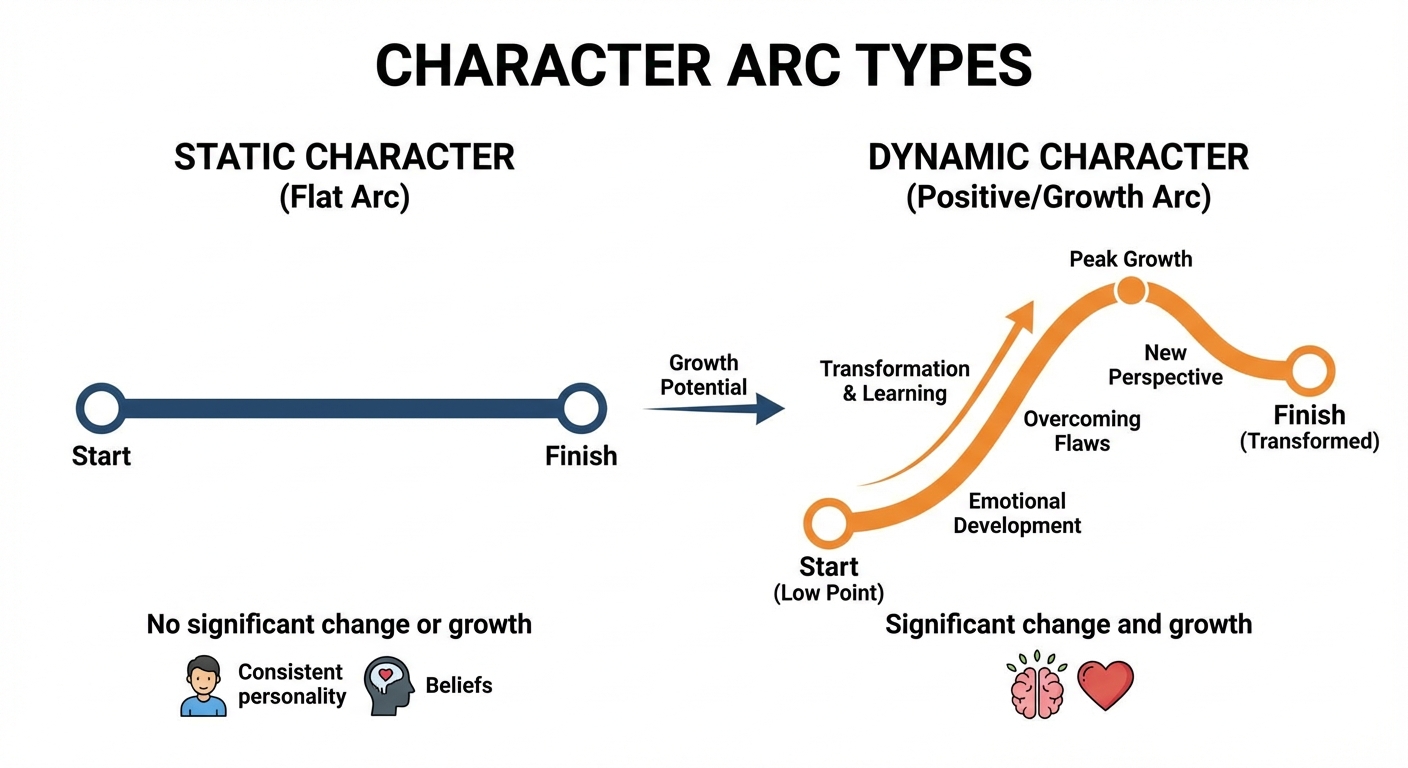
- Dynamic vs. Static:
- Dynamic: Undergoes a significant internal change or epiphany (realization) by the end.
- Static: Remains unchanged throughout the narrative.
- Round vs. Flat:
- Round: Complex, multi-dimensional, fully developed psychological depth.
- Flat: One-dimensional, defined by a single trait or stereotype.
Motivation and Conflict
Characters are driven by motivations (desires, needs, fears). Conflict arises when these key motivations are obstructed.
- Internal Conflict: Competing values or desires within the character (e.g., duty vs. passion).
- External Conflict: Obstacles from outside forces (e.g., society, nature, other characters).
Note: Just because a character does something "bad" doesn't mean they are simply "evil." AP Lit requires you to analyze the complex interplay of their motivations. A thief might steal out of greed (vice) or survival (desperation).
Common Mistakes: Character Analysis
- Moralizing: Do not judge characters as "good" or "bad." Analyze why they act the way they do.
- Confusing Author and Character: Never assume a character's dialogue represents the author's personal beliefs.
- Ignoring Changes: Failing to note if a character has evolved (dynamic) or remained static is a major oversight in analysis.
Setting and Atmosphere
The Function of Setting
Setting is not just a backdrop; it often functions as a character itself or a mirror for the plot. It encompasses three layers:
- Physical Location: Geography, room details, weather.
- Time Period: Historical era, season, time of day.
- Social/Cultural Environment: Social norms, class structure, religious expectations.
Setting as Mood
The description of the setting establishes the Mood (the feeling the reader gets).
- Example: A decaying mansion with dust-covered furniture suggests stagnation, decline, or resistance to change (common in Southern Gothic literature like Faulkner).
Historical and Cultural Values
Details about the setting reveal the values of the society.
- If a story is set in the Victorian era, descriptions of strict clothing or separate drawing rooms highlight social repression and gender roles.
- Macro vs. Micro: Analyze the contrast between the "Micro" setting (a character's bedroom) and the "Macro" setting (the bustling city outside). This often mirrors internal vs. external conflict.
Structure and Plot
Plot Ordering
The arrangement of events is the Structure. A plot is what happens; structure is how it is presented.
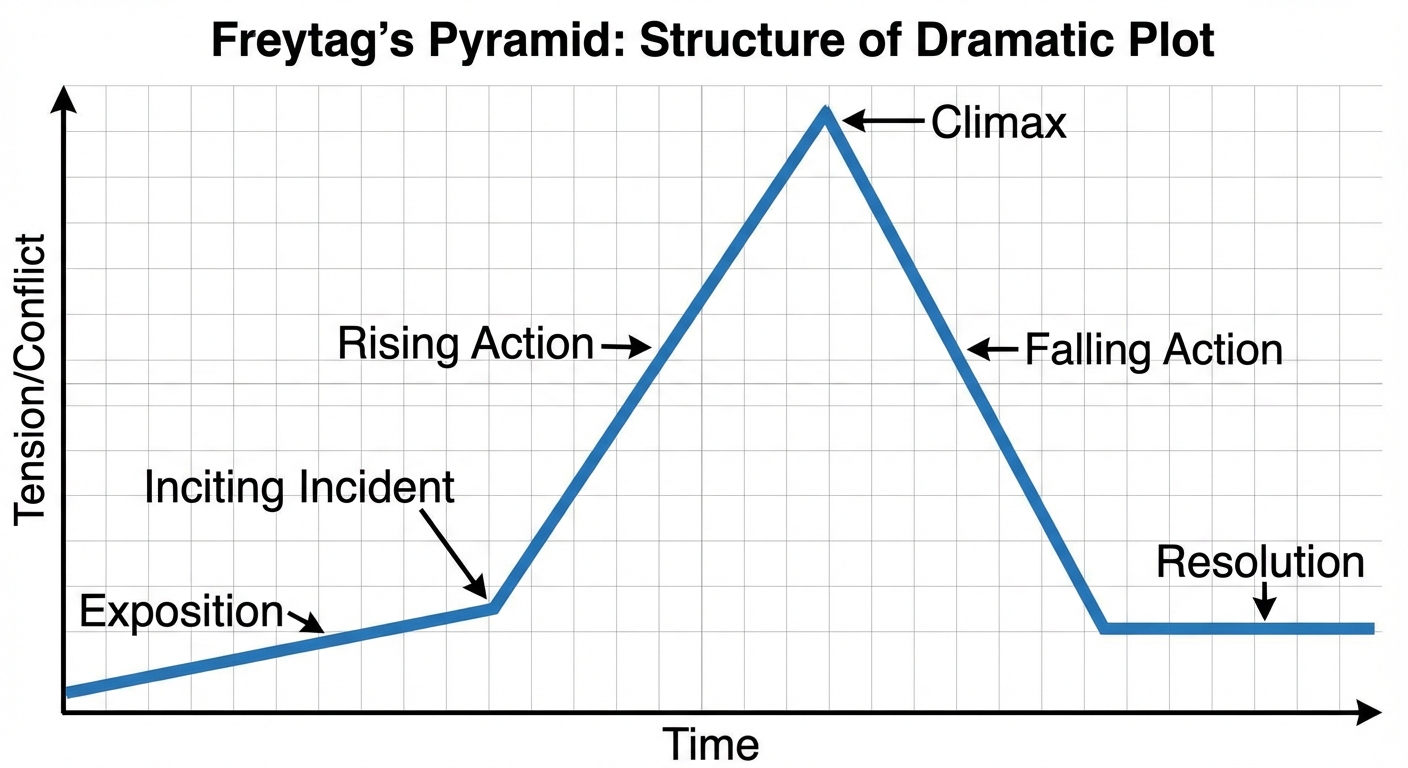
Freytag’s Pyramid (Linear Structure)
The classic narrative arc follows this pattern:
- Exposition: Introduction of characters, setting, and status quo.
- Inciting Incident: The event that disrupts the status quo and launches the conflict.
- Rising Action: Complications, increasing tension, and development of obstacles.
- Climax: The turning point or moment of highest tension; the point of no return.
- Falling Action: The aftermath of the climax; loose ends begin to wrap up.
- Resolution (Dénouement): The final outcome; a new status quo is established.
Non-Linear Manipulations
Authors often manipulate time to control pacing or reveal information strategically:
- In Media Res: Starting "in the middle of things" without exposition. This hooks the reader immediately and creates mystery.
- Flashback (Analepsis): Interrupting current events to show the past. This provides context or explains character motivation.
- Foreshadowing: Hints or clues about future events.
- Stream of Consciousness: A narrative mode that attempts to depict the multitudinous thoughts and feelings which pass through the mind of a narrator.
Pacing
Pay attention to how much text is devoted to a specific event.
- Slow Pacing: Detailed description, internal monologue. Used for significant moments or to build tension.
- Fast Pacing: Rapid dialogue, short sentences, skipping time. Used for action or transitions.
Narrator and Perspective
Point of View (POV)
The "lens" through which the story is told.
First-Person ("I")
- Effect: Intimate and immediate.
- Risk: Highly subjective. The narrator may be Unreliable due to bias, madness, innocence (child narrator), or ignorance.
Third-Person Limited ("He/She/They")
- Effect: Focuses on the thoughts/feelings of only one character (usually the protagonist).
- Constraint: The reader only knows what that specific character knows or sees.
Third-Person Omniscient
- Effect: The "God-like" narrator who knows everything about all characters.
- Utilty: Can provide objective context, contrast differents characters' internal thoughts, or offer moral judgment.
Perspective vs. Point of View
This is a critical AP distinction:
- POV is the grammatical vantage point (1st, 3rd person).
- Perspective is the specific worldview, values, and background that influence how the narrator or character perceives events.
Example: Two characters might both be described in Third-Person Limited (POV). However, if one is a wealthy prince and the other is a beggar, their perspectives on a feast will be entirely different.
Introductory Literary Argumentation
The Thesis Statement
In AP Lit, you must make a defensive claim. A strong thesis goes beyond summarizing the plot.
- Weak: In "The Story of an Hour," the author uses irony to show the character is sad.
- Strong: Through the use of dramatic irony and shifting narrative perspective, Chopin portrays the protagonist's grief not as a tragedy, but as a complex catalyst for a fleeting, forbidden joy.
Evidence and Commentary
Use the "Claim - Evidence - Commentary" structure for body paragraphs:
- Claim: A sub-argument supporting your thesis.
- Evidence: Direct quotes or specific paraphrases. Embedded smoothly into your own sentences.
- Commentary: The "So What?" Explain how the evidence proves the claim. Do not just restate the quote.
Common Mistakes: Argumentation
- Summary over Analysis: Retelling the story instead of explaining how the author creates meaning.
- "Armchair Psychology": Diagnosing characters with modern mental illnesses instead of analyzing them as literary constructs.
- Floating Quotes: Dropping a quote into a paragraph without introducing it or integrating it grammatically.