Unit 2: Networks of Exchange (c. 1200 – c. 1450)
The Silk Roads
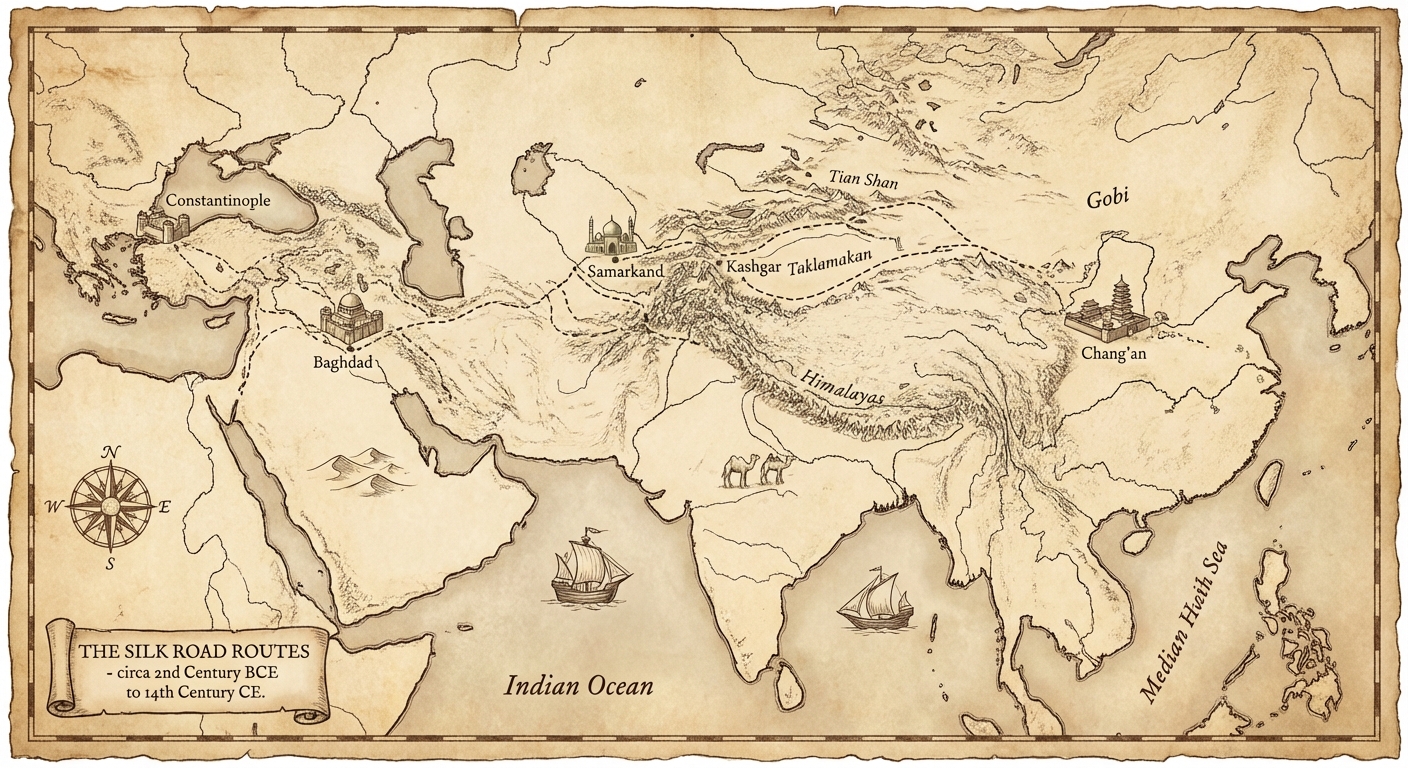
The Silk Roads were not a single road, but a vast network of overland trade routes connecting East Asia (China) to the Mediterranean (Europe) and North Africa. During the period 1200–1450, these routes flourished due to the stability provided by large empires (specifically the Mongols).
Causes of Growth
- Rise of New Empires: The Abbasid Caliphate and later the Mongol Empire unified large stretches of territory. This political stability promoted safe trade.
- Demand for Luxury Goods: Europe and Africa demanded Chinese silk, porcelain, and tea, while China sought horses, silver, and gold. Because overland transport was expensive, merchants focused on high-value, low-weight luxury goods.
Technological & Commercial Innovations
To manage the risks of long-distance trade, merchants and governments developed several key innovations:
- Caravanserai: Roadside inns located about 100 miles apart (the distance a camel could travel before needing water). They provided safety, rest, and animal exchange for merchants.
- Money Economy:
- Flying Cash: Developed in China; a system of credit allowing a merchant to deposit paper money in one location and withdraw it in another.
- Banking Houses: European precursors to modern banks where Bills of Exchange (a document stating the holder was legally promised a set payment) were used. This eliminated the danger of carrying heavy gold coins.
Major Trading Cities
Cities along the routes grew into centers of cultural exchange, not just commerce.
- Kashgar: Located at the western edge of China where northern and southern Silk Road routes crossed. Fueled by water from the Tianshan Mountains, it became a major Islamic center.
- Samarkand: Located in modern-day Uzbekistan; a cultural melting pot where Christianity, Buddhism, Zoroastrianism, and Islam co-existed before Islam became dominant. Known for magnificent mosques and mausoleums.
Common Mistakes: Silk Roads
- Mistake: Thinking the Silk Road was a paved highway. Correction: It was a series of shifting dirt paths and trails.
- Mistake: Assuming only goods traveled. Correction: The most significant impacts were arguably "invisible"—the spread of Buddhism, Islam, and the Bubonic Plague (Black Death).
The Mongol Empire and the Making of the Modern World
The Mongols were pastoral nomads from the Central Asian steppes who created the largest contiguous land empire in history. Their impact on trade is summarized by the concept of Pax Mongolica (Mongol Peace).
Rise of the Mongols
Under Genghis Khan (Temujin), the Mongols unified rival clans using:
- Adaptability: They mastered horsemanship and the short bow, but also adopted siege warfare and gunpowder technologies from the Chinese and Persians.
- Meritocracy: Promotion in the army was based on ability, not family lineage.
The Pax Mongolica & Economic Impact
Once the empire was established, the Mongols prioritized trade:
- Security: They heavily policed the Silk Roads, punishing bandits ruthlessly. It was said one could walk from Rome to Beijing with a gold plate on their head and not be robbed.
- Infrastructure: They built bridges and maintained the courier system (Yam system).
Cultural & Technological Transfers
The Mongols forcibly relocated administrators, scientists, and doctors to where they were needed, leading to massive cross-cultural exchange:
- Islamic Medical Knowledge: Moved to China.
- Printing & Gunpowder: Moved from China to the Islamic world and Europe.
- Uyghur Script: Adopted as the official alphabet of the Mongol Empire.
The Collapse
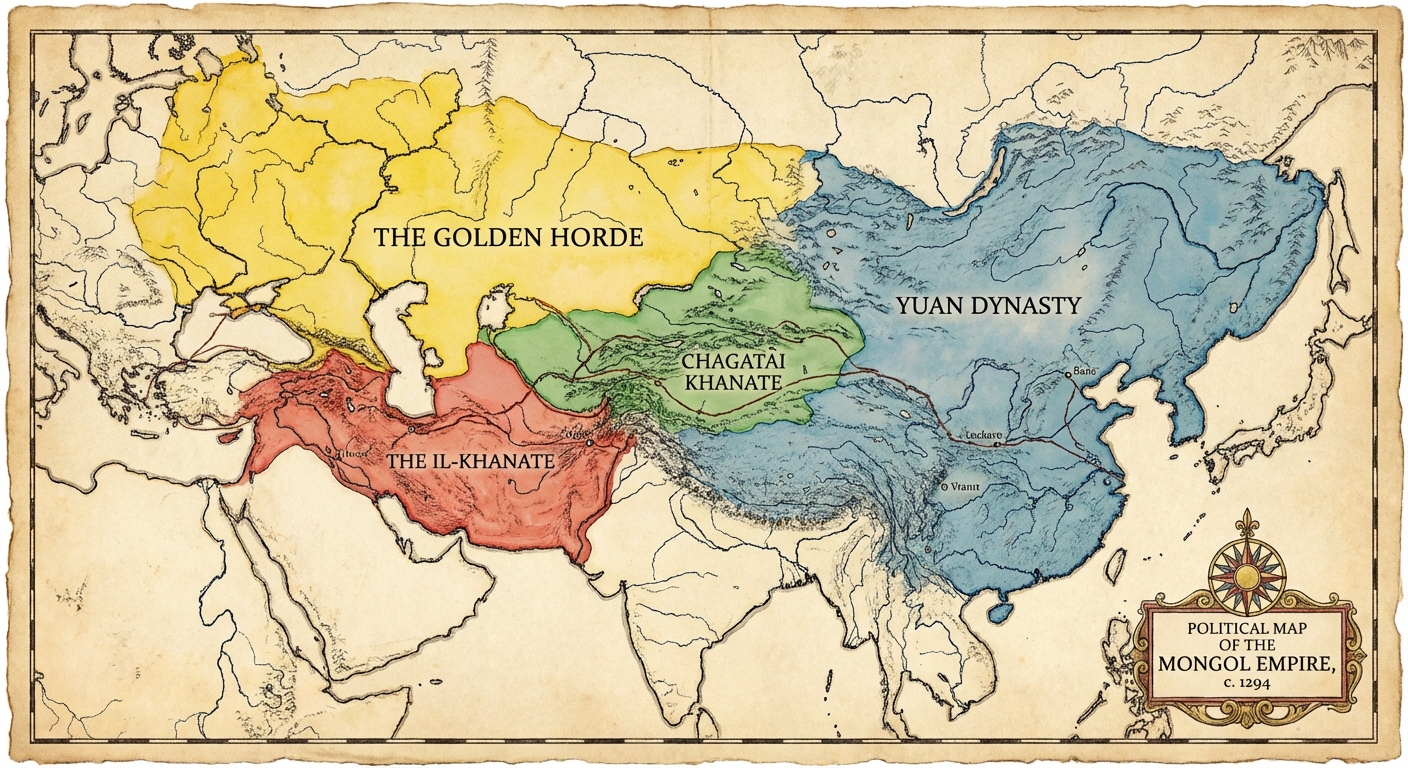
After Genghis Khan's death, the empire split into four Khanates:
- Golden Horde: Russia (tribute system).
- Il-Khanate: Middle East/Persia (converted to Islam).
- Chagatai Khanate: Central Asia.
- Yuan Dynasty: China (established by Kublai Khan; dismantled the civil service exam).
Exchange in the Indian Ocean
While the Silk Roads focused on luxury goods, the Indian Ocean allowed for the transport of bulk goods (timber, grain, spices) because ships could carry heavier loads than camels. This was the world's largest sea-based network until the late 15th century.
Environmental Knowledge: Monsoon Winds
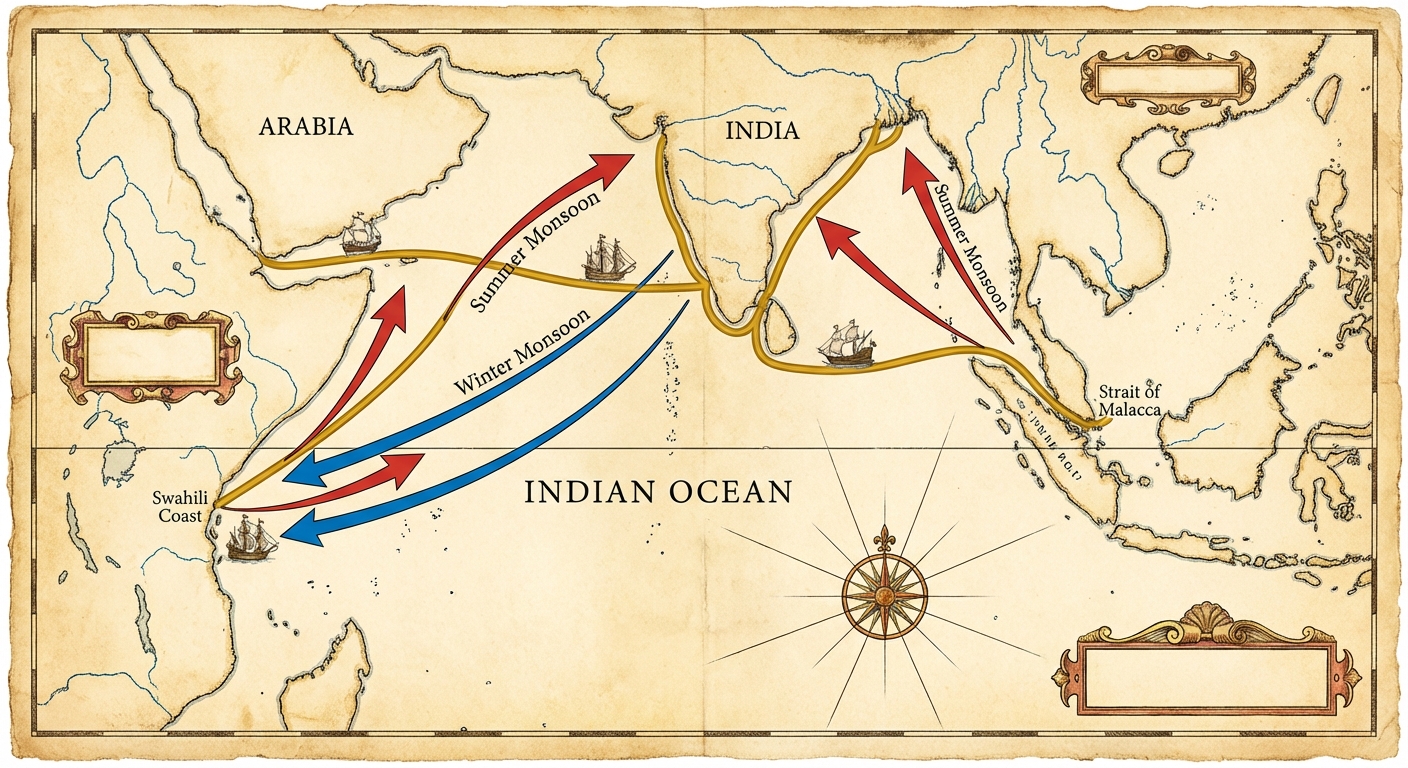
Understanding the environment was the key to this network. Monsoons are seasonal winds:
- Winter: Winds blow from Northeast (India) down to Africa.
- Summer: Winds blow from Southwest (Africa) up to India.
- Impact: Merchants had to wait for favorable winds, leading them to stay in port cities for months. This created Diasporic Communities (settlements of people away from their homeland) where cultures merged (e.g., Arab merchants in India, Chinese merchants in SE Asia).
Technological Innovations
- Lateen Sail: Triangular sail allowing ships to tack against the wind.
- Stern-rudder: Improved steering and stability (invented in China).
- Astrolabe: Allowed sailors to calculate latitude.
- Dhows: Traditional Arab ships.
- Junks: Massive Chinese ships (notably used by Admiral Zheng He).
Key States & Regions
- Swahili City-States: Located effectively on the East African coast (e.g., Kilwa, Mombasa). They traded gold, ivory, and enslaved people for Asian pottery and cloth. This interaction created the Swahili language (Bantu + Arabic).
- Sultanate of Malacca: Controlled the strategic Strait of Malacca (gateway between Indian Ocean and South China Sea). They became wealthy by taxing passing ships.
- Gujarat: A western Indian Rajput kingdom that became the go-to stopover for trade between East and West.
Common Mistakes: Indian Ocean
- Mistake: Believing Europeans dominated this trade in the 1200–1450 period. Correction: Europeans were almost entirely absent until Vasco da Gama arrived in 1498. This network was dominated by Muslim, Chinese, and Indian merchants.
Trans-Saharan Trade Routes
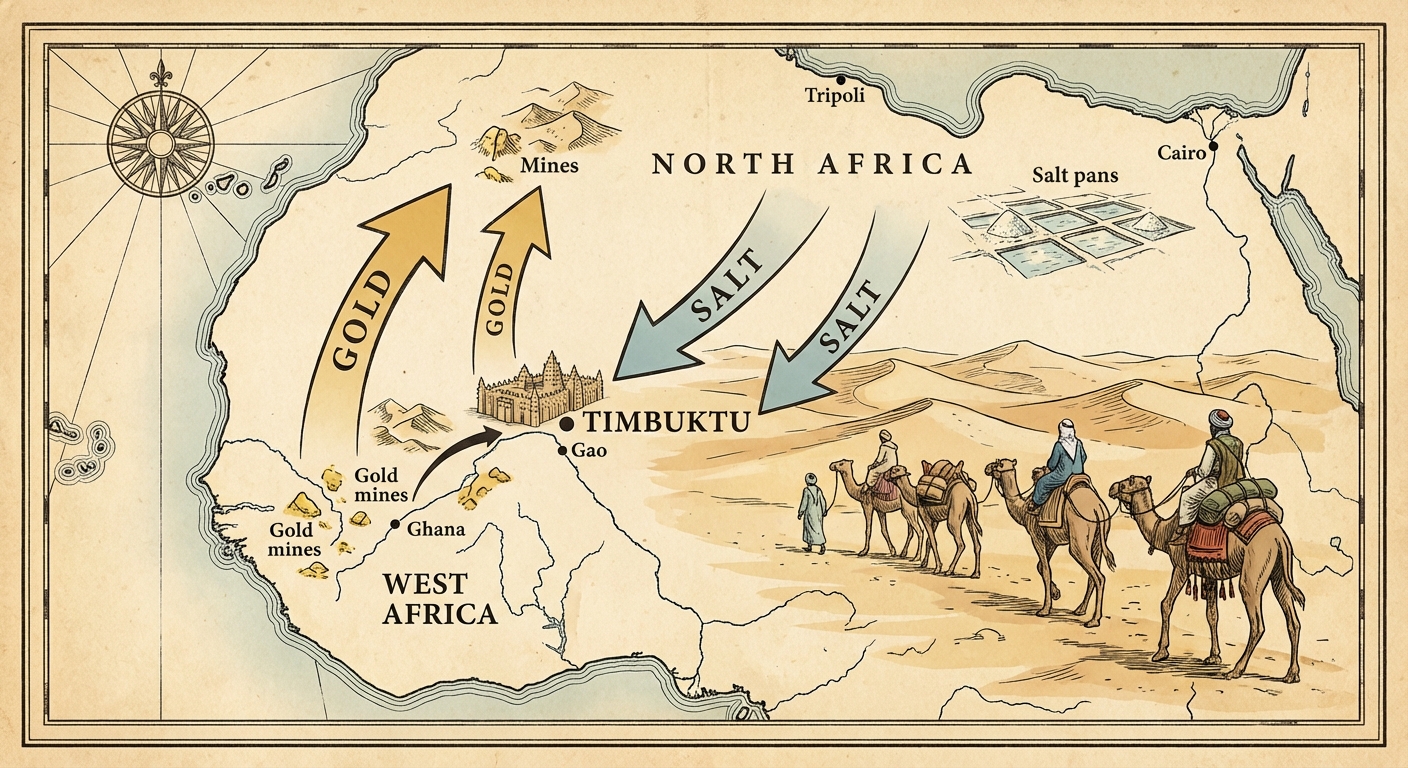
This network connected West Africa (Sub-Saharan) to the Mediterranean / Islamic World (North Africa). The driving force was the demand for two specific commodities: Gold and Salt.
Technology: The Camel
The introduction of the camel (and the camel saddle) transformed this region. Camels could consume 50 gallons of water and survive for long periods in the desert, acting as the "ships of the desert."
The Gold-Salt Trade
- West Africa: Rich in gold, but lacked salt (necessary for preserving food and human survival).
- North Africa: Rich in salt, but desired gold.
- Result: A massive exchange network facilitated by Muslim merchants.
Empire of Mali
Replacing the Ghana Empire, Mali rose as the dominant power.
- Mansa Musa: The ruler of Mali (14th century) known as the richest man in history. His pilgrimage (Hajj) to Mecca displayed Mali's wealth to the world, distributing so much gold that he caused inflation in Cairo.
- Timbuktu: Originally a campsite, it grew into a world-renowned center of Islamic learning and trade. Books were essentially the most valuable commodity here.
Cultural Consequence: Islam in West Africa
Unlike North Africa (where Islam arrived via conquest), Islam arrived in West Africa via trade. Rulers (like Mansa Musa) adopted Islam to strengthen trade ties with the north, though they often blended it with local animist traditions.
Comparison Table: Networks of Exchange
| Feature | Silk Roads | Indian Ocean | Trans-Saharan |
|---|---|---|---|
| Primary Transport | Horses, Camels | Dhows, Junks | Camels |
| Key Goods | Luxury: Silk, Porcelain, Textiles | Bulk: Spices, Timber, Textiles | State: Gold, Salt, Slaves |
| Primary Religion Spread | Buddhism, Neoconfucianism, Islam | Islam, Buddhism, Hinduism | Islam |
| Geographic Focus | Eurasia (East-West) | Maritime (Africa-Asia) | Africa (North-South) |
5 Common Mistakes on the AP Exam (Unit 2)
- Thinking the Mongols invented technology.
- Correction: Mongols rarely invented; they facilitated. They moved the gunpowder from China to the Middle East, but they didn't create it.
- Confusing the "tribute system" with direct rule.
- Correction: In places like Russia (Golden Horde) and China (Yuan), the Mongols often used local bureaucrats to manage daily affairs or demanded tribute rather than micro-managing day-to-day laws.
- Ignoring the environment.
- Correction: You cannot explain Indian Ocean trade without the Monsoons, or Trans-Saharan trade without the arid desert conditions necessitating camels.
- Assuming trade only benefits the rich.
- Correction: While elites bought the silk, the demand for these goods reshaped labor practices for peasants (e.g., caused Chinese producers to focus on silk rather than food crops).
- Forgetting the Black Death.
- Correction: The plague is a direct consequence of the stability of the Silk Roads. No trade ships = no plague rats in Europe.