Comprehensive Guide to Fluid Dynamics in AP Physics 1
Introduction to Ideal Fluids
Before diving into the math of moving fluids, it is crucial to understand the assumptions made in AP Physics 1. Real fluids can be messy and chaotic, so we model them as Ideal Fluids to simplify calculations.
For a fluid to be considered "ideal" in this course, it must meet four specific criteria:
- Incompressible: The density ($\rho$) of the fluid remains constant. (This is generally true for liquids like water, but less so for gases).
- Non-viscous: There is no internal friction (viscosity) between layers of the fluid. It flows freely without resistance.
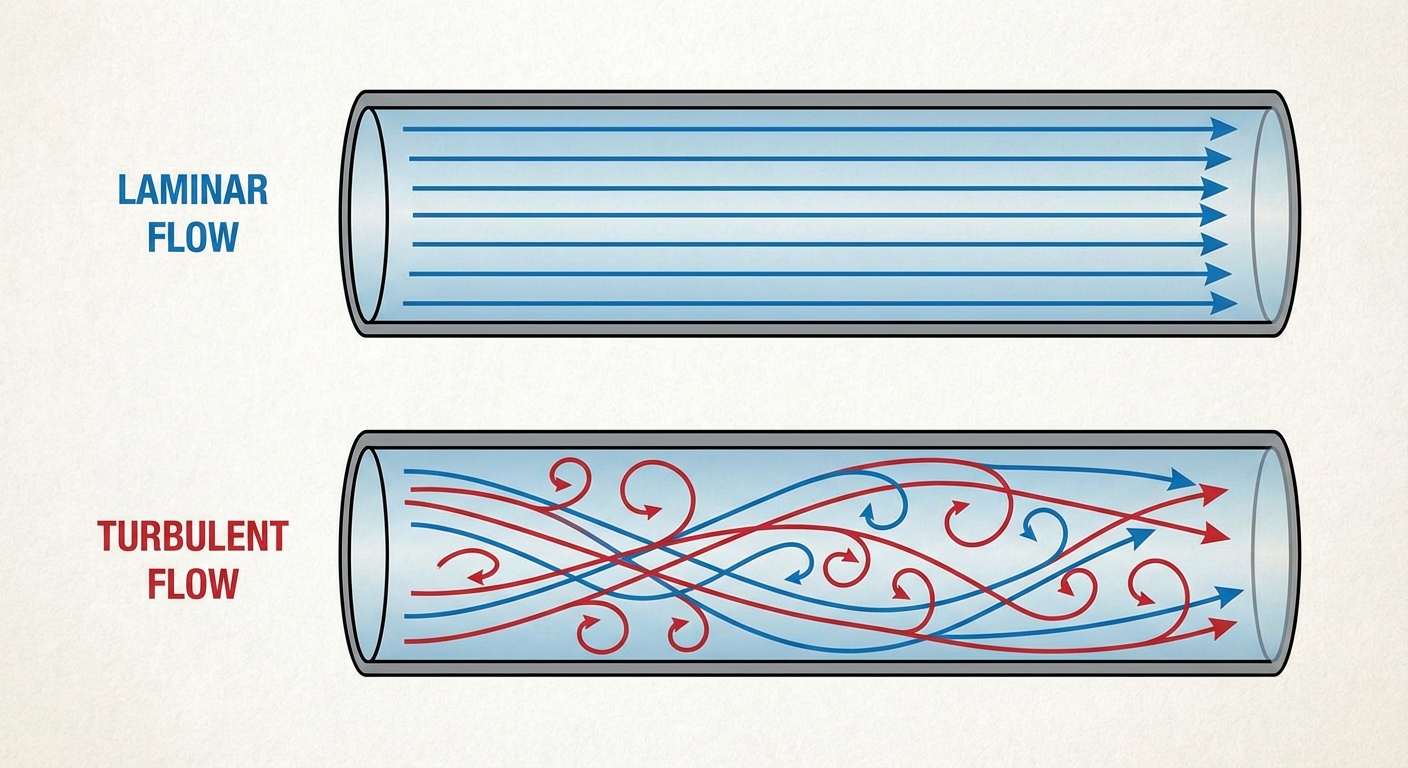
- Laminar Flow: The fluid moves in smooth paths or streamlines. These paths do not cross. We assume there is no turbulence.
- Irrotational: A small wheel placed in the fluid would not rotate about its own axis; the fluid flows without eddies.
Fluids and Conservation Laws
Fluid dynamics in AP Physics 1 is essentially the application of two fundamental conservation laws: Conservation of Mass and Conservation of Energy.
Conservation of Mass: The Continuity Equation
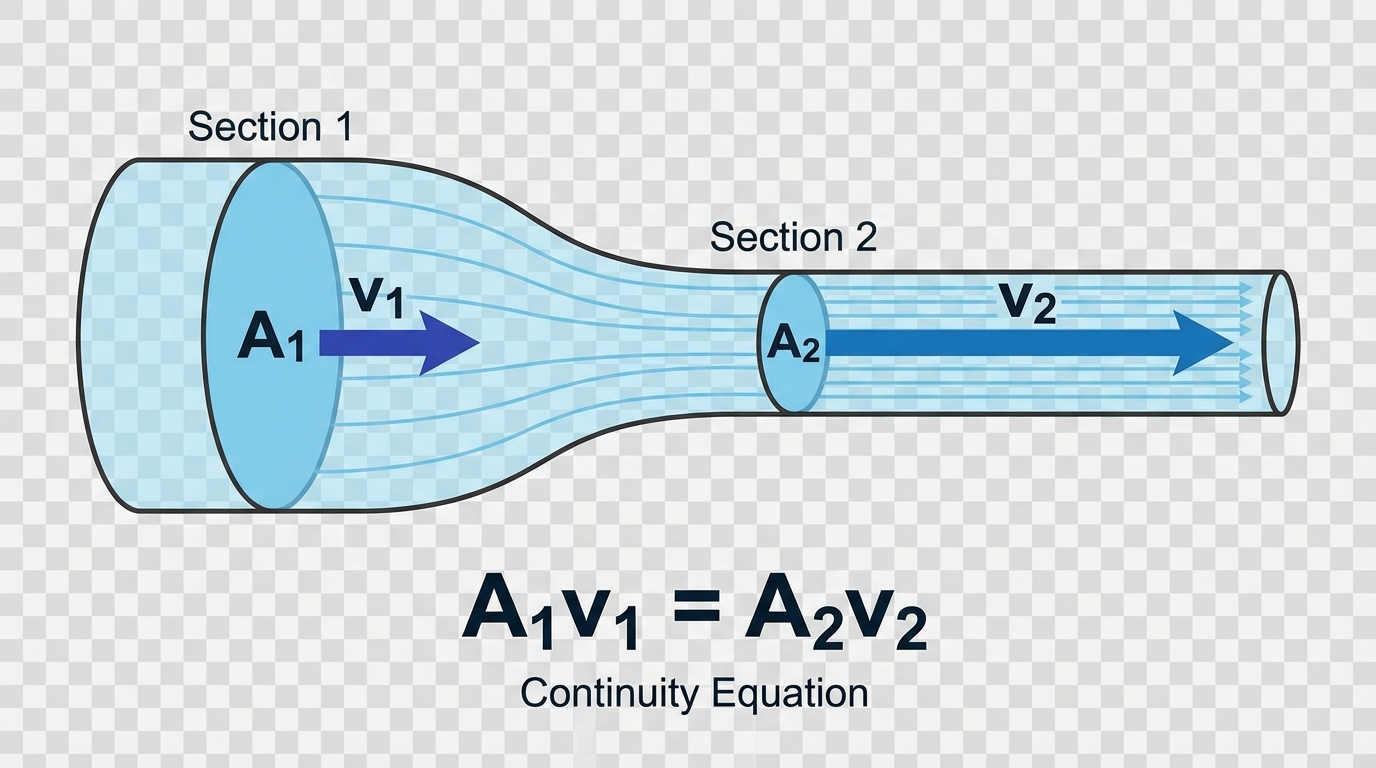
Because ideal fluids are incompressible, mass cannot be created or destroyed, nor can it "bunch up" inside a pipe. Therefore, the amount of fluid entering a pipe must equal the amount of fluid exiting it in the same amount of time.
We define the Volume Flow Rate ($Q$) as the volume of fluid ($V$) passing a point per unit time ($t$):
where:
- $A$ is the cross-sectional area of the pipe ($m^2$)
- $v$ is the velocity of the fluid ($m/s$)
The Continuity Equation:
Since the flow rate must be constant throughout a closed system:
Key Consequence:
If the area of the pipe decreases, the velocity of the fluid must increase to maintain the same flow rate. This is why putting your thumb over the end of a garden hose (decreasing $A$) causes the water to spray out faster (increasing $v$).
Conservation of Energy: Bernoulli’s Equation
Bernoulli's Principle is arguably the most important concept in fluid dynamics. It is effectively the Work-Energy Theorem applied to fluids. It relates pressure, flow speed, and height.
Consider a fluid moving through a pipe that changes height and thickness. The total energy per unit volume must remain constant.
Bernoulli’s Equation:
Where:
- $P$ = Absolute Pressure ($Pa$ or $N/m^2$)
- $\rho$ = Density of the fluid ($kg/m^3$)
- $g$ = Acceleration due to gravity ($9.8\; m/s^2$)
- $y$ = Vertical height ($m$)
- $v$ = Fluid velocity ($m/s$)
Breaking Down the Terms
The equation is composed of three energy densities:
- $P$: Variable representing internal energy (Pressure energy density).
- $\rho g y$: Gravitational potential energy per unit volume.
- $\frac{1}{2}\rho v_2^2$: Kinetic energy per unit volume.
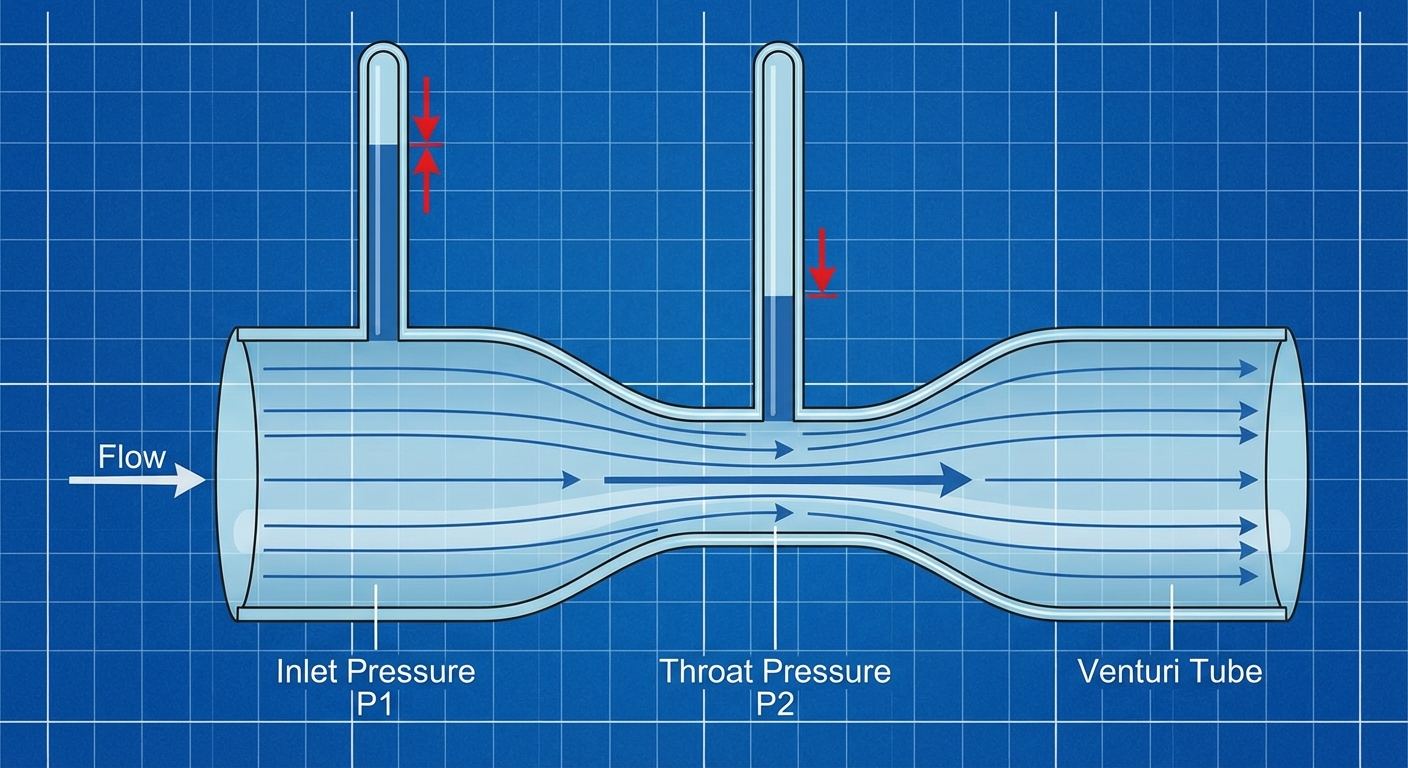
The Bernoulli Effect:
If height ($y$) remains constant, an increase in velocity results in a decrease in pressure.
Note: This is counter-intuitive for many students! You might think fast-moving water hits "harder" (Force), but inside the stream itself, the internal pressure against the walls of the pipe is lower.
Fluids and Newton's Laws
While Bernoulli's equation is derived from energy conservation, we can also analyze fluids using Newton's Second Law ($F_{net} = ma$).
Pressure Gradients as Forces
Why does a fluid accelerate? According to Newton's laws, an acceleration requires a net force. In fluids, this force is provided by a difference in pressure.
- Fluids naturally flow from areas of High Pressure to Low Pressure.
- If you look at a chunk of water entering a bottleneck, the pressure behind it is higher than the pressure in front of it (due to the Bernoulli effect). This pressure gradient creates a net force forward, causing the fluid to accelerate.
Relationship between Pressure Difference and Force:
Application: Torricelli’s Theorem
A classic application of Newton's Laws and Conservation principles is a tank with a small hole (orifice) near the bottom. We want to find the speed of the water shooting out.
Using Bernoulli's Equation comparing the top surface (1) and the hole (2):
- $P1 = P{atm}$ and $P2 = P{atm}$ (both open to air).
- $v_1 \approx 0$ (if the tank is large, the water level drops very slowly).
- Set height at the hole $y2 = 0$ and top surface $y1 = h$.
The equation simplifies to:
Solving for $v$ yields Torricelli's Law:
Notice this is identical to the kinematic equation for an object dropped from rest ($v^2 = v_0^2 + 2g\Delta y$). This reinforces the connection between Fluid Dynamics and standard Newtonian mechanics.
Comparison Table: Mechanics vs. Fluids
| Concept | Solid Mechanics | Fluid Mechanics |
|---|---|---|
| Inertia | Mass ($m$) | Density ($\rho$) |
| Motion | Velocity ($v$) | Flow Rate ($Q$) or Velocity ($v$) |
| Cause of Motion | Force ($F$) | Pressure Difference ($\Delta P$) |
| Conservation | Conservation of Energy | Bernoulli's Equation |
Worked Example
Problem:
A horizontal pipe carries water ($\rho = 1000\; kg/m^3$). At point A, the radius is $0.20\; m$ and the speed is $2.0\; m/s$. The pipe narrows to a radius of $0.10\; m$ at point B.
- Calculate the speed of the water at point B.
- If the pressure at point A is $200,000\; Pa$, what is the pressure at point B?
Solution:
Part 1: Continuity Equation
Calculate Areas ($A = \pi r^2$):
- $A_A = \pi (0.20)^2 = 0.04\pi\; m^2$
- $A_B = \pi (0.10)^2 = 0.01\pi\; m^2$
Apply $AA vA = AB vB$:
Part 2: Bernoulli’s Equation
Since the pipe is horizontal, $yA = yB$, so we can remove the potential energy terms.
Substitute known values:
Result check: The speed increased at B, and the pressure decreased. This satisfies Bernoulli's principle.
Common Mistakes & Pitfalls
Confusing Flow Rate ($Q$) with Velocity ($v$):
- Mistake: Thinking that because the pipe gets smaller, the amount of water coming out decreases.
- Correction: In a continuous system, Flow Rate ($m^3/s$) is constant everywhere. Velocity ($m/s$) changes.
The "High Speed = High Pressure" Fallacy:
- Mistake: Thinking that fast-moving air or water exerts higher pressure. (e.g., "The wind pushes hard, so it must be high pressure").
- Correction: Dynamic impact force is different from internal fluid pressure. Fast-moving fluids exert lower internal pressure (Bernoulli). This is how airplane wings generate lift.
Forgetting to Square the Radius:
- Mistake: When using the continuity equation, assuming if the radius is halved, the velocity doubles.
- Correction: Area depends on $r^2$. If radius is halved, Area is $1/4$ size, so velocity creates a factor of $4$.
Unit Inconsistencies:
- Mistake: Using ATM for pressure in Bernoulli's equation while using metric units for density and velocity.
- Correction: Always convert Pressure to Pascals ($Pa$) and density to $kg/m^3$ before calculating.