Comprehensive Study Guide: Energy Resources and Consumption
Energy Fundamentals & Thermodynamics
Only Physics You Need for APES
Before diving into specific resources, you must understand the rules governing energy transfer and measurement.
Forms of Energy
- Kinetic Energy: Energy of motion (e.g., wind blowing, water flowing through a dam).
- Potential Energy: Stored energy (e.g., water behind a dam, chemical bonds in coal).
- Thermal Energy: Heat generated by the movement of molecules.
The Laws of Thermodynamics
- First Law: Energy cannot be created or destroyed, only transformed.
- Implication: You can't get something from nothing. The energy in a piece of coal is not "lost" when burned; it converts to heat, light, and sound.
- Second Law: When energy is transformed, the quantity changes, but its ability to do work diminishes. Entropy (disorder) increases.
- Implication: No system is 100% efficient. We always lose high-quality energy to low-quality heat during conversion (e.g., electricity transmission, combustion).
Essential Units of Measurement
You must be able to convert between these units on the exam.
- Examples of Energy Units: Joules (J), Calorie (cal), British Thermal Unit (Btu), Kilowatt-hour (kWh).
- Examples of Power Units: Watt (W), Horsepower (hp).
The Power vs. Energy Formula:
Or commonly for electricity billing:
Note: A 100-Watt bulb left on for 10 hours uses 1,000 Watt-hours, or 1 kWh of energy.
6.2 Global Energy Consumption
Trends in Use
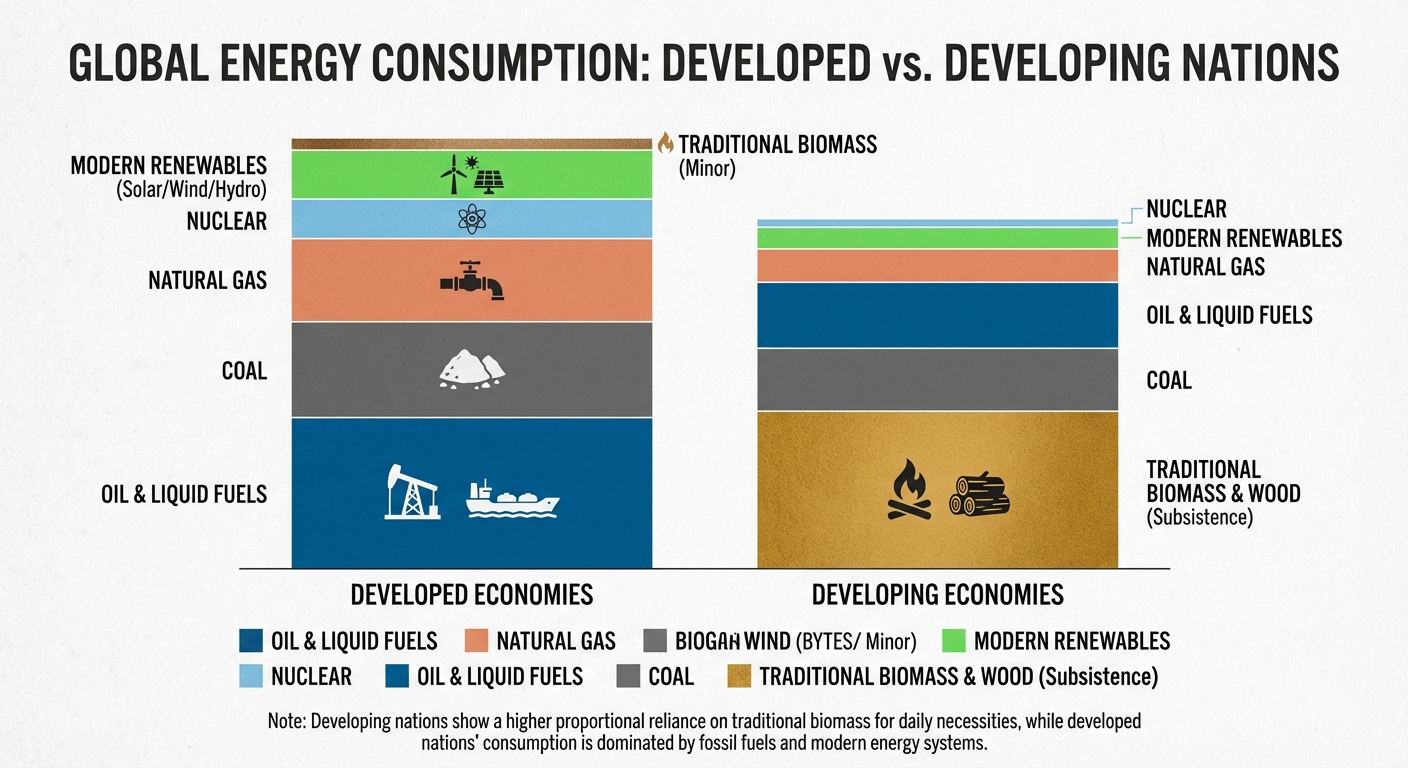
- Developed Nations: Use more commercial energy (bought and sold, like oil/coal/nuclear) per capita.
- Developing Nations: Rely heavily on subsistence energy (biomass like wood, charcoal, animal dung) for heating and cooking.
- Industrialization: As countries develop (e.g., China, India), their demand for fossil fuels increases, shifting from biomass to coal/oil, creating pressure on global prices and increasing emissions.
Energy Return on Energy Investment (EROEI)
This concept measures the efficiency of a fuel source.
- High EROEI: Coal, Oil, Wind (You get a lot out for a little effort).
- Low EROEI: Ethanol from corn (Requires massive energy for farming/distilling), Tar Sands.
6.3 - 6.5 Fossil Fuels
Coal
A solid fuel formed primarily from the remains of trees/ferns preserved 280-360 million years ago.
Types of Coal (By Age/Quality)
Ordered from lowest energy/highest moisture to highest energy/lowest moisture:
- Peat: Pre-coal; partially decayed plant matter (swampy).
- Lignite: Brown coal; low heat, creates lots of smoke.
- Bituminous: Soft coal; high sulfur content (causes acid rain). Most common for electricity.
- Anthracite: Hard coal; highest energy density, lowest sulfur, very rare.
Extraction & Pollution
- Methods: Surface mining (mountaintop removal) vs. Subsurface mining.
- Combustion Impacts: Releases $CO2$ (Greenhouse Gas), $SO2$ (Acid Rain), Mercury (Neurotoxin), and Particulates (Ash/Smog).
"Clean" Coal Technology
Techniques to reduce pollutants, NOT specifically $CO_2$ (though CCS attempts this).
- Scrubbers: Spray wet limestone slurry into exhaust to neutralize $SO_2$.
- Electrostatic Precipitators: Use electrical charge to attract and trap particulates (ash/dust).
- Fluidized Bed Combustion: Burning granulated coal near calcium carbonate to absorb $SO2$ and burn at lower temps (reducing $NOx$).
Oil (Petroleum)
A liquid fluid formed from ancient marine phytoplankton buried under ocean sediments.
Refinement
Crude oil is useless until refined via Fractional Distillation.
- Process: Oil is boiled; different components condense at different temperatures based on boiling points.
- Products: Tar/Asphalt (bottom) $\rightarrow$ Diesel $\rightarrow$ Gasoline $\rightarrow$ Jet Fuel $\rightarrow$ Gases (top).
Cogeneration
The use of a fuel to generate electricity and produce heat forms simultaneously.
- Efficiency: Increases purely from ~35% to ~80-90% because "waste heat" is captured for heating buildings.
Natural Gas
Methane ($CH_4$) found often alongside oil or coal beds.
- Pros: The "cleanest" fossil fuel. Emits almost no $SO2$ or mercury, and significantly less $CO2$ than coal.
- Cons: Methane leaks are potent greenhouse gases (80x worse than $CO_2$).
Hydraulic Fracturing (Fracking)
A method to extract gas/oil from tight shale rock.
- Drill: Go vertical, then turn 90 degrees horizontally.
- Inject: High-pressure water, sand, and proprietary chemicals.
- Fracture: Rock cracks; sand keeps cracks open, gas flows out.
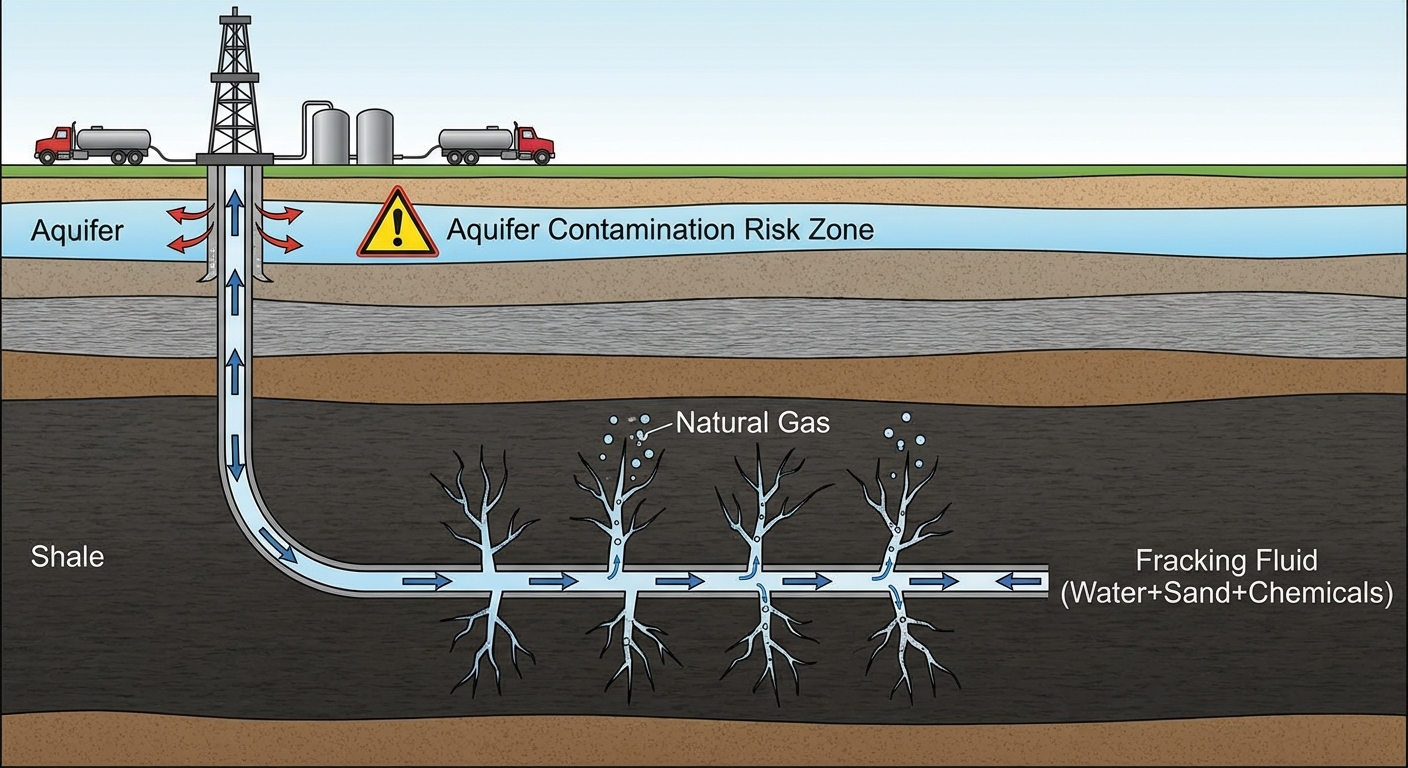
Environmental Risks of Fracking:
- Groundwater contamination (from casing leaks or fluid mishandling).
- Induced earthquakes (from wastewater injection).
- Excessive water consumption in arid regions.
6.6 Nuclear Energy
The Process: Fission
Nuclear plants do not burn fuel. They use fission (splitting atoms) to generate heat, creating steam to turn a turbine.
- Isotopes: Uranium-235 is the fuel. It is hit by a neutron, splits into smaller elements (like Barium and Krypton), and releases heat + more neutrons.
Reactor Components
- Fuel Rods: Tubes containing U-235 pellets.
- Control Rods: Inserted between fuel rods to absorb neutrons and slow/stop the reaction.
- Coolant: Keeps the core producing steam without melting.
Advantages vs. Disadvantages
| Pros | Cons |
|---|---|
| No $CO_2$ emissions during generation | Radioactivity remains dangerous for 10,000+ years |
| High energy density (small amount of fuel = massive energy) | Thermal pollution (hot water kills fish) |
| Reliable base-load power | High construction/decommissioning costs |
Famous Accidents
- Three Mile Island (USA, 1979): Partial meltdown due to valve failure. No known deaths, but public fear spiked.
- Chernobyl (Ukraine, 1986): Complete meltdown and explosion. Spread radiation over Europe. Thousands of cancer deaths.
- Fukushima (Japan, 2011): Tsunami caused cooling system failure. Triple meltdown.
Radioactive Half-Life
The time it takes for half of a sample to decay.
(Where $n$ = number of half-lives elapsed)
Renewable Resources
6.7 Biomass
Burning organic matter for heat/energy.
- Modern Carbon vs. Fossil Carbon: Burning biomass releases $CO2$, but it is considered "carbon neutral" theoretically because that $CO2$ was recently pulled from the atmosphere by the plant (unlike coal, which adds "new" carbon from millions of years ago).
Biofuels
- Ethanol: Fermented starches/sugars (corn/sugarcane). Mixed with gasoline.
- Issue: Low EROEI; competes with food prices.
- Biodiesel: Extracted from oils (soybean, palm, algae). Used in diesel engines.
6.8 Solar Energy
Passive vs. Active
- Passive Solar: No mechanics/moving parts. Uses building design (south-facing windows, stone floors for thermal mass) to heat buildings.
- Active Solar: Uses pumps/fluids. (e.g., Solar water heaters on roofs).
Photovoltaic (PV) Cells
Convert sunlight directly into electricity.
- Mechanism: Sunlight hits silicon strikes electrons loose, creating a current.
- Pros: No emissions, scalable.
- Cons: Intermittent (needs battery storage), mining for rare earth metals.
Concentrated Solar Power (CSP)
Uses mirrors to focus light on a central tower to melt salt/boil water $\rightarrow$ Steam $\rightarrow$ Turbine.
6.9 Hydroelectric Power
Methods
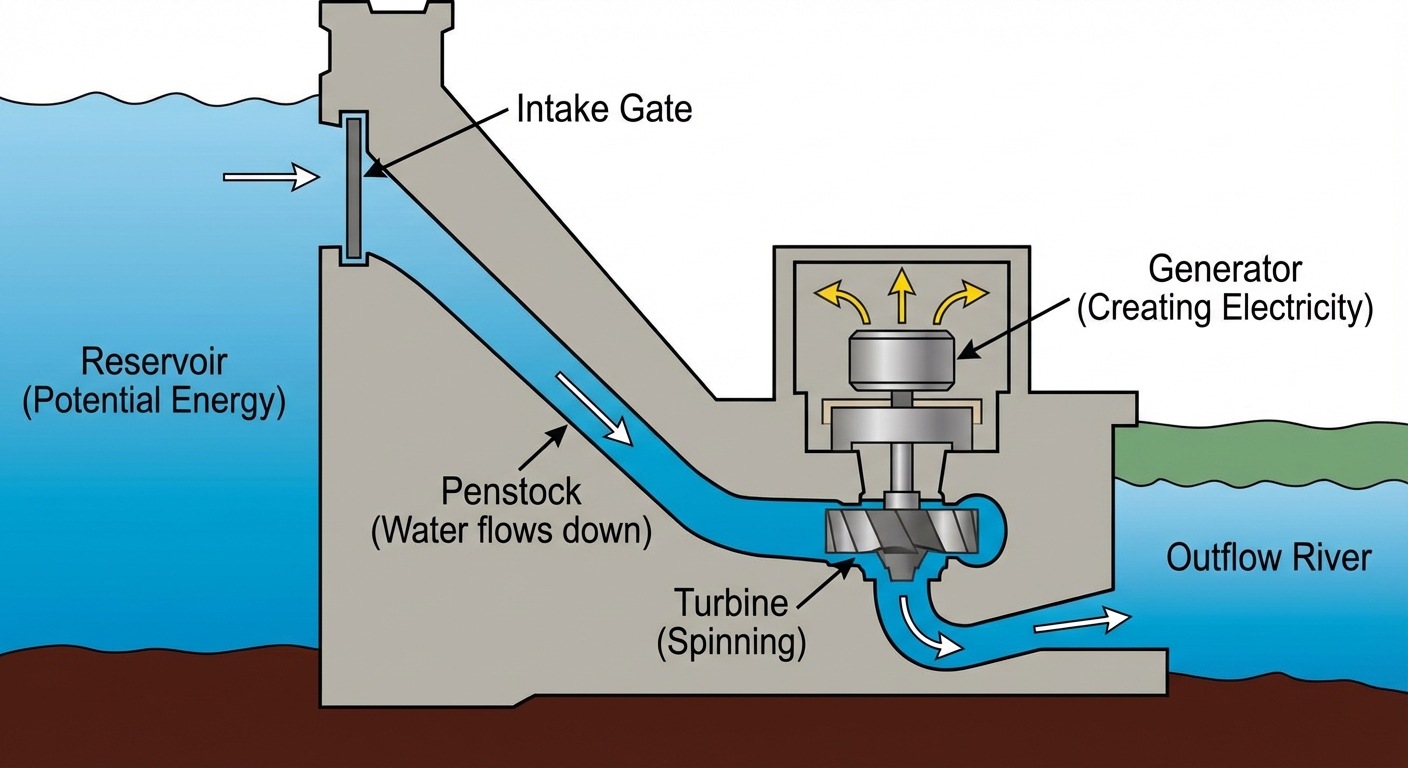
- Water Impoundment (Dams): Large reservoir. Reliable power.
- Impacts: Siltation (sediment builds up behind dam, depriving downstream delta of nutrients), fish migration blocked (needs fish ladders), methane production from rotting submerged vegetation.
- Run-of-the-River: Small channel diverts part of river.
- Impacts: Less disruptive, but unreliable in dry seasons.
- Tidal Energy: Uses ocean tides to spin turbines. Very location specific.
6.10 Geothermal Energy
Using heat from the Earth's interior.
- High Temperature: Direct steam from volcanic activity used to spin turbines (e.g., Iceland).
- Ground Source Heat Pumps: Uses the constant $55^\circ F$ temperature of soil 10ft underground to heat/cool homes. This is NOT electricity generation; it is conservation/HVAC efficiency.
6.11 Hydrogen Fuel Cells
How it Works
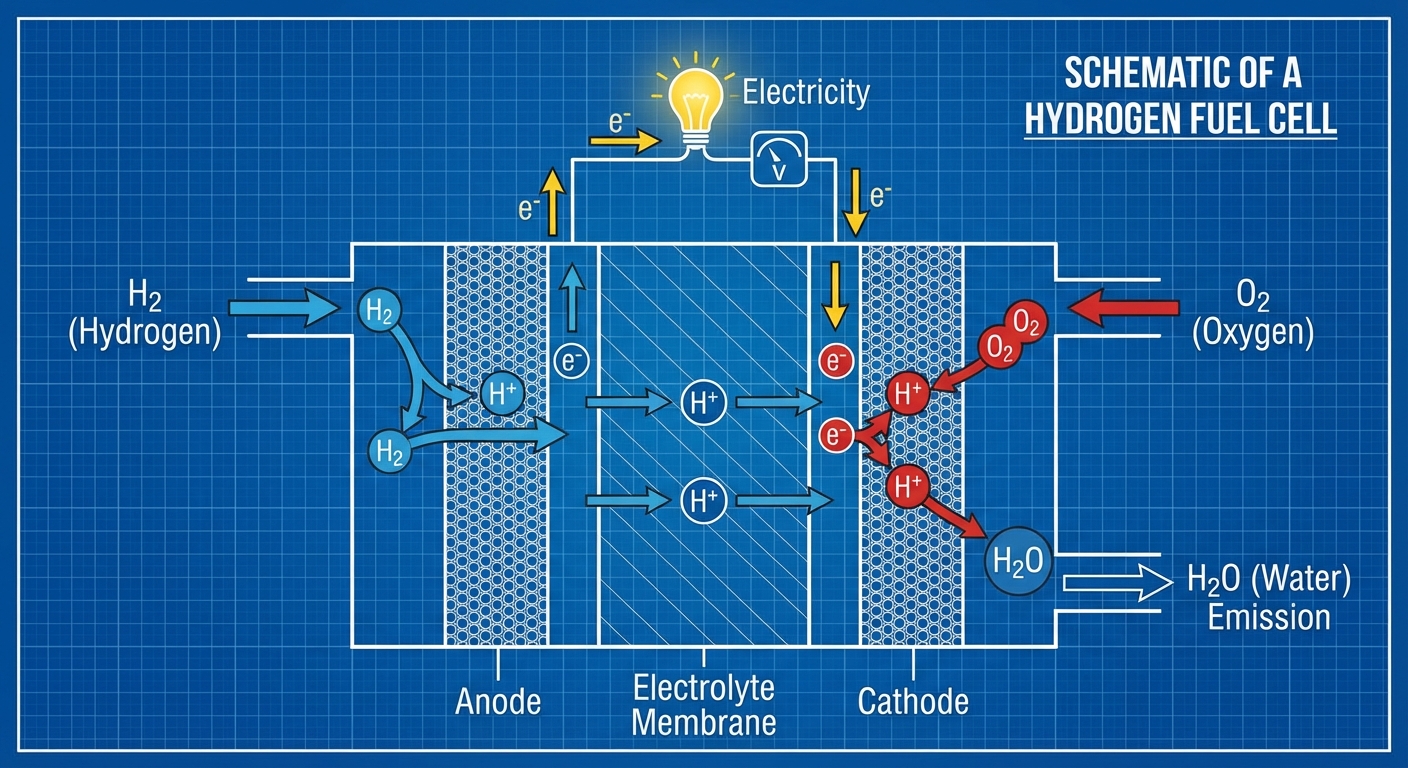
Operates like a battery, but needs constant fuel.
- Emission: Pure water vapor.
- The Challenge: Pure $H_2$ gas doesn't exist freely. To split it from water (electrolysis) requires massive amounts of electricity. If that electricity comes from coal, the Hydrogen cell is not "green."
6.12 Wind Energy
Kinetic energy of air $\rightarrow$ Mechanical energy of blades $\rightarrow$ Electrical energy.
- Pros: Highest EROEI of renewables, low cost, land can still be farmed underneath.
- Cons: Noise pollution, aesthetic complaints (NIMBY), bird/bat collisions (though domestic cats kill far more).
- Offshore Wind: Stronger, more consistent winds, but harder to maintain.
6.13 Energy Conservation
It is often cheaper to save a watt ("Negawatt") than to generate a new one.
Corporate/Government Level
- CAFE Standards (Corporate Average Fuel Economy): Regulations requiring auto manufacturers to increase the average MPG of the cars they sell.
- Smart Grid: An electrical grid that communicates between producers and consumers to manage demand (e.g., running dishwashers at night when power is cheap).
Individual Level
- Lower thermostat in winter / Raise in summer.
- Insulation: Traps heat/cold requiring less HVAC use.
- Phantom Loads: Unplugging electronics that draw power even when "off" (TVs, chargers).
Common Mistakes & Pitfalls (Unit 6)
- Confusion: Passive Solar vs. Photovoltaic: Students often think solar panels are "passive." They are technology. Passive is just "windows and rocks."
- Confusion: Greenhouse Effect vs. Ozone Layer: Burning fossil fuels drives the Greenhouse Effect (warming). It does not cause the hole in the ozone layer (that's CFCs). Do not mix these up on FRQs.
- Math Error: Power vs. Energy: Don't confuse kW (rate of flow) with kWh (amount used). If a question asks for "Energy," your answer usually involves time (kWh or Joules).
- Nuclear Emissions: Nuclear plants do NOT release $CO2$ during operation. They release water vapor. The construction of the plant releases $CO2$, but the reaction does not.
- Fracking Water: The issue isn't just using water; it's that the wastewater comes back up with salts and radioactive materials and is hard to dispose of.