Complete Guide to Angular Momentum in Rotating Systems
Angular Momentum and Angular Impulse
Defining Angular Momentum ($L$)
Angular Momentum ($L$) is the rotational equivalent of linear momentum. It represents the "quantity of rotation" of an object and is a measure of how difficult it is to bring that rotating object to rest. Just like linear momentum ($p$), angular momentum is a vector quantity, meaning it has both magnitude and direction.
In AP Physics 1, we generally treat direction as simply clockwise (-) or counter-clockwise (+) relative to the axis of rotation.
1. Rigid Object Rotating about a Fixed Axis
For a solid object (like a wheel, sphere, or rod) rotating about a fixed axis, angular momentum depends on the object's rotational inertia and its angular velocity.
Where:
- $L$ = Angular momentum ($\text{kg}\cdot\text{m}^2/\text{s}$)
- $I$ = Rotational inertia ($\text{kg}\cdot\text{m}^2$)
- $\omega$ = Angular velocity ($\text{rad}/\text{s}$)
2. A Point Particle Moving Relative to an Axis
A common misconception is that an object must be spinning to have angular momentum. However, a point particle moving in a straight line possesses angular momentum relative to a specific pivot point.
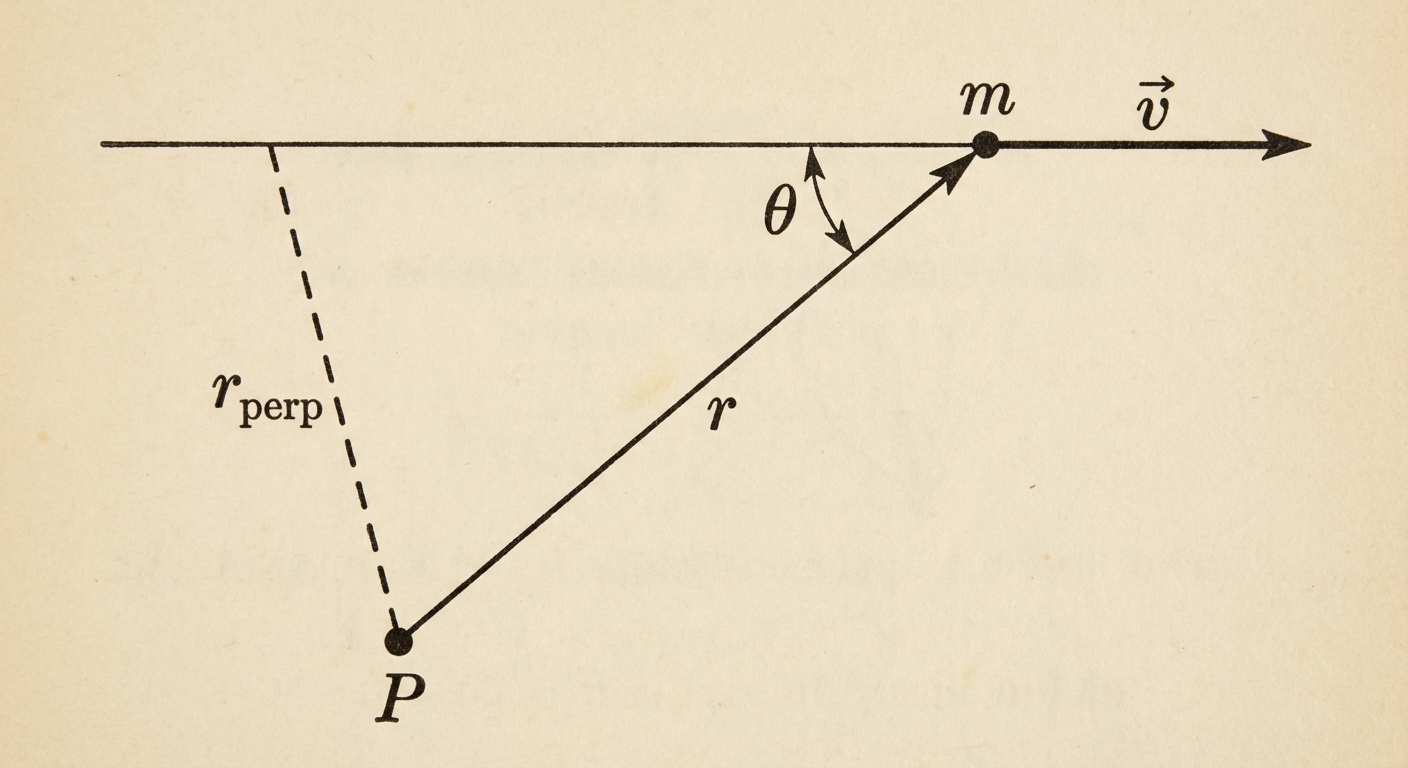
For a point particle of mass $m$ moving with velocity $v$, the angular momentum relative to an axis is:
Where:
- $m$ = Mass of the particle
- $v$ = Linear velocity
- $r$ = Distance from the pivot point to the particle
- $\theta$ = Angle between the position vector $r$ and velocity vector $v$
- $r_{\perp}$ = The "perpendicular distance" (or lever arm) from the axis to the line of motion
Angular Impulse ($\,\Delta L$)
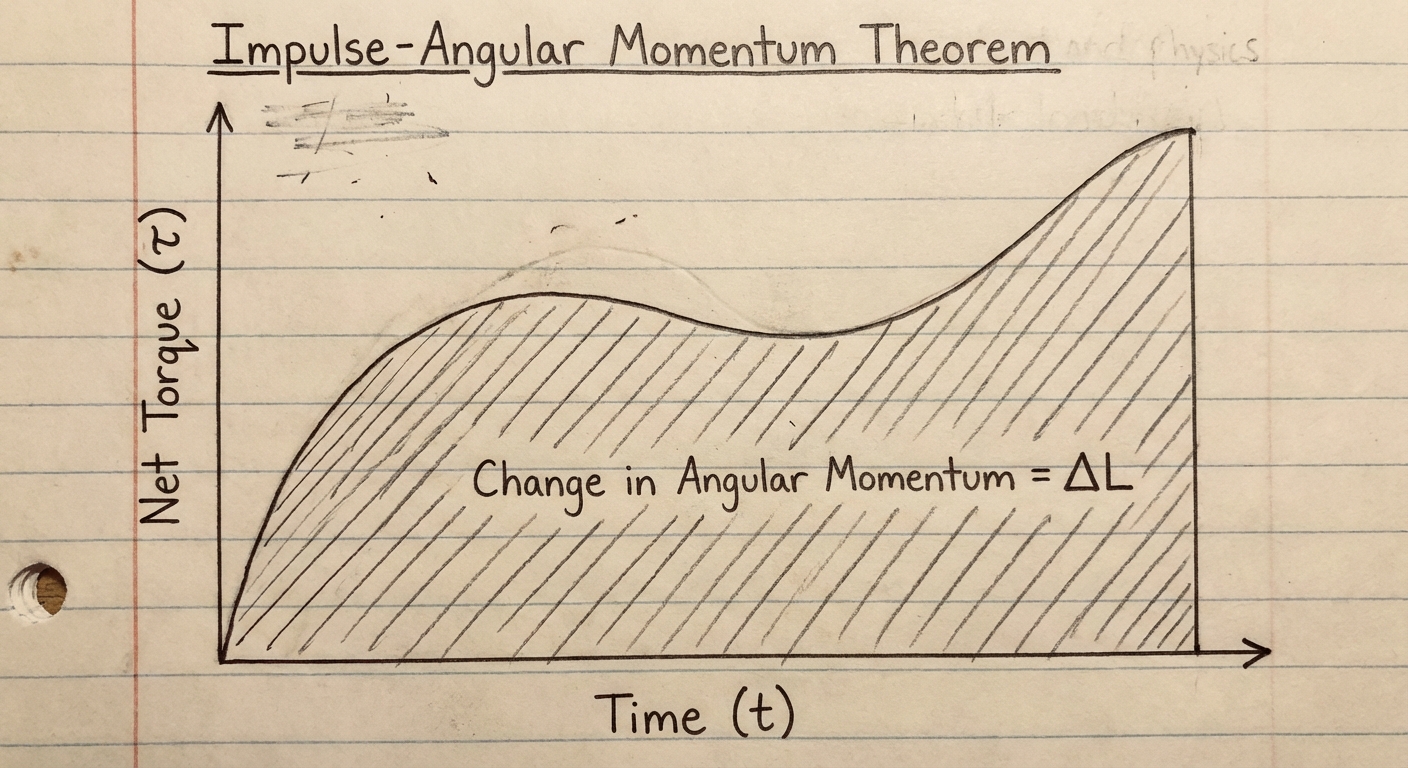
Just as a net force applied over time creates a linear impulse that changes linear momentum ($F\Delta t = \Delta p$), a net torque applied over time creates an angular impulse that changes angular momentum.
The Angular Impulse-Momentum Theorem
This relationship tells us that to change how fast something is spinning (change its $L$), you must apply a torque for a duration of time.
Graphical Analysis
If you are given a graph of Net Torque vs. Time, the area under the curve represents the change in angular momentum ($\Delta L$).
Conservation of Angular Momentum
The Fundamental Law
The Law of Conservation of Angular Momentum is one of the most powerful tools in rotational mechanics. It states:
If the net external torque on a system is zero, the total angular momentum of the system remains constant.
This applies to two main categories of problems in AP Physics 1: Changing Shape and Rotational Collisions.
1. Changing Shape (Internal Redistribution of Mass)
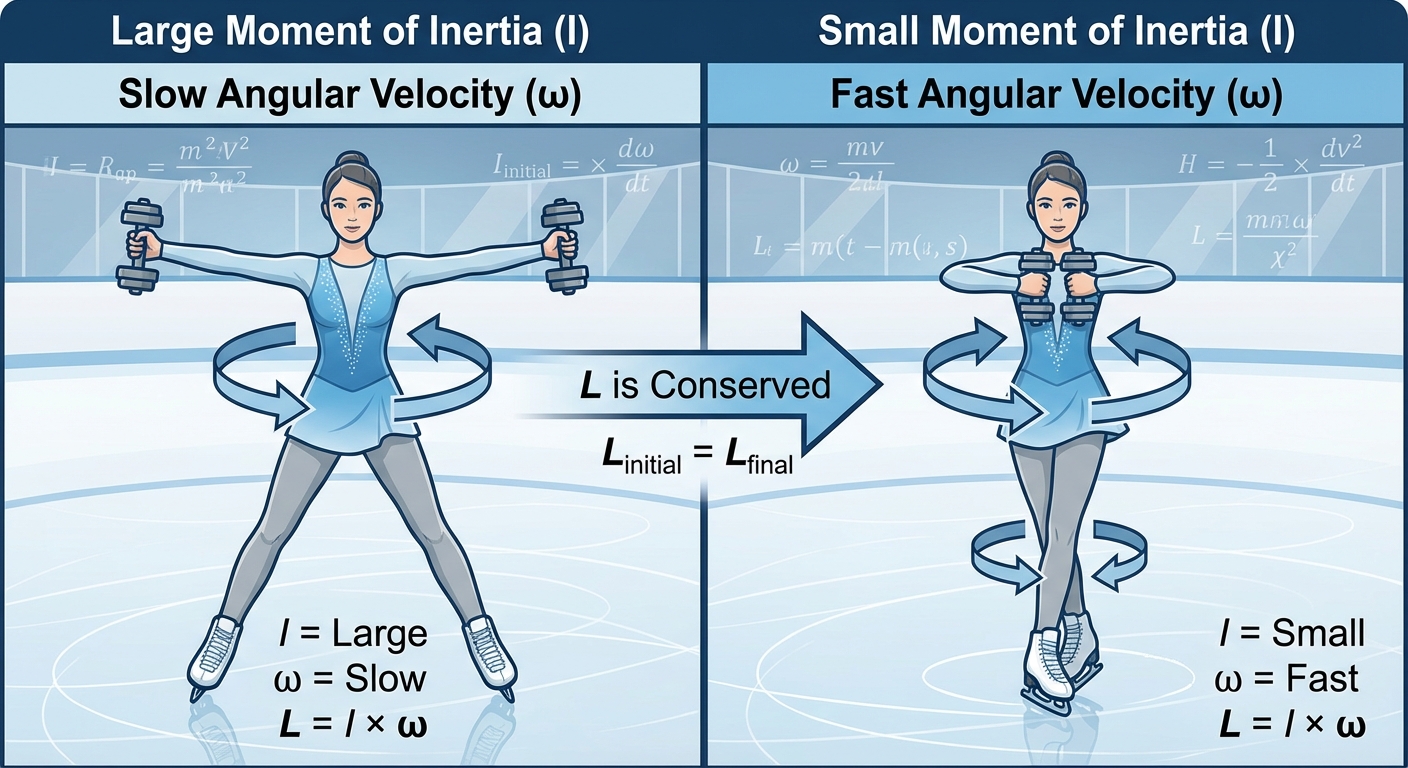
This scenario involves a single object (or system) changing its rotational inertia ($I$) by moving mass closer to or further from the axis of rotation. Since external torque is zero, the product of $I$ and $\omega$ must remain constant.
Real-World Example:
Consider an ice skater spinning on the tip of their skate (negligible friction/torque):
- Arms Out: Large radius $\rightarrow$ High Rotational Inertia ($Ii$) $\rightarrow$ Low Angular Velocity ($\omegai$).
- Arms In: Small radius $\rightarrow$ Low Rotational Inertia ($If$) $\rightarrow$ High Angular Velocity ($\omegaf$).
Because $I$ decreases, $\omega$ must increase to keep $L$ constant.
2. Rotational Collisions
Just like linear collisions, rotating systems can collide. In these problems, you must define a system where the collision forces are internal (canceling out to zero net torque).
Common Scenario: Point Mass striking a Pivoted Rod
Imagine a ball of clay thrown at a stationary rod that is pinned at one end.
- Before Collision: The rod has $L=0$. The clay has angular momentum relative to the pivot ($L = mvr{\perp}$).
- After Collision: The clay sticks to the rod. Now they rotate together as a single rigid body with a combined moment of inertia.
Equating them allows you to solve for the final rotational speed:
Linear vs. Angular Comparison Table
| Concept | Linear Motion | Rotational Motion |
|---|---|---|
| Inertia | Mass ($m$) | Rotational Inertia ($I$) |
| Velocity | Velocity ($v$) | Angular Velocity ($\omega$) |
| Momentum | $p = mv$ | $L = I\omega$ |
| Impulse | $J = F\Delta t = \Delta p$ | $\text{Ang. Impulse} = \tau\Delta t = \Delta L$ |
| Conservation | If $\Sigma F{ext}=0, pi=p_f$ | If $\Sigma \tau{ext}=0, Li=L_f$ |
Worked Example: The Merry-Go-Round
Problem:
A child of mass $25\text{ kg}$ stands at rest on the edge of a merry-go-round (modeled as a solid disk) of mass $100\text{ kg}$ and radius $2\text{ m}$. The system is initially stationary. The child begins running clockwise around the rim with a speed of $2\text{ m/s}$ relative to the ground. Calculate the resulting angular velocity of the merry-go-round.
Solution:
- Identify the System: The Child + Merry-Go-Round. Since the friction between the child's feet and the disk is an internal force, the net external torque is zero. Angular momentum is conserved.
- Initial State: Everything is at rest.
- Final State:
- Child: Treated as a point particle moving clockwise (negative direction) at radius $R$.
- Disk: Will rotate counter-clockwise (positive direction) due to Newton's 3rd Law.
(Note: For a solid disk, $I = \frac{1}{2}MR^2$)
- Child: Treated as a point particle moving clockwise (negative direction) at radius $R$.
- Conservation Equation:
- Solve:
Answer: The merry-go-round rotates at $0.5\text{ rad/s}$ counter-clockwise.
Common Mistakes & Pitfalls
- Forgetting the "Point Particle" Angular Momentum: Students often forget that an object moving in a straight line has angular momentum relative to a pivot. Always check for $L=mvr_{\perp}$.
- Confusing Conservation of Energy with Momentum: In collisions (like the clay hitting the rod), Kinetic Energy is usually NOT conserved (it is lost to heat/deformation). However, Angular Momentum IS conserved. Do not use energy equations to bridge the "before" and "after" gap of a collision.
- Ignoring Direction: $L$ is a vector. If a disk spins clockwise and a ring is dropped onto it spinning counter-clockwise, you must subtract their momenta, not add magnitudes.
- Radius Variable Confusion: In $L = mvr$, $r$ is the distance from the pivot. In $L = I\omega$, if calculating $I$ for a point mass ($mr^2$), $r$ is the distance from the axis. Ensure these match the physical situation.
- Units: Ensure mass is in kg, distance in meters, and angular velocity in radians/sec. Never use degrees for physics calculation formulas.