Unit 9 Study Guide: Parametric Equations
Fundamentals of Parametric Equations
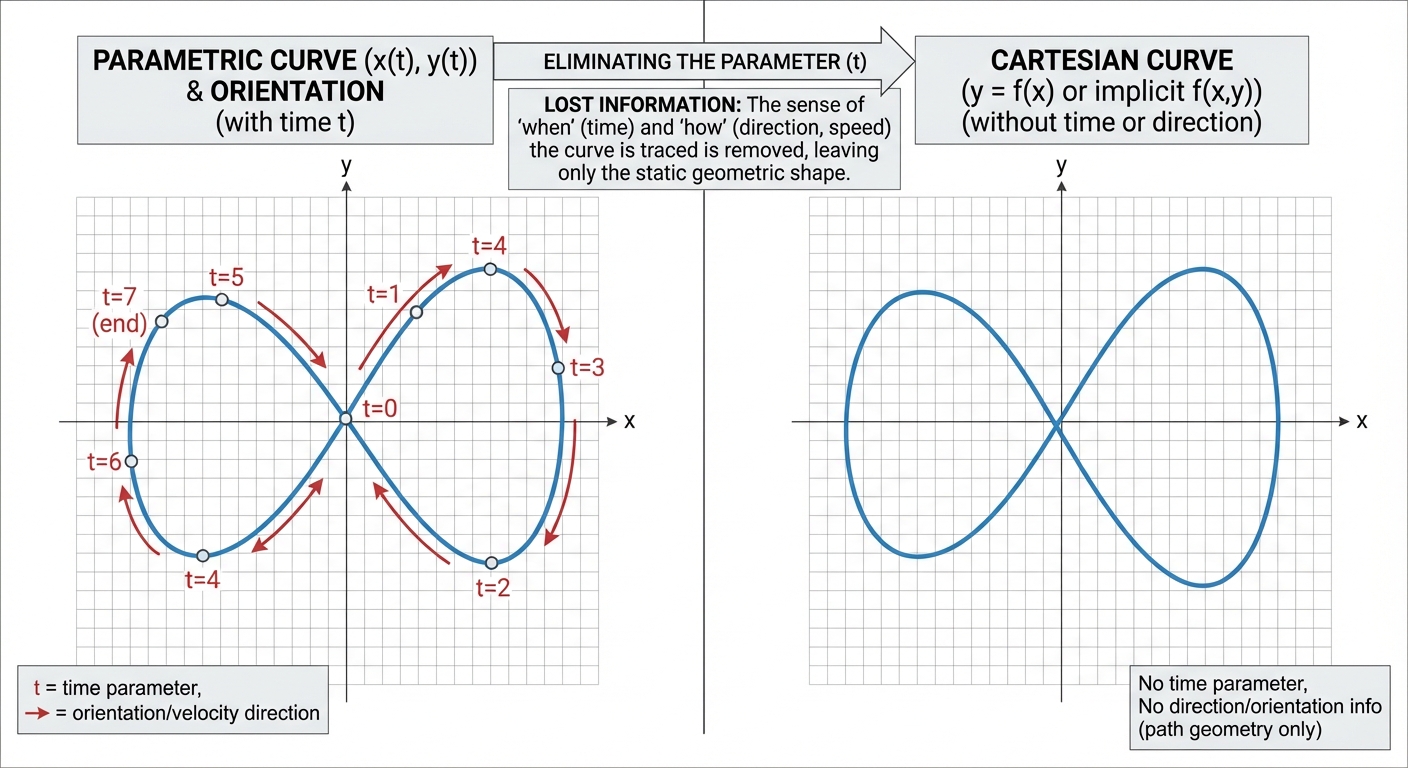
Unlike rectangular equations ($y = f(x)$) where vertical position is determined solely by horizontal position, parametric equations define the $x$ and $y$ coordinates as functions of a third variable, usually called the parameter $t$ (representing time or angle).
This approach allows us to describe paths that are not functions (i.e., they fail the vertical line test) and includes information about the direction and speed of motion along the curve.
Eliminating the Parameter
To visualize the shape of the curve, you can sometimes convert parametric equations into rectangular form by eliminating the parameter.
- Solve one equation for $t$.
- Substitute that expression into the other equation.
- Adjust the domain if necessary (the range of $x$ and $y$ is determined by the domain of $t$).
Example:
Given $x = \sqrt{t}$ and $y = 3t - 1$ for $t \ge 0$.
- Solve for $t$: $t = x^2$ (implied $x \ge 0$).
- Substitute: $y = 3(x^2) - 1$.
- Result: The curve is the right half of the parabola $y = 3x^2 - 1$.
Defining and Differentiating Parametric Equations
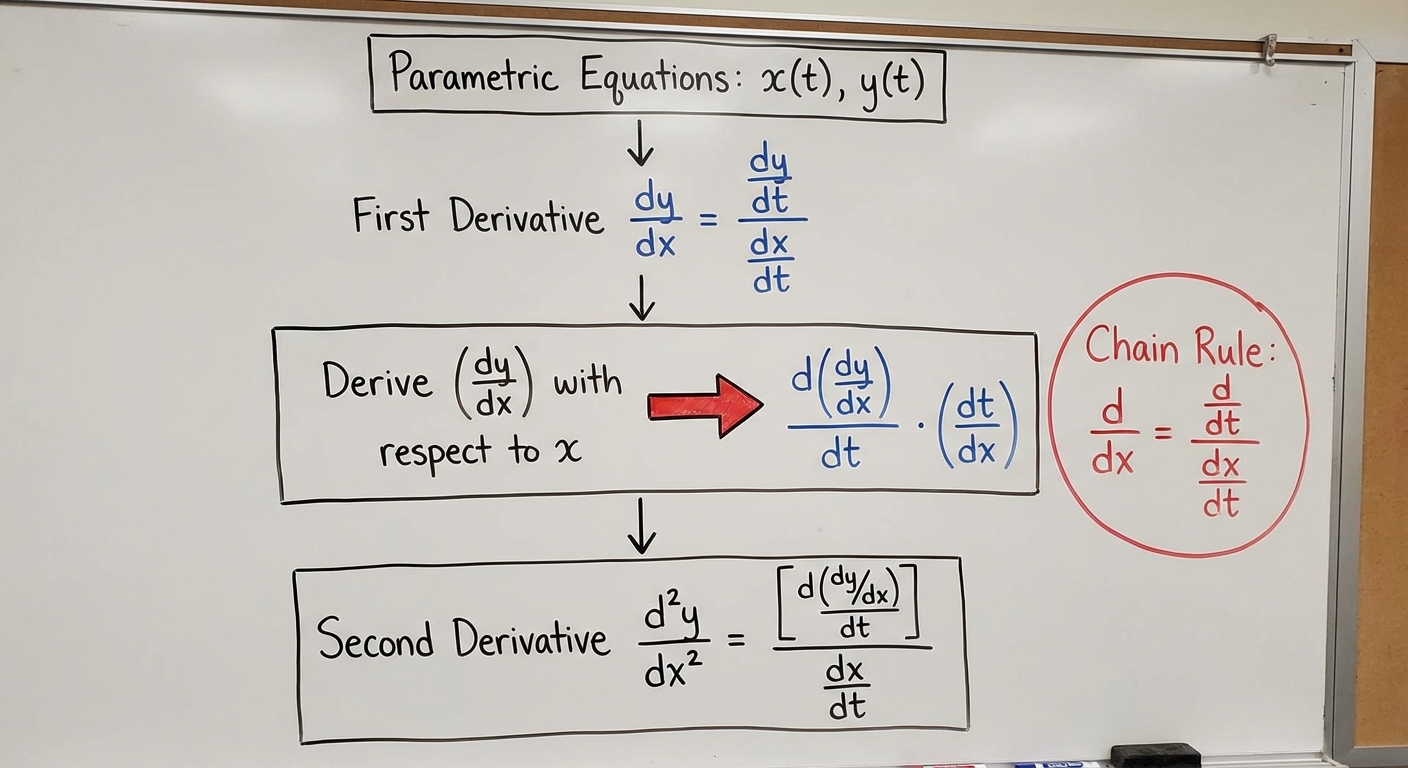
One of the primary goals in AP Calculus BC is finding the slope of the tangent line ($dy/dx$) without eliminating the parameter. We use the Chain Rule relationship.
First Derivative Formula
Given $x = f(t)$ and $y = g(t)$, the slope of the curve at any time $t$ is:
Tangent Lines and Orientation
- Tangent line equation: To find the tangent line at $t=a$, calculate the point $(x(a), y(a))$ and the slope $m = \frac{dy}{dx}\big|_{t=a}$. Use point-slope form: $y - y(a) = m(x - x(a))$.
- Horizontal Tangents: Occur where the numerator $\frac{dy}{dt} = 0$ and the denominator $\frac{dx}{dt} \neq 0$.
- Vertical Tangents: Occur where the denominator $\frac{dx}{dt} = 0$ and the numerator $\frac{dy}{dt} \neq 0$.
Note: If both $\frac{dy}{dt} = 0$ AND $\frac{dx}{dt} = 0$ at the same $t$, the slope is indeterminate (often a sharp turn or cusp). You must use limits to determine the behavior.
Second Derivatives of Parametric Equations
This is statistically one of the most common sources of error on the AP exam. The second derivative determines the concavity of the curve.
Second Derivative Formula
Do NOT simply divide the second derivatives of $y$ and $x$. You must differentiate the first derivative ($dy/dx$) with respect to $x$. Since $dy/dx$ is a function of $t$, we apply the Chain Rule again:
Step-by-Step Procedure
- Find the first derivative expression $\frac{dy}{dx}$ in terms of $t$.
- Differentiate that expression with respect to $t$. This gives the numerator: $\frac{d}{dt}\left(\frac{dy}{dx}\right)$.
- Divide the result by $\frac{dx}{dt}$ (the derivative of the original $x$-equation).
Visual Aid for Memory:
Think of the operator $\frac{d}{dx}$ as $\frac{1}{\frac{dx}{dt}} \cdot \frac{d}{dt}$.
Worked Example: Concavity
Find the concavity of the curve $x = t^2$, $y = t^3$ at $t = 1$.
- First Derivatives:
$\frac{dx}{dt} = 2t$, $\frac{dy}{dt} = 3t^2$. - First Derivative Slope ($dy/dx$):
$\frac{dy}{dx} = \frac{3t^2}{2t} = \frac{3}{2}t$. - Differentiate Slope w.r.t $t$:
$\frac{d}{dt}\left(\frac{3}{2}t\right) = \frac{3}{2}$. - Apply Formula ($d^2y/dx^2$):
$\frac{d^2y}{dx^2} = \frac{3/2}{dx/dt} = \frac{3/2}{2t} = \frac{3}{4t}$. - Evaluate:
At $t=1$, $\frac{d^2y}{dx^2} = \frac{3}{4}$. Since $\frac{3}{4} > 0$, the curve is concave up.
Arc Lengths of Parametric Curves
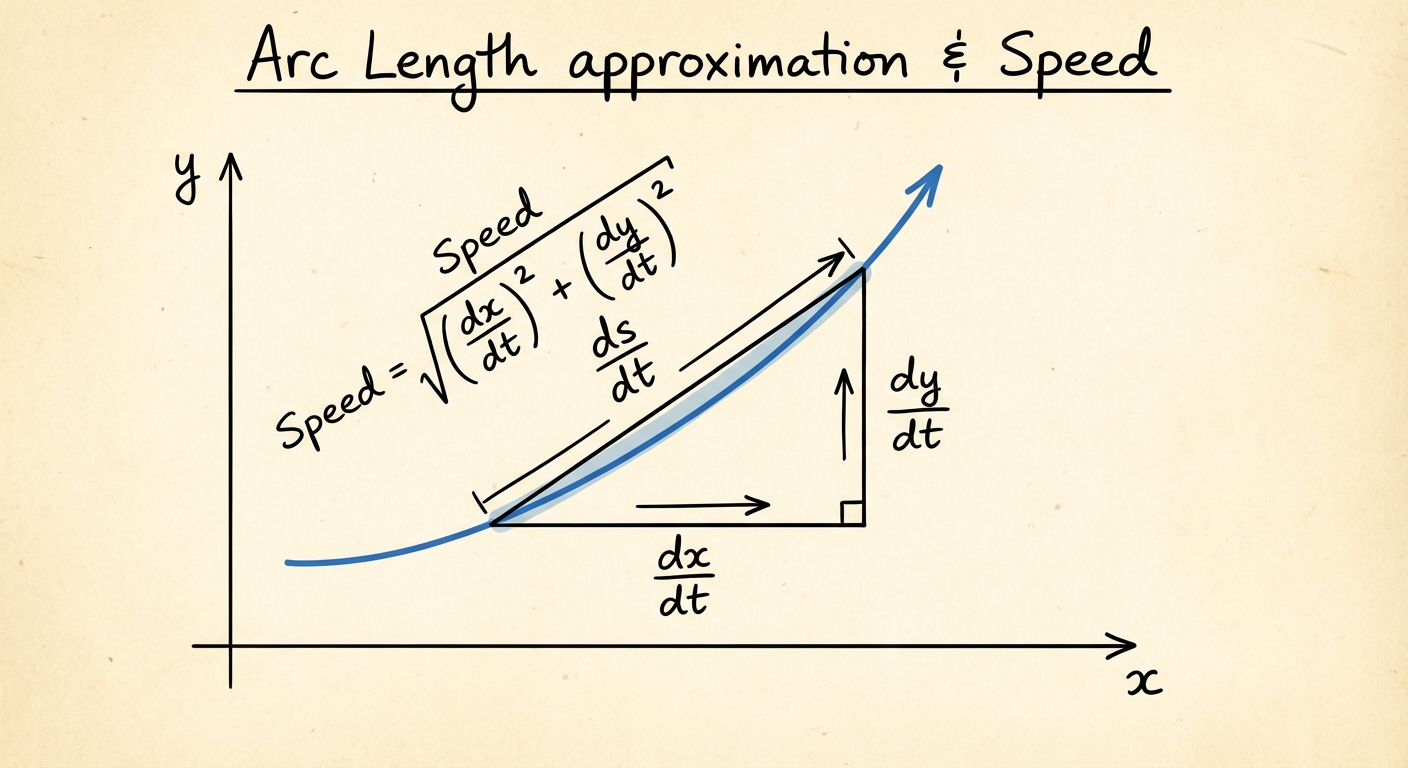
The length of a parametric curve traveling from $t=a$ to $t=b$ is the integral of the speed of the particle moving along the curve.
The Arc Length Formula
Derived from the Pythagorean theorem approximation of standard arc length ($L = \int \sqrt{1 + (dy/dx)^2} dx$), the parametric version is generally easier to compute:
Key Concepts Connection
- The expression underneath the radical, $\sqrt{(x'(t))^2 + (y'(t))^2}$, represents the speed of a particle moving along the curve.
- Therefore, Distance Traveled = $\int$ (Speed) $dt$.
- Ensure that the curve is traversed exactly once on the interval $[a, b]$. If a particle retraces its path, the integral calculates the total distance traveled, not just geometric length.
Common Mistakes & Pitfalls
1. The Second Derivative Trap
Mistake: Calculating $\frac{d^2y}{dx^2}$ as $\frac{y''(t)}{x''(t)}$.
Correction: You must use the Chain Rule formula: $\frac{\frac{d}{dt}(y')}{x'}$.
Example: If $x=t^2$ and $y=t^2$, $\frac{dy}{dx}=1$, so $\frac{d^2y}{dx^2}=0$. The incorrect method gives $\frac{2}{2}=1$, which is wrong.
2. Identifying Tangents Incorrectly
Mistake: Assuming a horizontal tangent exists whenever $\frac{dy}{dt} = 0$, ignoring the $x$-derivative.
Correction: Always check $\frac{dx}{dt}$. If both are zero, the slope is indeterminate, and you must evaluate the limit as $t \to c$.
3. Trigonometric Squared Notation
Mistake: When calculating Arc Length, writing $\left(\frac{dx}{dt}\right)^2$ as $\cos(t^2)$ instead of $\cos^2(t)$ or $(\cos t)^2$.
Correction: Be precise with parentheses. The entire derivative is squared, not the argument inside the trig function.