Comprehensive Guide to Church Modes
Introduction to Church Modes
In AP Music Theory, Modes (often referred to as Church Modes) are alternative scales derived from the familiar Major and Minor key systems. While they share the same collection of notes as the Major scale, each mode has a distinct tonic (home note) and a unique pattern of whole and half steps.
Understanding modes is crucial for analysis, melodic dictation, and composition tasks in the exam. You must be able to identify them by ear and by sight (notation).
There are seven diatonic modes, but the AP exam focuses primarily on distinguishing the four "modal" sounds—Dorian, Phrygian, Lydian, and Mixolydian—from the standard Major (Ionian) and Minor (Aeolian) scales.
Categorizing Modes: The Parallel Method
The most efficient way to memorize modes is by comparing them to the nearest parallel Major or Minor scale. We group the modes into two families based on the quality of their tonic triad (major or minor).
The Major Family (Major Third)
These modes have a Major 3rd above the tonic. We compare them to the Ionian (Standard Major) scale.
- Ionian: The standard Major scale ($1 - 2 - 3 - 4 - 5 - 6 - 7$).
- Lydian: Major scale with a raised 4th ($\,\sharp\hat{4}\,$\,).
- Mixolydian: Major scale with a lowered 7th ($\,\flat\hat{7}\,$\,).
The Minor Family (Minor Third)
These modes have a Minor 3rd above the tonic. We compare them to the Aeolian (Natural Minor) scale.
- Aeolian: The standard Natural Minor scale ($1 - 2 - \flat3 - 4 - 5 - \flat6 - \flat7$).
- Dorian: Minor scale with a raised 6th ($\,\natural\hat{6}\,$\, in relation to minor).
- Phrygian: Minor scale with a lowered 2nd ($\,\flat\hat{2}\,$\,).
- Locrian: Minor scale with a lowered 2nd AND lowered 5th. (Technically diminished, distinct for its unstable tonic triad).
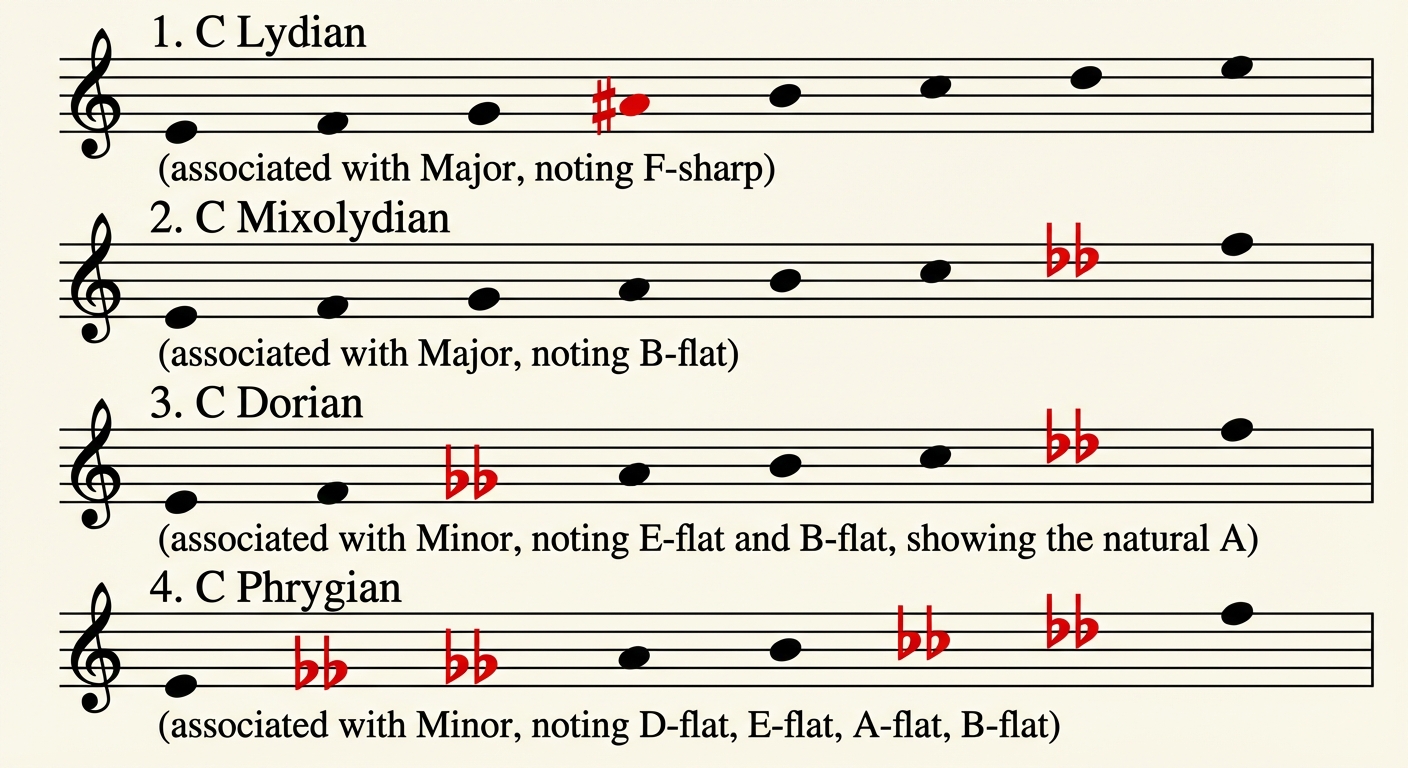
Detailed Breakdown of the Modes
1. Dorian Mode
- Base Family: Minor
- Distinctive Feature: The Raised 6th ($\sharp\hat{6}$ compared to natural minor).
- Formula: Whole - Half - Whole - Whole - Whole - Half - Whole
- Solfege Distinction: Do - Re - Me - Fa - Sol - La - Te - Do
Character & Usage:
Dorian is often described as a "brighter" minor. Because the 6th scale degree is major (a Major 6th interval above the tonic), it avoids the "sadness" associated with the minor 6th found in Aeolian. It is extremely common in folk music, jazz, and pop.
Example: Scarborough Fair (The melody emphasizes the raised 6th).
2. Phrygian Mode
- Base Family: Minor
- Distinctive Feature: The Lowered 2nd ($\flat\hat{2}$).
- Formula: Half - Whole - Whole - Whole - Half - Whole - Whole
- Solfege Distinction: Do - Ra - Me - Fa - Sol - Le - Te - Do
Character & Usage:
Phrygian is the "darkest" stable minor mode. The half-step movement immediately from the tonic to the second degree creates a very distinctive, often Spanish or Middle Eastern flavor.
Example: The opening movement of many Flamenco pieces or the "Jaws" theme motive (semitone oscillation).
3. Lydian Mode
- Base Family: Major
- Distinctive Feature: The Raised 4th ($\sharp\hat{4}$).
- Formula: Whole - Whole - Whole - Half - Whole - Whole - Half
- Solfege Distinction: Do - Re - Mi - Fi - Sol - La - Ti - Do
Character & Usage:
Lydian is exceptionally bright and floaty. The raised 4th creates a tritone with the tonic, but in a context that sounds ethereal or "dreamy" rather than dissonant. It is a favorite of film composers for space or fantasy themes.
Example: The opening theme of The Simpsons or the flying theme from E.T.
4. Mixolydian Mode
- Base Family: Major
- Distinctive Feature: The Lowered 7th ($\flat\hat{7}$).
- Formula: Whole - Whole - Half - Whole - Whole - Half - Whole
- Solfege Distinction: Do - Re - Mi - Fa - Sol - La - Te - Do
Character & Usage:
Mixolydian sounds like a Major scale but without the leading tone tension. The lowered 7th gives it a bluesy, rock, or Celtic feel. It resolves gently rather than with the sharp pull of a major 7th.
Example: Sweet Home Alabama or the melody of Norwegian Wood.
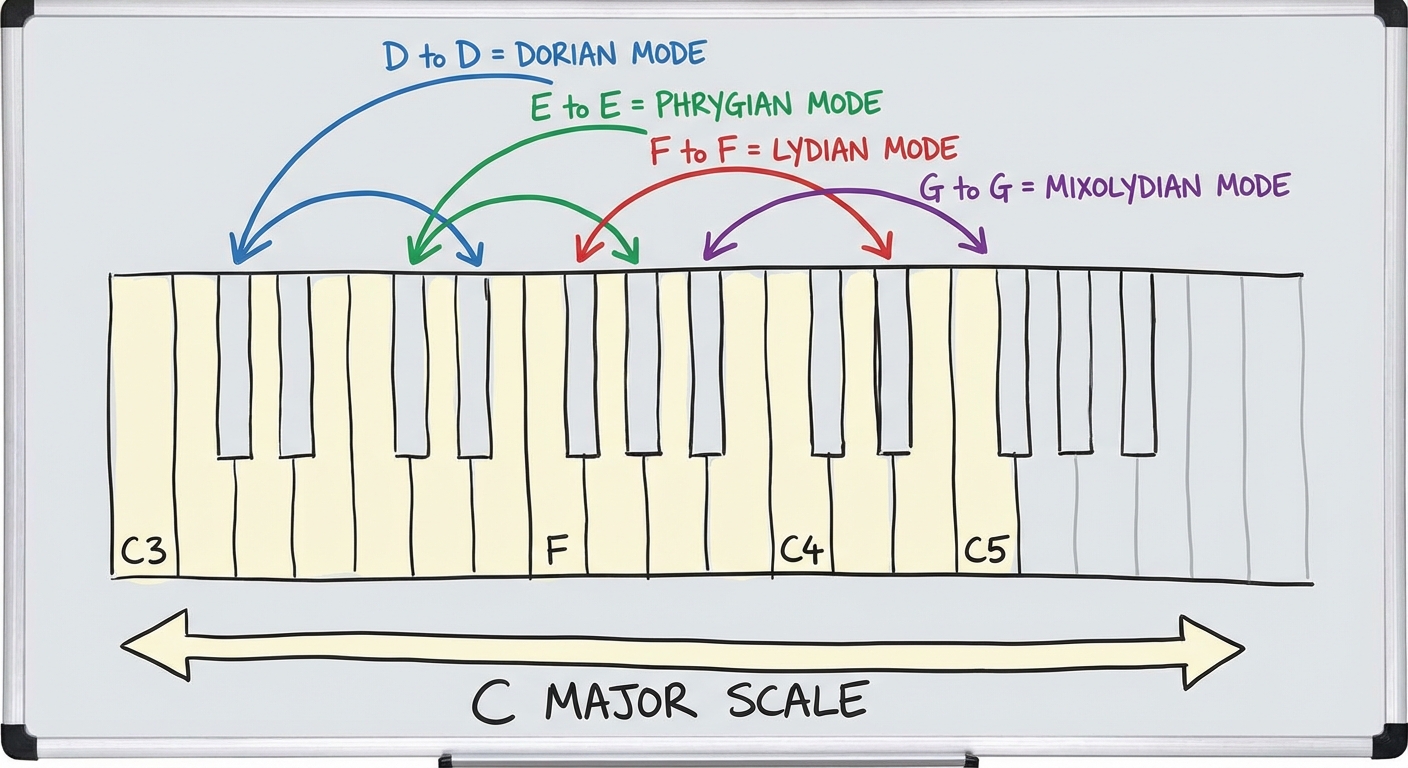
The Relative Method (White Key Rotation)
While the parallel method (above) is best for identification, the relative method is useful for deriving the notes if you forget the accidentals. This method visualizes the modes using the white keys of the piano (C Major key signature).
| Mode Name | Starts on Scale Degree (in Major) | White Key Example |
|---|---|---|
| Ionian | 1 (Do) | C to C |
| Dorian | 2 (Re) | D to D |
| Phrygian | 3 (Mi) | E to E |
| Lydian | 4 (Fa) | F to F |
| Mixolydian | 5 (Sol) | G to G |
| Aeolian | 6 (La) | A to A |
| Locrian | 7 (Ti) | B to B |
Mnemonic for Order
To remember the order of modes relative to the Major scale:
I Don't Play Loud Music At Lunch
Summary Table of Features
| Mode | Family | Scale Degree Alteration (vs. Parallel Major/Minor) | Characteristic Interval |
|---|---|---|---|
| Lydian | Major | $\sharp\hat{4}$ | Aug 4th above Tonic |
| Ionian | Major | (None) | Major 7th |
| Mixolydian | Major | $\flat\hat{7}$ | Minor 7th |
| Dorian | Minor | $\sharp\hat{6}$ (rel. to minor) | Major 6th above Tonic |
| Aeolian | Minor | (None - Natural Minor) | Minor 6th |
| Phrygian | Minor | $\flat\hat{2}$ | Minor 2nd above Tonic |
Common Mistakes & Pitfalls
Confusing Relative and Parallel:
- Mistake: Thinking D Dorian has the same key signature as D Major.
- Correction: D Dorian is the relative mode starting on the 2nd degree of C Major (0 sharps/flats). Or, use the parallel method: D Minor key signature (1 flat) + scale adjustment (raised 6th = B$\natural$).
Misidentifying Phrygian vs. Dorian:
- Mistake: Hearing a minor mode and guessing randomly.
- Correction: Listen to the second note. If the melody moves immediately a half-step up from the tonic (1 to $\flat2$), it is Phrygian. If the second note is a whole step (1 to 2) and the quality is minor, check the 6th degree next.
Leading Tone Errors in Mixolydian:
- Mistake: Writing a raised leading tone ($\,\sharp\hat{7}\,$\,) in a melody intended to be Mixolydian.
- Correction: Mixolydian is defined by the subtonic (whole step below tonic). If you raise the 7th, you have turned it back into Ionian (Major).
Forgetting Clefs:
- Mistake: Calculating the mode correctly but misreading the clef (e.g., Alto or Tenor clef on the AP exam).
- Correction: Always double-check the clef before counting lines and spaces to identify the tonic.