Foundations of Integration: From Accumulation to Riemann Sums
Before we dive into the mechanics of integration, we must understand the conceptual foundation: Integration is the accumulation of change. Just as the derivative looks at the instantaneous rate of change at a single point, the integral looks at the total amount of quantity accumulated over an interval.
Exploring Accumulations of Change
The fundamental concept of Unit 6 is understanding the relationship between a rate of change and the net change in quantity.
The Geometric Interpretation
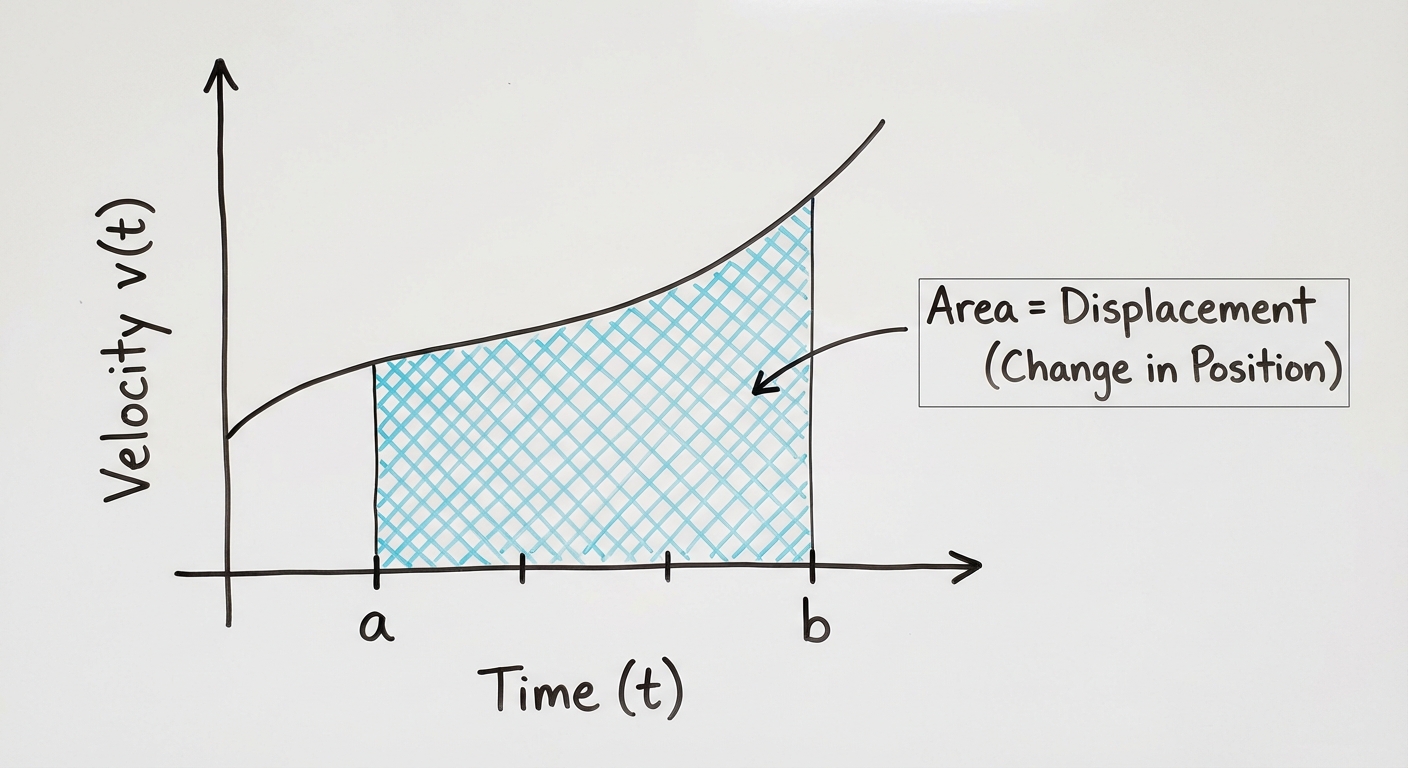
If you have a graph where the $y$-axis represents a rate (e.g., velocity in meters/sec) and the $x$-axis represents time (seconds), the area under the curve bounded by the function and the $x$-axis represents the total change in quantity (displacement in meters).
Key Principles
- Positive Area: When the rate curve is above the horizontal axis, accumulation is positive (quantity is increasing).
- Negative Area: When the rate curve is below the horizontal axis, accumulation is negative (quantity is decreasing).
- Net Accumulation: To find the total net change, you subtract the area below the axis from the area above the axis.
Real-World Example:
Imagine water flowing into a tank. Let $r(t)$ be the rate of water flow in gallons per minute.
- If $r(t)$ is constant at 5 gal/min for 10 minutes, the calculation is simple geometry: $5 \times 10 = 50$ gallons.
- If $r(t)$ varies, finding the "area" becomes harder, requiring us to approximate using rectangles (Riemann Sums) or use calculus (Definite Integrals).
Approximating Areas with Riemann Sums
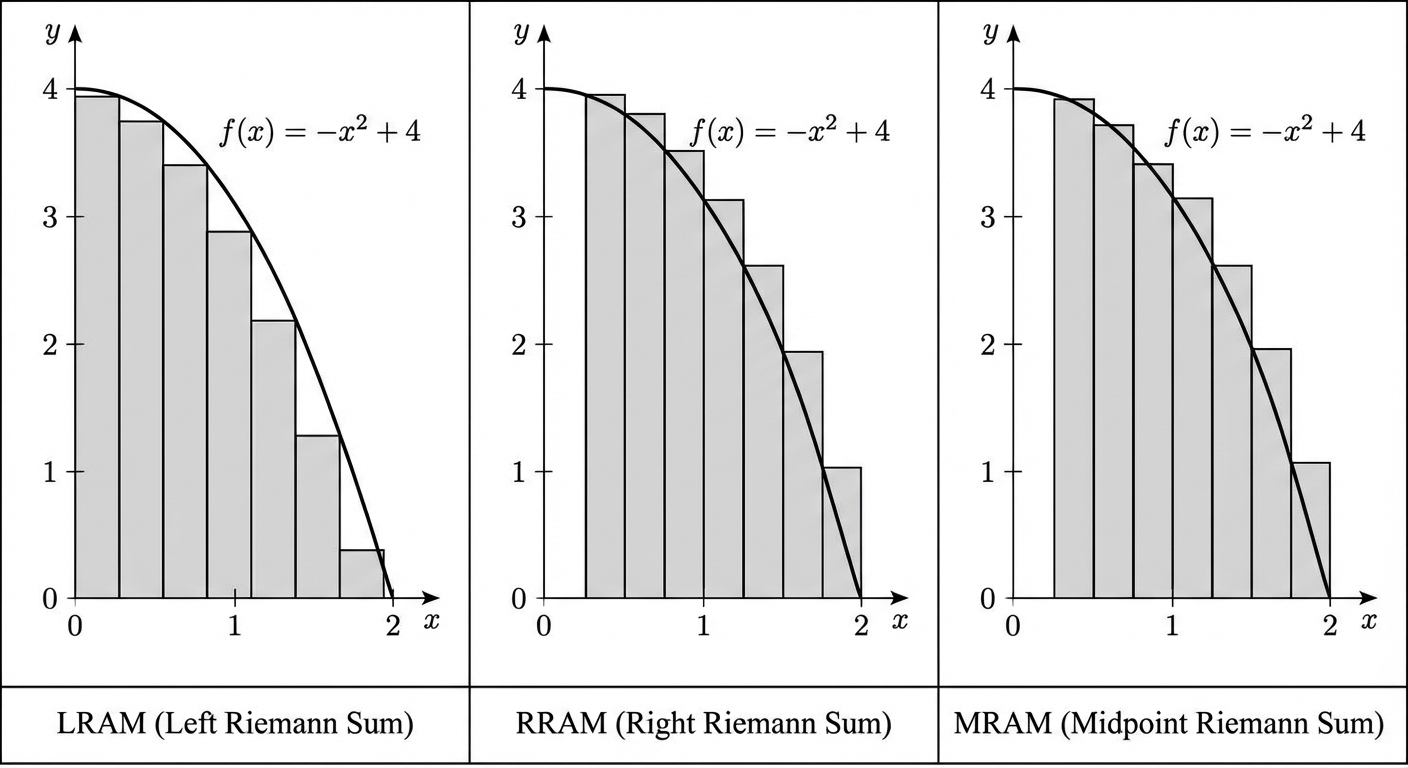
A Riemann Sum is a method for approximating the total area underneath a curve on a graph. We do this by slicing the area into smaller shapes (usually rectangles) that are easy to calculate.
1. Left, Right, and Midpoint Sums
Given a function $f(x)$ on an interval $[a, b]$, we divide the interval into $n$ sub-intervals (rectangles) of width $\Delta x$.
- Partition (Width): Usually, we solve problems with uniform width:
- Left Riemann Sum (LRAM): The height of the rectangle is determined by the function value at the left endpoint of the sub-interval.
- Right Riemann Sum (RRAM): The height is determined by the function value at the right endpoint.
- Midpoint Riemann Sum (MRAM): The height is determined by the function value at the exact middle of the sub-interval.
2. Overestimation vs. Underestimation Rules
A frequent AP Exam question asks if a Riemann sum is an overestimate or an underestimate of the true area. This depends strictly on whether the function is increasing or decreasing.
| Function Behavior | LRAM (Left Sum) | RRAM (Right Sum) |
|---|---|---|
| Increasing ($f'(x) > 0$) | Underestimate (Rectangles sit under the curve) | Overestimate (Rectangles stick out above) |
| Decreasing ($f'(x) < 0$) | Overestimate | Underestimate |
Note on Concavity: Concavity (concave up vs. down) generally dictates the error for Trapezoidal sums, but for standard Riemann (rectangular) sums, only increasing/decreasing behavior matters.
3. Worked Example: Using a Table
Problem: A particle's velocity $v(t)$ is given in the table below. Estimate the displacement from $t=0$ to $t=8$ using a Left Riemann Sum with the 4 sub-intervals indicated by the data.
| $t$ (seconds) | 0 | 2 | 5 | 7 | 8 |
|---|---|---|---|---|---|
| $v(t)$ (m/s) | 10 | 12 | 15 | 9 | 11 |
Solution:
Identify sub-intervals and widths ($\Delta t$):
- $[0, 2] \rightarrow \Delta t = 2$
- $[2, 5] \rightarrow \Delta t = 3$
- $[5, 7] \rightarrow \Delta t = 2$
- $[7, 8] \rightarrow \Delta t = 1$
Identify heights using the Left endpoints ($t = 0, 2, 5, 7$):
- Heights: $v(0)=10$, $v(2)=12$, $v(5)=15$, $v(7)=9$.
Calculate Sum (Height $\times$ Width):
Summation Notation and Definite Integral Notation
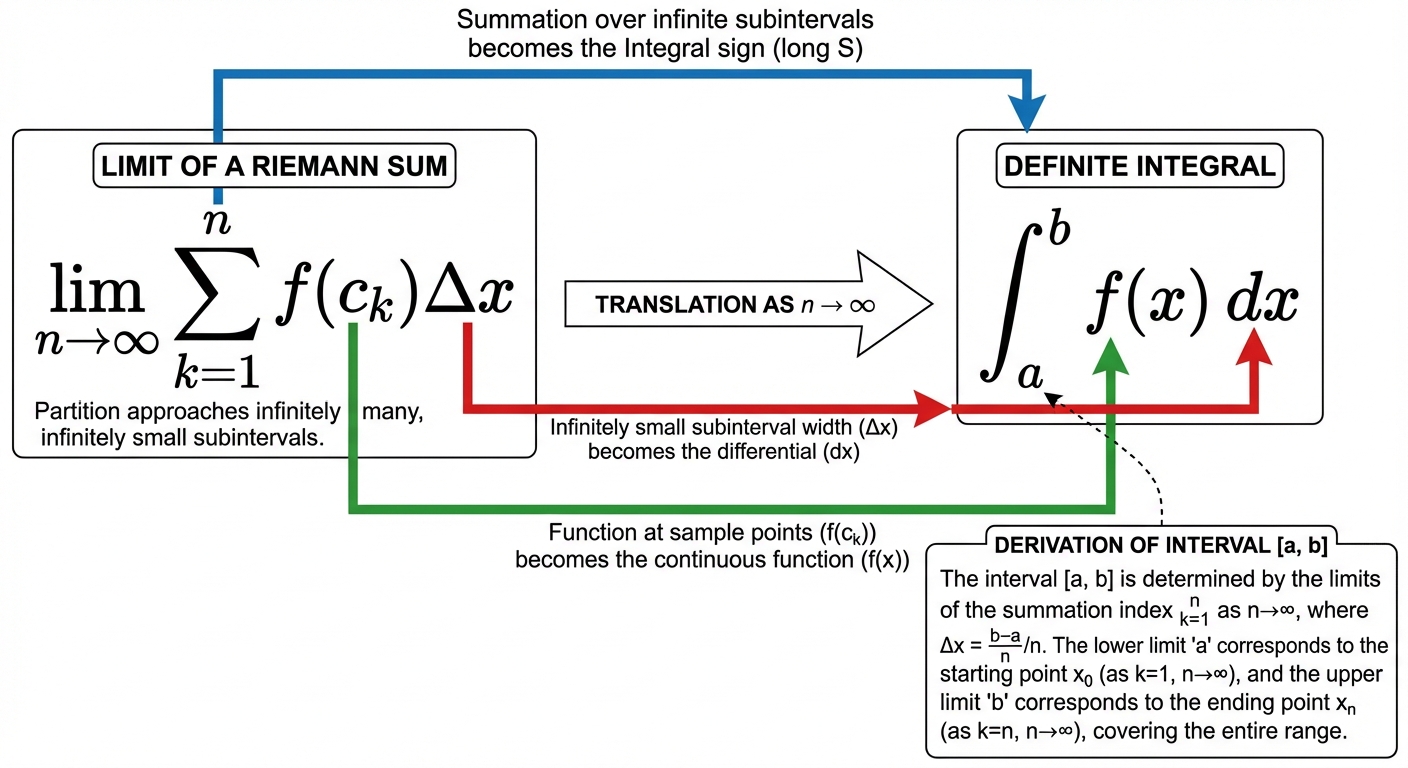
As the number of rectangles ($n$) approaches infinity, their width ($\Delta x$) approaches zero. The approximation becomes exact. This describes the definition of the Definite Integral.
The Limit Definition
You must be able to recognize and convert between the "Limit of a Riemann Sum" notation and Integral notation. This is a guaranteed multiple-choice topic on the AP exam.
Where:
- $\Delta x = \frac{b-a}{n}$ becomes $dx$ (the infinitesimal width).
- $c_k = a + k\Delta x$ is the sample point (often the right endpoint used in the formula).
- The Sigma ($\sum$) stretches into the Integral symbol ($\int$).
Deconstructing the Notation
When presented with a limit like this:
Follow these steps to convert it to an integral $\int_a^b f(x) dx$:
- Find $\Delta x$: Look for the term multiplying the function (usually on the outside or end). Here, $\Delta x = \frac{3}{n}$.
- Since $\Delta x = \frac{b-a}{n}$, we know that $b-a = 3$ (the length of the interval is 3).
- Find the "input" ($x_k$): precise looking for the pattern $a + k\Delta x$ inside the function.
- We see $2 + \frac{3k}{n}$.
- This implies the starting value $a = 2$.
- Find $b$: Since $a=2$ and interval length is 3, $b = 2 + 3 = 5$.
- Identify the Function: Replace the "input" cluster ($2 + \frac{3k}{n}$) with $x$.
- The function is $f(x) = x^4$.
Result:
Common Mistakes & Pitfalls
Concavity vs. Increasing/Decreasing Logic:
- Mistake: Thinking that concavity determines if LRAM is an over/underestimate.
- Correction: LRAM/RRAM strictly depend on whether $f(x)$ is increasing or decreasing. Concavity only matters for Trapezoidal sums.
Assuming Uniform Widths:
- Mistake: In table problems, assuming $\Delta x$ is always the same number.
- Correction: Always check the difference between $x$-values in the table. AP questions frequently vary the interval widths (e.g., gap of 2, then gap of 5).
Notation Mix-ups:
- Mistake: converting $\lim{n \to \infty} \sum (2 + \frac{k}{n})^2 \frac{1}{n}$ into $\int0^1 (2+x)^2 dx$.
- Correction: While mathematically equivalent in value, the standard translation usually treats the $a$ value inside the parenthesis as the lower limit. If the inside is $2 + …$, the lower limit is usually 2, making the function simply $x^2$. However, if you rewrite the lower limit as 0, the function shifts to $(2+x)^2$. The standard AP expectation is usually: identify $a$ from the $a + k\Delta x$ calculation.