Unit 2 Guide: Sound Qualities, Instrumentation, and Texture
Timbre and Instrumentation
Before analyzing how musical lines interact, we must understand the quality of the sound itself. Timbre (pronounced tam-ber), often referred to as "tone color," is the distinct quality of a sound that separates one instrument or voice from another, even when they play the same pitch at the same loudness.
The Families of Instruments
In AP Music Theory, you are expected to identify instruments aurally and understand their transposition properties physically. The standard orchestra is divided into four families:
- Strings: Violin, Viola, Cello, Double Bass (Contrabass). Use techniques like pizzicato (plucking) and arco (bowing).
- Woodwinds: Flute, Oboe, Clarinet, Bassoon, Saxophone. Defined by the use of reeds (except flute) and air columns.
- Brass: Trumpet, French Horn, Trombone, Tuba. Defined by buzzing lips into a mouthpiece.
- Percussion: Pitched (Timpani, Xylophone) and Unpitched (Snare Drum, Cymbols).
Sonic Descriptors
When describing timbre in listening exercises, move beyond "happy" or "sad." Use specific texturing words:
- Dark/Warm: Cello, French Horn, Lower Woodwinds
- Bright/Brilliant: Trumpet, Oboe, Violin
- Reedy/Nasal: Oboe, Bassoon
- Piercing/Shrill: Piccolo, High Clarinet
Transposition
One of the most technical aspects of Unit 2 is Transposition. While a piano or violin plays at Concert Pitch (what you see is what you hear), many wind and brass instruments are Transposing Instruments.
The Core Concept
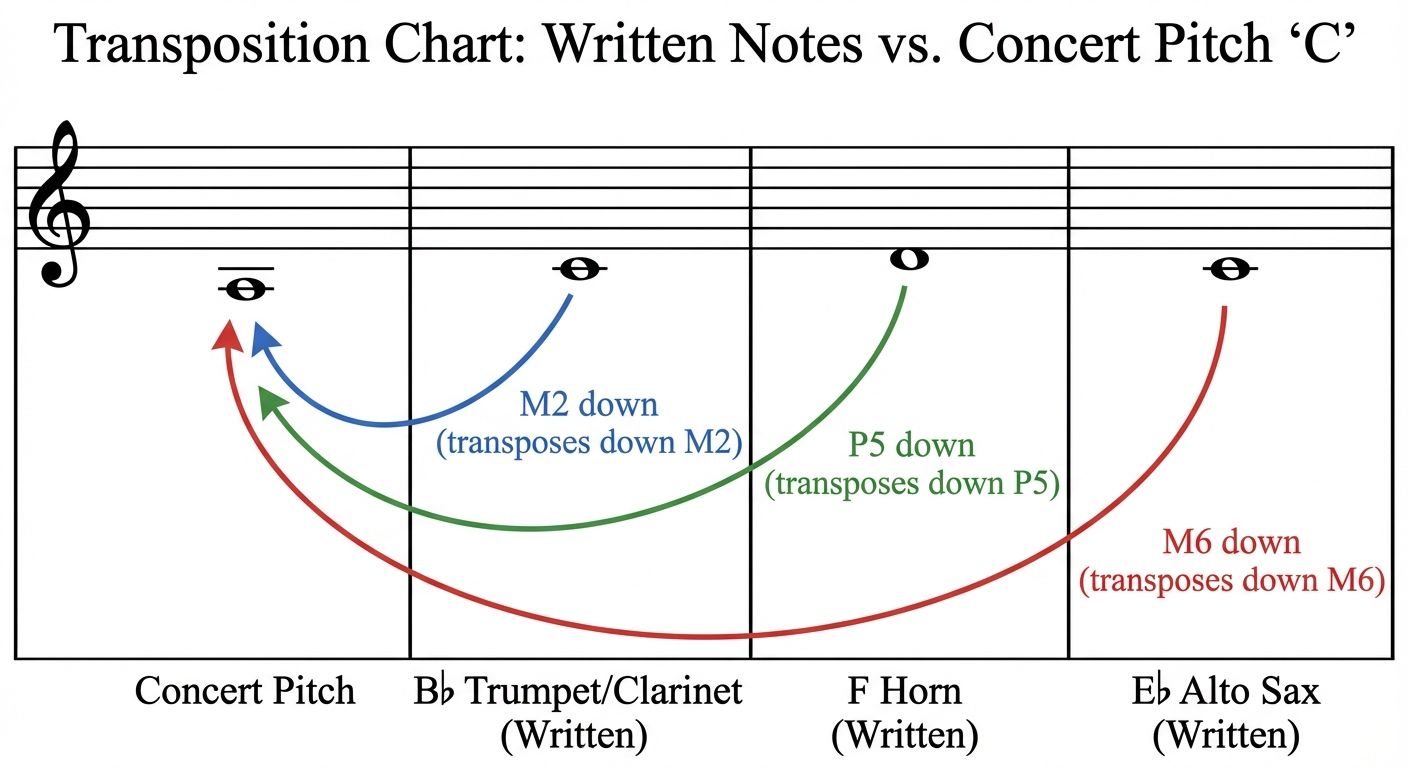
When a transposing instrument plays a specific written note, the actual pitch heard (sounding pitch) is different. Instruments are named by the note they produce when they play a written C.
The "See a C, Hear the Key" Rule:
If an instrument is "in Bb," when they see/read a C, the audience hears a Bb.
Common Transposing Instruments
| Instrument Key | Sounding Interval (Relative to Written Pitch) | Example Instruments |
|---|---|---|
| C Instruments | Unison (Sounds as written) | Piano, Violin, Flute, Oboe, Bassoon, Trombone |
| Bb Instruments | Sounds a Major 2nd Lower | Clarinet, Trumpet, Soprano Saxophone |
| F Instruments | Sounds a Perfect 5th Lower | French Horn, English Horn |
| Eb Instruments | Sounds a Major 6th Lower | Alto Saxophone |
| Octave Instruments | Sounds an Octave Higher or Lower | Double Bass (Sounds 8vb), Piccolo (Sounds 8va) |
Calculating Transposition
There are two directions you will need to calculate:
Written $\rightarrow$ Concert (Hearing): You see the music on the page, what note sounds?
- Method: Move the note DOWN by the instrument's interval.
- Example: A Bb Trumpet plays a written G. Move down a Major 2nd. The sounding pitch is F.
Concert $\rightarrow$ Written (Composing): You want to hear a specific pitch, what do you write?
- Method: Move the note UP by the instrument's interval.
- Example: You want a French Horn (in F) to sound a Concert C. Move up a Perfect 5th. You must write a G.
Common Mistakes: Transposition
- Wrong Direction: Students often transpose down when they should transpose up. Remember: To compensate for an instrument that sounds low, you must write high.
- Forgetting Key Signatures: When transposing a melody, the key signature must also change. If a piece is in Concert C Major, the Bb Trumpet part must be written in D Major (add two sharps).
- Clef Confusion: Some instruments transpose and change clefs. The Viola plays C insturment pitch but reads Alto Clef. The Double Bass reads Bass clef but sounds an octave lower.
Texture
Texture describes how melodic, rhythmic, and harmonic materials are combined in a composition. It answers the question: "How many layers of sound are there, and how do they relate to one another?"
1. Monophony (Monophonic)
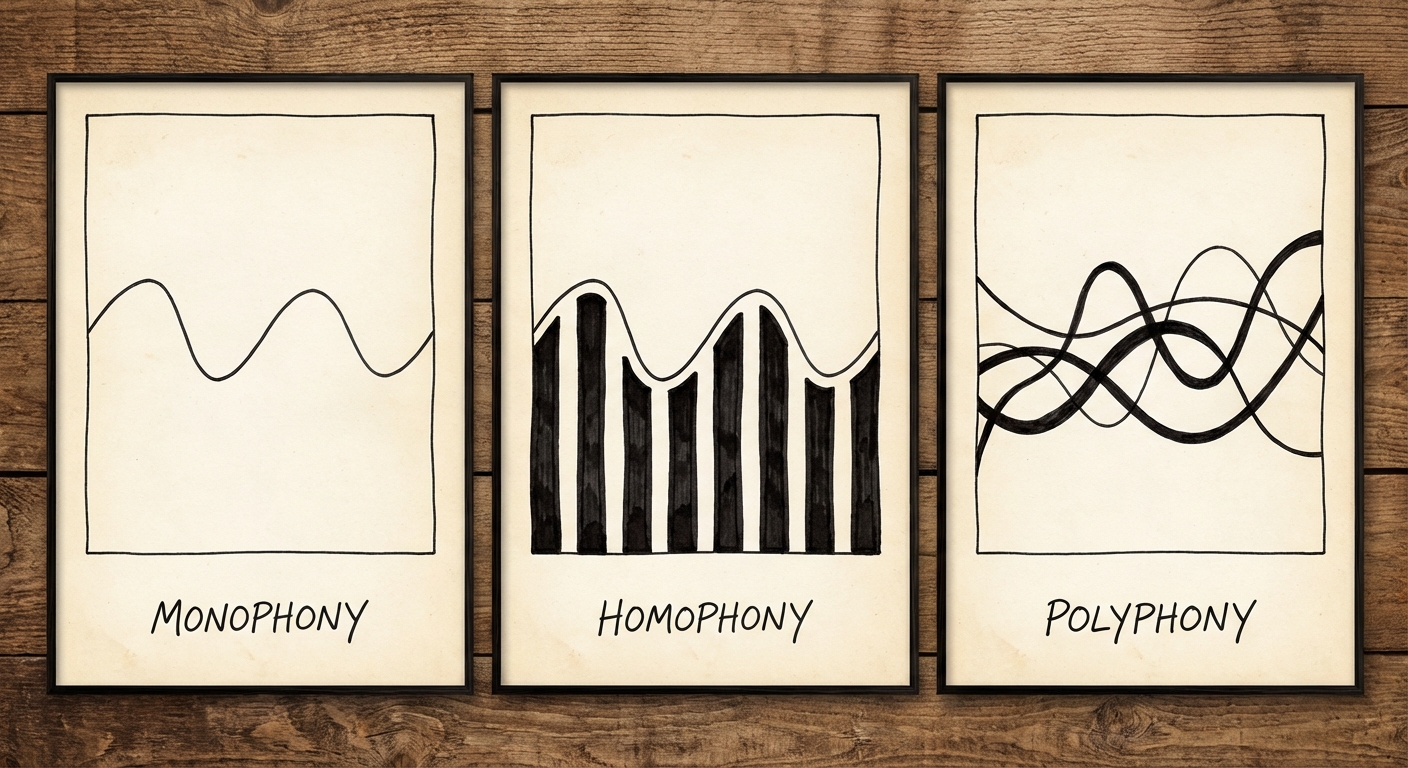
- Definition: A single melodic line with no accompaniment.
- Key Feature: Just melody.
- Nuance: If 50 people sing the exact same melody at the same time (even if men and women are an octave apart), it is still monophonic. This is called Unison or Octave vs. Unison monophony.
- Examples: Gregorian Chant, a solo flute passage.
2. Homophony (Homophonic)
- Definition: A primary melody supported by accompaniment.
- Type A: Melody and Accompaniment: Distinct melody with a subordinate background (e.g., a singer with a guitar strumming chords).
- Type B: Homorhythmic (Chordal Homophony): All voices move together in the same rhythm but on different pitches, creating block chords.
- Example: A standard church hymn or chorale. Even though there are 4 distinct voices (SATB), if they move with the same rhythm, the texture is homophonic.
3. Polyphony (Polyphonic)
- Definition: Multiple strictly independent melodic lines occurring simultaneously.
- Key Feature: Independence. No single line is merely "background"; they all compete for attention.
- Imitative Polyphony: The lines sound similar and echo each other (e.g., a Canon, Round, or Fugue).
- Non-Imitative Polyphony: Totally different melodies played at the same time.
- Example: Bach Fugues, "Row, Row, Row Your Boat" (when performed as a round).
heterophony (Heterophonic)
- Note: Less common in AP basics, but occasionally tested as a distractor or concept.
- Definition: Simultaneous variation of a single melodic line. Two musicians play the same melody, but one adds ornaments or changes the rhythm slightly while the other plays it straight.
Summary Table: Texture
| Texture | Formula | Visual Analogy |
|---|---|---|
| Monophony | One Line | A single thread |
| Homophony | Melody + Chords | A foreground object on a background landscape |
| Polyphony | Line + Line (Independent) | A woven basket or braid |
Common Mistakes: Texture
- Mixing up Homophony and Polyphony: Students see four voices in a Bach Chorale and assume "4 voices = Polyphony." This is incorrect. If the rhythm is identical (vertical alignment), it is Homophonic.
- Confusing Unison with Homophony: If a violin and a flute play different notes, it is not Monophony. Monophony requires the same pitch class (unisons or octaves only).