Unit 5 Guide: Harmony, Rhythm, and Melodic Harmonization
Principles of Harmonic Rhythm
When identifying chords or writing progressions, students often focus entirely on the vertical stacks of notes. However, the horizontal timeline—the rate at which chords change—is equally crucial. This concept is known as Harmonic Rhythm.
Definition and Purpose
Harmonic Rhythm refers to the speed and regularity with which chords change within a musical composition. It differs from melodic rhythm (the rhythm of the melody) and surface rhythm (the rhythm of the accompaniment texture).
Understanding harmonic rhythm is vital for two reasons:
- Analysis: It helps you determine which notes are chord tones and which are non-chord tones.
- Composition: It ensures your part-writing feels grounded and propulsive rather than disjointed.
Rules of Metric Placement
In the Common Practice Period (1600–1900), which AP Music Theory focuses on, harmonic changes align with the metric hierarchy of the measure.
- Strong Beats: Chords most frequently change on strong beats (Downbeat/Beat 1).
- Weak Beats: Chords can change on weak beats, but usually to facilitate movement toward the next strong beat.
The Bar Line Rule
One of the most important rules in traditional harmony is the treatment of the bar line.
- Mandatory Change: You should generally change harmonies across the bar line (from the last beat of a measure to the first beat of the next).
- Effect: This emphasizes the downbeat and establishes the meter.
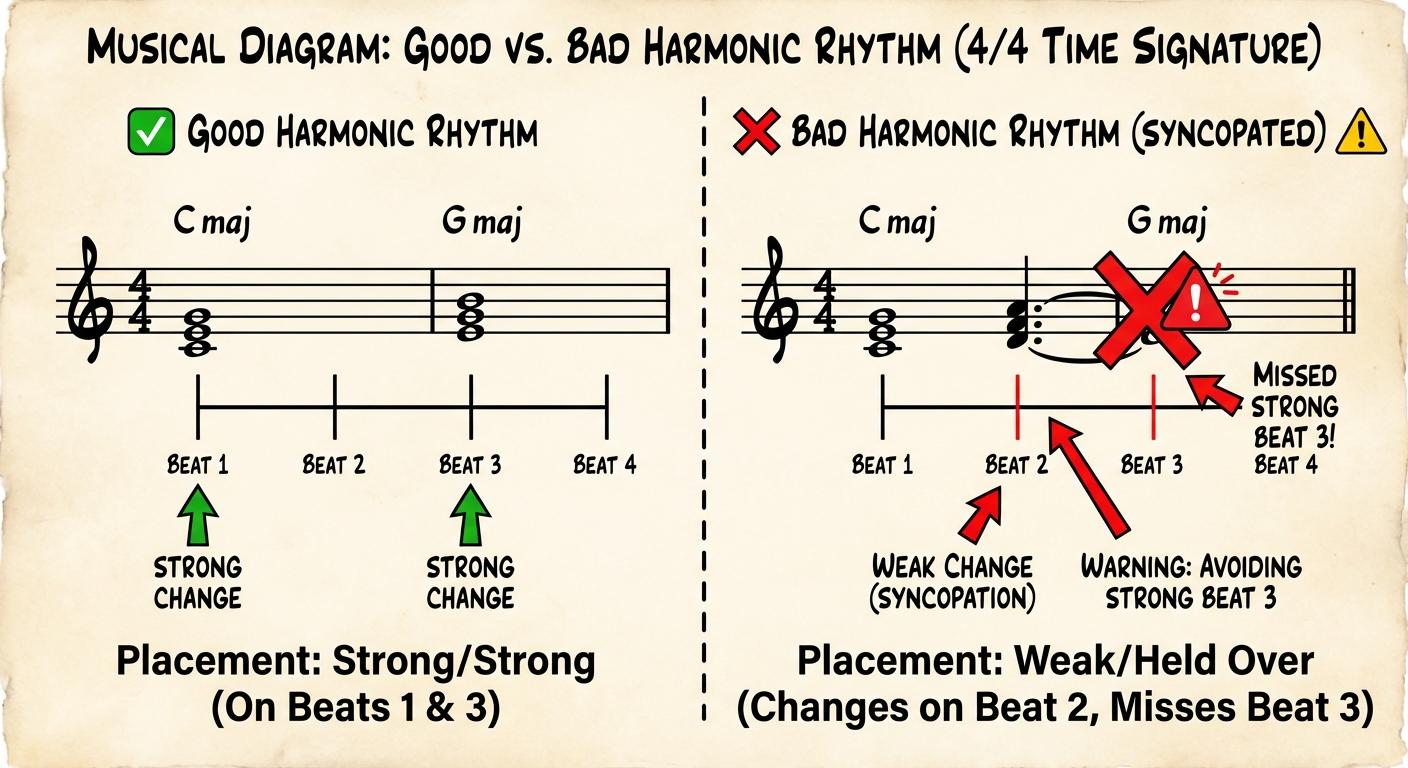
Syncopated Harmonic Rhythm (The "Do Not" Rule)
A major error to avoid is Syncopated Harmonic Rhythm. This occurs when a chord arrives on a weak beat and holds over (ties/sustains) into the following strong beat.
Why is this incorrect?
Strong beats (like Beat 1 or Beat 3 in 4/4) are meant to provide an accent. If the harmony changes on a weak beat (like Beat 2) and remains static through Beat 3, the metric accent of Beat 3 is undermined by the static harmony. This makes the listener lose the sense of the meter.
Exceptions:
- This is distinct from a pedal point, where the bass stays the same while harmonies above change.
- This is distinct from melodic syncopation, which is perfectly acceptable.
Determining Harmonic Rate
When analyzing a score, looking at the bass line is the fastest way to determine harmonic rhythm.
- If the bass note changes, the harmony has likely changed.
- If the bass note is static but the upper voices move significantly (e.g., from a 5th to a 6th above the bass), the position or inversion may have changed, or it may be a cadential $_{4}^{6}$ progression.
Harmonizing Melodies
Harmonizing a melody—often called realizing a lead sheet or four-part writing from a soprano line—requires you to construct a chord progression that supports an existing melody while following the rules of voice leading.
The Functional Phrase Model (T-PD-D-T)
The foundation of harmonizing any melody in Unit 5 is the functional relationship between chords. You typically do not choose chords randomly; you follow the standard Phrase Model.
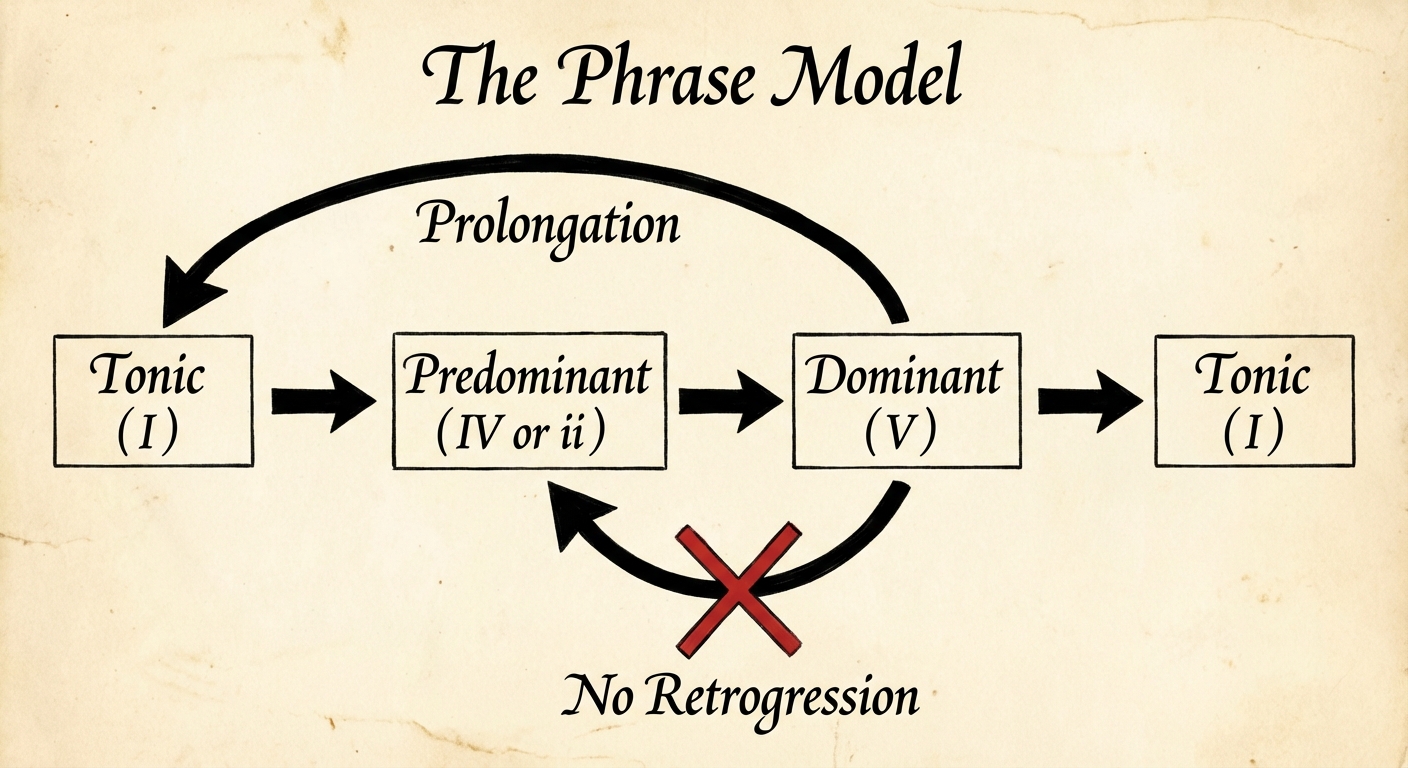
- Tonic (T): Stability. The home base. (I, i, I$^6$, etc.)
- Predominant (PD): Preparation. Moves away from Tonic and sets up the Dominant. (ii, IV, ii$^6$, etc.)
- Dominant (D): Tension. Pulls strongly back to Tonic. (V, V$^7$, vii$^{\circ}$)
- Tonic (T): Resolution.
Crucial Rule: Avoid Retrogression. In standard classical harmony, Dominants do not move backward to Predominants (e.g., V should not go to ii).
Step-by-Step Harmonization Process
When presented with a melody line to harmonize:
1. Analyze the Key and Cadence
- Look at the key signature and the final note.
- Identify the cadence at the end of the phrase first. If the phrase ends $2-1$ or $7-1$, it is likely an Authentic Cadence (V–I). If it pauses on $2$, $5$, or $7$, it might be a Half Cadence (ending on V).
2. Determine Harmonic Rhythm
- Decide how often chords need to change. Usually, one chord per beat or one chord per two beats is standard for AP style exercises.
- Look for melodic leaps; a leap in the soprano usually implies the two notes belong to the same chord, or the chord changes to accommodate the new note.
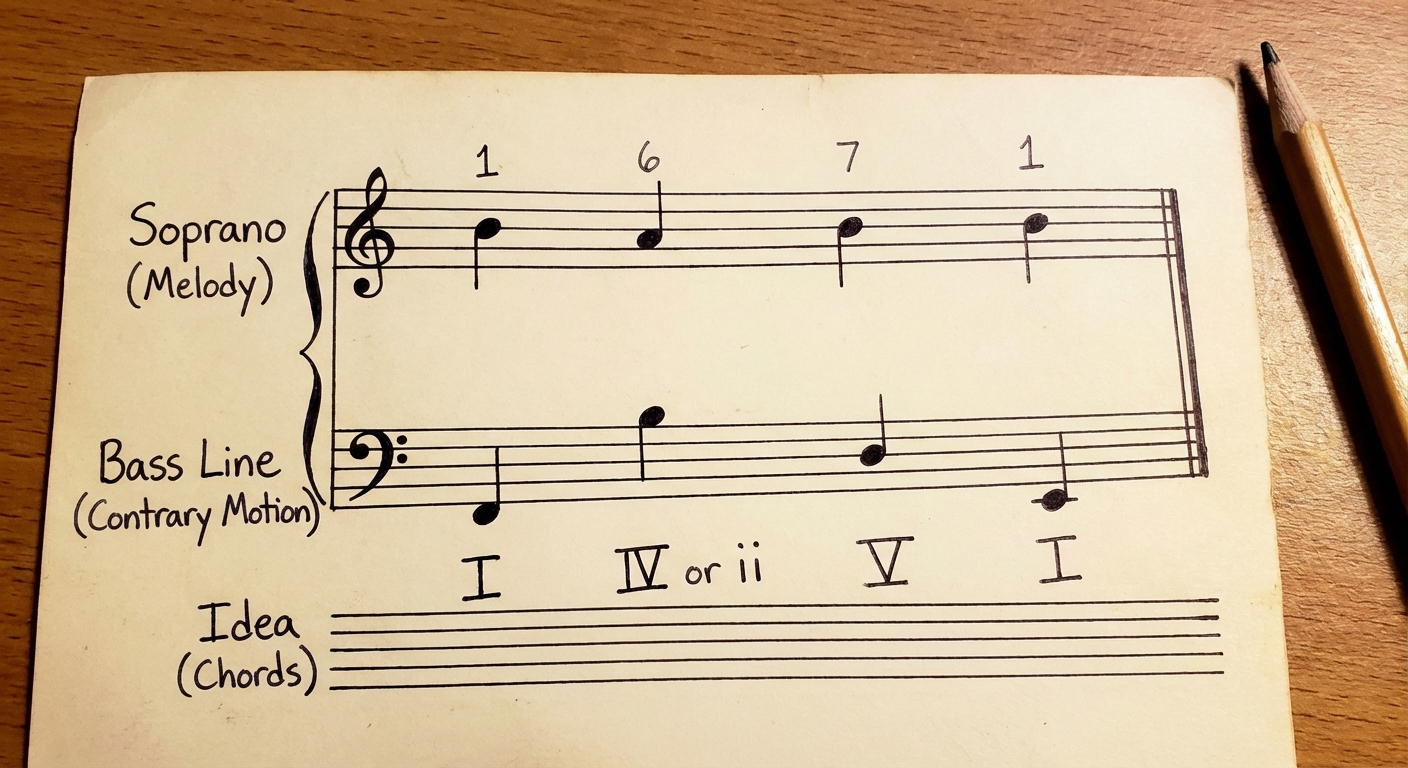
3. Assign Roman Numerals (The Bass Line)
- For each melody note, list the diatonic chords that contain that note.
- Example: In C Major, if the melody note is D (scale degree 2), it could fit into:
- ii (d-f-a)
- V (g-b-d)
- vii$^{\circ}$ (b-d-f)
- Example: In C Major, if the melody note is D (scale degree 2), it could fit into:
- Select chords that create a logical T → PD → D → T flow.
- Write the Bass Line: Create a bass line that moves in contrary motion (opposite direction) to the soprano wherever possible to maintain independence.
4. Fill in Inner Voices (Alto and Tenor)
- Once the Soprano and Bass are set, fill in the Alto and Tenor to complete the triads.
- Follow standard spacing rules:
- Adjacent upper voices (S-A, A-T) should be within an octave.
- Tenor and Bass can be more than an octave apart.
- Doubling Rules:
- Root position chords: Double the Root.
- First inversion chords ($^6$): Double the Soprano (often) or the Bass (if tonal variety allows), but avoid doubling the leading tone.
- Second inversion chords ($_{4}^{6}$): Always double the Bass (the 5th of the chord).
Common Pitfalls in Harmonization
1. Parallel Fifth and Octaves
This is the most frequent deduction on the AP exam.
- The Mistake: Moving two voices in the same direction separated by a Perfect 5th or Perfect 8ve.
- ** The Fix:** Use contrary motion between the Soprano and Bass. If the soprano goes up, move the bass down.
2. Doubling the Leading Tone
- The Mistake: In a V chord or vii$^{\circ}$ chord, doubling the leading tone (scale degree 7).
- The Fix: NEVER double the leading tone. It has a strong tendency to resolve up to the tonic. If you double it, you will likely get parallel octaves when both resolve, or create frustration if one doesn't resolve.
3. Unequal 5ths (Parallel 5ths Trap)
- The Mistake: Moving from a diminished 5th to a perfect 5th between the bass and an upper voice.
- The Fix: Check the interval quality carefully when moving between vii$^{\circ}$ and I.
4. Crossing Voices
- The Mistake: Writing the Alto note higher than the Soprano, or the Tenor lower than the Bass.
- The Fix: Keep voices in their respective lanes.
Summary Table: Chord Function & Selection
| Function | Scale Degree in Bass | Common Chords (Major) | Common Chords (Minor) |
|---|---|---|---|
| Tonic | $\hat{1}$, $\hat{3}$ | I, I$^6$ | i, i$^6$ |
| Predominant | $\hat{2}$, $\hat{4}$, $\hat{6}$ | IV, ii, ii$^6$ | iv, ii$^{\circ}$, ii$^{\circ6}$ |
| Dominant | $\hat{5}$, $\hat{7}$ | V, V$^7$ | V, V$^7$ (raise leading tone!) |