Unit 9: Mastering Advanced Rhetorical Strategies
Understanding Sophistication in Argument
In AP English Language and Composition, Unit 9 is the culmination of your skills. While previous units focused on the basics of claims, evidence, and rhetorical analysis, this unit targets the elusive Row C: Sophistication point on the AP scoring rubrics.
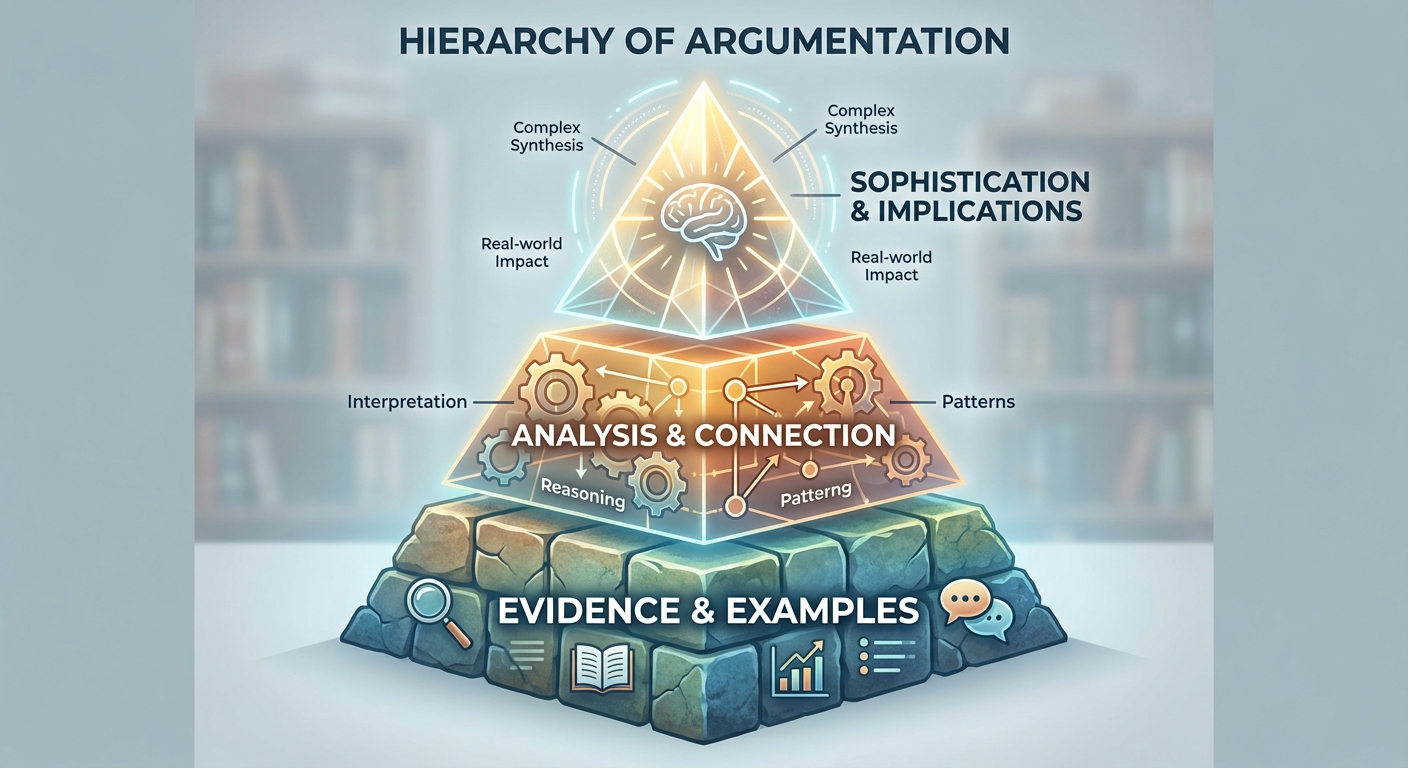
Sophistication is not merely about using elevated vocabulary; it is about the complexity of thought. A sophisticated argument demonstrates a deep understanding of the rhetorical situation and explores the implications of the topic beyond the surface level.
Characteristics of a Sophisticated Argument
To achieve sophistication, your writing must move beyond binary (good/bad, pro/con) thinking. You should aim to:
- Situate the argument in a broader context: Explain how specific evidence relates to broader societal, historical, or philosophical trends.
- Explore tensions: Identify where values conflict (e.g., freedom vs. security) rather than ignoring the conflict.
- Employ vivid style: Use rhetorical devices (metaphor, analogy, parallelism) organically to enhance persuasion, not just for decoration.
The "So What?" Factor
A key component of sophistication is articulation of the implications of an argument. This is often called the "So What?" factor. If your claim is true, what happens next? What are the long-term consequences?
| Basic Argument | Sophisticated Argument |
|---|---|
| "Libraries are important because they provide books to people who can't afford them." | "While libraries certainly address economic disparities by providing access, they function more profoundly as the last bastion of true democracy, offering a shared civic space that resists monetization in an increasingly capitalist society." |
In the diverse example above, the sophisticated argument acknowledges the basic point (access) but elevates it to a discussion about democracy and economics.
Complexity Through Counterargument
One of the most effective ways to demonstrate complexity is by engaging with opposing viewpoints. This prevents your argument from appearing one-sided or dogmatic. In the AP, you must do more than simply mention the opposition; you must interact with it through concession and refutation.
The Concession-Refutation Structure
This strategy is often associated with Rogerian Argumentation, which emphasizes finding common ground.
- Concession (The "Yes"): You acknowledge that part of the opposing argument is valid, logical, or understandable. This builds Ethos (credibility) by showing you are fair-minded.
- Refutation (The "But"): You pivot back to your stance, explaining why, despite the valid point just mentioned, your argument is still stronger or more applicable to the specific situation.
Strategic Transitions
Using the right transitional phrases is crucial for navigating counterarguments smoothly.
- "While it is true that…"
- "Admittedly…"
- "One might argue that X, and they are correct to the extent that…"
- "However, this overlooks the fact that…"
Example of Complex Counterargument
Prompt: Should schools eliminate summer break?
- Weak/Dismissive: Some people think kids need summer break to relax, but they are lazy and should be in school to learn more. (This is a strawman and lacks complexity).
- Complex: Proponents of the traditional calendar argue that summer break provides essential mental decompression for students, preventing burnout. [Concession] While true that rest is necessary for cognitive development, the three-month hiatus exacerbates the socioeconomic achievement gap, as affluent students attend enrichment camps while lower-income students lose academic ground. [Refutation/Nuance]
Nuance and Qualification
Nuance defines the gray area of an argument. It is the refusal to accept absolute, universal truths in complex social situations. Qualification is the grammatical and rhetorical method used to express that nuance.
avoiding Absolutes
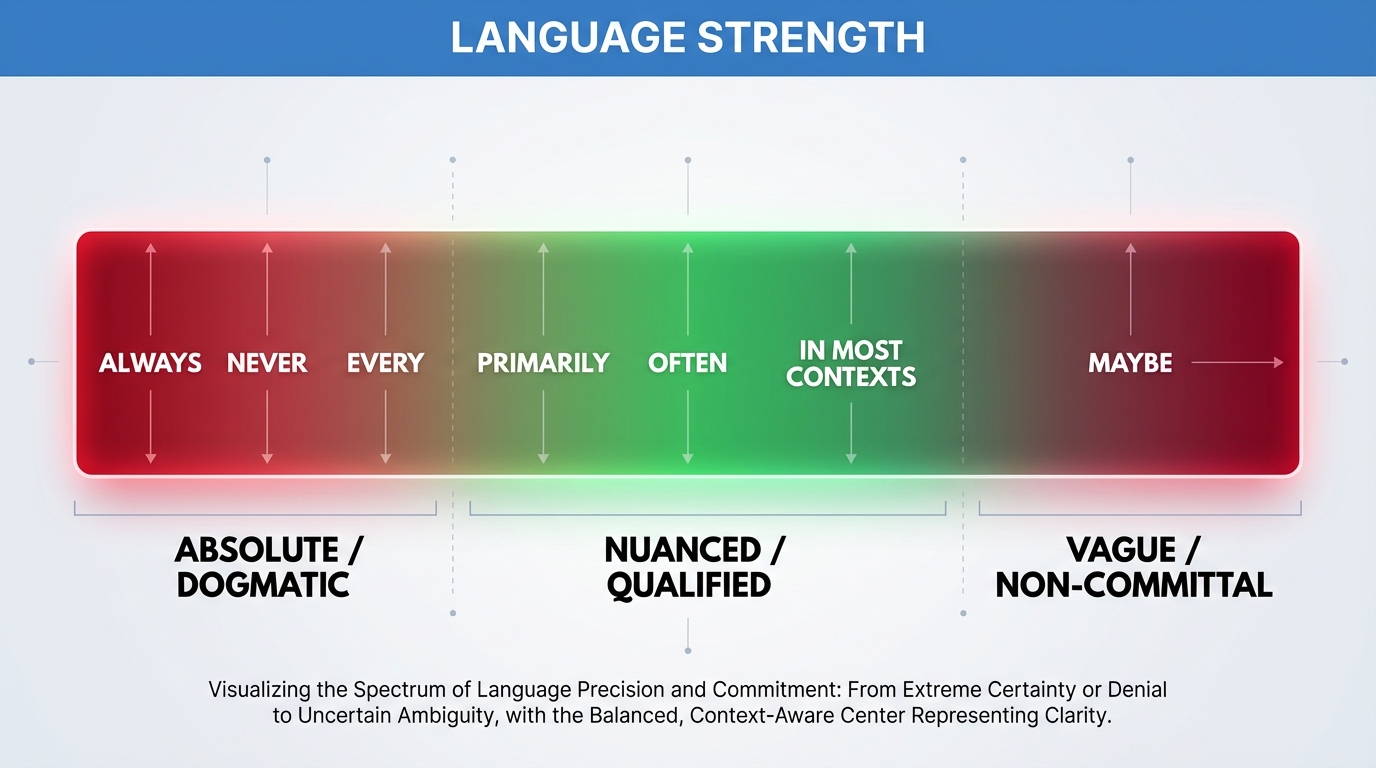
On the AP exam, arguments that use absolute language are rarely successful because they are easily disproven. If you claim "Technology always ruins human connection," a reader only needs one example of a text message strengthening a relationship to prove you wrong.
Limiting Modifiers
To add nuance, use limiting modifiers. These words limit the scope of your claim, making it harder to refute and more accurate.
- Frequency: instead of always/never, use typically, frequently, often, rarely, occasionally, historically.
- Certainty: instead of will/prove, use suggests, implies, indicates, likely, probably, may.
- Scope: instead of everyone/society, use many, most demographics, Western culture, segments of the population.
The Thesis Qualification Formula
A strong, nuanced thesis often follows a specific structure that includes a counter-clause.
Example:
- "Although safety regulations may ostensibly limit personal freedom (Counter-Clause), they predominantly serve (Scope Limiter) to protect the collective well-being of the community (Main Claim)."
Common Mistakes & Pitfalls
1. The Strawman Fallacy
Mistake: Creating a weak, exaggerated version of the opposing argument just to easily destroy it.
Why it fails: It destroys your credibility (Ethos). It shows you don't understand the complexity of the issue.
Correction: Always represent the opposing view in its strongest, most reasonable form before refuting it.
2. "Thesaurus Syndrome"
Mistake: Using obscure, multi-syllabic words to sound "sophisticated" when simple words would suffice.
Why it fails: Sophistication comes from complex ideas, not confusing sentences. If your grammar breaks down because you forced a big word in, you lose points.
Correction: Focus on clarity first. Use precise terminology, not just long words.
3. The "Fence Sitter"
Mistake: Using so much nuance and qualification that you never actually take a stand. (e.g., "There are good points on both sides, so it is hard to say.")
Why it fails: You must have a defensible position. Nuance qualifies the position; it does not eliminate it.
Correction: Ensure that even with concessions, your essay leans definitively 70/30 or 60/40 toward one side.
4. Dismissing the Nuance
Mistake: Using the word "but" to completely erase the concession. (e.g., "X is true, but it doesn't matter.")
Correction: Explain why the concession is outweighed by your point, rather than pretending it is irrelevant.