Unit 4 Review: Public Opinion, Data, and Party Ideologies
Public Opinion and Its Influence
In American politics, Public Opinion is the distribution of the population's beliefs about politics and policy issues. Understanding how these opinions are formed, how they are measured by pollsters, and how they align with the platforms of major political parties is essential for success on the AP exam.
Influence of Political Events on Ideology
While political socialization (the process by which we acquire political beliefs from family, school, and peers) is continuous, major historical events can permanently scar or shape the ideological outlook of a specific generation. This concept is often broken down into generational effects and lifecycle effects.
Generational Effects
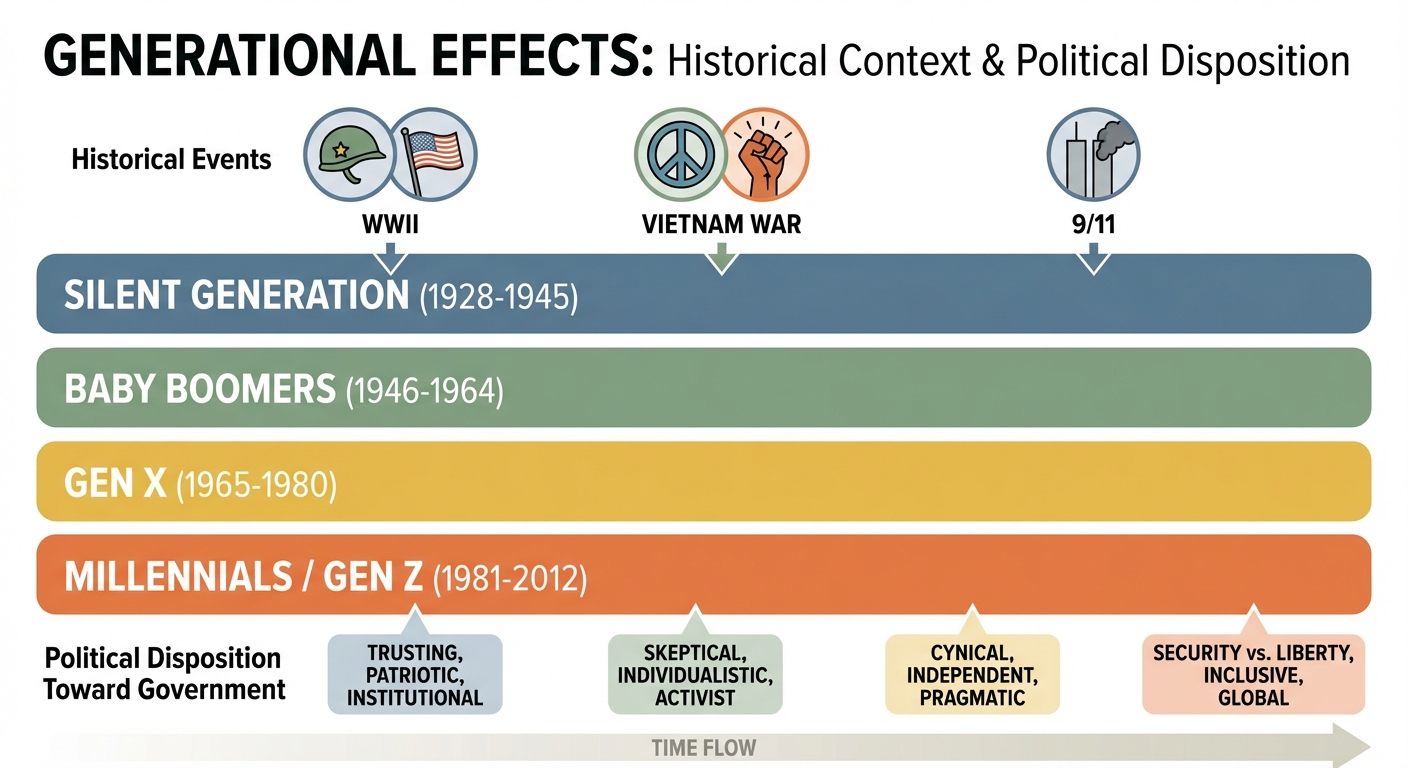
Different generations experience different defining moments during their impressionable years (ages 14–24). These events create a "cohort effect," where a specific age group holds unique views distinct from previous generations.
- The Silent Generation (pre-1945): Lived through the Great Depression and World War II. These events generally fostered a respect for authority, a belief in the necessity of government intervention during crises, and a strong sense of patriotism.
- Baby Boomers (1946–1964): Came of age during the Vietnam War and the Watergate Scandal. This led to a marked decrease in trust in government institutions compared to their parents. They are currently the most reliable voting bloc.
- Millennials and Gen Z: Their political consciousness was shaped by 9/11, the Great Recession (2008), and the COVID-19 Pandemic. Consequently, these generations often lean toward government support for social safety nets (due to economic instability) but may hold Libertarian views regarding social issues and privacy rights.
Lifecycle Effects
Distinct from generational effects, Lifecycle Effects refer to physical, social, and psychological changes that people go through as they age.
- Youth: Typically more concerned with student debt, job market entry, and social justice. They generally lean more liberal.
- Middle Age/Seniors: As citizens earn higher incomes, buy property, and retire, their priorities shift toward protecting assets, low taxes, and Social Security stability. This often (though not always) correlates with becoming more conservative.
Measuring Public Opinion
To understand what the public wants, political scientists and campaigns rely on scientific polling. On the AP exam, you must be able to differentiate between valid scientific polls and flawed data.
Types of Polls
- Benchmark Polls: The first poll taken in a campaign. It is used to gather baseline information about how well the candidate is known and what issues voters care about.
- Tracking Polls: Continuous surveys that enable a campaign or news organization to chart a candidate's daily rise or fall in support.
- Entrance and Exit Polls: Conducted outside polling places on Election Day to predict the outcome of the election before the polls close and to analyze the demographic behavior of voters.
- Focus Groups: Small demographically diverse groups (10–40 people) assembled for an in-depth conversation.
- Note: These provide qualitative data (the "why"), whereas mass surveys provide quantitative data (the statistics).
Methodology of Scientific Polling
For a poll to be considered "scientific" and credible, it must meet specific criteria:
- Random Sample: Every person in the population (universe) must have an equal chance of being selected. This is the single most important factor.
- Representative Sample: The demographic breakdown of the sample must mirror the demographic breakdown of the total population (e.g., if the country is 51% female, the sample should be roughly 51% female).
- Sample Size: A standard national poll typically requires a sample of 1,000 to 1,500 people to be accurate.
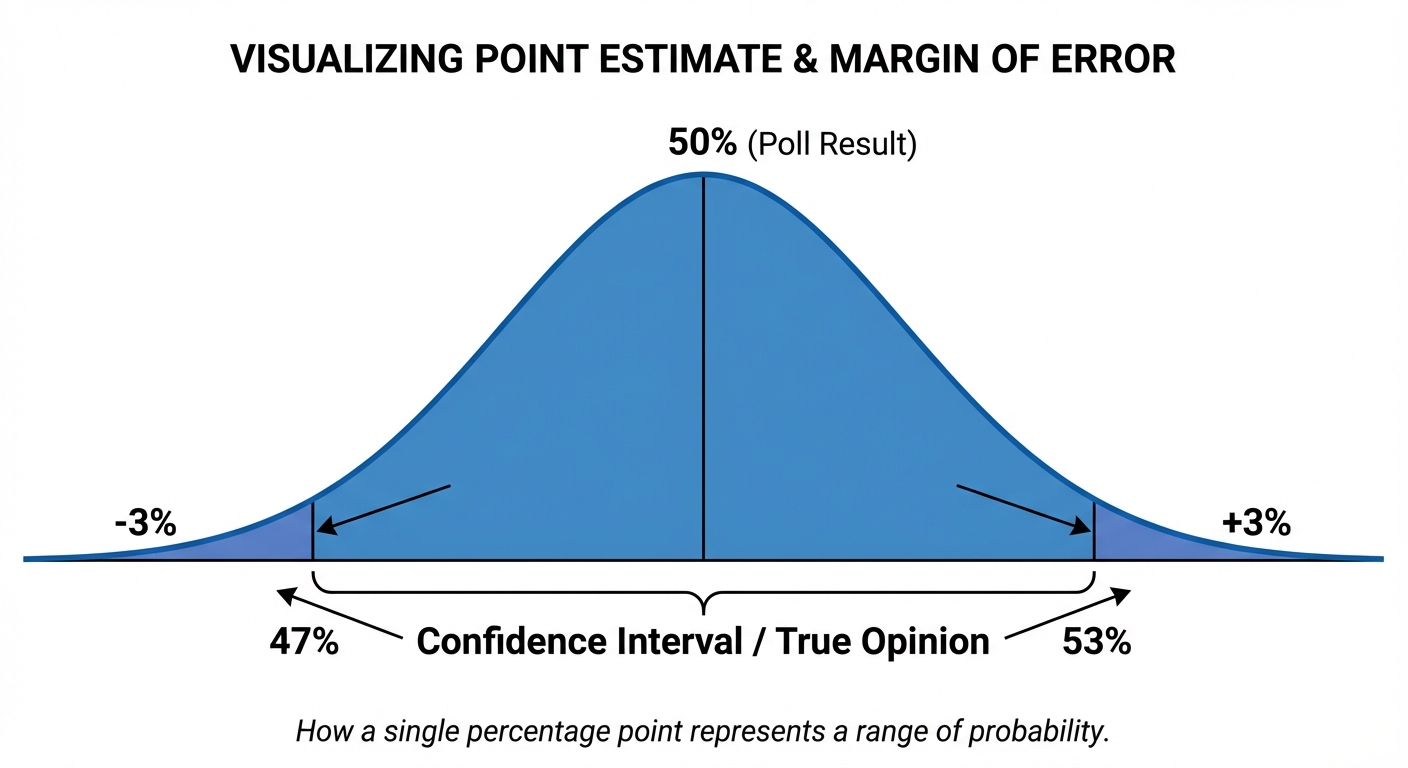
- Margin of Error (Sampling Error): The measure of the accuracy of a public opinion poll. A good poll typically has a margin of error of $\pm 3\%$.
- Example: If a poll shows Candidate A at $51\%$ and Candidate B at $49\%$ with a margin of error of $\pm 3\%$, the race is statistically a tie. Candidate A could be as low as $48\%$ and Candidate B as high as $52\%$.
Challenges to Accuracy
Even with scientific methods, polls can be misleading due to several factors:
- Question Wording (Framing): Loaded or confusing questions can manipulate answers.
- Bad: "Do you support killing unborn babies?"
- Neutral: "Do you identify as Pro-Choice or Pro-Life?"
- Selection Bias: If the method of reaching people excludes a certain type of person.
- Historical Example: The 1936 Literary Digest Poll predicted Alf Landon would beat FDR. The magazine polled via telephone directories and car registrations during the Great Depression. This excluded the poor (who voted FDR), leading to a massive prediction failure.
- Social Desirability Bias (The "Bradley Effect"): Respondents tell pollsters what they think is the "correct" or socially acceptable answer rather than their true feelings leading to inaccuracies regarding controversial candidates or issues.
- Non-Response Bias: With the decline of landlines, it is harder to get people to answer phones, making it difficult to get a truly random sample.
Ideologies of Political Parties
In the United States, the two-party system is dominated by the Democratic and Republican parties, which broadly align with Liberal and Conservative ideologies, respectively. However, identifying the specific policy stances of these parties is a frequent exam topic.
The Democratic Party (Liberalism)
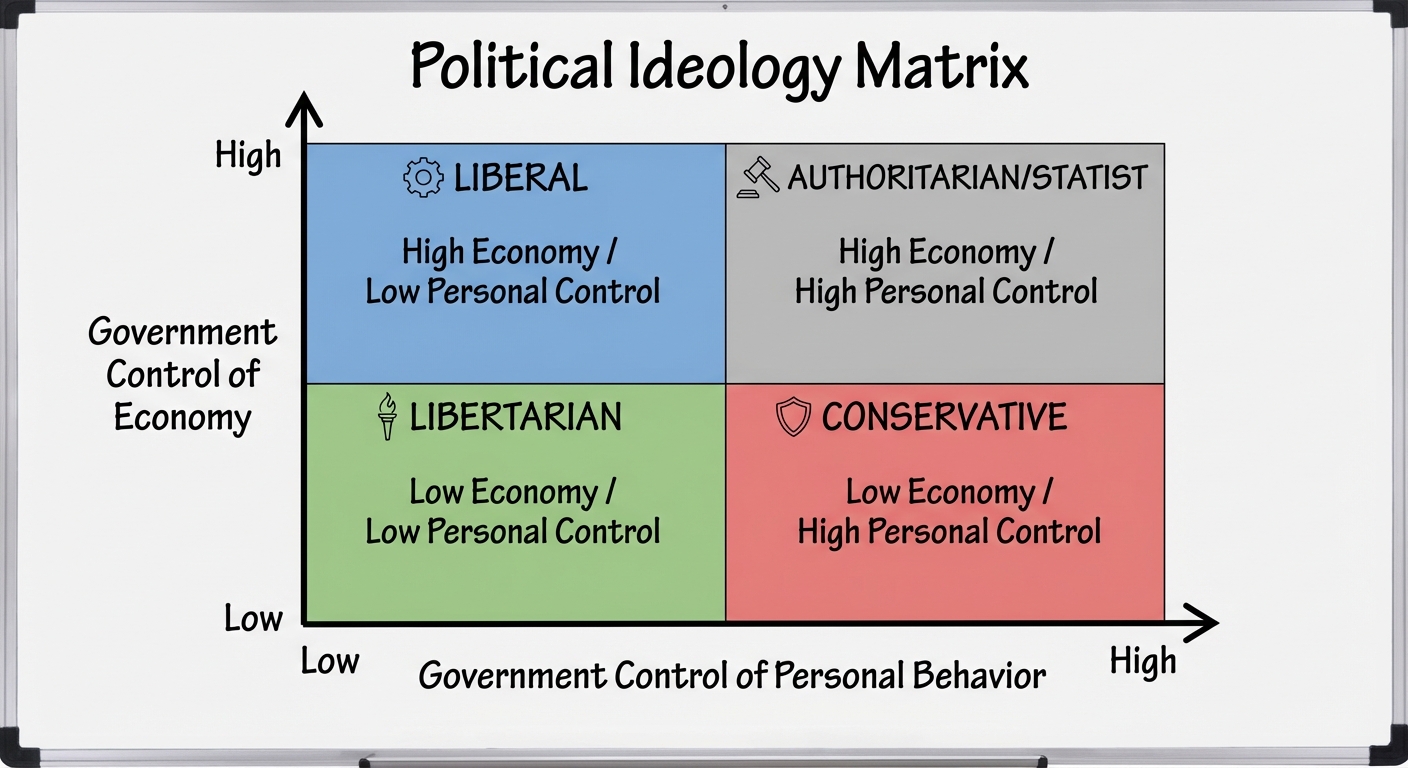
Generally aligns with modern Liberalism. They believe in a stronger role for the government in economic matters but a weaker role (more privacy) in social/personal matters.
- Economic Stance:
- Support Keynesian Economics: Government should spend money to stimulate the economy, even if it requires deficit spending.
- Advocate for social safety nets (Social Security, Medicaid, Medicare).
- Favor progressive taxation (higher taxes on the wealthy) and increased regulation of businesses to protect the environment and workers.
- Social/Political Stance:
- Prioritize civil rights and protections for minority groups.
- Support a "wall of separation" between church and state.
- Advocate for the rights of the accused.
The Republican Party (Conservatism)
Generally aligns with modern Conservatism. They believe in a limited role for government in economic matters but often support government intervention to uphold traditional moral values.
- Economic Stance:
- Support Supply-Side Economics: Cutting taxes and deregulation will stimulate economic growth (the "trickle-down" theory).
- Favor fiscal responsibility and balanced budgets (ideologically, though not always in practice).
- Believe the private sector is more efficient than the public sector.
- Social/Political Stance:
- Prioritize law and order.
- Advocate for religious freedom and often support policies reflecting Judeo-Christian values (e.g., opposition to abortion).
- Support strong national defense and border security.
Comparing with Libertarian Ideology
It is crucial to distinguish the main parties from the Libertarian perspective, which frequently appears as a distractor or comparison point on the AP exam.
- Key Tenet: Maximum liberty, minimum government.
- Economic: Agreements with Republicans (low taxes, no regulation, free market) but takes it further—abolish even the Federal Reserve.
- Social: Agreements with Democrats (decriminalization of drugs, marriage equality, privacy rights) but takes it further—government should have no say in marriage or personal habits.
| Issue | Democrats (Liberal) | Republicans (Conservative) | Libertarians |
|---|---|---|---|
| Market Regulation | High | Low | None |
| Taxation | Progressive | Lower/Flat | Minimal/None |
| Abortion | Pro-Choice | Pro-Life | Government shouldn't decide |
| Defense Spending | Decrease/Maintain | Increase/Maintain | Decrease (Non-interventionist) |
Common Mistakes & Pitfalls
- Confusing Sample Size with Representativeness: A poll of 10,000 Internet users is less accurate than a poll of 1,000 random people. Size does not correct for selection bias.
- Tracking Polls vs. Exit Polls: Students often mix these up. Tracking polls happen during the campaign to show trends; Exit polls happen on election day to explain the result.
- Monolithic Parties: Remember that not all Democrats are radical leftists and not all Republicans are hard-right. Factions exist (e.g., Blue Dog Democrats, Moderate Republicans). Avoid absolute language like "Republicans represent the wealthy"—stick to "Republican policy generally favors lower corporate taxes."
- Liberal vs. Classical Liberal: In AP Euro or History, "Liberal" (Classical Liberalism) means free markets and limited government. In AP US Gov, "Liberal" means Modern Liberalism (government intervention in the economy). Don't mix them up!