AP English Language: Strategizing Organization and Rhetoric
Crafting Effective Introduction Paragraphs
In AP English Language and Composition (Unit 2), the introduction is not merely a formality; it is the strategic opening move of your argument. Its primary function is to contextualize the Rhetorical Situation and establish a defensible claim (thesis) that appeals to a specific audience.
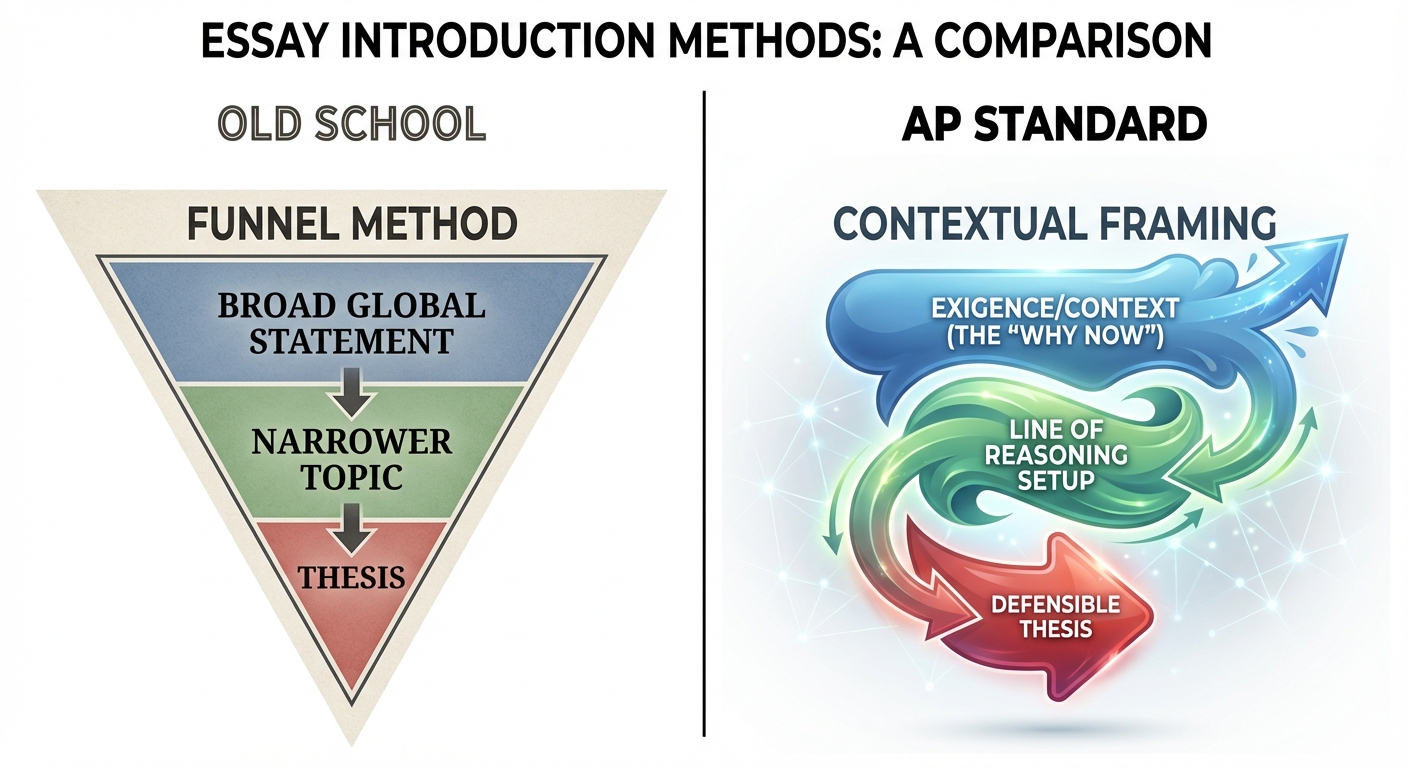
The Funnel Method vs. Contextual Framing
While students are often taught the "funnel" method (broad hook → narrow topic → thesis), AP readers prefer a Contextual Framing approach. This method avoids clichés and immediately engages with existing discourse.
Key Components of an AP Introduction
- Exigence (The Hook): Identify why this topic matters now. What sparked this discourse? Avoid dictionary definitions or "Since the dawn of time…" statements.
- Contextual Bridge: Acknowledge the complexity of the issue. This might involve briefly mentioning a counterargument or the history of the debate. This demonstrates you are informed and builds ethical appeal (Ethos).
- Thesis Statement: The anchor of your essay. It must be:
- Defensible: It can be argued heavily with evidence.
- Specific: It delineates the scope of the argument.
- Previewing: It hints at the Line of Reasoning (the logical order of your points).
Example: Thesis for a Specific Audience
Prompt: Argue whether technology isolates or connects people.
- Weak (Generic): Technology has good and bad points, but mostly it connects us.
- Strong (Audience-Aware): While critics argue that screens replace face-to-face intimacy, digital platforms actually democratize community building, allowing marginalized groups to form vital support networks that transcend physical geography.
Body Paragraphs and Evidence
Body paragraphs are where you prove the validity of your thesis. In Unit 2, the focus is on Organizing Information to suit the audience.
The Topic Sentence as a "Mini-Thesis"
Every body paragraph should begin with a Topic Sentence that connects directly back to the thesis statement. It should not be a summary of a plot or a fact; it must be a claim.
- Summary (Avoid): In the text, the author talks about the environment.
- Claim (Preferred): The author utilizes vivid imagery of decaying landscapes to evoke a sense of urgency in the audience regarding climate change.
Selecting Evidence for Your Audience
To persuade a specific audience, you must choose evidence that resonates with their values/needs:
- Skeptical Audience: Requires hard data, statistics, and expert testimony (Logos).
- Sympathetic/Hostile Audience: May respond better to anecdotes, emotional appeals (Pathos), or concessions.
Synthesizing Sources (The Sandwich Method)
Never leave a quote "floating" in a paragraph. You must anchor it using the sandwich method:
- Top Bun: Introduce the context of the evidence.
- Meat: The specific textual evidence (quote or paraphrase).
- Bottom Bun: The commentary (analysis).
Tip: Use Embedded Quotes for better flow. Do not write "The quote says…" Instead, integrate the text grammatically into your own sentence.
Commentary and Analysis
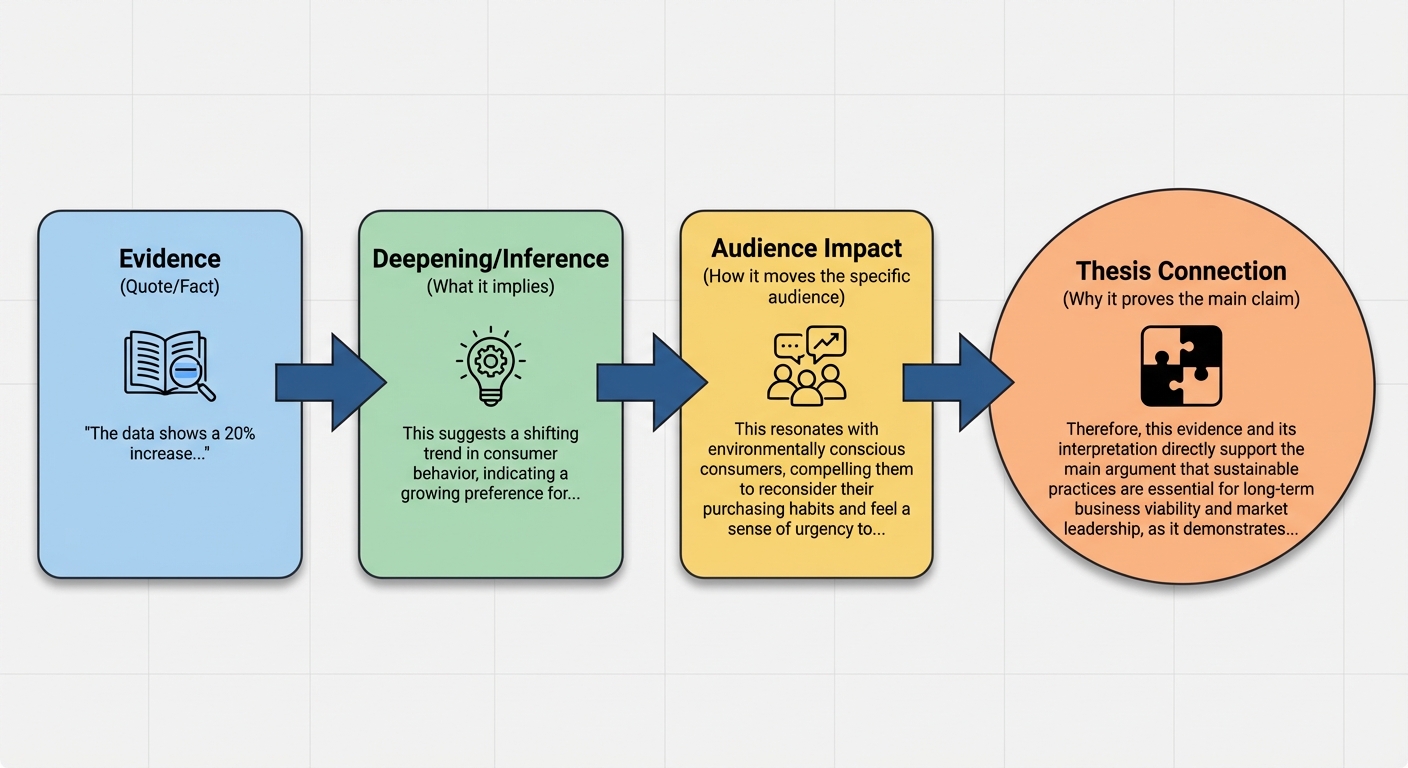
This is the most critical component of your score (Row B on the rubric). Commentary explains the relationship between the evidence and the claim. It answers the question: "So What?"
Moving Beyond Summary
Summary repeats what the text says; analysis explains what the text does and why it matters.
The "Why" and "How"
Effective commentary often follows a two-step logic:
- Interpretation: What implies or suggests about the subject.
- Connection: How this supports the thesis or influences the specific audience.
Sample Commentary Breakdown
- Evidence: "The author describes the coal miners as 'caked in the soot of a thousand breathless days.'"
- Weak Commentary: This shows the author thinks mining is dirty and hard work.
- Strong Commentary: By using the hyperbole "a thousand breathless days," the author emphasizes the chronic, suffocating nature of the labor. This appeals to the audience's sense of empathy (Pathos), forcing the privileged upper-class readers to confront the physical toll of the industry that fuels their lifestyle.
Conclusions
A strong conclusion does not simply restate specific points already made. It provides a sense of finality and places the argument in a broader context.
The "So What?" Factor
The goal is to answer why this argument matters outside the confines of the essay.
- Implications: What happens if we ignore this argument? What happens if we accept it?
- Call to Action: What should the audience do or think now?
Mnemonics: The 3 R's of Conclusions
- Restate (the thesis in a new way—do not copy/paste).
- Reflect (on the evidence presented; synthesize, don't summarize).
- Reach (out to a universal truth or broader context).
Common Mistakes and Pitfalls
1. The "Laundry List" Approach
- Mistake: Writing body paragraphs that just list rhetorical choices (e.g., "First he uses a metaphor, then he uses diction, then he uses a simile").
- Correction: Organize by idea or argument, not by device. Discuss how multiple choices work together to convey a single point.
2. Generalizations about Audience
- Mistake: Using vague phrases like "The author uses facts to show the audience…" or "This makes the reader interested."
- Correction: Be specific. Who is the audience? (e.g., "scientific skeptics," "concerned parents," "18th-century voters"). How specifically does the evidence target their values?
3. Circular Reasoning in Commentary
- Mistake: Restating the evidence in different words as analysis.
- Correction: Use verbs of agency (e.g., constructs, contrasts, undermines, validates) to describe the function of the evidence.
4. Weak Thesis Statements
- Mistake: writing a thesis that is a statement of fact or a personal preference.
- Correction: Ensure the thesis creates a tension that requires proof. If no reasonable person could disagree with you, it is not an argument.