Unit 3: The 17th Century and the Baroque Era (Siglo de Oro)
Introduction to the Spanish Baroque
The 17th Century (El siglo XVII) in Spain is the latter half of the Siglo de Oro (Golden Age). While the Renaissance (16th Century) was characterized by harmony, balance, and humanism, the Baroque period is defined by complexity, contrast (claroscuro), pessimism, and a focus on the fleeting nature of life.
Key Historical Context
During this period, the Spanish Empire was in a state of political and economic decline (loss of territories, bankruptcy), despite a flourishing conceptual and artistic output. This contradiction leads to the central mood of the era: El Desengaño (Disillusionment).
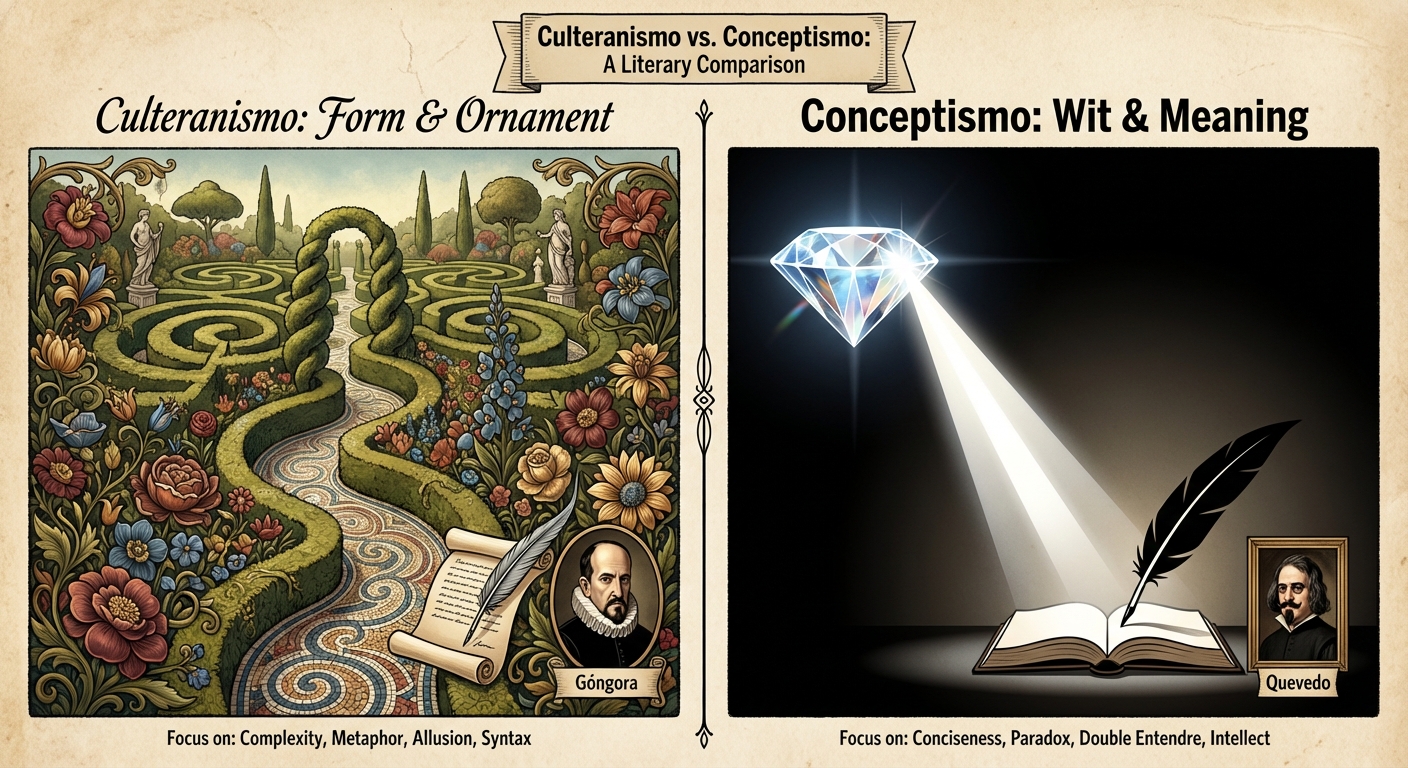
Literary Movements: Culteranismo vs. Conceptismo
Unlike the unified style of Garcilaso (Renaissance), Baroque poetry split into two rival aesthetic movements. Understanding the difference is critical for the AP exam.
1. Culteranismo (Gongorismo)
- Representative: Luis de Góngora.
- Focus: Beauty of form, ornamental richness, sensory appeal.
- Characteristics:
- Complex syntax and hypérbaton (inverting word order).
- Latinisms (words derived directly from Latin).
- Elaborate metaphors and mythological allusions.
- Aim: To elevate Spanish to the dignity of Latin; difficult for the commoner to understand.
2. Conceptismo
- Representative: Francisco de Quevedo.
- Focus: Meaning regarding form, wit, intellectual intensity.
- Characteristics:
- Polysemy (multiple meanings for one word).
- Puns and wordplay (juegos de palabras).
- Concise, sharp expression (lo bueno, si breve, dos veces bueno).
- Aim: To express maximum meaning with minimum words.
| Feature | Culteranismo | Conceptismo |
|---|---|---|
| Primary Goal | Aesthetic Beauty | Intellectual Wit |
| Language | Latinized, ornamental | Concise, double-meanings |
| Complexity | Syntax (sentence structure) | Semantics (meaning) |
Baroque Poetry: Góngora and Quevedo
Luis de Góngora: Soneto CLXVI
Full Title: "Mientras por competir con tu cabello"
- Theme: Carpe Diem (Seize the day) and Memento Mori (Remember you will die).
- Summary: The speaker tells a woman to enjoy her beauty (hair like gold, forehead like lilies) before time destroys it.
- Key Literary Devices:
- Anaphora: The repetition of "mientras" emphasizes the fleeing passage of time.
- Nature Metaphors: Gold (hair), Lily (forehead), Carnation (lips), Crystal (neck).
- Chromatism: Use of color to represent youth (white/red/gold) vs. no color (shadows/dust).
The "Gradación" (Climax):
The poem ends with a descending gradation that leads to absolute nothingness—a nihilistic Baroque twist on the Renaissance Carpe Diem:
"…en tierra, en humo, en polvo, en sombra, en nada."
(into earth, into smoke, into dust, into shadow, into nothing.)
Francisco de Quevedo: Salmo XVII
Full Title: "Miré los muros de la patria mía"
- Theme: Memento Mori and the Decay of Imperial Spain.
- Summary: The poet looks at his country's walls (crumbling), nature (drying up), his house (stained), and his sword (vanquished). Everywhere he looks, he sees death.
- Analysis:
- The poem serves as an allegory for the fall of the Spanish Empire.
- Progression: It moves from the macro (walls of the country) $\rightarrow$ landscape (fields) $\rightarrow$ domestic (house) $\rightarrow$ personal (sword/vestments).
- Conceptismo Style: The phrase "báculo más corvo y menos fuerte" (cane more curved and less strong) refers simultaneously to a literal walking stick and the poet's own aging, failing body.
El Burlador de Sevilla y convidado de piedra
Author: Tirso de Molina (Gabriel Téllez)
Genre: Comedia del Siglo de Oro (Golden Age Drama)
Character: Don Juan Tenorio (The Archetype)
Plot Overview
Don Juan is a young noble who seduces women by deceiving them (often pretending to be their fiancé) and then fleeing. He relies on his high social status and the phrase "¡Tan largo me lo fiais!" (How long you grant me!) to dismiss warnings about divine judgment. In the end, he mocks a statue of a man he killed (Don Gonzalo), invites it to dinner, and the statue drags him to hell/death without a chance for confession.
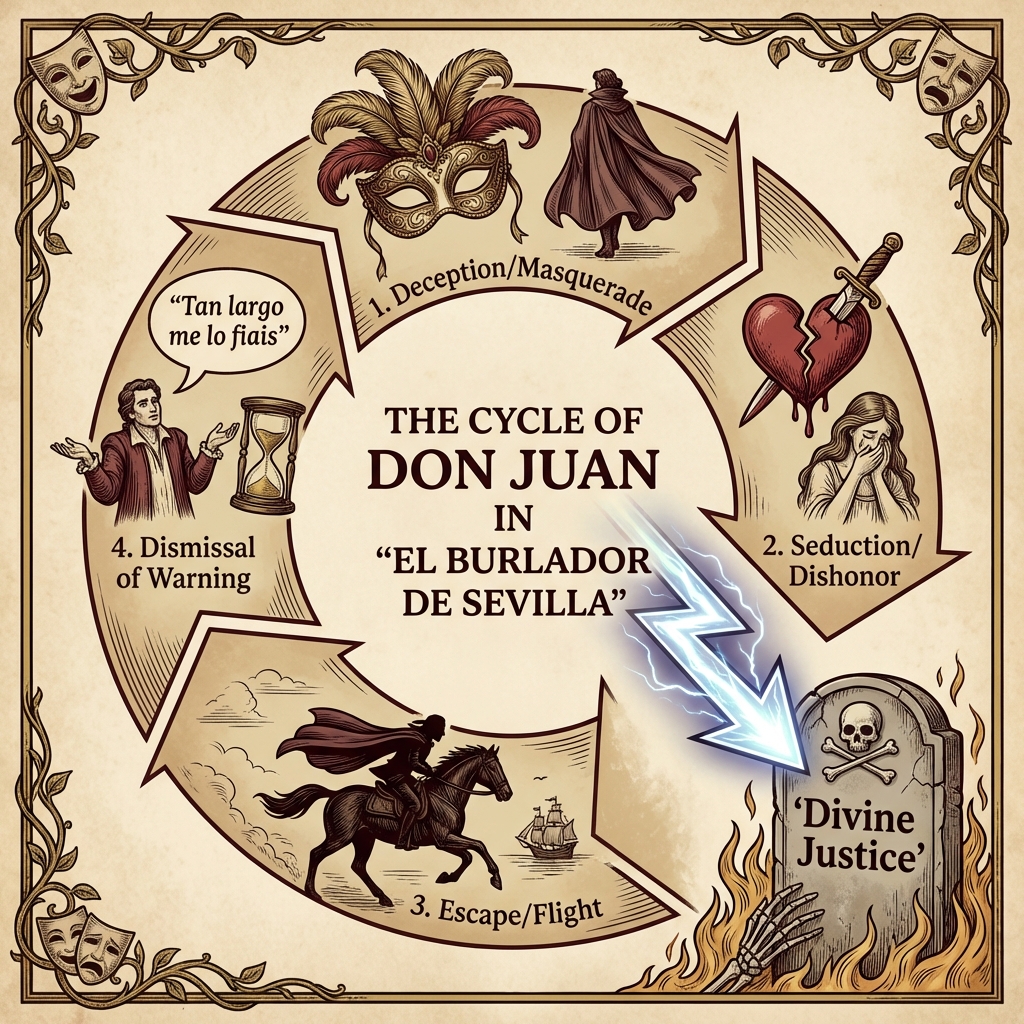
Key Themes & Concepts
- Divine Justice (Justicia Divina): The central theological conflict. Don Juan believes he has plenty of time to repent later. God's justice is swift; he is denied salvation because he presumed upon God's grace.
- Honor (La Honra): In this society, a woman's honor was tied to her chastity. By seducing noblewomen (Isabela, Ana) and commoners (Tisbea, Aminta), Don Juan disrupts the social order.
- The Catchphrase: "¡Tan largo me lo fiais!"
- Translation: "You're giving me such a long time (to pay)!" or "That deadline is so far away!"
- Meaning: It represents his hubris and lack of concern for the afterlife.
Structure and Style
- Polymetry: The play uses different meters for different situations (e.g., Romances for narrative, Redondillas for love scenes).
- In Media Res: The play opens right in the middle of the action (Don Juan seducing Duchess Isabela in Naples).
Sor Juana Inés de la Cruz: Feminist Baroque
Context: Writing from New Spain (Mexico), Sor Juana is a nun and an intellectual genius. She is often called the "Tenth Muse."
Poem: "Hombres necios que acusáis" (Satira Filosófica)
Form: Redondilla
- Stanzas of four lines.
- 8 syllables (Arte menor).
- Rhyme Scheme:
Analysis and Arguments
Sor Juana uses Baroque wit to expose the Hypocrisy and Double Standard (Doble Moral) of men.
- The Main Argument: Men criticize women for being "easy" or sinful, yet men are the ones begging women to sin with them.
- The Dilemma:
- If a woman rejects a man, she is cruel (ingrata).
- If she accepts him, she is a whore (liviana).
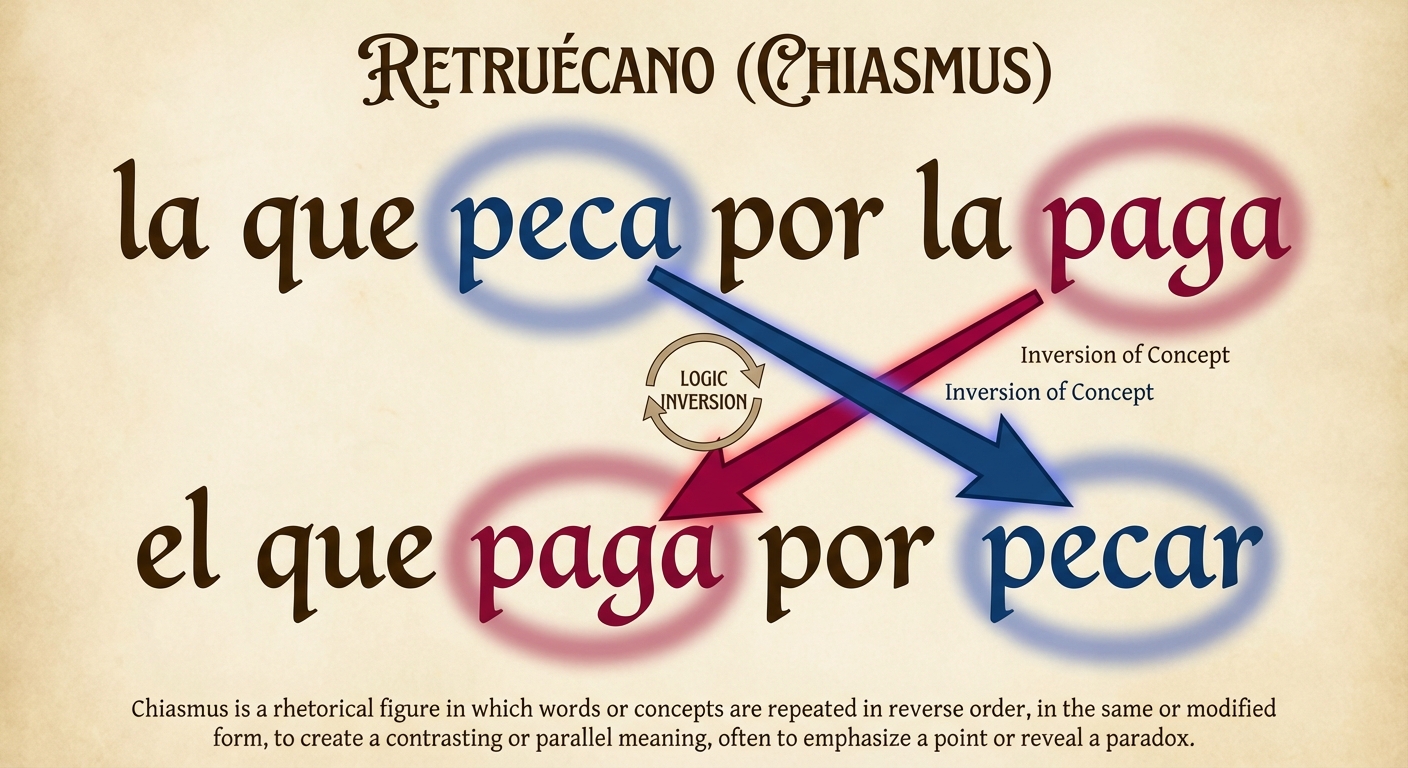
- "¿…cuál es más de culpar / aunque cualquiera mal haga / la que peca por la paga / o el que paga por pecar?"
Key Rhetorical Devices
- Retruécano (Chiasmus): A reversal of word order in successive phrases to create contrast.
- Example: "La que peca por la paga / o el que paga por pecar." (She who sins for pay / or he who pays to sin.)
- Antithesis: Contrasting concepts (Thais vs. Lucretia).
- Apostrophe: Addressing "Hombres necios" (Foolish men) directly.
Common Mistakes & Pitfalls
- Don Juan's Fate: Students often think Don Juan repents at the end. He does not. He asks for a confessor, but the statue says it is too late ("This is divine justice"). This distinguishes Tirso's version from later Romantic versions where he is saved by love.
- Góngora vs. Quevedo: Do not swap the authors. Remember: Góngora = Glorious/Flowery language (Culteranismo). Quevedo = Quick wit/Concept (Conceptismo).
- Sor Juana's Tone: She is not attacking all men, but rather "hombres necios" (foolish men) who perpetuate the double standard. Her tone is satirical and logical, not purely emotional.
- Desengaño: Do not define this purely as "disappointment." In the Baroque context, it is the "awakening" to the lie of the material world—seeing the skull beneath the skin.
Memory Aid: The Baroque "ABC"
- Arificality (complexity, metaphors)
- Brevity of Life (Memento Mori)
- Contrasts (Claroscuro, paradoxes)