Study Notes: Modernity & The Avant-Garde (1750–1980 CE)
Unit 4: Later Europe and Americas 1750–1980 CE
Historical Context & Intellectual Shifts
This unit spans a period of massive global change characterized by the Industrial Revolution, political upheavals (American and French Revolutions), and a shift from traditional patronage (church/royalty) to the commercial art market. The definition of art itself is challenged, moving from mimesis (copying reality) to abstraction.
The Enlightenment (c. 1715–1789)
The Enlightenment was an intellectual movement that prioritized reason, empirical evidence, and individualism over tradition and religion.
- Key Concept: Philosophers like Voltaire and Rousseau challenged the monarchy and the church.
- Impact on Art:
- Scientific observation: Artists began documenting the natural world and scientific experiments.
- Moralizing narratives: Art became a tool to teach virtue.
- The Grand Tour: Wealthy young men traveled to Italy to study classical antiquity, fueling the Neoclassical movement.
The Industrial Revolution (c. 1760–1840)
- Technological Shift: Mass production, steam power, and railways transformed society.
- Social Impact: Rise of the urban working class (proletariat) and a wealthy middle class (bourgeoisie).
- Artistic Reaction:
- Some embraced technology (architecture using iron/steel).
- Others rejected it, retreating to nature (Romanticism) or handicraft (Arts and Crafts).
18th Century: Rococo vs. Neoclassicism
Rococo (c. 1700–1750)
Rococo is the art of the French aristocracy. It is characterized by lightness, elegance, and themes of love and leisure.
- Visual Characteristics: Pastel colors, curving forms (arabesques), asymmetrical compositions, lighthearted subjects (fêtes galantes).
- Key Work: The Swing (Jean-Honoré Fragonard, 1767)
- Form: Lush garden, pastel pinks and greens, atmospheric perspective.
- Content: A scandalous intrigue; a lover hides in the bushes looking up a woman's dress as she is pushed on a swing by an older man (likely a bishop or husband).
- Context: Epitomizes the hedonism of the pre-Revolution French elite.
- Key Work: Self-Portrait (Elisabeth Louise Vigée Le Brun, 1790)
- Context: Painted during the French Revolution; she was the court painter for Marie Antoinette but portrays herself here as a working mother/artist, blending Rococo colors with Neoclassical clarity.
Enlightenment & Neoclassicism (c. 1750–1830)
Neoclassicism was a reaction against the "frivolous" Rococo, inspired by the archaeological discovery of Pompeii and the democratic values of Greece and Rome.
- Visual Characteristics: Linear style (crisp outlines), invisible brushwork, classical architecture, heroic figures, somber colors.
- Philosophical Goal: Promote civic duty, sacrifice, and reason.
Key Neoclassical & Enlightenment Works
- A Philosopher Giving a Lecture on the Orrery (Joseph Wright of Derby, c. 1763-1765)
- Form: Uses Tenebrism (dramatic contrast of light/dark) usually reserved for religious figures, but here applied to a scientist (the new "savior").
- Content: A demonstration of the solar system; faces reflect the wonder of knowledge.
- The Oath of the Horatii (Jacques-Louis David, 1784)
- Form: Geometric rigidity, tripartite composition (three arches), harsh lighting.
- Content: Roman brothers swearing loyalty to the state over family.
- Function: Call to arms/civic duty (pre-French Revolution propaganda).
- Monticello (Thomas Jefferson, 1768–1809)
- Form: Usage of brick, Doric columns, octagonal dome.
- Context: Jefferson adapted classical principles (Palladio) to reinforce the democratic ideals of the new American Republic.
- George Washington (Jean-Antoine Houdon, 1788–1792)
- Form: Marble sculpture.
- Content: Washington depicted as a gentleman-farmer (plow behind him) and a general (sword hanging up), referencing the Roman Cincinnatus who gave up power.
Colonial Americas: Baroque Transition
- Portrait of Sor Juana Inés de la Cruz (Miguel Cabrera, c. 1750)
- Context: Sor Juana was a genius Hieronymite nun and feminist scholar in Mexico.
- Content: She is shown with books and scientific instruments, wearing an escudo (badge). It asserts her intellect in a male-dominated society.
19th Century: Romanticism, Realism, and Photography
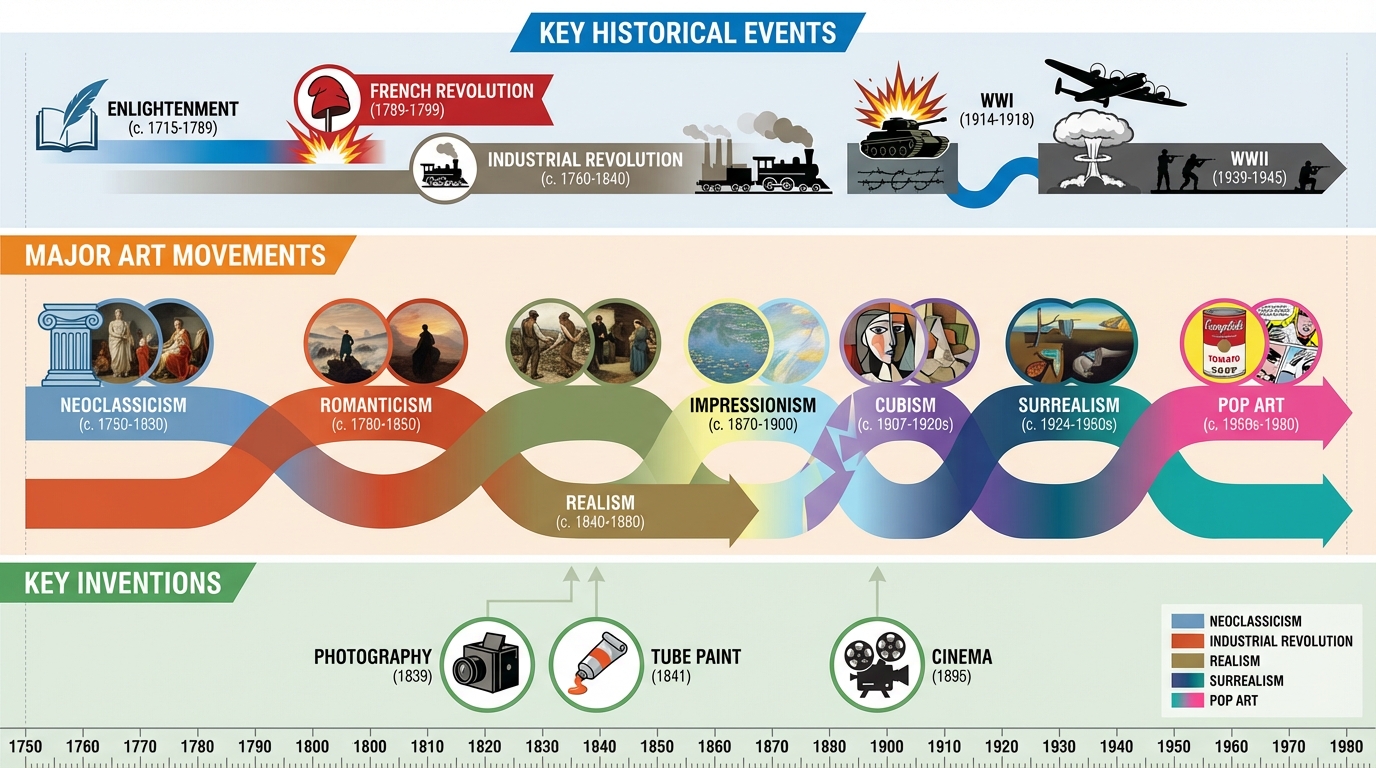
Romanticism (c. 1780–1850)
Definition: A rejection of Enlightenment logic, focusing effectively on emotion, the Sublime (awe mixed with terror), and nature's power.
- Key Work: Y no hai remedio (And There's Nothing to Be Done) (Francisco de Goya, 1810–1823)
- Media: Etching (Disasters of War series).
- Content: French soldiers executing Spanish rebels. Raw, un-heroic violence. Critique of war.
- Key Work: Liberty Leading the People (Eugène Delacroix, 1830)
- Context: Depicts the July Revolution of 1830.
- Form: Pyramid composition, energetic brushwork. Liberty is an allegorical nude figure.
- Key Work: Slave Ship (J.M.W. Turner, 1840)
- Form: Hazy, expressive color, impasto.
- Content: A captain throwing sick slaves overboard to collect insurance. Nature (the typhoon) punishes human evil. The first steps toward abstraction.
- Key Work: The Oxbow (Thomas Cole, 1836)
- Context: Hudson River School (USA).
- Content: Contrast between "wild" nature (left) and "civilized" settlement (right). Discusses Manifest Destiny.
The Invention of Photography
Photography democratized images and challenged painting's role in depicting reality.
- Still Life in Studio (Louis-Jacques-Mandé Daguerre, 1837)
- Technique: Daguerreotype (one-of-a-kind image on metal plate, long exposure).
- Significance: Photography claiming status as "art" by mimicking painting compositions.
- The Horse in Motion (Eadweard Muybridge, 1878)
- Function: Scientific study of locomotion.
- Impact: Proved horses lift all four legs directly influencing cinema available to masses.
- The Steerage (Alfred Stieglitz, 1907)
- Shift: Photography as "Modern Art." Focus on geometry/form rather than just subject matter.
Realism (c. 1848–1900)
Concept: Depicting the world as it is, focusing on the working class, the poor, and the mundane without idealization. Triggered by the Revolutions of 1848.
- The Stone Breakers (Gustave Courbet, 1849 - destroyed in WWII)
- Content: Poor men breaking rocks. No narrative climax, just labor.
- Philosophy: "Show me an angel, and I will paint one." (Courbet refused to paint what he couldn't see).
- Olympia (Édouard Manet, 1863)
- Shock Factor: A nude prostitute staring directly at the viewer. Her look is confrontation, not submission.
- Form: Flat painting style, harsh lighting, dirty hands/feet. A pivotal work bridging Realism and Impressionism.
The Shift to Modernism: Impressionism to Post-Impressionism
Impressionism (c. 1860–1890)
Interested in light, color, and the fleeting moment (en plein air painting). The subject is often the bourgeoise leisure class.
- The Saint-Lazare Station (Claude Monet, 1877)
- Focus: The steam and light inside a modern train station, not the trains themselves.
- The Coiffure (Mary Cassatt, 1890–1891)
- Influence: Japonisme (influence of Japanese woodblock prints)—flattened space, patterns, no perspective.
- Content: A private, tender moment of a woman adjusting her hair.
Post-Impressionism (c. 1880–1905)
Artists who felt Impressionism lacked structure or emotion. They kept the bright colors but added symbolic meaning or structural geometry.
- Starry Night (Vincent van Gogh, 1889)
- Form: Impasto (thick paint), swirling lines, expressionist color.
- Meaning: A view from an asylum window; represents the spiritual connection between earth and sky (cypress tree = death/mourning).
- Where Do We Come From? What Are We? Where Are We Going? (Paul Gauguin, 1897-1898)
- Context: Painted in Tahiti. Reads right to left (birth to death).
- Primitivism: Western fascination with non-Western cultures, often projecting exoticized stereotypes.
- Mont Sainte-Victoire (Paul Cézanne, 1902–1904)
- Significance: Breaking nature into geometric planes and facets. The direct precursor to Cubism.
- The Scream (Edvard Munch, 1893)
- Movement: Symbolism.
- Content: Visual representation of sound and anxiety. Synesthesia.
Early 20th Century: The Avant-Garde
Cubism (c. 1907–1920)
Definition: Showing multiple viewpoints simultaneously. Rejecting 500 years of Renaissance perspective.
- Les Demoiselles d’Avignon (Pablo Picasso, 1907)
- Content: Five prostitutes in a brothel.
- Form: Jagged shards, African mask influence on faces. It destroys the concept of the continuous body.
- The Portuguese (Georges Braque, 1911)
- Analytic Cubism: Monochromatic, fractured forms. Stenciled letters emphasize the canvas is a flat surface, not a window.
Fauvism & Expressionism
- Goldfish (Henri Matisse, 1912) - Fauvism
- Focus: Arbitrary, bright color used to evoke emotion rather than reality. "Wild Beasts."
- Self-Portrait as a Soldier (Ernst Ludwig Kirchner, 1915) - German Expressionism (Die Brücke)
- Context: WWI anxiety. Shows the artist with a severed hand (metaphor for loss of creativity/virility during war).
- Memorial Sheet for Karl Liebknecht (Käthe Kollwitz, 1919-1920)
- Media: Woodcut (references crude medieval prints).
- Content: Mourning a communist leader. Focus on the grief of the working class.
Abstraction & Constructivism
- Improvisation 28 (Vassily Kandinsky, 1912)
- Concept: Synesthesia (hearing color). Art should be spiritual, like music, without representational objects.
- Illustration from The Results of the First Five-Year Plan (Varvara Stepanova, 1932)
- Context: Soviet Constructivism (Propaganda).
- Form: Photomontage. Celebrates Stalin's industrialization (ignoring the famine).
- Composition with Red, Blue and Yellow (Piet Mondrian, 1930) - De Stijl
- Goal: Universal harmony. reduced art to the absolute basics: primary colors and straight lines.
Dada & Surrealism
Dada emerged as a reaction to the senseless slaughter of WWI, embracing absurdity.
Surrealism explored the unconscious mind (Freud).
- Fountain (Marcel Duchamp, 1917/1950)
- Concept: Readymade. Art is about the idea (conceptual), not the craft. He selected a urinal and signed it "R. Mutt."
- Object (Le Déjeuner en fourrure) (Meret Oppenheim, 1936)
- Content: Fur-covered cup.
- Effect: Visceral reaction (feeling fur in mouth). Unexpected combination of objects.
- The Two Fridas (Frida Kahlo, 1939)
- Content: Dual identity (European vs. Indigenous Mexican). Bloodline connects them. Personal, psychological surrealism.
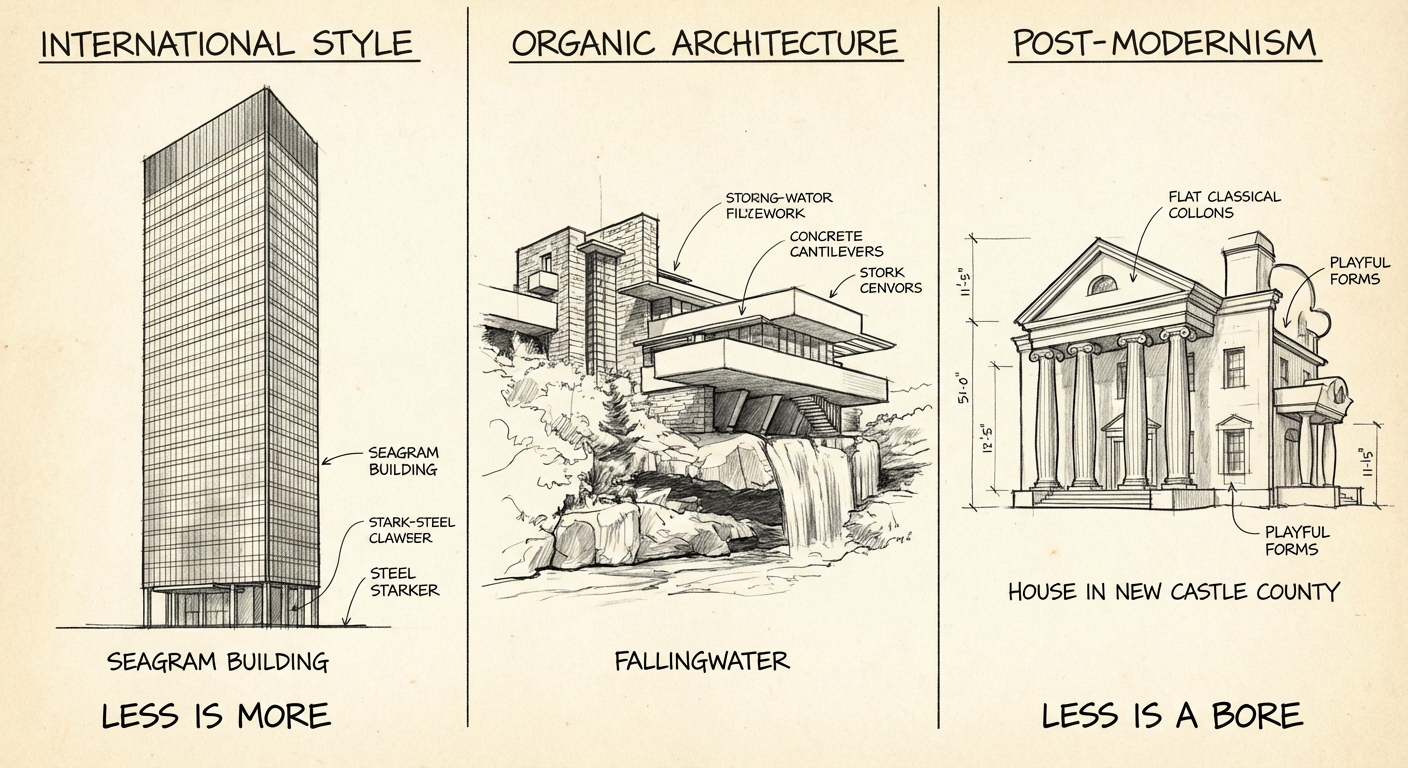
Architecture: 19th Century to Post-Modernism
| Style | Key Characteristics | Example |
|---|---|---|
| 19th C. Historicism | Revival of Gothic/Classical styles for modern government. | Palace of Westminster (Barry & Pugin). Gothic Revival. |
| Early Skyscraper | Steel frame, vertical emphasis, "Form follows Function." | Carson, Pirie, Scott and Company Building (Louis Sullivan). Chicago. |
| International Style | Steel/Glass box, pilotis (stilts), open floor plan, no ornament. | Villa Savoye (Le Corbusier) & Seagram Building (Mies van der Rohe). |
| Organic Architecture | Harmony with nature, local materials, cantilevers. | Fallingwater (Frank Lloyd Wright). Built over the waterfall. |
| Post-Modernism | reaction against "boring" glass boxes. Returns to ornament, humor, and historical references. | House in New Castle County (Robert Venturi). "Less is a bore." |
Late 20th Century: Abstract Expressionism to Pop
Abstract Expressionism (The New York School)
Post-WWII, the center of the art world shifted from Paris to New York. Action painting and Color Field painting.
- Woman I (Willem de Kooning, 1950–1952)
- Process: Aggressive brushwork, scraped away and repainted hundreds of times. A critique of the pin-up girl.
- The Bay (Helen Frankenthaler, 1963)
- Technique: Soak-stain. Pouring diluted acrylic onto unprimed canvas. The paint becomes part of the fabric.
Pop Art (1950s–60s)
Blurred the line between "High Art" and mass culture (advertising, celebrity).
- Marilyn Diptych (Andy Warhol, 1962)
- Form: Silkscreen (mass production technique).
- Meaning: Repetition de-sensitizes us to her death. She is a commodity/product, not a person.
- Lipstick (Ascending) on Caterpillar Tracks (Claes Oldenburg, 1969)
- Context: Vietnam War protests at Yale.
- Symbolism: Feminine consumerism (lipstick) vs. Masculine violence (tank tracks).
Environmental & Site-Specific Art
- Spiral Jetty (Robert Smithson, 1970)
- Type: Earthwork (Great Salt Lake, Utah).
- Concept: Entropy. The work changes with the water levels and salt crystals. It cannot be bought or sold in a gallery.
- Narcissus Garden (Yayoi Kusama, 1966)
- Action: Selling mirrored balls for $2. Critique of art market vanity (