Mastery Guide: Polynomial Functions for AP Precalculus
Rates of Change: Linear vs. Nonlinear Functions
The fundamental distinction between linear and polynomial (nonlinear) functions lies in how they change over an interval. In AP Precalculus, understanding the nature of this change is crucial for modeling real-world data.
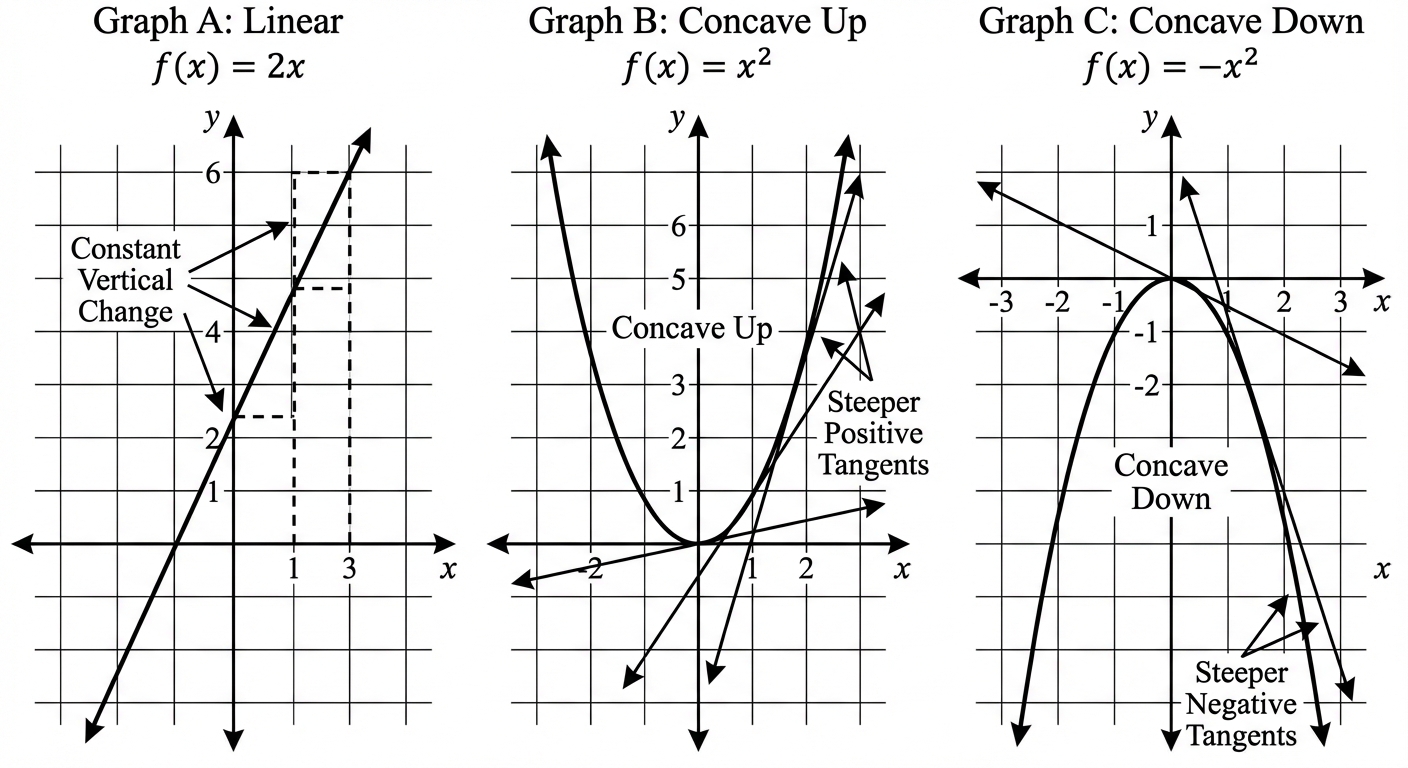
Constant vs. Varying Rates of Change
- Linear Functions: Characterized by a constant rate of change. No matter which interval you choose, the output changes by a constant amount for equal changes in input. This is represented by the slope ($m$).
- Polynomial Functions: Characterized by varying rates of change. The slope is not constant; it increases or decreases depending on the interval.
Calculating Average Rate of Change (AROC)
The Average Rate of Change measures the slope of the secant line connecting two points on a curve. For a function $f$ over the interval $[a, b]$:
Concavity and Rate of Change Analysis
When identifying polynomial behavior from data tables or graphs, look at the change in the rate of change (often called the second difference for quadratics).
- Concave Up: The rate of change is increasing. The graph creates a cup shape ($\cup$).
- Concave Down: The rate of change is decreasing. The graph creates a frown shape ($\cap$).
Polynomials: Degree, Coefficients, and End Behavior
A polynomial function in one variable is an expression consisting of variables and coefficients involving only non-negative integer exponents.
Standard Form Definition:
Where:
- $n$ is the Degree (the highest exponent, $n \geq 0$).
- $an$ is the Leading Coefficient ($an \neq 0$).
- $a_0$ is the Constant Term.
The Leading Term Test (End Behavior)
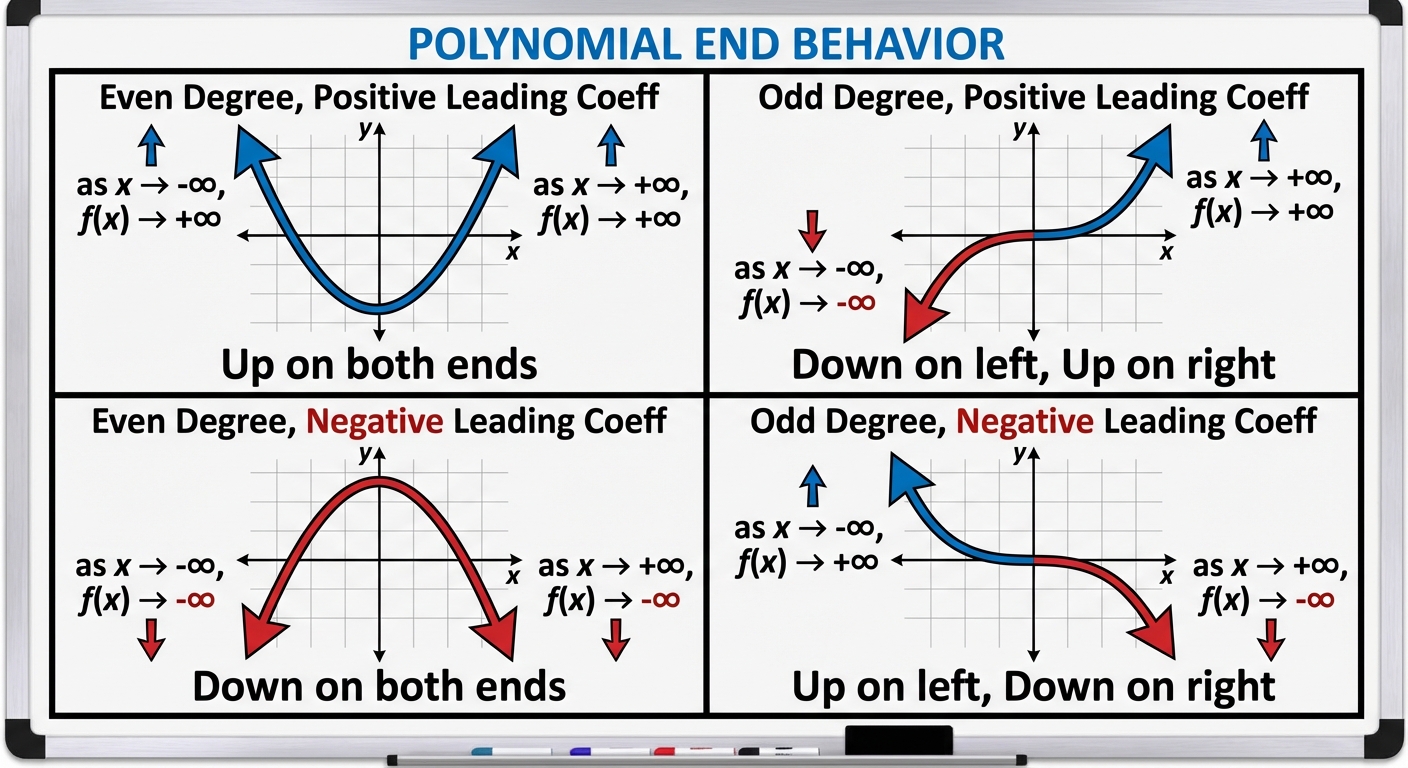
The end behavior describes what happens to the function values $f(x)$ as $x$ approaches positive infinity ($\infty$) or negative infinity ($-\infty$). In AP Precalculus, you must use limit notation to describe this.
The leading term ($a_n x^n$) dominates the behavior of the polynomial for large $|x|$.
| Degree ($n$) | Leading Coefficient ($a_n$) | Left End Behavior ($x \to -\infty$) | Right End Behavior ($x \to \infty$) | Visual Shape |
|---|---|---|---|---|
| Even | Positive ($+$) | $\lim_{x \to -\infty} f(x) = \infty$ | $\lim_{x \to \infty} f(x) = \infty$ | Up / Up |
| Even | Negative ($-$) | $\lim_{x \to -\infty} f(x) = -\infty$ | $\lim_{x \to \infty} f(x) = -\infty$ | Down / Down |
| Odd | Positive ($+$) | $\lim_{x \to -\infty} f(x) = -\infty$ | $\lim_{x \to \infty} f(x) = \infty$ | Down / Up |
| Odd | Negative ($-$) | $\lim_{x \to -\infty} f(x) = \infty$ | $\lim_{x \to \infty} f(x) = -\infty$ | Up / Down |
Turning Points
A polynomial of degree $n$ has at most $n-1$ turning points (local maxima or minima).
Zeros and Multiplicity of Polynomial Functions
The zeros (roots) of a polynomial are the $x$-values where $f(x) = 0$. These correspond to the $x$-intercepts of the graph.
Factored Form and Mutiplicity
If a polynomial is written as $f(x) = a(x - r1)^k (x - r2)^m \dots$, the exponent on the factor is the multiplicity of that zero.
- Single Zero (Multiplicity 1):
- The graph crosses the x-axis straight through.
- Behavior is roughly linear near the intercept.
- Odd Multiplicity ($>1$):
- The graph crosses the x-axis but flattens out slightly at the crossing point (inflection).
- Example: $y = (x-2)^3$ crosses at $x=2$ with a "wiggle."
- Even Multiplicity:
- The graph touches (is tangent to) the x-axis and turns around.
- Often called a "bounce" or "kiss."
- Example: $y = -(x+3)^2$ touches the axis at $x=-3$ and goes back down.
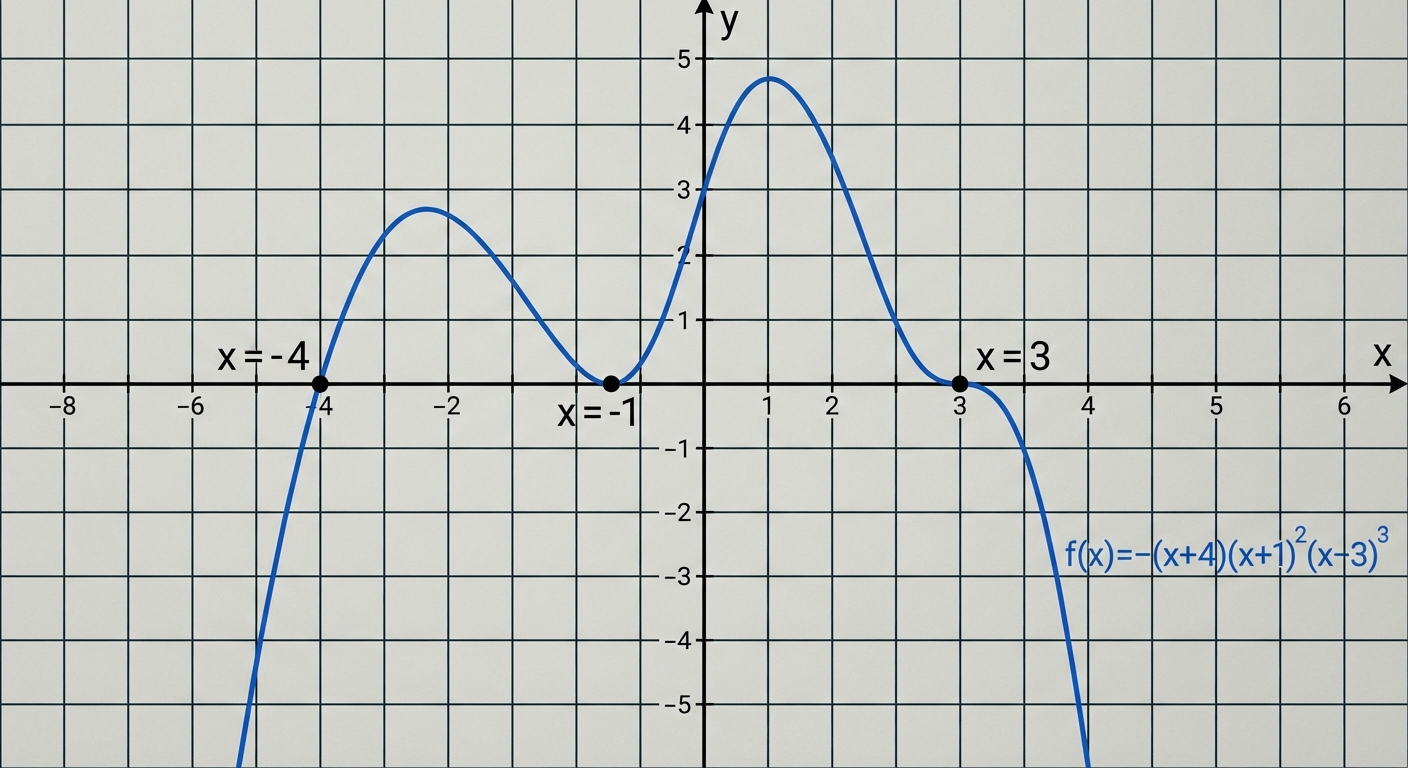
Key Concept: The sum of the multiplicities equals the degree of the polynomial (assuming complex roots are counted, though AP Precalc focuses primarily on real roots for graphing context).
Polynomial Inequalities and Sign Analysis
Solving inequalities like $P(x) > 0$ or $P(x) < 0$ requires finding the intervals where the graph is above or below the x-axis.
The Method of Sign Charts
- Find all real zeros: Set $P(x) = 0$ and solve (usually by factoring).
- Set up intervals: Use the zeros to divide the number line into test intervals.
- Test values: Pick a number within each interval and determine the sign of $P(x)$ (Positive or Negative).
- Reference Multiplicity: Alternatively, find the sign of the far right interval using the Leading Term Test, then move left across the zeros:
- If multiplicity is odd, the sign changes.
- If multiplicity is even, the sign stays the same.
Worked Example
Problem: Solve $(x - 1)^2 (x + 3) > 0$.
Solution:
- Zeros: $x = 1$ (multiplicity 2) and $x = -3$ (multiplicity 1).
- Intervals: $(-\infty, -3)$, $(-3, 1)$, and $(1, \infty)$.
- Testing:
- Test $x = 2$ (in $(1, \infty)$): $(+)(+) = +$.
- At $x = 1$, multiplicity is even (bounce). Sign stays $+$.
- At $x = -3$, multiplicity is odd (cross). Sign switches to $-$.
- Sign Analysis: Negative on $(-\infty, -3)$, Positive on $(-3, 1)$ and $(1, \infty)$.
- Conclusion: We want $>0$. The solution is $(-3, 1) \cup (1, \infty)$.
- Note: We exclude $x=1$ because the inequality is strictly greater than, not equal to.
Common Mistakes & Pitfalls
- Limit Notation Errors:
- Wrong: $x \to \infty = \infty$.
- Right: $\lim_{x \to \infty} f(x) = \infty$. (You are describing the limit of the function, not equating x to a value).
- Confusing Degree with Parity:
- An even degree polynomial is not necessarily an even function (symmetric about y-axis). $x^2 + x$ is even degree, but has no y-axis symmetry.
- Inequality Brackets:
- For strict inequalities ($
- For inclusive inequalities ($\leq, \geq$), use brackets [ ] for the zeros, but always use parentheses for $\infty$.
- The "Bounce" Factor:
- Students often forget that even multiplicity means the function does not change signs. Always verify the sign change at roots.