Unit 4 Complete Study Guide: American Political Ideologies and Beliefs
Unit 4 Complete Study Guide: American Political Ideologies and Beliefs
This guide covers the foundational beliefs that define American political culture, how citizens acquire these beliefs, and how they evolve over time. These concepts form the bedrock for understanding voting behavior and policy debates in the United States.
American Attitudes About Government and Politics
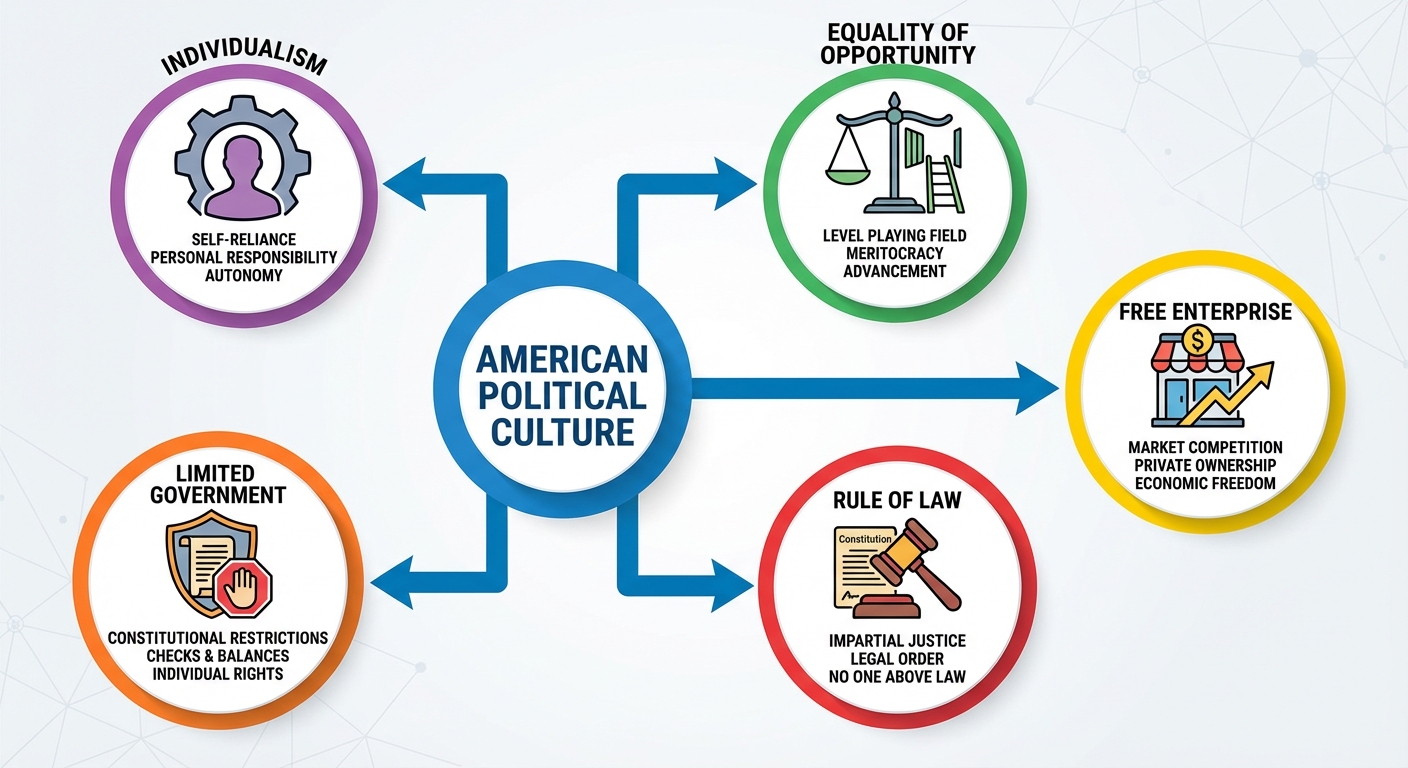
American political culture is distinct because it is rooted in a shared set of core values, rather than a shared ethnicity or religion. While Americans agree on these values in principle, conflict often arises over how to prioritize and implement them.
Core Political Values
There are five key values you must know for the AP exam. These concepts often appear in Multiple Choice Questions (MCQs) regarding interpretation of foundational documents.
Individualism
- The belief in the fundamental worth and importance of the individual.
- Rooted in: Enlightenment philosophy (e.g., John Locke’s inalienable rights).
- Tension: Balances self-reliance with the need for social order. Sometimes heavily emphasized by policies prioritizing personal freedom over collective welfare.
Equality of Opportunity
- The idea that each person should have the same chance to succeed.
- Crucial Distinction: This is not equality of outcome. Americans generally accept economic inequality as long as the "race" started at the same line.
- Application: Civil Rights Act of 1964; public education systems.
Free Enterprise
- An economic system where private business operates in competition and largely free of state control.
- Laissez-faire: A "let it be" approach to the economy.
- Reality: The U.S. creates a mixed economy—mostly private, but with government regulations (minimum wage, OSHA) to protect workers and consumers.
Rule of Law
- The principle that the law applies to everyone, including those who govern.
- Key Feature: No one is above the law. Laws are public, fair, and enforced equally.
- Checks: Transparency, due process, and independent judiciaries ensure this value is upheld.
Limited Government
- Restrictions should be placed on government to protect the natural rights of citizens.
- Bill of Rights: The clearest example of limited government in action—defining exactly what the government cannot do (e.g., cannot abridge freedom of speech).
Interpretation in Policy
Different ideologies prioritize these values differently:
- Liberals tend to prioritize Equality of Opportunity, supporting government intervention to level the playing field.
- Conservatives tend to prioritize Free Enterprise and Individualism, desiring less government interference.
Political Socialization
Political Socialization is the process by which people acquire their political beliefs and ideology. It is a lifelong process, though the most significant development happens during childhood and young adulthood.
Agents of Socialization
These are the sources that influence your views. They are ranked below by generally accepted impact.
Family (The #1 Influence)
- "Kitchen Table Politics": Children heavily adopt the political leanings of their parents.
- If both parents identify with a party, the child is statistically very likely to identify with that same party.
School and Education
- Schools promote national unity and respect for political institutions (e.g., Pledge of Allegiance).
- Higher Education: Historically, college graduates have leaned more liberal, though this fluctuates based on specific demographics and majors.
Peers and Social Structures
- Race, religious affiliation, and gender significantly predict voting behavior.
- Example: Evangelicals correlate strongly with the Republican party; African Americans designate overwhelmingly as Democrats.
Media
- Often serves as a "gatekeeper" determining what issues are important.
- With the rise of social media and niche news, echo chambers reinforce existing beliefs rather than challenging them.
Civic and Religious Organizations
- Churches or unions often act as community hubs that align members with specific political causes.
The Impact of Globalization
Globalization refers to the increasing interconnectedness of world economies and cultures. This influences U.S. political culture in two ways:
- U.S. Influence Abroad: American values (democracy, Hollywood, consumerism) spread to other nations.
- Foreign Influence Here: Exposure to global diversity challenges American views (e.g., immigration policies, trade agreements like NAFTA/USMCA, environmental treaties like the Paris Agreement).
Changes in Ideology
Political beliefs are not static. They change based on when you entered the electorate and how old you are now.
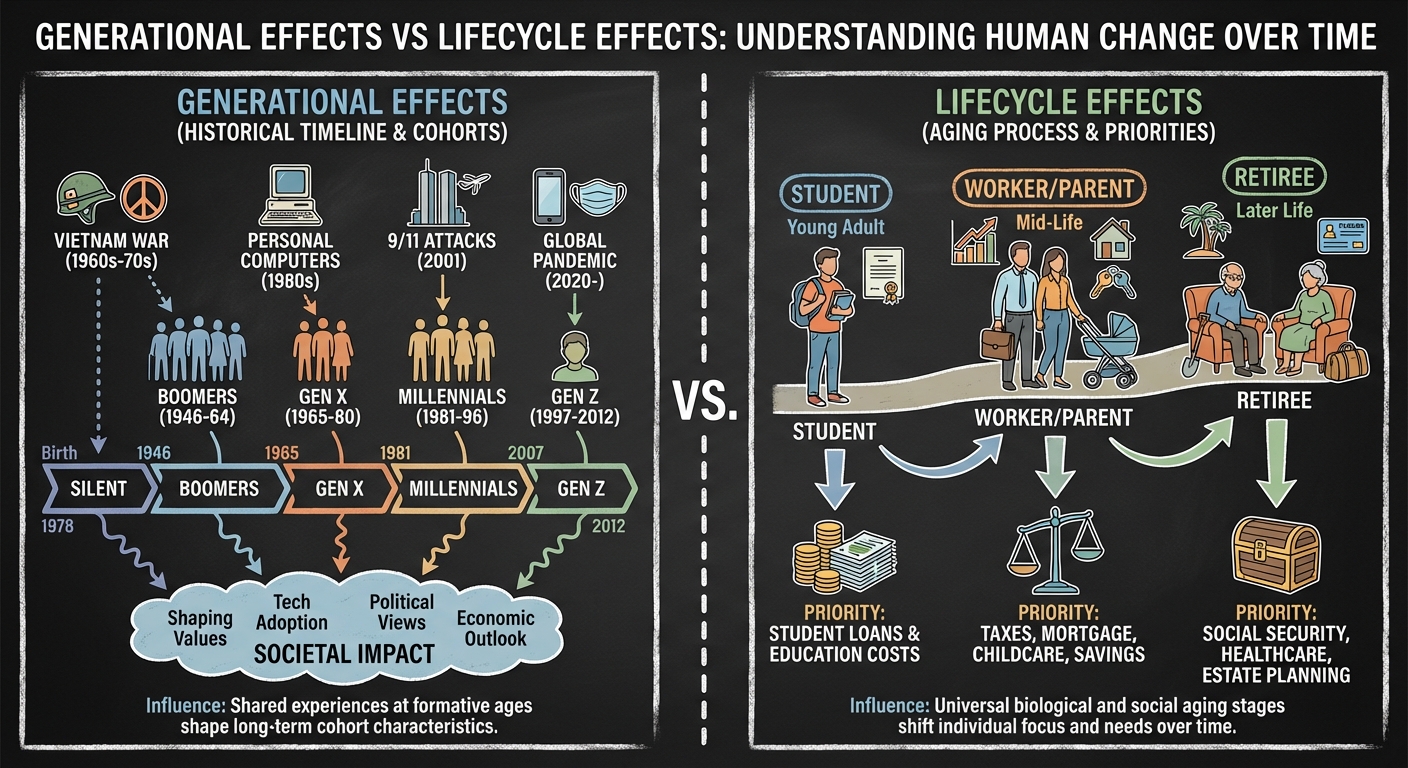
1. Generational Effects
Different generations experience different "formative events" between the ages of roughly 14–24 that shape their worldview permanently.
| Generation | Key Formative Events | Political Tendency |
|---|---|---|
| Silent Generation (born before 1945) | Great Depression, WWII, Cold War | High trust in government; value law and order; reliable voters. |
| Baby Boomers (born 1946–1964) | Vietnam War, Civil Rights Movement, Watergate | Shifted from idealism to skepticism of government; currently largely Conservative. |
| Gen X (born 1965–1980) | Late Cold War, Rise of Divorce | Independent, distrustful of institutions. |
| Millennials (born 1981–1996) | 9/11 Attacks, 2008 Financial Crisis | Socially liberal; economically impacted by recession; lower religiously. |
| Gen Z (born 1997–2012) | Digital Era, COVID-19, Climate Change | High emphasis on equality and government intervention; very socially liberal. |
2. Lifecycle Effects
People's political priorities change as they age, regardless of which generation they belong to.
- Young Adulthood: Focus on college debt, job market entry, and social issues. Tend towards novelty and reform.
- Middle Adulthood: Focus on taxation, property ownership, and schools for children. Tend towards stability.
- Seniority: Focus on retirement security (Social Security) and healthcare (Medicare). They are the most reliable voting bloc.
3. Period Effects
Major events that shift the ideology of the entire population simultaneously, regardless of age.
- Example: Immediate patriotism post-9/11 (rally 'round the flag effect).
- Example: Widespread distrust in government following the Watergate scandal.
Common Mistakes & Pitfalls
Confusing Equality of Opportunity with Equality of Outcome
- Correction: American political culture guarantees the chance to accept a job or education (Opportunity), but does not guarantee everyone earns the same salary (Outcome).
Overestimating School Influence vs. Family
- Correction: Students often think schools or media are the biggest influence because they are loud. Data consistently shows Family is the single strongest predictor of political party identification.
Conflating Lifecycle and Generational Effects
- Correction: Ask yourself: "Are they changing because they are getting older (Lifecycle, e.g., needing Medicare)? Or are they acting this way because they grew up during a war (Generational)?"
Misunderstanding "Rule of Law"
- Correction: It doesn't just mean "following the rules." It specifically means the government itself is bound by law. If the President breaks a law, they can be prosecuted—that is Rule of Law.