Unit 4: Contextual Applications of Differentiation
Understanding Rates of Change and Motion
In AP Calculus AB, Unit 4 shifts focus from the mechanics of calculating derivatives (Power Rule, Chain Rule, etc.) to using them to describe the real world. This unit bridges the gap between abstract math and physical reality.
Interpreting the Derivative in Context
The derivative, $f'(x)$ or $\frac{dy}{dx}$, represents the instantaneous rate of change of a function with respect to its independent variable. On the AP Exam, you are frequently asked to "interpret the meaning of the derivative in the context of the problem."
The "NUT" Method
To ensure you get full credit on Free Response Questions (FRQs), your interpretation must include three components (N.U.T.):
- Number: The specific numerical value of the derivative.
- Units: The correct units for the rate of change.
- Time (or Input): The specific instant $x=c$ or $t=c$ at which this rate occurs.
Determining Units
The units of the derivative are always a ratio of the dependent variable's units to the independent variable's units:
Example Scenario:
Let $W(t)$ represent the amount of water in a tank (in gallons) at time $t$ (in minutes). If $W'(5) = -12$, how do we interpret this?
- Incorrect: "The water is changing by -12."
- Correct: "At time $t=5$ minutes, the amount of water in the tank is decreasing at a rate of 12 gallons per minute."
Note: If you use the word "decreasing," use the positive value (12). If you say "changing," use the signed value (-12).
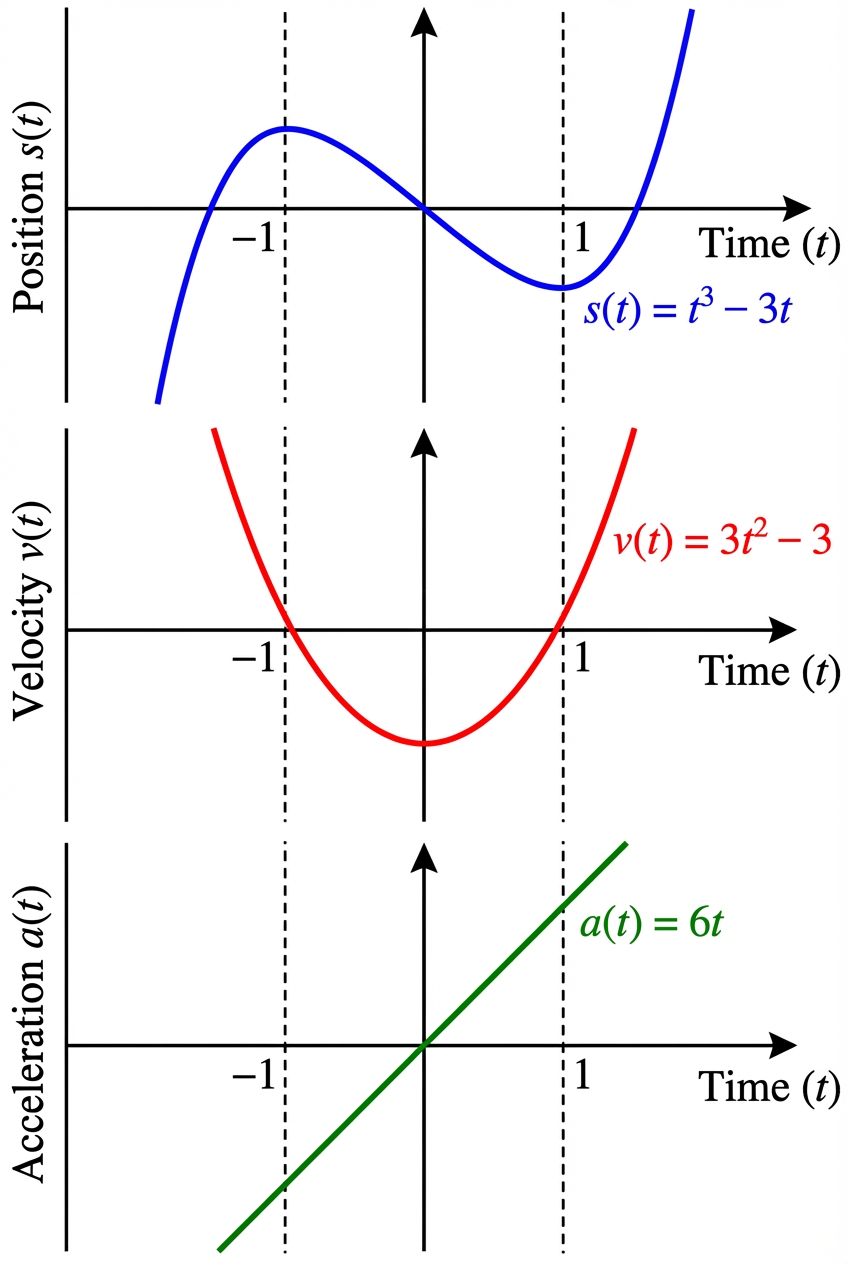
Straight-Line Motion: Position, Velocity, and Acceleration
One of the most common applications of differentiation is rectilinear motion (motion along a straight line). We analyze the movement of a particle along an axis (usually the $x$ or $y$ axis) over time $t$.
The PVA Hierarchy
The relationship between position, velocity, and acceleration is defined by differentiation:
- Position ($x(t)$ or $s(t)$): The location of the particle relative to the origin at time $t$.
- Velocity ($v(t)$): The rate of change of position—how fast and in which direction the particle moves.
- Acceleration ($a(t)$): The rate of change of velocity.
Analyzing Motion
Understanding the signs of these functions is crucial for AP problems:
| Function | Positive (+) Value | Negative (-) Value | Zero (0) |
|---|---|---|---|
| $x(t)$ | Particle is to the right (or above) the origin. | Particle is to the left (or below) the origin. | Particle is at the origin. |
| $v(t)$ | Particle is moving right (or up). | Particle is moving left (or down). | Particle is at rest (stopped). |
| $a(t)$ | Velocity is increasing. | Velocity is decreasing. | Velocity is constant. |
Speed vs. Velocity
While velocity is a vector (magnitude and direction), speed is a scalar (magnitude only).
- If velocity is $-50 \text{ ft/sec}$, the speed is $50 \text{ ft/sec}$.
- Speed is always $\ge 0$.
Speeding Up vs. Slowing Down
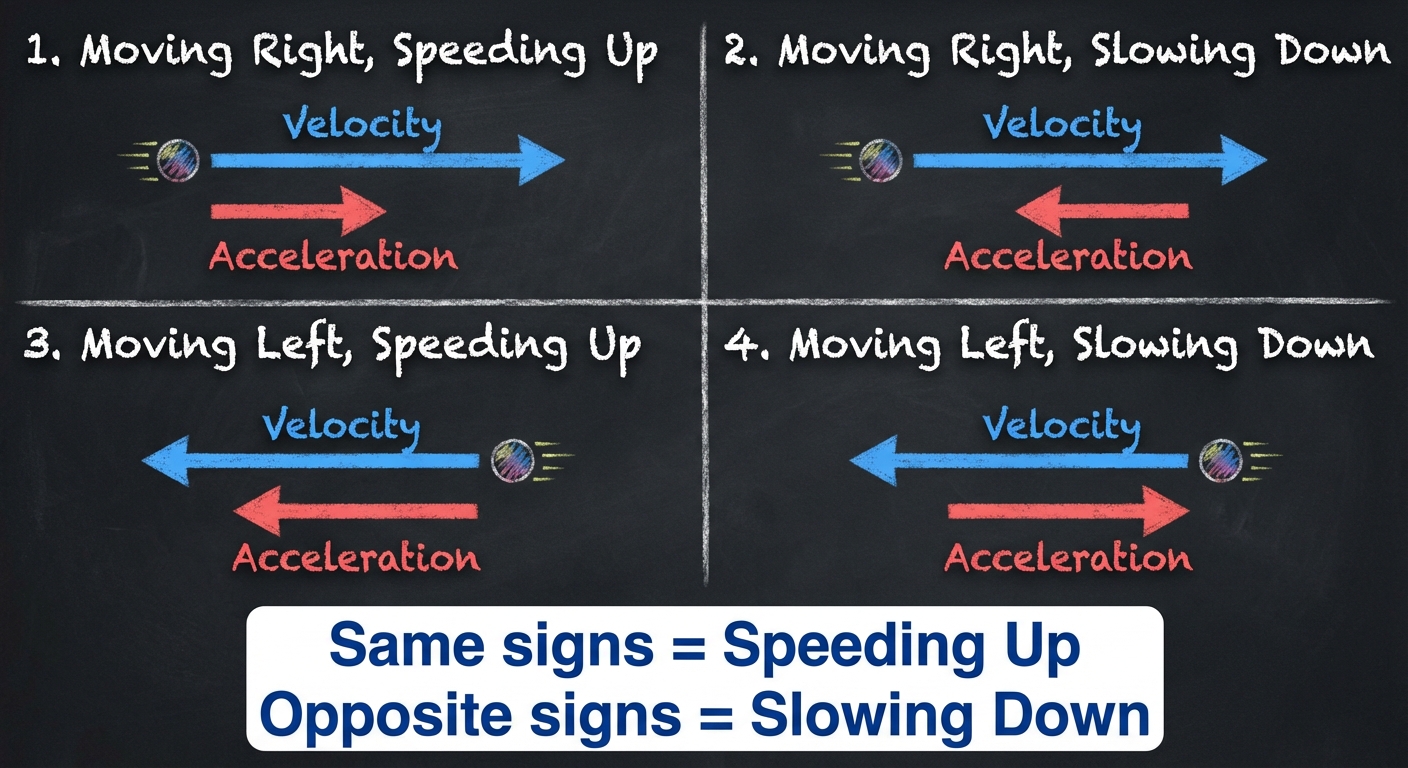
This is a frequent exam trap. A particle is NOT necessarily speeding up just because acceleration is positive.
- Speeding Up: $v(t)$ and $a(t)$ have the SAME sign (both positive or both negative). The velocity and acceleration vectors are pushing in the same direction.
- Slowing Down: $v(t)$ and $a(t)$ have DIFFERENT signs. The acceleration is fighting against the velocity.
Example:
If $v(3) = -4$ m/s and $a(3) = 2$ m/s²:
- The particle is moving left (since $v < 0$).
- The particle is slowing down (since $v$ and $a$ have opposite signs).
Rates of Change in Applied Contexts
Beyond physics, calculus is used in economics, biology, and environmental science. We treat these problems similarly to motion problems: the derivative describes how a quantity changes.
Common Applications
Economics (Marginals):
- Cost Function $C(x)$: Total cost to produce $x$ items.
- Marginal Cost $C'(x)$: The approximate cost to produce the next ($x+1$) item.
Population Growth:
- If $P(t)$ is population size, $P'(t)$ is the growth rate (individuals per year).
Flow Rates:
- If $V(t)$ is the volume of a substance, $V'(t)$ is the rate of flow (e.g., cubic ft per min).
Interpreting Signs in Context
- $f'(x) > 0$: The quantity is increasing.
- $f'(x) < 0$: The quantity is decreasing.
Common Mistakes & Pitfalls
- Unit Confusion: Students often calculate the number correctly but fail to write the correct units (e.g., writing "gallons" instead of "gallons per minute"). Remember: Derivative units = Dependent Units / Independent Units.
- "Speeding Up" Misconception: Thinking "Positive Acceleration = Speeding Up." You must check the sign of velocity as well. If velocity is negative and acceleration is positive, the object is slowing down.
- Justification: On FRQs, simply drawing a sign chart is usually not sufficient for justification. You must write a sentence, e.g., "The particle is speeding up at $t=2$ because $v(2)$ and $a(2)$ are both negative."
- Absolute Value: Forgetting that speed is the absolute value of velocity. If asked for the maximum speed, you must check the maximum value of $|v(t)|$, not just the maximum of $v(t)$.