Mastering Analytical Derivative Applications
These study notes cover Section 5.3–5.7 of the AP Calculus BC curriculum. Understanding how the first and second derivatives influence the shape and behavior of a function's graph is essential for curve sketching and optimization problems.
Intervals of Increase and Decrease
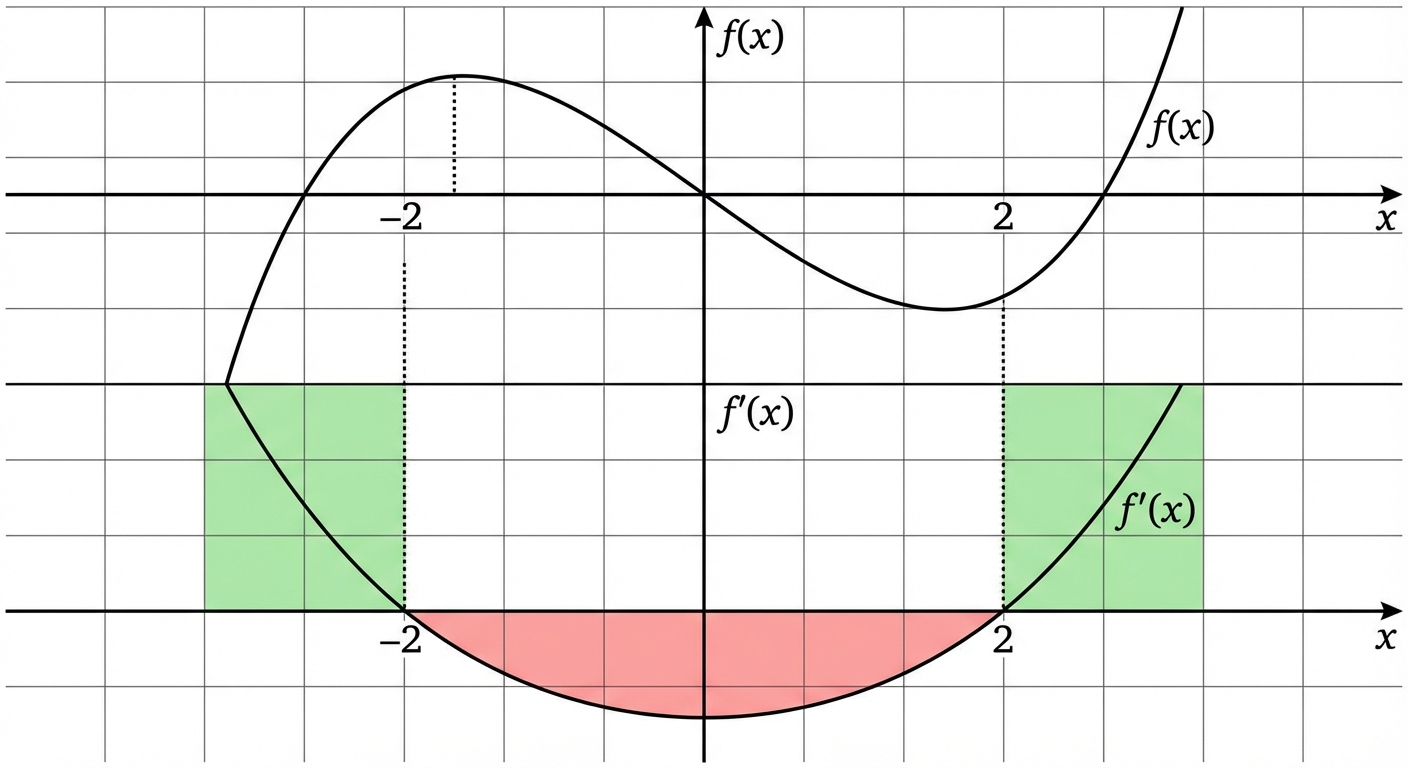
The first derivative, $f'(x)$, represents the instantaneous rate of change (slope) of the original function $f(x)$. Analyzing the sign of $f'(x)$ tells us the direction of the function.
Determining Function Behavior
- Increasing Function: If $f'(x) > 0$ on an interval, then the graph of $f(x)$ is rising from left to right.
- Decreasing Function: If $f'(x) < 0$ on an interval, then the graph of $f(x)$ is falling from left to right.
- Constant: If $f'(x) = 0$ on an interval, $f(x)$ is a horizontal line.
Critical Points
To find where the behavior changes, you must first identify Critical Points. A critical point occurs at $x=c$ if:
- $f'(c) = 0$ (Horizontal tangent)
- $f'(c)$ is undefined (Corner, cusp, or vertical tangent), provided $c$ is in the domain of $f$.
Key Concept: Extrema (maxima/minima) can only occur at critical points, but not every critical point is an extremum.
The First Derivative Test
Once critical points are identified, the First Derivative Test is used to classify them as relative (local) maxima, minima, or neither.
Steps to Apply the Test
- Find all critical points of $f$.
- Set up a Sign Chart (number line) using the critical points to divide the domain into intervals.
- Test a value in each interval to determine if $f'$ is positive or negative.
Classification Rules
Suppose $c$ is a critical point of a continuous function $f$:
- Relative Maximum: If $f'(x)$ changes from positive to negative at $c$.
- Relative Minimum: If $f'(x)$ changes from negative to positive at $c$.
- Neither: If $f'(x)$ does not change sign at $c$ (e.g., $y=x^3$ at $x=0$).
Worked Example
Problem: Find the local extrema for $f(x) = x^3 - rac{3}{2}x^2$.
Solution:
- Find Derivative: $f'(x) = 3x^2 - 3x$.
- Find Critical Points: Set $3x^2 - 3x = 0 \Rightarrow 3x(x - 1) = 0$. Critical points are $x=0, x=1$.
- Sign Analysis:
- Test $x = -1$: $f'(-1) = 3(-1)^2 - 3(-1) = 6$ ($+$)
- Test $x = 0.5$: $f'(0.5) = 3(0.25) - 1.5 = -0.75$ ($-$)
- Test $x = 2$: $f'(2) = 12 - 6 = 6$ ($+$)
Conclusion:
- At $x=0$, $f'$ changes from positive to negative $\rightarrow$ Relative Max.
- At $x=1$, $f'$ changes from negative to positive $\rightarrow$ Relative Min.
Concavity and Inflection Points
While the first derivative tells us direction (up/down), the second derivative $f''(x)$ tells us the shape (curvature) of the graph.
Defining Concavity
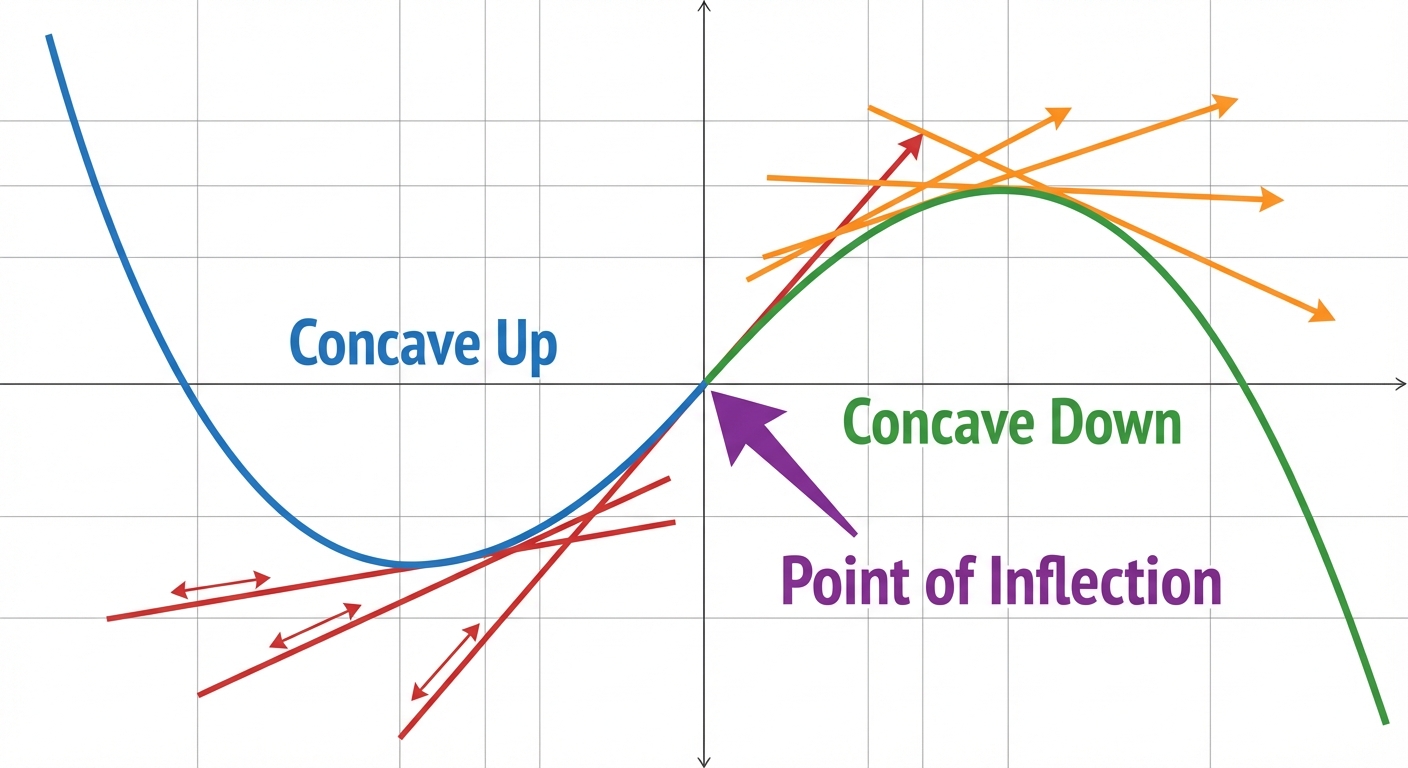
- Concave Up: The graph lies above its tangent lines. Think of a cup holding water ($\cup$).
- Condition: $f''(x) > 0$ (meaning $f'(x)$ is increasing).
- Concave Down: The graph lies below its tangent lines. Think of a frown ($\cap$).
- Condition: $f''(x) < 0$ (meaning $f'(x)$ is decreasing).
Points of Inflection (POI)
A Point of Inflection is a point on the graph where the concavity changes.
To find a POI:
- Find candidates where $f''(x) = 0$ or is undefined.
- Verify that $f''(x)$ actually changes sign at that point.
Pitfall Alert: Solving $f''(x)=0$ helps you find candidates, but if the sign doesn't change (like $f(x)=x^4$ at $x=0$), it is NOT an inflection point.
The Second Derivative Test (for Extrema)
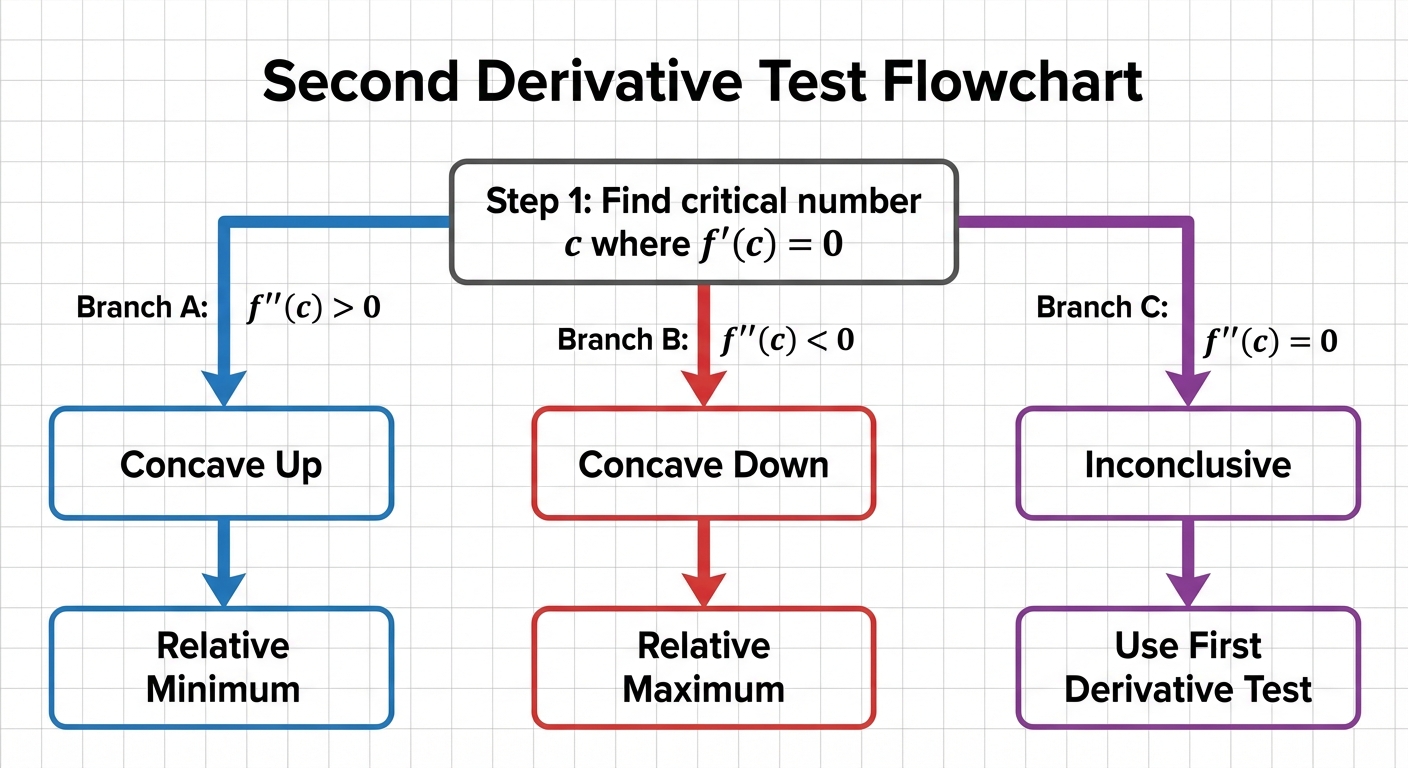
This is an alternative method to find local maxima and minima. Instead of using a sign chart (interval testing), you evaluate concavity at the critical point itself.
The Rules
Let $f$ be a function such that $f'(c) = 0$ and $f''$ exists on an open interval containing $c$.
| Condition at $x=c$ | Visual Logic | Conclusion |
|---|---|---|
| $f'(c)=0$ AND $f''(c) < 0$ | Flat tangent, Concave Down ($\cap$) | Relative Maximum |
| $f'(c)=0$ AND $f''(c) > 0$ | Flat tangent, Concave Up ($\cup$) | Relative Minimum |
| $f'(c)=0$ AND $f''(c) = 0$ | Unknown curvature | Test is Inconclusive |
Note: If the test is inconclusive, you MUST revert to the First Derivative Test.
Summary of Relationships
Memorizing the "Ladder of Derivatives" helps connect these concepts.
| Feature | $f(x)$ Behavior | $f'(x)$ Behavior | $f''(x)$ Behavior |
|---|---|---|---|
| Rising | Increasing | Positive ($>0$) | N/A |
| Falling | Decreasing | Negative ($<0$) | N/A |
| Turning Point | Local Max/Min | Zero/Undefined (changes sign) | N/A |
| Happy Shape ($\cup$) | Concave Up | Increasing (slope gets steeper) | Positive ($>0$) |
| Sad Shape ($\cap$) | Concave Down | Decreasing (slope drops) | Negative ($<0$) |
| Twisting | Inflection Point | Local Extremum | Changes Sign (through 0 or DNE) |
Common Mistakes & Pitfalls
- Vague Justifications: Never write "the function changes direction" or "it goes from positive to negative." ALWAYS specify which function.
- Correct: "$f$ has a local max at $x=c$ because $f'$ changes from positive to negative."
- Assuming $f''(c)=0$ is a POI: Students often set the second derivative to zero, find $x$, and claim it's an inflection point without checking for a sign change.
- Ignoring Domain: Always check if the critical values are actually inside the domain of the original function $f(x)$.
- Misinterpreting "Increasing": A function is increasing if $f' > 0$. If $f'$ is increasing, that means $f$ is concave up, not necessarily increasing itself.
- Global vs. Local: The First and Second Derivative Tests define relative (local) extrema. To find absolute (global) extrema on a closed interval [a, b], you must also test the endpoints $f(a)$ and $f(b)$.