AP Spanish Literature Unit 2: The 16th Century (Renaissance & Conquest)
Unit Context: The Spanish Golden Age (Siglo de Oro)
Definition and Scope
The Siglo de Oro (Golden Age) is a broad term covering the cultural splendor of Spain from the early 16th century through the late 17th century. However, Unit 2 focuses specifically on the 16th Century (The Renaissance).
This era is characterized by two major simultaneous events:
- Imperial Expansion: The encounter and conquest of the Americas.
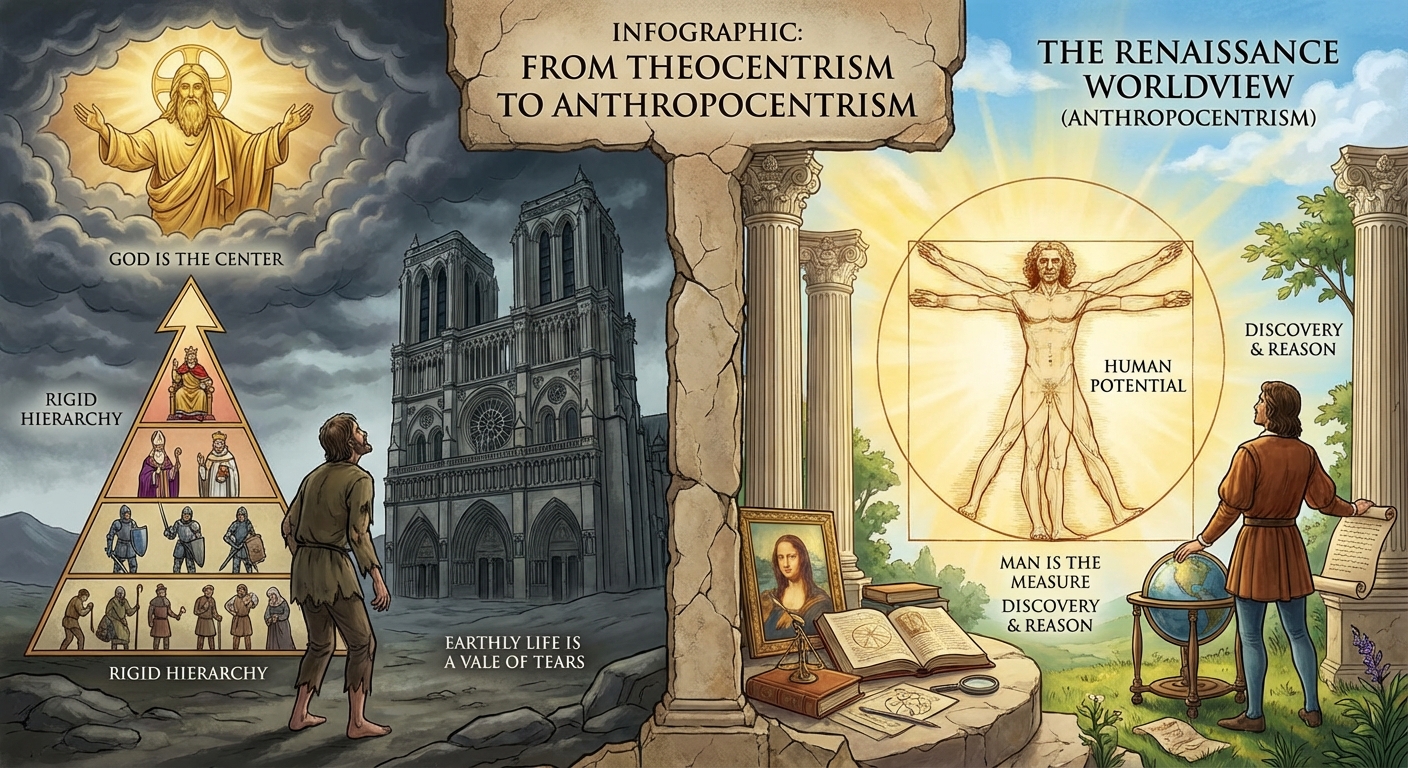
- Cultural Renaissance: The shift from Medieval Teocentrism (God-centered) to Humanist Anthropocentrism (Man-centered), influenced by Italian aesthetics.
Historical Background
- The Unification: Following the Reconquista (ended 1492), Spain unified under the Catholic Monarchs.
- The Empire: The reigns of Carlos V (Charles I) and Felipe II marked Spain as the global superpower.
- The Counter-Reformation: In response to the Protestant Reformation in Europe, Spain positioned itself as the defender of Catholicism. This led to censorship (The Inquisition) which heavily influenced literature (e.g., Lazarillo de Tormes was banned/redacted).
- Social Stratification: A rigid class system defined by Limpieza de sangre (blood purity—no Jewish/Muslim ancestry) and Honor.
Literary Movement: El Renacimiento (The Renaissance)
Key Characteristics
Unlike the pessimistic and ornamental Baroque period that would follow in Unit 3, the Renaissance is defined by:
- Anthropocentrism: A focus on human potential, reason, and earthly experience rather than just the afterlife.
- Classicism: Imitation of Greek and Roman models (Plato, Virgil, Ovid).
- Order and Harmony: Preference for balance, simple forms, and symmetry.
- Nature: Portrayed as idealized and harmonious (Locus Amoenus).
- Carpe Diem: The urge to "seize the day" because youth and beauty are fleeting.
Sub-Topic 1: The Encounter of Two Worlds (La Conquista)
This section covers the clash between the Spanish Empire and indigenous civilizations. The AP curriculum juxtaposes European accounts with Indigenous voices.
2.1 Visión de los vencidos (The Vision of the Vanquished)
- Author/Compiler: Miguel León-Portilla (compiled in the 20th century from 16th-century sources by Bernardino de Sahagún).
- Perspective: Indigenous (Nahuatl/Aztec).
- Genre: Crónica / Compilation of oral tradition.
- Language: Translated from Nahuatl to Spanish.
Part A: "Los presagios, según los informantes de Sahagún"
- Content: Describes eight ominous signs (presagios) that appeared before the Spanish arrived (e.g., a comet, a temple fire, a weeping woman—La Llorona).
- Significance: Shows the fatalism of the Aztec worldview. They believed the gods had destined their fall.
- Key Literary Element: Prefiguration (foreshadowing events).
Part B: "Se ha perdido el pueblo mexica"
- Content: An elegiac poem (icnocuícatl) lamenting the fall of Tenochtitlan.
- Tone: Sorrowful, desperate, hopeless.
- Quote to Know: "El llanto se extiende…" (The weeping spreads).
- AP Theme: Las sociedades en contacto (Societies in Contact).
2.2 Segunda carta de relación
- Author: Hernán Cortés.
- Addressee: Emperor Carlos V (King Charles I of Spain).
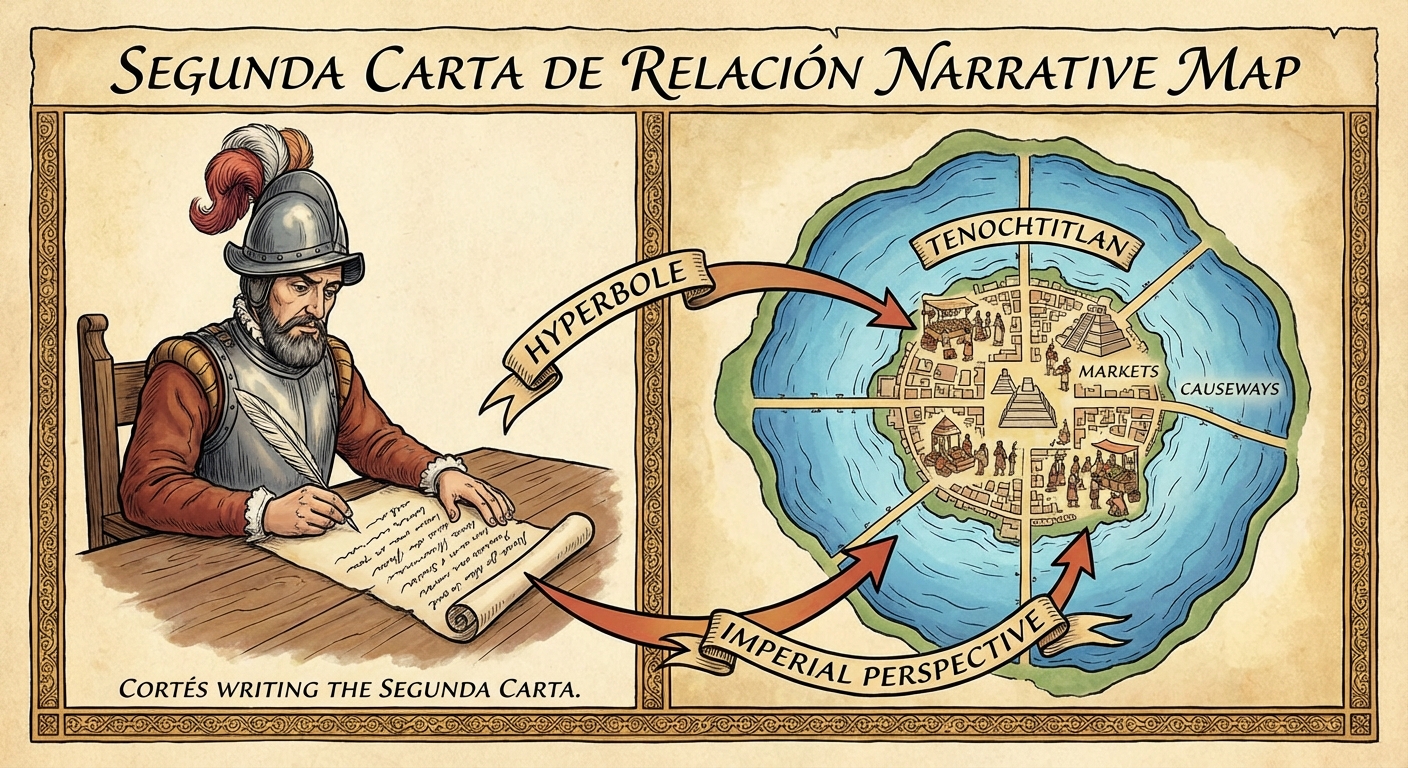
- Context: Written in 1520 to justify Cortés's unauthorized expedition and describe the grandeur of Mexico.
- Perspective: European/Conqueror (Imperialist).
- Tone: Formal, calculating, awe-struck but descriptive.
- Key Content:
- Description of Tenochtitlan (comparing it to Seville or Cordoba).
- Description of Moctezuma (depicted as a powerful but eventually submissive king).
- The markets and advanced infrastructure of the Aztecs.
- Critical Analysis:
- Unreliable Narrator: Cortés writes to save his own neck and impress the King. He exaggerates the wealth and interprets Aztec actions through a European lens.
- Style: Very detailed enumerations (enumeración) to catalogue the vastness of the empire.
Comparison Table: Two Views of the Conquest
| Feature | Visión de los vencidos | Segunda carta de relación |
|---|---|---|
| Source | Indigenous (Nahuatl) informers | Hernán Cortés (Conquistador) |
| Intention | To record trauma and divine destiny | To justify political action and gain favor |
| Tone | Despair, fatalism, fear | Admiration, calculation, authority |
| Focus | The collapse of a civilization | The acquisition of a new asset for Spain |
Sub-Topic 2: Renaissance Poetry
2.3 Soneto XXIII ("En tanto que de rosa y azucena")
- Author: Garcilaso de la Vega (The prince of poets).
- Influences: Italian poetry (Petrarch).
- Form: Sonnet (Soneto).
- 14 lines.
- Endecasílabos (11 syllables per line).
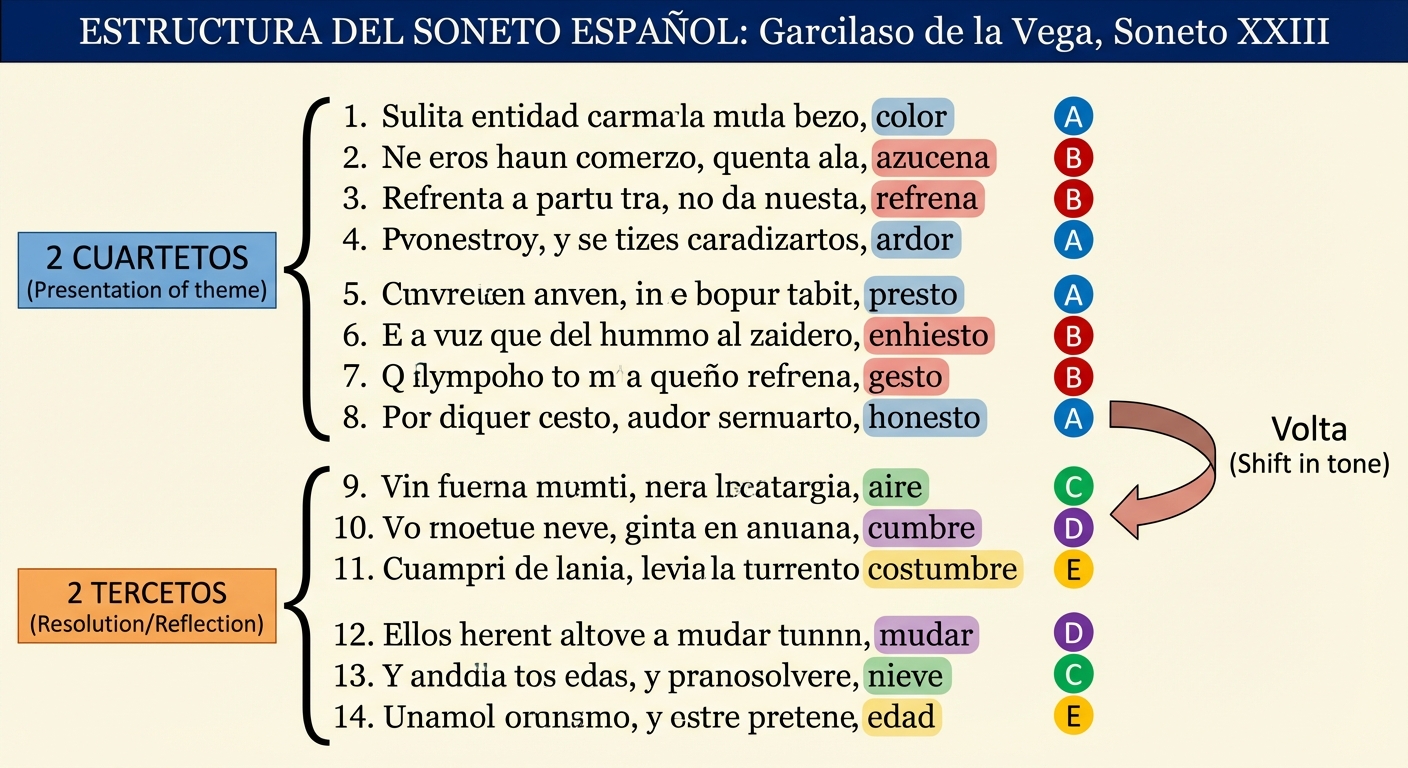
- Rima consonante (Consonant rhyme): ABBA ABBA CDE DCE.
- Two quatrains (cuartetos) followed by two tercets (tercetos).
Key Themes & Analysis
- Carpe Diem ("Seize the day"): The poem urges a young woman to enjoy her beauty before old age destroys it.
- Descriptio Puellæ: A classical description of female beauty using nature metaphors.
- Rosa (Rose) = Passion/Red lips.
- Azucena (Lily) = Purity/Pale skin.
- Oro (Gold) = Blonde hair.
- The Turn (Volta): In the tercets, the tone shifts from admiring beauty to warning about the passage of time (el tiempo airado).
Essential Rhetorical Figures
- Metaphor: Comparing hair to gold veins (vena del oro).
- Anaphora: Repetition of "En tanto que…"
- Hipérbaton: Inverting normal syntax (Yoda-speak) to fit the rhyme/meter (e.g., "Marchitará la rosa el viento helado" instead of "The cold wind will wither the rose").
- Antithesis: Contrasting colors (Red/White) and concepts (Youth/Age).
Sub-Topic 3: The Picaresque Novel (La Novela Picaresca)
2.4 Lazarillo de Tormes (1554)
- Author: Anonymous (likely due to the sharp anticlerical criticism).
- Genre: Novela Picaresca.
- Format: Epistolary novel (written as a letter).
Plot Breakdown (Required Tratados)
- Prólogo: Lázaro writes to "Vuestra Merced" (Your Grace) to explain his "case" (why he is currently living in a shameful situation).
- Tratado 1 (The Blind Man): The defining education. The blind man teaches Lázaro to be cunning (astuto) through cruel abuse (the stone bull incident, the sausage, the wine jar). Lázaro loses his innocence.
- Tratado 2 (The Priest): Critiques the corruption and greed of the clergy. Lázaro almost starves while the priest hoards bread. Paradox: The priest is worse than the blind man.
- Tratado 3 (The Squire/Escudero): Critiques Appearances vs. Reality. The Squire dresses like a noble but is starving and penniless. Lázaro feels pity for him rather than hatred. This subverts the master-servant dynamic (Lázaro feeds the master).
- Tratado 7 (The Archpriest): Lázaro is an adult, married to the Archpriest's maid. It is implied she is the Archpriest's mistress. Lázaro accepts being a cuckold in exchange for food and stability.
The "Pícaro" (Anti-Hero)
A pícaro is the opposite of a knight errant:
- Low birth: No lineage or honor.
- Survival: Motivated by hunger (hambre), not ideals.
- Trickster: Uses wit to survive a cruel world.
- Deterministic: Hard to escape his social class.
Key Themes
- Las apariencias: The Squire looks rich but is poor; the Clergy looks holy but is cruel.
- Social Criticism: Attack on the hypocrisy of the Church and the vanity of the nobility.
- El qué dirán: Lázaro ignores public gossip to maintain his comfortable life at the end.
Key Terminology for AP Exam
Course Themes (Temas del Curso)
- La creación literaria: The reliability of the narrator (Cortés, Lázaro).
- Las relaciones interpersonales: Power dynamics (Master/Servant, Conqueror/Conquered).
- La dualidad del ser: Public facade vs. private reality (The Squire in Lazarillo).
Rhetorical Terms
- Apostrofe: Speaking directly to someone/something (Garcilaso speaking to the woman).
- Cromatsimo: Use of colors to express ideas (Red/White in Garcilaso).
- Narratario: The specific person the text is addressed to inside the fiction (e.g., "Vuestra Merced" in Lazarillo).
- Polisíndeton: Repeated conjunctions (y… y… y) found often in chronicles to emphasize quantity.
Common Mistakes & Pitfalls
Confusing the Century:
- Mistake: Calling Garcilaso a Baroque poet.
- Correction: Garcilaso is Renaissance (16th C). Góngora and Quevedo are Baroque (17th C). Garcilaso is balanced; Baroque is complicated/pessimistic.
Misinterpreting Lazarillo's "Author":
- Mistake: Thinking Lázaro is the author.
- Correction: Lázaro is the narrator and protagonist. The author is anonymous. The recipient is the "Narratario" (Vuestra Merced).
Cortés vs. León-Portilla Perspectives:
- Mistake: Assuming Visión de los vencidos was written during the conquest.
- Correction: It was compiled much later (20th C) based on Sahagún's 16th-century anthropological work. It is a reconstruction of the indigenous memory, whereas Cortés wrote in the moment.
Overlooking "El hambre":
- Mistake: Analyzing Lazarillo only as a comedy.
- Correction: Hunger is the central driving force (leitmotif) of the novel. It justifies Lázaro's moral corruption.
Metric Confusion:
- Mistake: Counting syllables without applying Sinalefa.
- Correction: In Spanish poetry, when a word ends in a vowel and the next begins with a vowel, they count as one syllable. En tanto que de rosa y azucena (11 syllables).