State-Building and Belief Systems: Land-Based Empires (c. 1450–1750)
Unit 3 Overview: The Age of Gunpowder Empires
During the period c. 1450–1750, the global balance of power shifted as large, land-based empires expanded using gunpowder technology. While maritime empires (Unit 4) were establishing colonies overseas, these land-based giants focused on consolidating power centrally, managing diverse populations, and legitimizing their rule through religion, art, and bureaucracy.
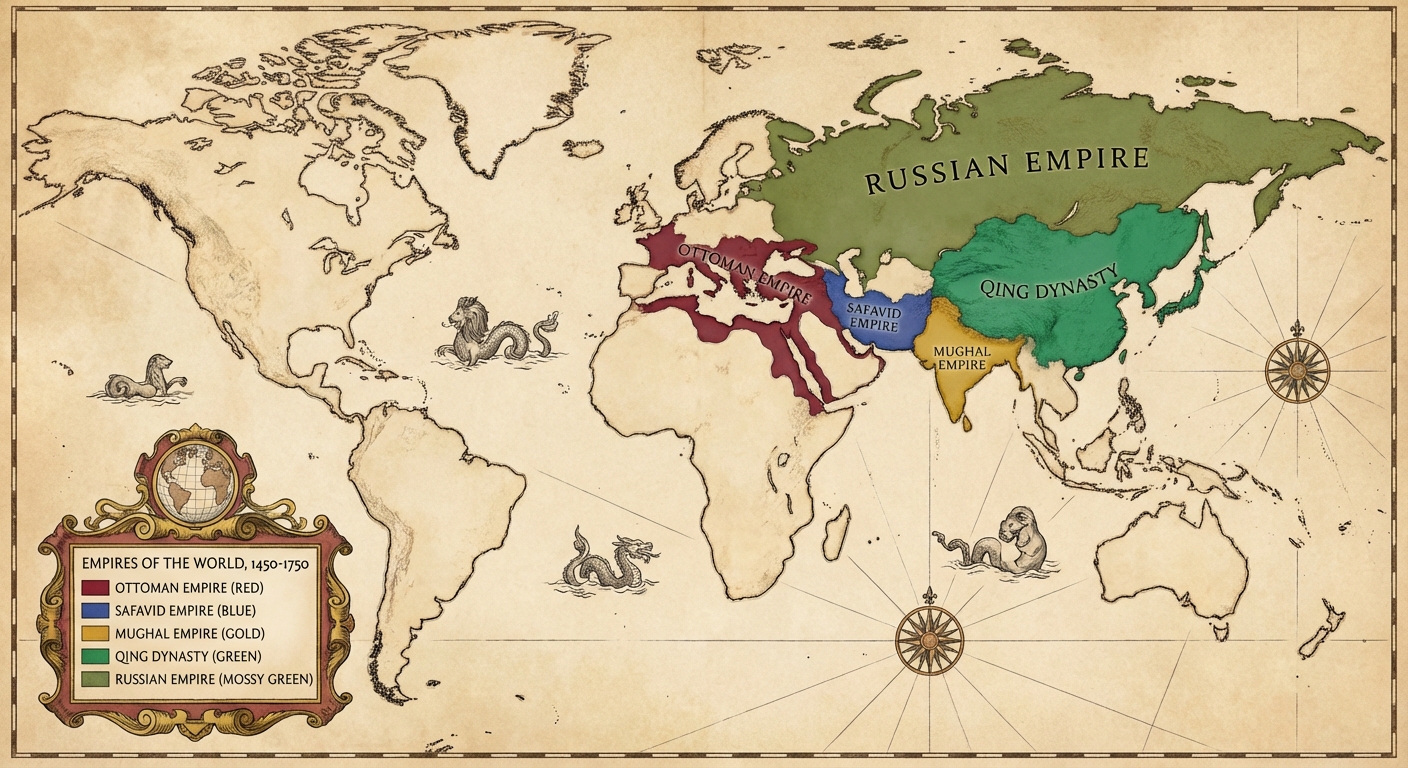
3.1 Imperial Expansion: The Gunpowder Empires
Definitions & Concepts
- Gunpowder Empires: Large, multiethnic states in Southwest, Central, and South Asia that relied on firearms (cannons and artillery) to conquer and control territories.
- Key Characteristics: Centralized bureaucracy, professional militaries, and monumental architecture.
The Major Empires
- Ottoman Empire (Middle East/Southern Europe): Sunni Muslim. Ended the Byzantine Empire. Longest lasting.
- Safavid Empire (Persia/Iran): Shi’a Muslim. Sandwiched between Ottomans and Mughals.
- Mughal Empire (India): Sunni Muslim rulers over a Hindu majority.
- Qing Dynasty (China): Manchu rulers over a Han Chinese majority.
- Russian Empire (Eurasia): Eastern Orthodox. Pivot to Westernization.
3.2 Administration: Consolidating Power
Rulers used specific strategies to centralize control and limit internal dissent.
1. Centralized Bureaucracies
Rulers stripped power from the nobility and placed it in the hands of appointed officials loyal only to the monarch.
- Ming/Qing China: Reinstated and strengthened the Civil Service Exam. This ensured officials were Confucian scholars chosen by merit, not just birth.
- Ottoman Empire: The Devshirme System.
- Definition: A "blood tax" where Christian boys from the Balkans were enslaved, converted to Islam, and trained to serve the state.
- Outcome: Produced the Janissaries (elite military units) and viziers (high-ranking administrators). Since they were loyal to the Sultan rather than tribal tribes, they stabilized the ruler's power.
- Japan: The Tokugawa Shogunate required the sankin-kotai (alternate attendance policy). Daimyo (feudal lords) had to maintain a residence in Edo (Tokyo) and live there every other year. If they left, their families stayed behind as hostages.
2. Taxation Systems
To fund large armies and building projects, empires systematized revenue collection.
| Empire | System | Description |
|---|---|---|
| Mughal | Zamindars | Local officials (often elites) collected taxes from peasants and kept a portion before sending the rest to the emperor. Eventually, they became corrupt and kept too much. |
| Ottoman | Tax Farming | The government auctioned off the right to collect taxes in a region. The highest bidder paid the state upfront, then fleeced the population to make a profit. |
| Aztec | Tribute Lists | (Americas) Conquered peoples owed specific goods (food, feathers, sacrificial victims) to Tenochtitlan. |
| Ming | Hard Currency | Taxes often had to be paid in silver, leading to a global demand for silver (linked to Unit 4). |
3. Military Professionals
Empires moved away from feudal levies (knights/samurai loyal to local lords) toward professional soldiers loyal to the state.
- Janissaries (Ottoman): Highly trained gunpowder troops.
- Ghulams (Safavid): Slave soldiers taken from Georgian/Armenian populations to counter the power of tribal warriors.
- Elite Samurai (Japan): Following the chaotic Sengoku period, the Tokugawa unified Japan. Samurai became bureaucrats and administrators rather than active warriors, though they retained their social status.
3.3 Legitimizing Power
Rulers justified their absolute control through belief systems and monumental art.
Art and Architecture
By building massive structures, rulers displayed their wealth and power to their subjects and rivals.
- Taj Mahal (Mughal): Built by Shah Jahan as a tomb for his wife. Utilized Islamic domes and geometric patterns, showing religious piety and immense wealth.
- Palace of Versailles (France): Built by Louis XIV. He forced nobles to live there to monitor them. The sheer scale and opulence intimidated diplomats.
- Winter Palace/St. Petersburg (Russia): Built by Peter the Great to demonstrate Russia's modernization and Westernization.
- Imperial Portraits (Qing): Emperors had portraits painted in traditional Chinese styles to portray themselves as legitimate Confucian rulers, despite being Manchu foreigners.
Religious Legitimacy
- Divine Right of Kings (Europe): The belief that the King serves as God’s representative on earth. Rebellion against the King is rebellion against God. (e.g., King James I of England, Louis XIV of France).
- Shi’a Islam (Safavid): The Safavid Shahs claimed to be descendants of Ali (Muhammad’s cousin/son-in-law), making them divinely appointed political and religious leaders. This created a theocracy.
- Aztec Human Sacrifice: Rituals performed publicly to keep the gods satisfied and to terrorize conquered subjects into submission.
3.3 Belief Systems: Continuity and Schism
While political borders solidified, religious borders fractured.
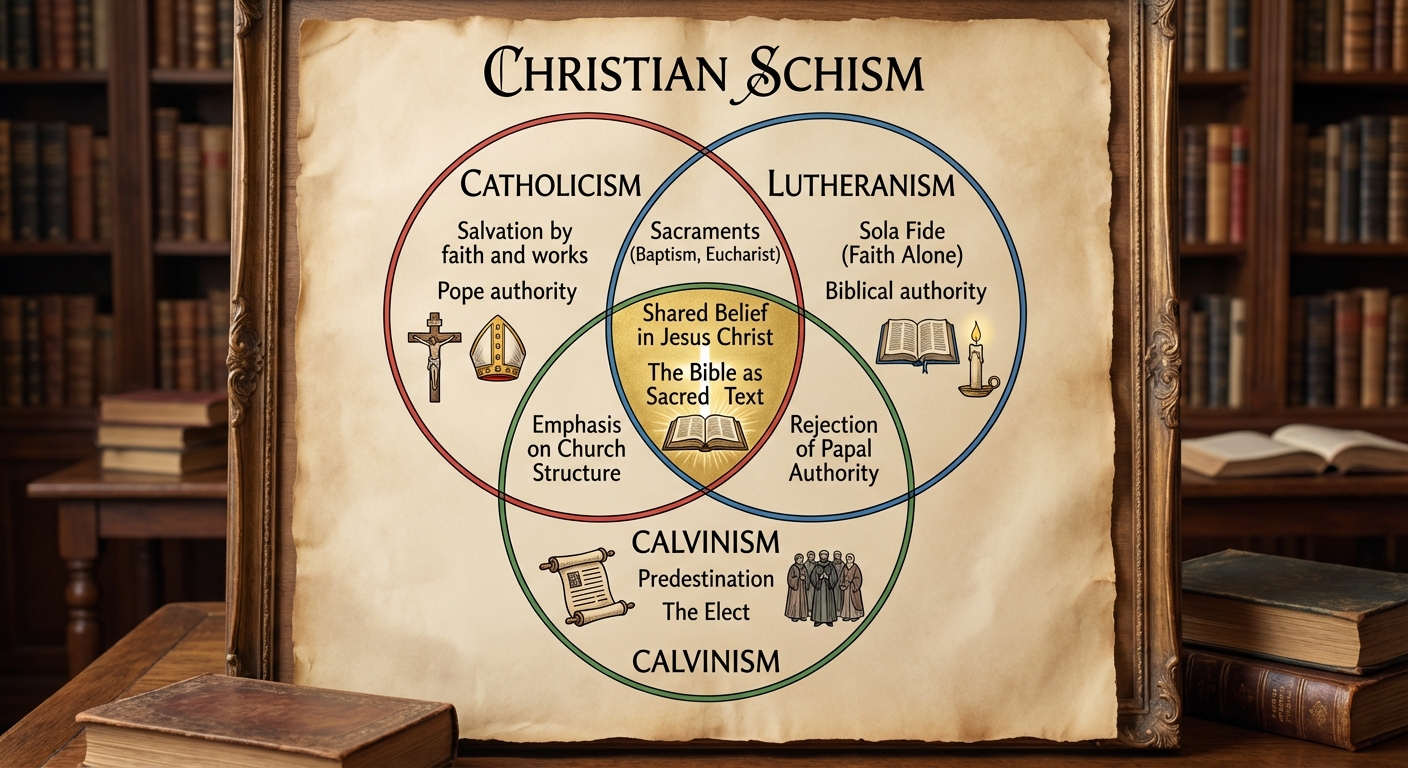
1. The Protestant Reformation (Europe)
In 1517, the unity of Western Christendom shattered.
- Context: The Catholic Church was the primary power in feudal Europe but faced corruption allegations (e.g., sale of indulgences—payments to reduce time in purgatory).
- Martin Luther: A German monk who posted the 95 Theses.
- Key Doctrines: Sola Fide (Salvation by faith alone, not good works) and biblical authority over Church authority.
- Political Impact: Kings (like Henry VIII in England) used Protestantism to break free from the Pope’s political control.
- Anglicanism: Henry VIII became head of the Church of England.
- The Counter-Reformation: The Catholic Church responded at the Council of Trent (1545–1563).
- Reaffirmed Catholic doctrine.
- Founded the Jesuits (Society of Jesus) to convert people and educate Europe.
- Expanded the Inquisition.
2. The Sunni-Shi'a Split (Middle East)
Political rivalry deepened the religious divide between the Ottomans (Sunni) and Safavids (Shi'a).
- Battle of Chaldiran (1514): The Ottomans (using gunpowder) stopped the Safavid expansion. This set the border between modern-day Turkey and Iran and solidified the region's religious distinctiveness.
- Significance: This was not just a religious war; it was a geopolitical struggle for control of trade routes and territory.
3. Syncretism (Blending of Beliefs)
- Sikhism (South Asia): Founded by Guru Nanak in the Punjab region of India.
- Context: Developed in the Mughal Empire where Hinduism and Islam interacted.
- Beliefs: Monotheistic (like Islam) but believes in karma/reincarnation (like Hinduism). Rejected the caste system.
- Din-i Ilahi: The "Divine Faith" attempted by Mughal emperor Akbar. It blended Islam, Hinduism, Christianity, and Zoroastrianism to promote peace, but it died with him.
Regional Deep Dives
The Islamic Gunpowder Empires
The Ottoman Empire (Turkey/Balkans/North Africa)
- Suleiman the Magnificent (r. 1520–1566): The peak of Ottoman power. He reconstructed the legal system and threatened Vienna.
- Social Structure: Tolerant of non-Muslims via the Millet System (autonomous communities for Christians/Jews who paid the jizya tax).
- Decline: Slow decline due to "Harem politics" (succession struggles involving wives/concubines) and failure to modernize technology after 1700.
The Safavid Empire (Persia)
- Shah Abbas I (r. 1588–1629): The height of power. Imported weaponry from Europe to fight the Ottomans.
- Key Distinction: Strictly Twelver Shi’a. They denied legitimacy to any Sunni rule, creating deep hostility with neighbors.
The Mughal Empire (India)
- Akbar the Great: Famous for religious tolerance. Abolished the jizya tax on Hindus. Encouraged art/culture.
- Aurangzeb: Reversed Akbar’s tolerance. Reinstated the jizya, destroyed Hindu temples. His intolerance led to the fracturing of the empire and rise of the Maratha Empire (Hindu warriors).
East Asia
The Qing Dynasty (China)
- Origins: The Manchus (from Manchuria) seized power from the crumbling Ming Dynasty in 1644.
- Cultural Identity: To maintain control, they imposed the Queue (a braided hairstyle) on Han Chinese men. Refusal was punishable by death ("Keep your hair and lose your head").
- Kangxi and Qianlong Emperors: Expanded China’s borders into Taiwan, Mongolia, and Tibet. Ruled as Confucian scholars to gain respect.
Tokugawa Japan
- The Great Peace: Ended feudal warfare.
- Isolationism: The Sakoku Edict (1635) closed Japan to Europeans (except the Dutch at Nagasaki). Christianity was banned and persecuted.
- Culture: Kabuki theater and Haiku poetry flourished.
Europe: The Rise of Absolutism
France
- Louis XIV ("The Sun King"): The ultimate Absolute Monarch. "L'état, c'est moi" (I am the state).
- Goal: Destroy the power of the nobles and Huguenots (French Protestants).
- Note: His finance minister, Jean-Baptiste Colbert, enhanced the economy through mercantilism.
Russia
- Peter the Great (r. 1682–1725): realized Russia was technologically behind Europe.
- Westernization: Forced nobles (Boyars) to shave traditional beards and wear Western clothes. Moved capital from Moscow to St. Petersburg (his "Window on the West").
- Resistance: The Streltsy (musketeers) and Old Believers (orthodox traditionalists) resisted his reforms.
Common Mistakes & Pitfalls
- Confusing the "Gunpowder Empires": Students often forget that Russia and Japan are also "Gunpowder Empires" in this era, not just the Islamic trio (Ottoman/Safavid/Mughal). Russia used gunpowder to expand East; Japan used it to unify under the Tokugawa.
- Chronology of the Reformation: Don't confuse the Protestant Reformation (1517) with the Great Schism (1054). The Great Schism split East/West (Catholic/Orthodox). The Reformation split the Western Church (Catholic/Protestant).
- Mughal Tolerance vs. Intolerance: Akbar and Aurangzeb are opposites. Do not generalize Mughal rule as entirely tolerant or entirely oppressive—it changed over time.
- Overlooking Safavids: Students often write about the Ottomans and Mughals but skip the Safavids. You must know them to explain the Sunni-Shi'a conflict in this period.
- Manchu vs. Mongol: The Qing were Manchus, not Mongols. The Yuan Dynasty (Unit 1/2) was Mongol. The Qing (Unit 3/4) were Manchu. Both were foreigners ruling China, but they are distinct groups.
Exam Tips: The "Compare" Question
If you get a SAQ (Short Answer Question) or LEQ (Long Essay Question) asking to compare methods of rule:
- Similarity: All used religion to legitimize rule (Mughal mosques, French Divine Right, Aztec sacrifice).
- Similarity: All centralized bureaucracy (Ottoman Devshirme, Chinese Civil Service, Japanese Samurai-bureaucrats).
- Difference: Treatment of Minorities.
- Ottomans: Millet system (relative tolerance).
- Spain/France: Expulsion of Jews/Protestants (strict intolerance).
- Mughals: Varied by ruler (Akbar tolerant, Aurangzeb intolerant).