Comprehensive Guide to Unit 2: Differentiation
Average vs. Instantaneous Rate of Change
Calculus is fundamentally the study of change. In Unit 2, we bridge the gap from Algebra (static slopes) to Calculus (dynamic slopes) by distinguishing between average and instantaneous variation.
The Average Rate of Change (AROC)
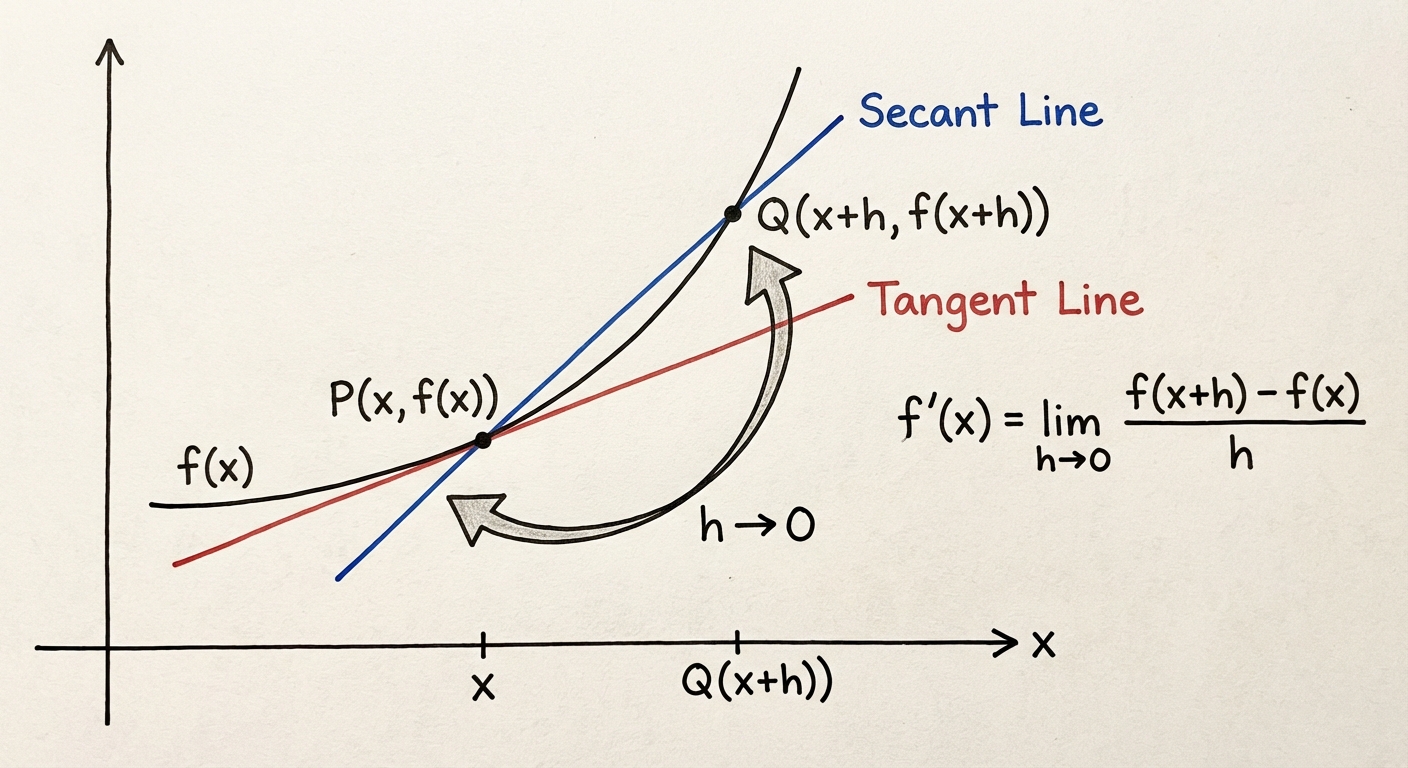
The Average Rate of Change represents the slope of the line connecting two distinct points on a curve. Geometrically, this line is called a Secant Line.
Given a function $f(x)$ over an interval $[a, b]$, the average rate of change is calculated using the difference quotient:
This is essential for approximating how a function behaves over a period of time. For example, if you drive 100 miles in 2 hours, your average velocity is 50 mph, even if your speedometer fluctuated during the trip.
The Instantaneous Rate of Change (IROC)
The Instantaneous Rate of Change describes the exact rate at which a quantity is changing at a specific moment ($x=c$). Geometrically, this corresponds to the slope of the Tangent Line that touches the curve at exactly one point.
To find the instantaneous rate, we take the average rate of change and shrink the interval distance to zero. This process relies on limits.
The Definition of the Derivative
The derivative of a function $f(x)$, denoted as $f'(x)$ or $\frac{dy}{dx}$, is the mathematical function that gives the instantaneous rate of change (the slope of the tangent line) at any input $x$.
1. The Limit Definition (The "h" Method)
This is the general definition used to find the derivative function $f'(x)$.
- $f(x+h) - f(x)$: The change in $y$ (rise).
- $h$: The change in $x$ (run).
- $\lim_{h \to 0}$: The operation that turns a secant line into a tangent line.
2. The Alternative Definition (Derivative at a Point)
This form is often seen in multiple-choice questions when checking if a specific derivative exists at a point $x = c$.
Common Notation Reference
In Calculus, several notations are used interchangeably. You must recognize all of them:
| Notation | Meaning | Origin |
|---|---|---|
| $f'(x)$ | The prime notation for the first derivative | Lagrange |
| $y'$ | Shorthand prime notation | Lagrange |
| $\frac{dy}{dx}$ | Differential notation (change in y over change in x) | Leibniz |
| $\frac{d}{dx}[f(x)]$ | The operator command: "Take the derivative of this" | Leibniz |
Estimating Derivatives from Tables & Graphs
On the AP exam, you will not always be given an algebraic function. You might deal with data tables or visual graphs.
Estimating from a Table
If you are asked to estimate $f'(c)$ given a table of values, use the Average Rate of Change of the two points surrounding $c$ (the symmetric difference quotient).
Example:
Estimate $f'(3)$ given the following table:
| $x$ | 1 | 2 | 4 | 5 |
|---|---|---|---|---|
| $f(x)$ | 2 | 5 | 9 | 14 |
Since $x=3$ is not in the table, use $x=2$ and $x=4$:
Differentiability and Continuity
A critical concept in Unit 2 is the relationship between continuity (no holes/breaks) and differentiability (the ability to take a derivative).
The Theorem
Differentiability implies Continuity.
If $f'(c)$ exists, then $f(x)$ must be continuous at $x=c$.
The Contrapositive
If $f(x)$ is NOT continuous at $x=c$, then it is NOT differentiable at $x=c$.
You cannot have a slope at a hole, jump, or asymptote.
Failures of Differentiability
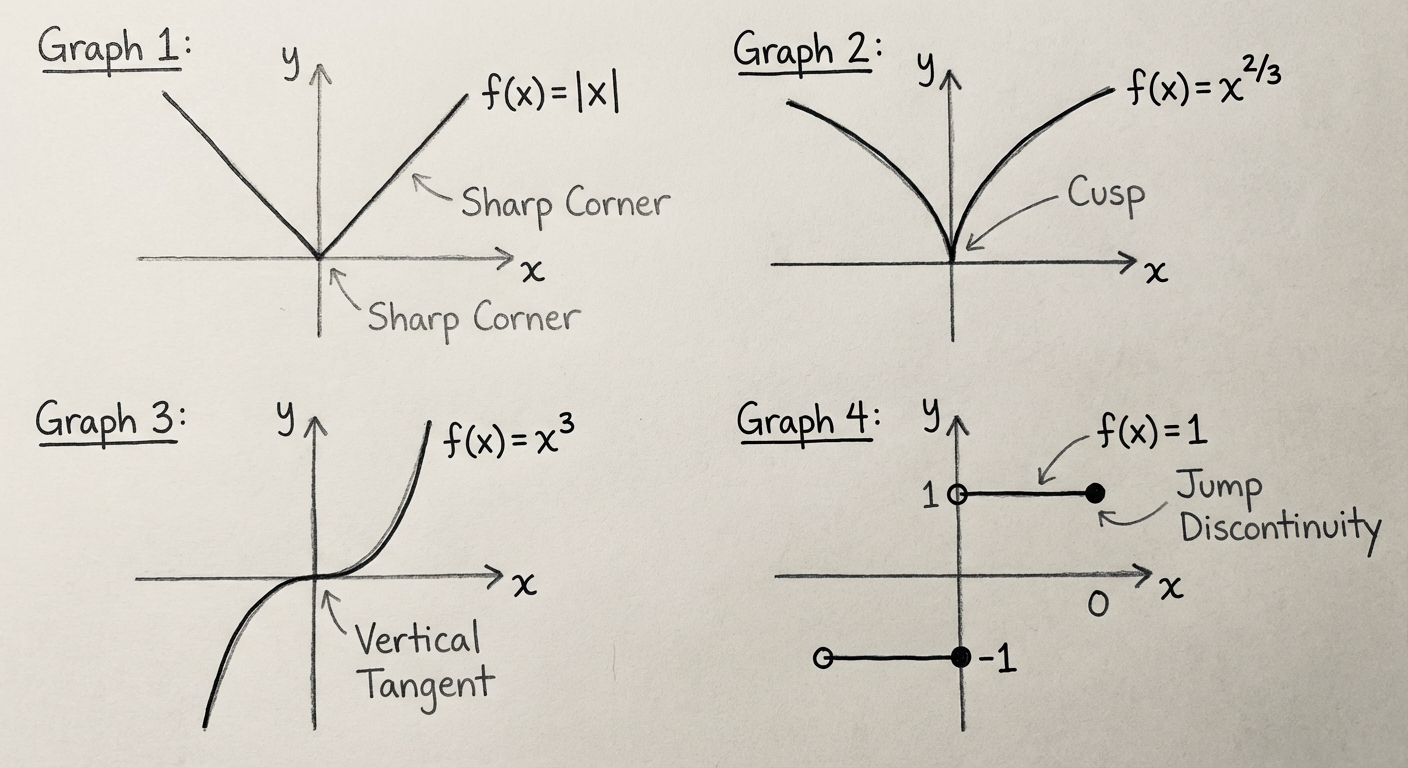
Even if a function is continuous, it might not be differentiable. The derivative fails to exist at:
- Corners: Sharp turns where the slope abruptly changes (e.g., $f(x) = |x|$ at $x=0$). The limit from the left does not equal the limit from the right.
- Cusps: Extreme distinct curves meeting at a point (e.g., $f(x) = x^{2/3}$).
- Vertical Tangents: Points where the slope is undefined/infinite (e.g., $f(x) = \sqrt[3]{x}$ at $x=0$).
Basic Derivative Rules
Using the limit definition for every problem is inefficient. We use proof-based rules to shortcut the process.
1. The Power Rule
This is the workhorse of differentiation. It works for any real number exponent $n$.
- Phrase: "Bring the power down, subtract one from the power."
- Example: Let $f(x) = x^4$. Then $f'(x) = 4x^3$.
- Example (Roots): Let $y = \sqrt{x} = x^{1/2}$. Then $y' = \frac{1}{2}x^{-1/2} = \frac{1}{2\sqrt{x}}$.
2. The Constant Rule
The slope of a horizontal line is zero. Therefore, if $f(x) = k$ (where $k$ is a constant):
3. Sum and Difference Rules
Derivatives are linear operators. You can take the derivative term-by-term.
4. Constant Multiple Rule
Coefficients stay attached.
Advanced Derivative Rules
When functions are multiplied or divided, you CANNOT simply take the derivatives individually. You must use the structure-specific rules.
1. The Product Rule
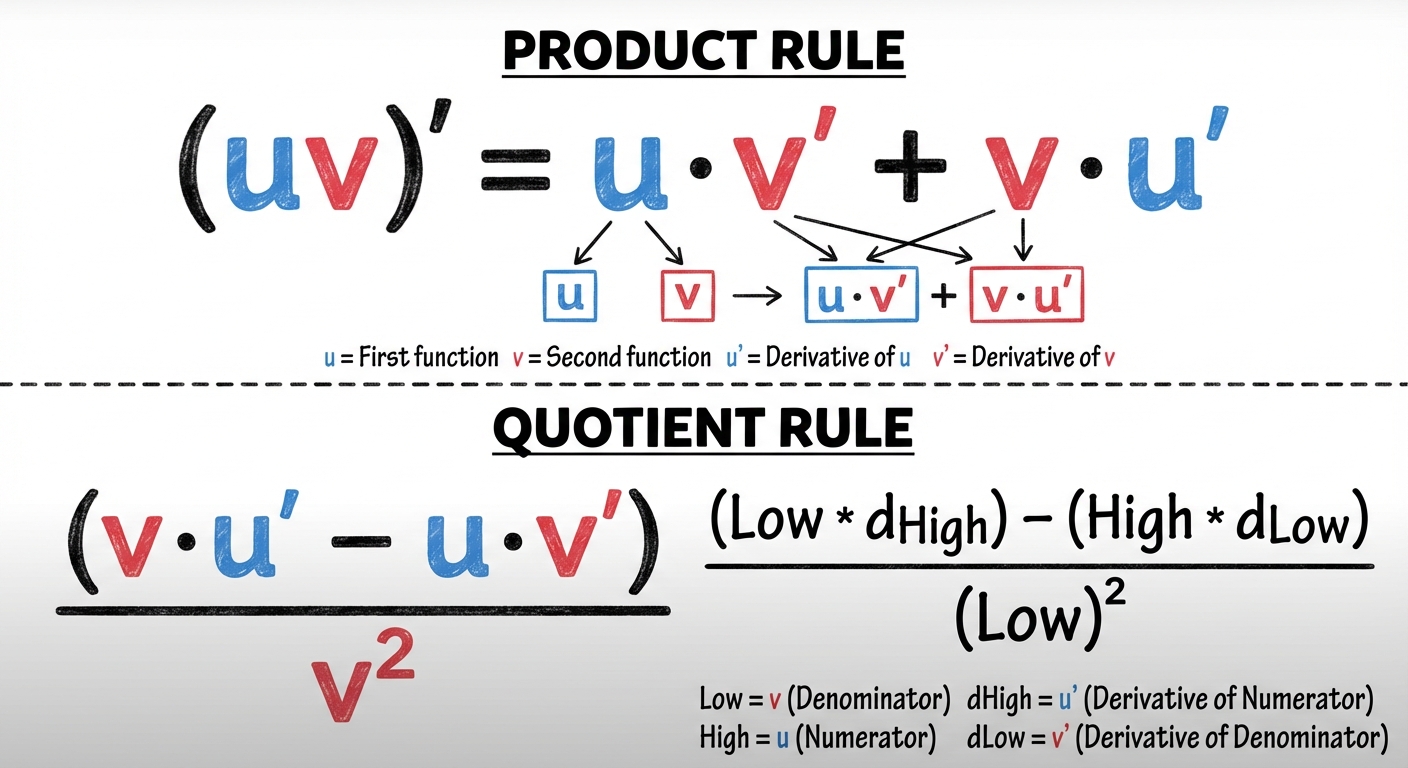
Used when differentiating the product of two functions, $f(x) = u(x) \cdot v(x)$.
Mnemonic: "First d-Second plus Second d-First" (1d2 + 2d1).
Example: $f(x) = (x^2)(3x - 1)$
- $u = x^2 \implies u' = 2x$
- $v = 3x - 1 \implies v' = 3$
- $f'(x) = (x^2)(3) + (3x-1)(2x) = 3x^2 + 6x^2 - 2x = 9x^2 - 2x$
2. The Quotient Rule
Used when differentiating a fraction, $f(x) = \frac{u(x)}{v(x)}$.
Mnemonic: "Low d-High minus High d-Low, over Low Low."
Warning: Order matters here because of the subtraction! You must start with the denominator ($Low$) multiplied by the derivative of the numerator ($dHigh$).
Transcendental Derivatives (Memory Derivatives)
You must memorize the derivatives of trigonometric, exponential, and logarithmic functions.
Exponential & Logarithmic
- Natural Base: $\frac{d}{dx}(e^x) = e^x$
- Note: This is the only function that is its own derivative.
- Natural Log: $\frac{d}{dx}(\ln x) = \frac{1}{x}$
Trigonometric Functions
| Function ($y$) | Derivative ($y'$) |
|---|---|
| $\sin x$ | $\cos x$ |
| $\cos x$ | $-\sin x$ |
| $\tan x$ | $\sec^2 x$ |
| $\csc x$ | $-\csc x \cot x$ |
| $\sec x$ | $\sec x \tan x$ |
| $\cot x$ | $-\csc^2 x$ |
Memory Tip:
- All "C" functions (Cos, Csc, Cot) have negative derivatives.
- Tan and Sec go together; Cot and Csc go together.
Physics Application: Linear Motion
Unit 2 introduces the relationship between position, velocity, and acceleration for a particle moving along a line.
- Position function $x(t)$ or $s(t)$: Use this to find location at time $t$.
- Velocity function $v(t)$: This is the first derivative of position.
- If $v(t) > 0$, the particle is moving forward/right/up.
- If $v(t) < 0$, the particle is moving backward/left/down.
- Acceleration function $a(t)$: This is the derivative of velocity (second derivative of position).
Common Mistakes & Pitfalls
Misusing the Power Rule on Constants:
- Wrong: $\frac{d}{dx}(\pi^3) = 3\pi^2$
- Right: $\pi^3$ is just a number (approx 31). The derivative of any constant is 0.
Quotient Rule Order:
- Students often swap the numerator terms. Remember: you must differentiate the top first (High). "Lo d-Hi" comes first.
Forgetting Parentheses in Product/Quotient Rule:
- When $v(x)$ is a binomial like $(x+1)$, failing to distribute the negative sign in the quotient rule is a frequent algebra error.
$f(c)$ vs $f'(c)$:
- Do not confuse the value of the function (height) with the derivative of the function (slope). A function can be high (large $y$) but have a zero slope (flat), or low (small $y$) and have a steep slope.
Notation Errors:
- When writing a limit definition, you must keep writing "$\lim$" in every step until you actually substitute $h=0$. Dropping the limit notation early is a notation error on the AP Free Response section.