Unit 8: Applications of Integration — Average Value & Motion
Finding the Average Value of a Function on an Interval
Definition and Concept
When calculating the average of a finite set of numbers (like test scores), you sum them up and divide by the count. In calculus, when dealing with a continuous function $f(x)$ over an interval $[a, b]$—which has effectively infinite points—we cannot simply sum points. Instead, we use the definite integral to represent the sum of the values and divide by the length of the interval.
The Average Value of a continuous function $f(x)$ on the closed interval $[a, b]$ is defined as:
It is crucial to remember the coefficient $\frac{1}{b-a}$ outside the integral. This represents dividing the "accumulated total" (area) by the "width."
Geometric Interpretation
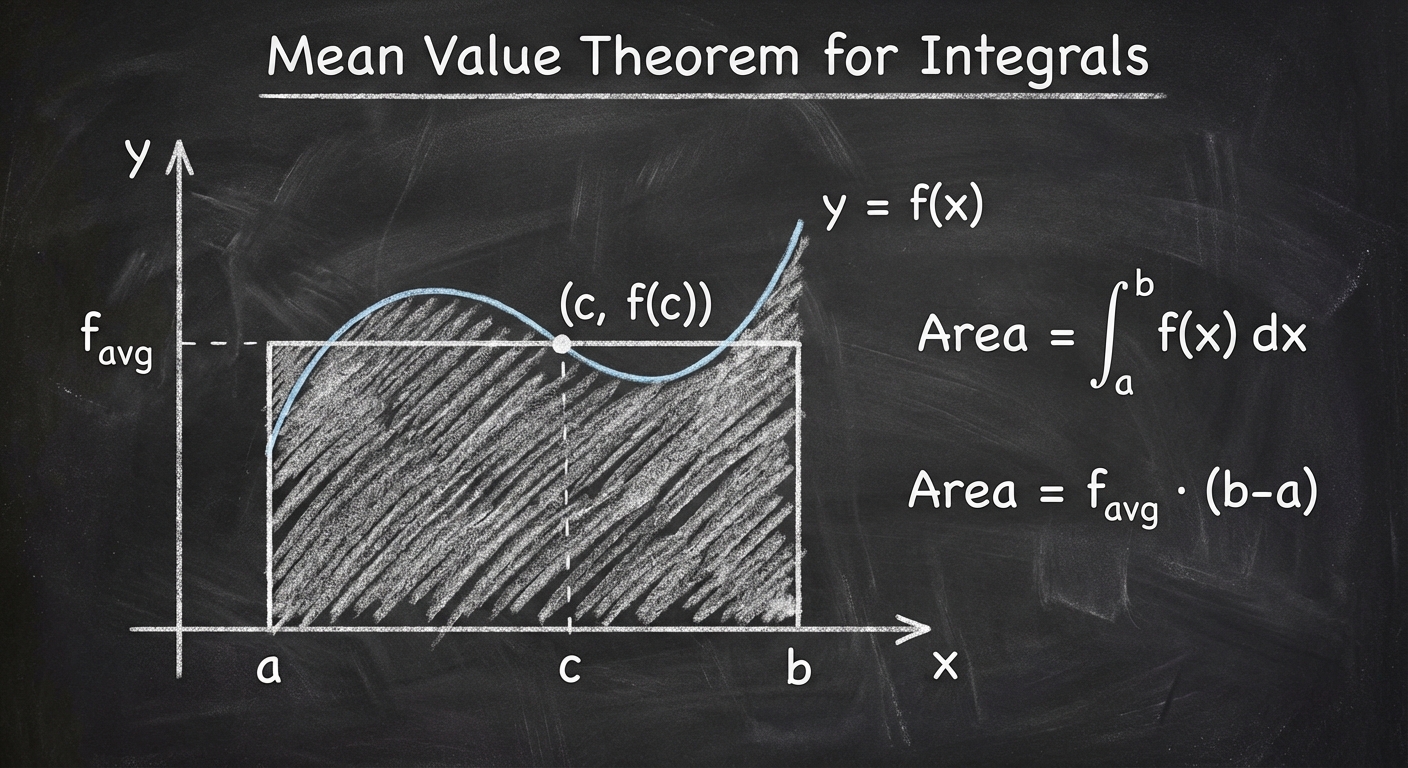
Geometrically, the integral $\int{a}^{b} f(x) \, dx$ represents the area under the curve. The average value $f{\text{avg}}$ represents the height of a rectangle over the interval $[a, b]$ that has the exact same area as the region under the curve $f(x)$.
The Mean Value Theorem (MVT) for Integrals
The Mean Value Theorem for Integrals guarantees that for a continuous function, the function actually attains its average value at least once within the interval.
Theorem: If $f$ is continuous on $[a, b]$, there exists at least one number $c$ in $(a, b)$ such that:
Or, rearranged:
This means at some point $c$, the height of the function equals the average height.
Example: Calculating Average Value
Problem: Find the average value of $f(x) = 3x^2 - 2x$ on the interval $[1, 4]$.
Solution:
- Identify the interval: $a = 1$, $b = 4$. Width is $4 - 1 = 3$.
- Set up the formula:
- Evaluate the integral:
- Apply Fundamental Theorem of Calculus:
The average value is 16.
Connecting Position, Velocity, and Acceleration Using Integrals
The Relationship Chain
A core application of integration in AP Calculus is particle motion. Recall the derivative relationships:
- Position $s(t)$ $\xrightarrow{\text{derive}}$ Velocity $v(t)$ $\xrightarrow{\text{derive}}$ Acceleration $a(t)$
Integration allows us to move backward through this chain. The integral functions as an accumulator of change.
Net Change and Position
The Fundamental Theorem of Calculus tells us that calculating the definite integral of a rate of change gives the net change in the original quantity.
This formula represents the Displacement (net change in position) of the particle from time $t=a$ to $t=b$.
To find the Final Position at time $t=b$, you need the initial position $s(a)$ plus the displacement:
Memory Aid: $\text{Current Amount} = \text{Starting Amount} + \text{Accumulated Change}$
Displacement vs. Total Distance Traveled
It is vital to distinguish between how far a particle traveled (odometer reading) and how far it is from where it started (net movement).
| Concept | Definition | Formula |
|---|---|---|
| Displacement | The net change in position. (Can be positive, negative, or zero). | $\int_{a}^{b} v(t) \, dt$ |
| Total Distance | The total ground covered, ignoring direction. (Always $\geq 0$). | $\int_{a}^{b} |
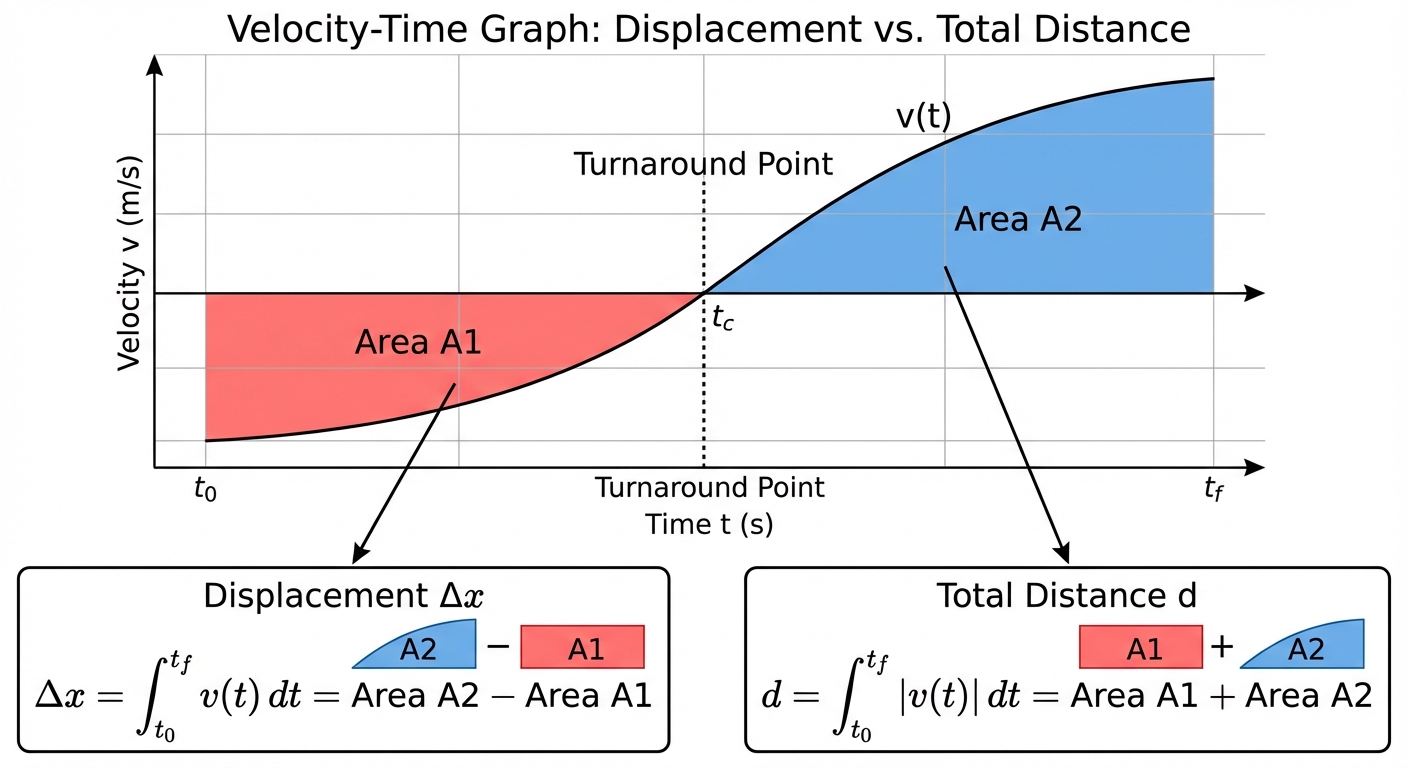
Since velocity $v(t)$ can be negative (moving backwards), integrating plain $v(t)$ cancels out backward motion against forward motion. Integrating the speed $|v(t)|$ treats all motion as positive accumulation.
Real-World Example: Particle Motion
Scenario: A particle moves along the x-axis with velocity $v(t) = t^2 - 4$ for $0 \leq t \leq 3$. The particle's initial position at $t=0$ is $s(0) = 5$.
1. Find the Displacement on $[0, 3]$.
The particle ended up 3 units to the left of where it started involving this interval.
2. Find the Final Position at $t=3$.
3. Find the Total Distance Traveled on $[0, 3]$.
Using the formula $\int_{0}^{3} |t^2 - 4| \, dt$.
Note that $v(t)$ is negative on $[0, 2)$ and positive on $(2, 3]$. We must split the integral at the zero $t=2$:
Since $t^2 - 4$ is negative between 0 and 2, $|t^2 - 4| = -(t^2 - 4)$.
Since $t^2 - 4$ is positive between 2 and 3, $|t^2 - 4| = t^2 - 4$.
- Integral 1 (Areas 0 to 2): $\left[ 4t - \frac{t^3}{3} \right]_0^2 = (8 - \frac{8}{3}) = \frac{16}{3}$
- Integral 2 (Areas 2 to 3): $\left[ \frac{t^3}{3} - 4t \right]_2^3 = (9 - 12) - (\frac{8}{3} - 8) = -3 - (-\frac{16}{3}) = \frac{7}{3}$
- Total Distance = $\frac{16}{3} + \frac{7}{3} = \frac{23}{3}$ units.
Common Mistakes & Pitfalls
1. Forgetting the Fraction in Average Value
Students frequently calculate the integral $\int_{a}^{b} f(x) \, dx$ correctly but forget to multiply by $\frac{1}{b-a}$.
- Correction: Always write the fraction immediately when setting up the integral.
2. Disregarding Initial Position
When asked for the position of a particle at time $t$, typical student work typically calculates only the displacement $\int_{0}^{t} v(x) \, dx$.
- Correction: Check if the problem says "starts at the origin" or gives a specific $s(0)$. You must add the initial position to the integral.
3. Confusing Displacement and Distance
Calculators usually have an abs() function. If you are solving for Total Distance on a Calculator Active section, ensure you enter fnInt(abs(v(x)), x, a, b). If you omit the absolute value, you are calculating displacement.
4. Interpretation of Negative Acceleration
Remember that negative acceleration does not always mean "slowing down."
- If velocity is negative and acceleration is negative, the particle is speeding up in the negative direction.
- Speed increases when velocity and acceleration share the same sign.