Unit 5 Guide: Economic Policy, Globalization, and Development in Comparative Politics
Economic Transitions and Global Integration
This guide covers the distinct policies, measurements, and international pressures that shape the economies of the AP Comparative Government core countries (UK, Mexico, Nigeria, Russia, China, and Iran). We will explore how states move from command to market economies, how development is measured beyond just wealth, and the tension between national sovereignty and global integration.
Economic Liberalization and Trade
Economic Liberalization refers to the policy of reducing government intervention in the economy. This process involves moving a state's economy toward a free-market emphasis, often to boost efficiency and integrate into the global market.
Key Components of Liberalization
To liberalize an economy, governments typically enact specific changes:
- Reduction of Tariffs: Lowering taxes on imports to encourage free trade.
- Privatization: Selling state-owned enterprises (SOEs) to private investors to increase efficiency and reduce government spending.
- Removal of Subsidies: Cutting government financial support for industries or consumer goods (like fuel or food), often leading to short-term social unrest.
- Foreign Direct Investment (FDI): Easing restrictions to allow foreign companies to build factories or invest in the country.
Country Specific Contexts
- China: Initiated under Deng Xiaoping (post-1978), China created Special Economic Zones (SEZs) where capitalism was encouraged, despite maintaining strict political control. This resulted in massive growth but rising inequality.
- Mexico: Shifted away from Import Substitution Industrialization (ISI)—a policy of high tariffs to protect local industry—toward neoliberalism and free trade (NAFTA/USMCA) in the 1980s and 90s.
- Russia: Underwent "Shock Therapy" in the 1990s (rapid liberalization), which led to the rise of oligarchs. Under Putin, there has been a trend of re-nationalization, particularly in strategic sectors like oil and natural gas (e.g., Gazprom).
- Nigeria: Has attempted to liberalize to satisfy international lenders but faces backlash when struggling to remove fuel subsidies.
Economic Development and Inequality
Wealth does not always equal well-being. Political scientists use specific metrics to analyze the health of an economy and the welfare of its citizens.
Measuring Development
| Metric | Definition | what it Tells Us |
|---|---|---|
| GDP per Capita | The total value of goods/services produced divided by population. | Indicates average wealth/standard of living, but hides inequality. |
| Purchasing Power Parity (PPP) | Adjusts GDP calculations based on the cost of living (buying power) in that country. | A more accurate comparison of living standards than raw GDP. |
| Gini Index (Coefficient) | A mathematical formula that measures the amount of economic inequality in a society. | 0 = Perfect Equality; 100 = Perfect Inequality. High scores (e.g., South Africa, Brazil) indicate a large gap between rich and poor. |
| Human Development Index (HDI) | A composite statistic of life expectancy, education, and per capita income. | Measures quality of life and social welfare, not just money. |
The Rentier State and the Resource Curse
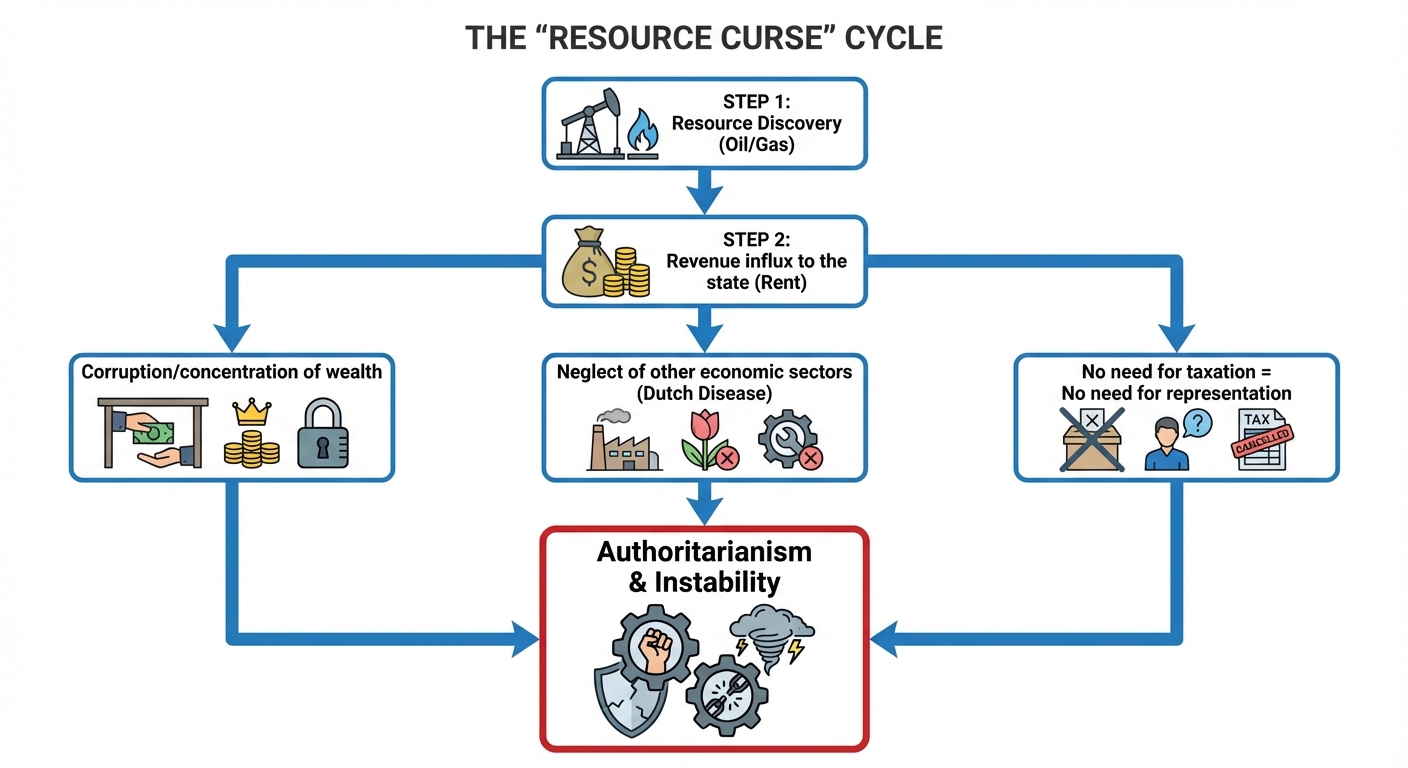
Many developing nations possess vast natural resources but struggle with development. This is often due to the Resource Curse.
A Rentier State is a country that obtains a significant portion of its revenue from the export of raw materials (rent) rather than through taxation of the population.
- Examples: Nigeria (Oil), Iran (Oil), Russia (Oil/Gas).
- Consequences:
- Lack of Accountability: Since the government doesn't rely on taxes, it doesn't feel obligated to listen to citizens' demands.
- Corruption: Wealth is concentrated in the hands of those who control the resource.
- Sensitivity to External Shocks: If global oil prices drop, the entire national budget collapses.
Globalization and Its Impact
Globalization is the increasing interconnectedness of people and countries through the flow of goods, services, money, and ideas. While it drives economic growth, it often challenges state sovereignty.
Economic Consequence: Interdependence
Countries are no longer economic islands. A recession in China impacts oil prices in Nigeria and factory orders in Mexico.
- Foreign Direct Investment (FDI): Globalization enables MNCs (Multinational Corporations) to invest abroad. This brings jobs and technology to countries like Mexico and China but can lead to environmental degradation and labor exploitation.
- Sector shifts: Economies often shift from agriculture to industry (secondary sector) and then to services (tertiary sector) as they integrate globally.
Social and Political Consequences
- Migration: Economic disparities drive migration (e.g., from Mexico to the US, or from rural China to urban centers like Shanghai).
- Environmental Challenges: Rapid industrialization in China and India has led to severe pollution, creating domestic political pressure for cleanup.
Supranational Organizations
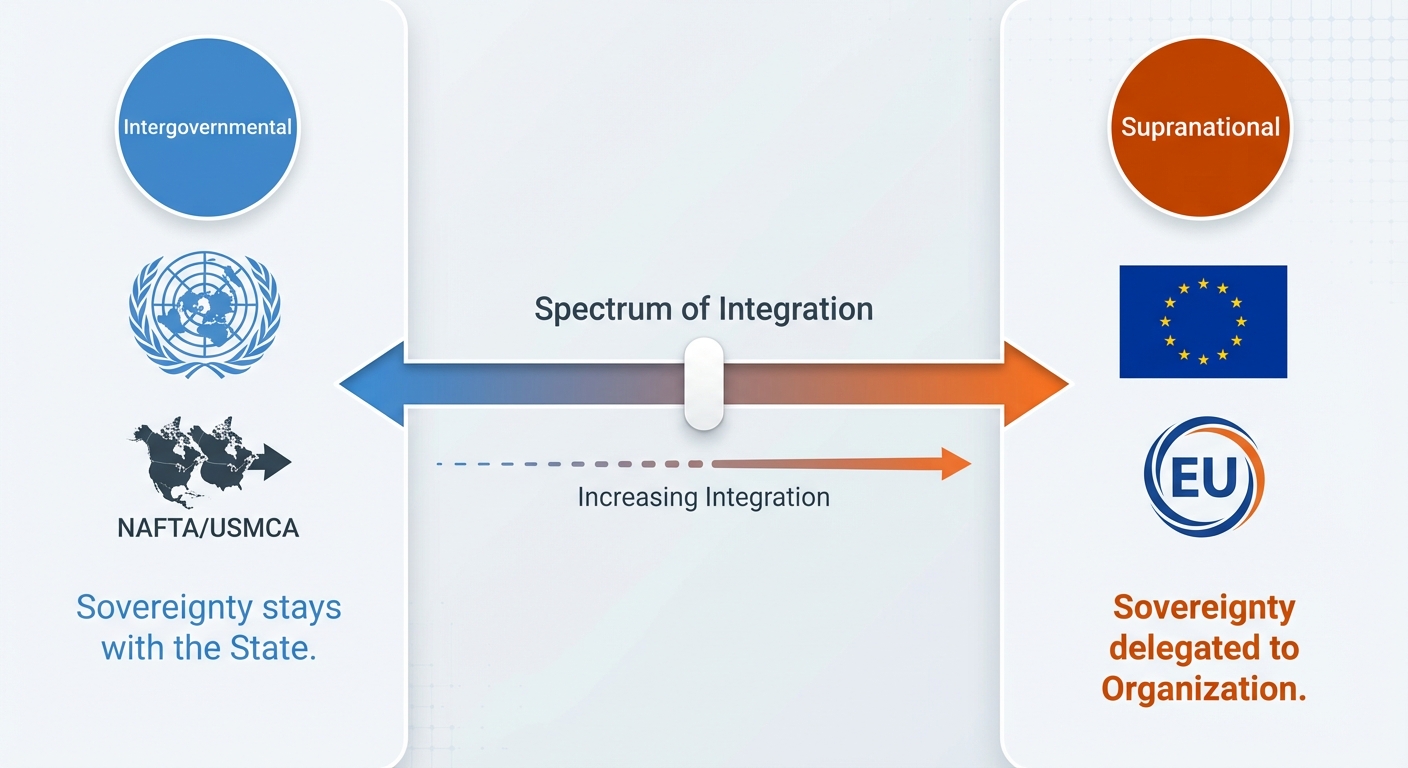
It is vital to distinguish between Intergovernmental Organizations (where states cooperate but keep full sovereignty) and Supranational Organizations.
Supranational Organizations are international groups where member states surrender some amount of sovereignty (decision-making power) to a higher authority in exchange for political or economic benefits.
Major Organizations in AP COGO
1. The European Union (EU)
- Type: Supranational.
- Relevance: The United Kingdom (prior to Brexit) struggled with the tension between EU regulations and Parliamentary sovereignty. The EU controls monetary policy for Eurozone members (Euro currency) and trade policy for all members.
2. The World Trade Organization (WTO)
- Type: Intergovernmental (mostly), but binds members to trade rules.
- Function: Lowers trade barriers and settles disputes.
- Relevance: China’s entry into the WTO in 2001 exploded its economic growth but forced it to meet international legal standards.
3. The IMF (International Monetary Fund) and World Bank
- Type: International Financial Institutions.
- Function: The IMF provides loans to countries facing balance-of-payment crises.
- Relevance: Structural Adjustment Programs (SAPs). When Nigeria or Mexico borrows from the IMF, they must agree to "austerity measures" (cutting spending, privatizing, raising taxes). This is often viewed as a loss of economic sovereignty and creates domestic political backlash.
4. ECOWAS (Economic Community of West African States)
- Type: Regional organization.
- Relevance: Nigeria is the dominant power here, using ECOWAS to promote trade and manage regional security in West Africa.
Common Mistakes & Pitfalls
- Confusing Liberalization with Democratization:
- Mistake: Assuming that because a country opens its markets (liberalization), it is also becoming a democracy.
- Correction: China is the prime example of Economic Liberalization without political democratization. They are distinct processes.
- Misinterpreting the Gini Index:
- Mistake: Thinking a high Gini score is "good."
- Correction: A low Gini (closer to 0) means equality. A high Gini (closer to 100) means high inequality. Think of the 100 as 1 person having 100% of the money.
- Rentier State Revenue:
- Mistake: Thinking Rentier States are poor.
- Correction: They can be very wealthy (Russia, Iran during high oil prices), but the wealth is not evenly distributed, and the source of income (resources vs. taxes) alters the relationship between the government and the governed.
- UK vs. Euro:
- Mistake: Thinking the UK uses the Euro.
- Correction: Even when the UK was in the EU, it kept the Pound Sterling. Not all EU members use the Euro.