AP Art History Unit 4: Structural Innovation and New Media (1750–1980 CE)
Modern Architecture: Steel, Glass, and Concrete
In Unit 4, architecture shifts dramatically due to the Industrial Revolution. The availability of mass-produced iron, steel, and reinforced concrete allowed architects to abandon load-bearing masonry walls. This led to the development of the skyscraper, the open floor plan, and a debate between structure-as-ornament versus structure-as-habitation.
The Rise of the Skyscraper
Early modern architecture focused on verticality and the maxim "Form follows function" (coined by Louis Sullivan). This meant the shape of a building should be purely based on its intended purpose and structure, not historical decoration.
Key Work: Carson, Pirie, Scott and Company Building
- Architect: Louis Sullivan
- Location: Chicago, Illinois
- Materials: Iron, steel, glass, and terra cotta
- Context: Built after the Great Chicago Fire demonstrated the weakness of iron (which melts); steel was encased in terra cotta for fireproofing.
- Key Features:
- Tripartite Division: Mimics a classical column (Base = ground floor shops; Shaft = identical office floors; Capital = attic/cornice).
- Chicago Window: A three-part window (large fixed center pane with two smaller movable side panes) allowing ventilation and light.
The International Style & Le Corbusier
The International Style emerged in Europe (associated with the Bauhaus school in Germany) and spread to the US. It emphasized volume over mass, regular layouts, and the avoidance of applied decoration.
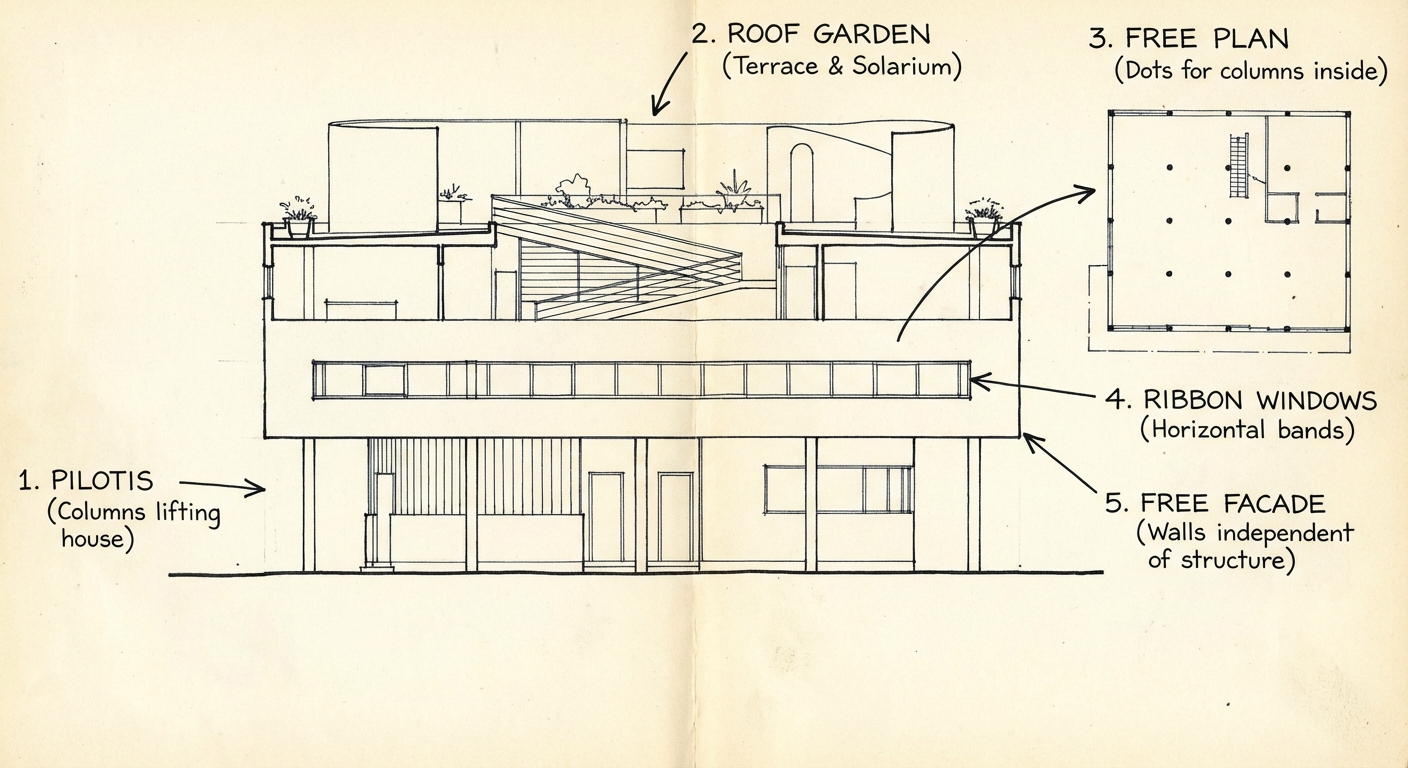
Key Work: Villa Savoye
- Architect: Le Corbusier
- Location: Poissy-sur-Seine, France
- Concept: A "Machine for Living."
- Le Corbusier’s Five Points of Architecture:
- Pilotis: Slender columns that raise the building off the ground, leaving the space below free.
- Roof Gardens: Reclaiming nature on the roof.
- Free Plan: Structural columns are separate from interior walls, allowing flexible room layouts.
- Free Facade: The exterior walls are non-load-bearing skins, allowing freedom of design.
- Ribbon Windows: Long horizontal windows providing even light.
Key Work: Seagram Building
- Architects: Ludwig Mies van der Rohe and Philip Johnson
- Location: New York City
- Style: High International Style / Minimalism.
- Features: A bronze and glass monolith. Mies valued discipline and geometry (“Less is more”). He added vertical I-beams to the exterior (which were decorative, not structural) to visually emphasize the building's verticality.
Organic Architecture: Frank Lloyd Wright
While European modernists favored the machine aesthetic, American architect Frank Lloyd Wright believed architecture should seek harmony with its environment. He coined Organic Architecture.
Key Work: Fallingwater (Kaufmann House)
- Architect: Frank Lloyd Wright
- Location: Pennsylvania, U.S.
- Concept: Integration of the house into the waterfall/landscape rather than viewing the landscape from afar.
- Key Features:
- Cantilevers: Reinforced concrete terraces extend unsupported over the waterfall.
- Hearth: The center of the home, literally built on a natural boulder found at the site.
- Compression and Release: Narrow, low entryways open into expansive living spaces.
Photography and Film as Art
Before the mid-19th century, capturing reality was the job of painting. The invention of photography liberated painting to become more abstract (Impressionism) while photography slowly gained status as a fine art form.
The Birth of Photography
Daguerreotypes were the first commercially successful photographic process. They produced a single, sharp image on a metal plate (no negative, so no copies).
Key Work: Still Life in Studio
- Artist: Louis-Jacques-Mandé Daguerre
- Significance: Mimicked traditional Dutch Vanitas paintings (skulls, art objects) to prove photography could be an artistic medium, not just a scientific tool.
Motion Studies and Early Film
Photography eventually captured time and motion, leading to cinema.
Key Work: The Horse in Motion
- Artist: Eadweard Muybridge
- Context: A bet was made to see if a galloping horse lifts all four hooves off the ground at once (it does).
- Technique: Used a row of cameras triggered by tripwires.
- Impact: Bridged the gap between still photography and moving pictures (zoopraxiscope).
Photography as Fine Art (Pictorialism vs. Straight Photography)
- Pictorialism: Manipulating photos to look like paintings (blur, soft focus).
- Straight Photography: Emphasizing the camera's unique technical abilities (clarity, contrast, framing).
Key Work: The Steerage
- Artist: Alfred Stieglitz
- Style: Straight Photography / Modernism.
- Concept: Stieglitz was less interested in the social commentary of the immigrants and more interested in the composition of shapes: the round straw hat, the intersecting gangway bridges, and the contrast of light and dark.
Photomontage and Propaganda
In the Soviet Union, photography was used to support political ideology through Constructivism.
Key Work: Illustration from The Results of the First Five-Year Plan
- Artist: Varvara Stepanova
- Technique: Photomontage (cutting and pasting photos to create a composite image).
- Context: Propaganda praising Stalin's economic policies. The use of red (color of the Soviet flag) and dynamic diagonals creates energy and optimism.
Conceptual Art and Performance Art
In the 20th century, the definition of art expanded beyond the physical object. The idea (concept) became the art, while the physical manifestation was secondary.
Routes of Conceptualism: The Readymade
Marcel Duchamp challenged the Art Academy by presenting mass-produced objects as art.
Key Work: Fountain
- Artist: Marcel Duchamp (Dada movement)
- Type: Readymade (an ordinary manufactured object designated by an artist as a work of art).
- Meaning: Art is about the artist's choice and intent, not their manual skill (craftsmanship).
Earth Art / Land Art
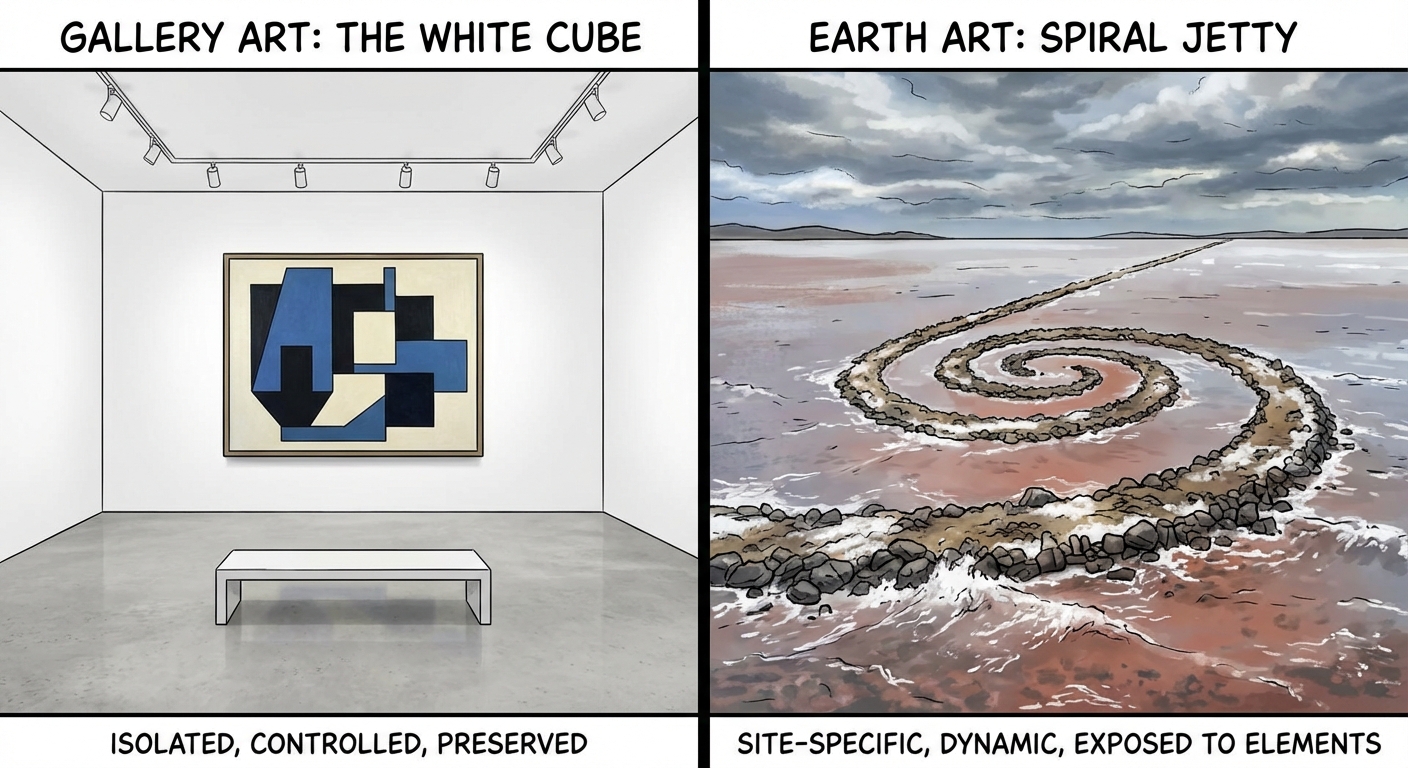
Artists moved out of the gallery system (the "White Cube") to interact directly with nature. These works are often ephemeral (temporary) and site-specific.
Key Work: Spiral Jetty
- Artist: Robert Smithson
- Location: Great Salt Lake, Utah.
- Form: A coil of mud, salt crystals, and basalt rocks.
- Themes: Entropy (the tendency of all things to move toward disorder). The work changes as water levels rise and fall, submerging or revealing the jetty.
Performance Art & Happenings
Art became an action or event rather than a static object.
Key Work: Narcissus Garden
- Artist: Yayoi Kusama
- Context: Originally installed at the 1966 Venice Biennale (unofficially).
- Action: Kusama stood among 1,500 mirrored balls and sold them to passersby for $2 each.
- Meaning: A critique of the commercialization of the art world. The mirrored balls forced viewers to stare at their own reflection (Narcissism).
Comparison Table: Modern Architectural Approaches
| Feature | International Style (Le Corbusier/Mies) | Organic Architecture (Wright) |
|---|---|---|
| Relationship to Nature | Sits on the landscape (distinct from it) | Sits within the landscape (integrated) |
| Form | Geometric, box-like, vertical | Horizontal, irregular, complex |
| Materials | Machine-made: Steel, glass, concrete | Natural mix: Local stone, wood combined with concrete |
| Philosophy | "Machine for living" | Harmony between human and nature |
Common Mistakes & Pitfalls
- Confusing "Modern" with "Contemporary": In Art History, "Modern" refers to a specific period (approx. 1860s–1970s). "Contemporary" is 1980–Present. Don't call a 2024 building "Modernist" unless referring to the style.
- Overlooking Function in Architecture: Students often focus only on how a building looks. For AP exams, you MUST explain how the materials (steel/concrete) enabled the function (open floor plans, fireproofing, higher density).
- Misinterpreting "The Steerage": Many students think Stieglitz created this solely to document the plight of immigrants. While the subject is immigrants, Stieglitz's primary stated intent was formalist—he was obsessed with the geometry and shapes in the photo.
- Dada vs. Surrealism: While related, Dada (Duchamp) focuses on nonsense and anti-art to protest rational thought (after WWI). Surrealism focuses on the unconscious mind and dreams. Fountain is Dada.
- Site-Specificity: Students often forget that works like Spiral Jetty rely heavily on their location. You cannot move Spiral Jetty to a museum; its meaning is tied to the Great Salt Lake's ecology.