Unit 7 Study Notes: Fundamental Principles of Gravitation
Newton's Law of Universal Gravitation
Before Newton, gravity was largely viewed as a terrestrial phenomenon. Newton's great leap was unifying the physics of the Apple (Earth-bound objects) with the Physics of the Moon (celestial bodies). In AP Physics C: Mechanics, you must treat gravity not just as a force, but as an interaction that follows the Inverse-Square Law and incorporates the Principle of Superposition.
The Force Equation
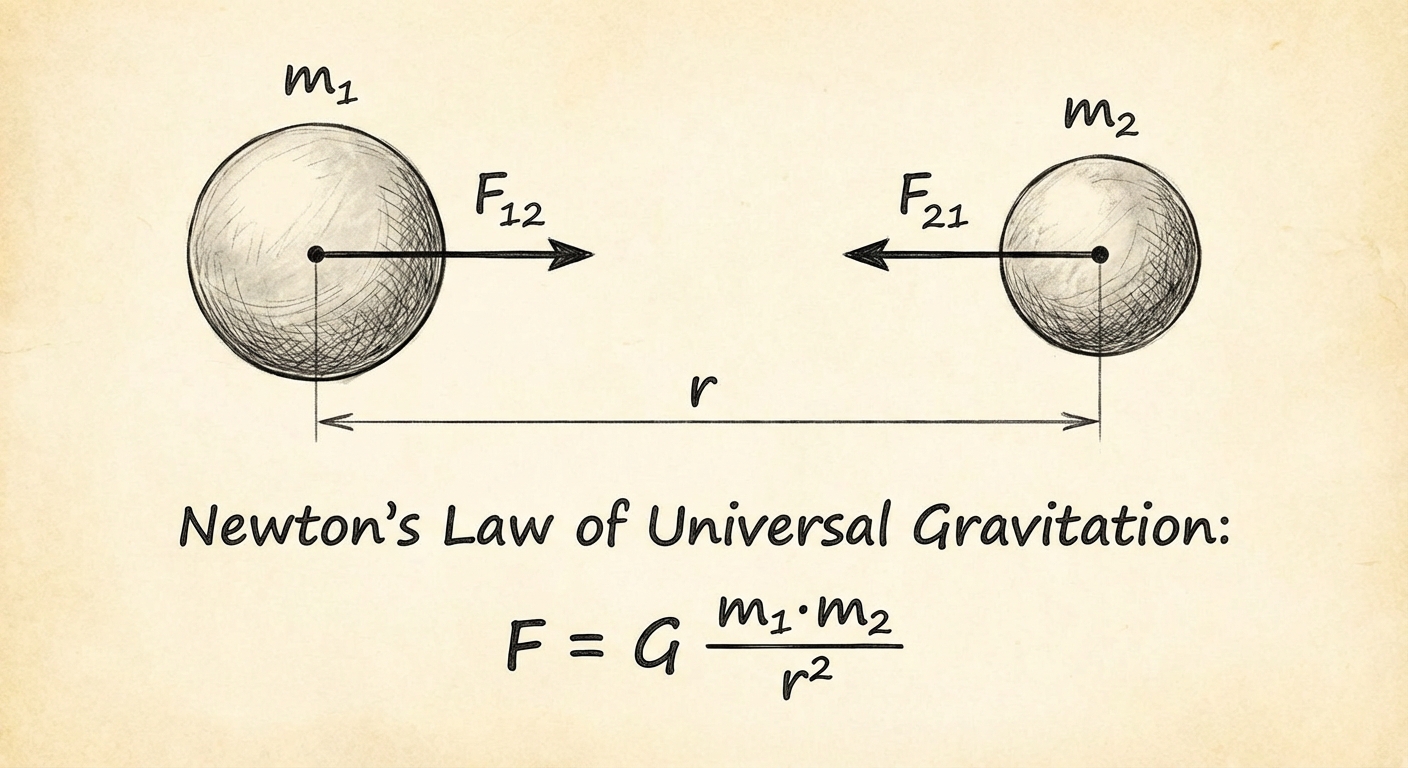
Every point mass in the universe attracts every other point mass with a force that is directly proportional to the product of their masses and inversely proportional to the square of the distance between them.
Where:
- $F_g$ is the magnitude of the gravitational force (Newtons, N)
- $G$ is the Universal Gravitational Constant ($6.67 \times 10^{-11} \, \text{N}\cdot\text{m}^2/\text{kg}^2$)
- $m1$ and $m2$ are the masses of the objects (kg)
- $r$ is the center-to-center distance between the masses (m)
Key Properties of the Gravitational Force
- Always Attractive: Unlike electrostatics, gravity never pushes; it only pulls.
- Action-Reaction Pair: According to Newton's Third Law, Earth pulls on you with force $F$, and you pull on Earth with an equal force $F$ in the opposite direction.
- Central Force: The force acts along the line connecting the centers of mass.
- Inverse-Square Law: If you double the distance ($2r$), the force drops to one-quarter ($\frac{1}{4}F$). If you triple the distance, it drops to one-ninth.
The Shell Theorem
For AP Physics C, you are often dealing with spheres (planets), not point masses. The Shell Theorem (developed by Newton using calculus) simplifies this:
- Outside a uniform spherical shell: The shell acts as if all its mass were concentrated at a single point at its center.
- Inside a hollow uniform spherical shell: The net gravitational force on a particle placed anywhere inside is zero. The pulls from different parts of the shell cancel out perfectly.
Principle of Superposition due to Multiple Bodies
If a mass is acted upon by multiple other masses, the net force is the vector sum of the individual forces.
Exam Tip: Because force is a vector, you must resolve forces into $x$ and $y$ components before adding them. Do not simply add magnitudes unless the masses are all in a straight line.
Gravitational Field and Acceleration
While $F_g$ describes the interaction between two objects, the Gravitational Field describes the region of influence created by a single mass.
Defining the Field ($g$)
The gravitational field vector, $\vec{g}$, is defined as the gravitational force experienced by a test mass divided by that mass.
Here, $\vec{g}$ represents the local acceleration due to gravity. On Earth's surface, this is approximately $9.8 \, \text{m/s}^2$.
Gravitational Field of a Solid Sphere (Planet Model)
This is a high-frequency topic on AP Exams involving derivation. Consider a planet of mass $M$, radius $R$, and uniform density $\rho$.
1. Outside the Sphere ($r \ge R$)
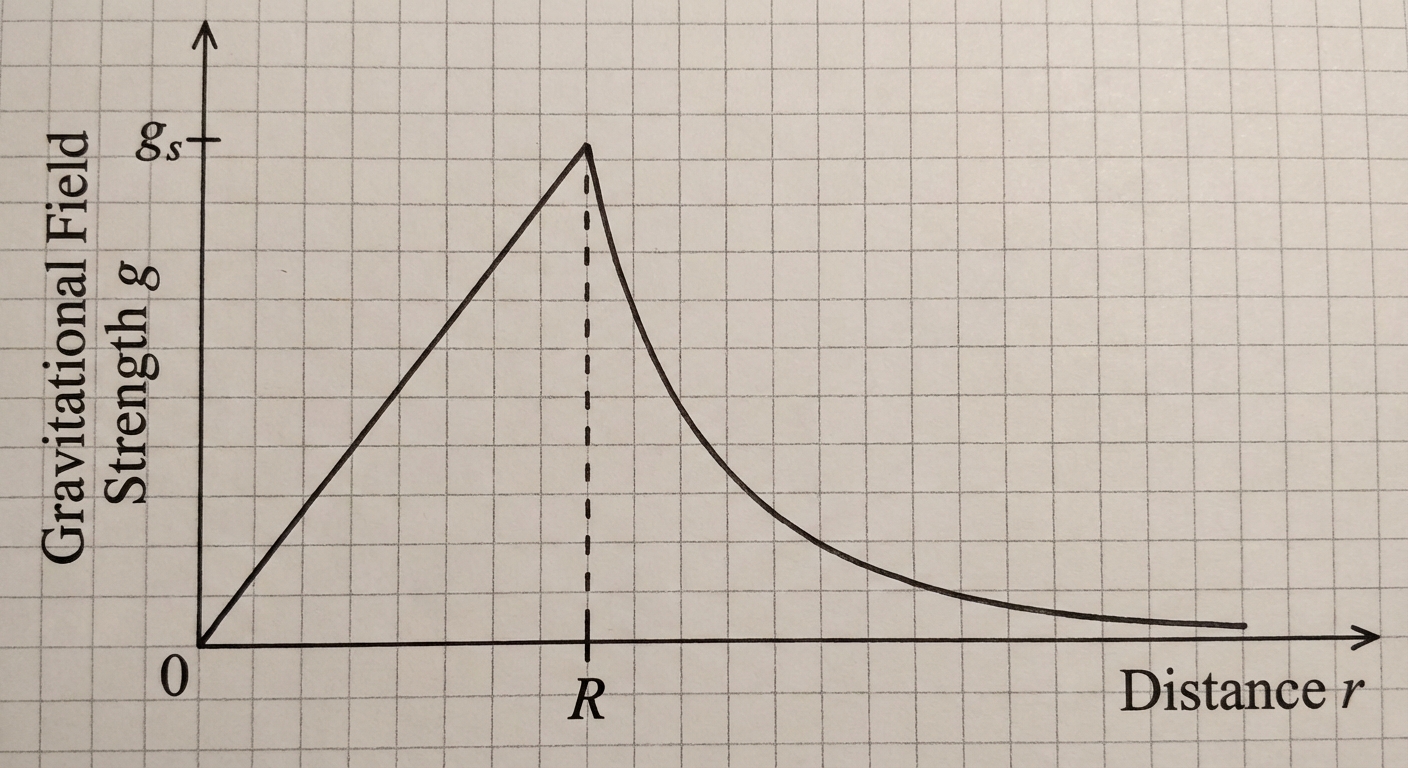
Outside the planet, the Shell Theorem applies. The field behaves like a point mass.
2. Inside the Sphere ($r < R$)
Inside the planet, only the mass enclosed within your current radius $r$ contributes to the gravitational force. The mass in the "outer shell" (from $r$ to $R$) cancels out.
Using density $\rho = \frac{M}{\frac{4}{3}\pi R^3}$ and enclosed mass $M_{enc} = \rho \left(\frac{4}{3}\pi r^3\right)$, we derive:
Substituting this into the gravity equation:
Key Takeaway: Inside a uniform solid sphere, gravity increases linearly with distance from the center ($g \propto r$).
Gravitational Potential Energy ($U_g$)
In introductory physics, you learned $U_g = mgh$. However, $mgh$ assumes $g$ is constant, which is only true for small height changes near the surface. In AP Physics C, specifically for orbits and celestial mechanics, you must use the general formula derived from calculus.
Calculus Derivation
The change in potential energy is defined as the negative work done by a conservative force:
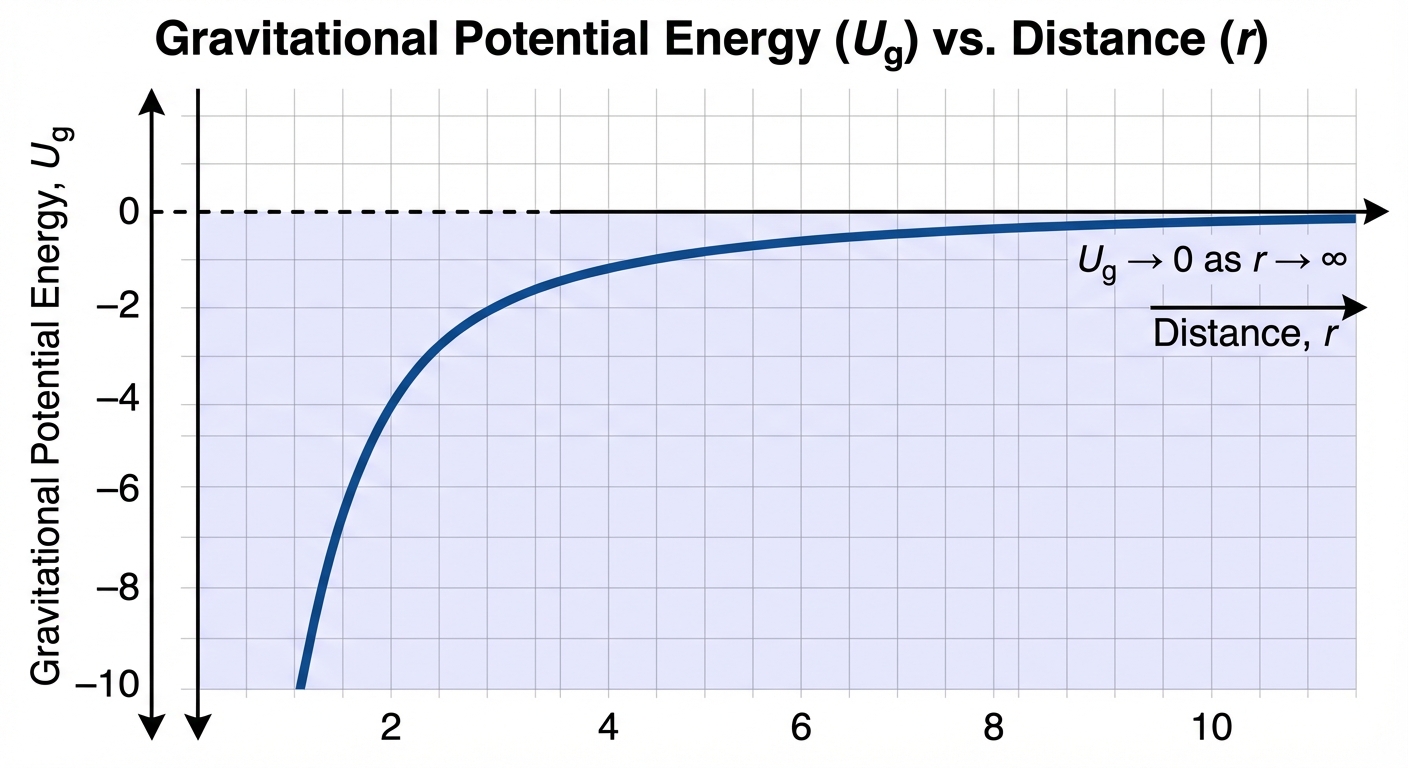
By convention, we set the reference point where $U_g = 0$ at infinity ($r = \infty$). Calculating the work done moving a mass $m$ from infinity to a distance $r$ from a source mass $M$:
(Note: The force is negative because it points inward, opposite to the displacement vector usually defined outward).
Evaluating the integral:
Understanding the Formula
- The Negative Sign: Gravity is an attractive force. You must do positive work to pull two masses apart (move toward infinity). Therefore, bound systems have negative energy. If $Ug = 0$ at $\infty$, then $Ug$ must be negative everywhere closer.
- Scalar Quantity: Potential energy is a scalar. When calculating the total potential energy of a system of 3+ stars, you simply sum the scalars algebraically (no vectors involved).
Mechanical Energy in Orbits
The total mechanical energy ($E_{mech}$) of a satellite is constant (conserved) in the absence of drag.
For a circular orbit, specific relationships apply (often leading to $E_{total} = -\frac{GMm}{2r}$), but the conservation law above is universal for all conic sections (circles, ellipses, parabolas, hyperbolas).
Summary of Key Relationships
| Concept | Variable | Formula | Relationship to $r$ (Point Mass) |
|---|---|---|---|
| Force (Vector) | $\vec{F}_g$ | $G \frac{m1 m2}{r^2}$ | $\propto \frac{1}{r^2}$ |
| Field (Vector) | $\vec{g}$ | $G \frac{M}{r^2}$ | $\propto \frac{1}{r^2}$ |
| Potential Energy (Scalar) | $U_g$ | $-G \frac{m1 m2}{r}$ | $\propto \frac{1}{r}$ |
| Potential (Scalar) | $V_g$ | $-G \frac{M}{r}$ | $\propto \frac{1}{r}$ |
Common Mistakes & Pitfalls
- Forgetting to Square $r$ in Force: A very common error is writing $F = GMm/r$ instead of $r^2$. Remember: Forces usually decay rapidly ($r^2$), while Energy decays slowly ($r$).
- Confusing $r$ with Altitude: In the formula, $r$ is the distance from center to center. If a problem gives you the altitude $h$ above the surface of a planet with radius $R$, you must use $r = R + h$.
- Mixing up Vectors and Scalars:
- Force and Field are vectors. You must decompose them into components to add them.
- Energy and Potential are scalars. You simply add them (keeping the negative signs).
- Using $mgh$ in Space: Never use $U = mgh$ for satellites or rockets moving significant distances from Earth. It assumes $g$ is constant. Always use $U = -GMm/r$.
- Neglecting the Negative Sign: When calculating $\Delta U$ or Conservation of Energy, dropping the negative sign on the potential energy term will completely ruin your calculation. A satellite has negative total energy if it is in orbit.