Unit 2: Interactions Among Branches of Government
The Legislative Branch: Congress
Structure and Organization of Congress
Congress is the bicameral (two-house) legislature responsible for writing laws, overseeing the bureaucracy, and representing the citizenry. This structure was established by the Great Compromise (Connecticut Compromise) at the Constitutional Convention.
Comparison: House of Representatives vs. Senate
| Feature | House of Representatives | Senate |
|---|---|---|
| Membership | 435 voting members | 100 members (2 per state) |
| Representation | By population (Census based) | Equal representation (state based) |
| Term Length | 2 years | 6 years (staggered elections) |
| Constituency | Specific Congressional District | Entire State |
| Qualifications | 25 years old, 7 years citizen | 30 years old, 9 years citizen |
| Prestige/Focus | More formal, strict rules, domestic focus | Less formal, foreign policy focus |
| Constitutional Power | Initiates revenue bills, Impeachment charges | Ratifies treaties, Confirms appointments, Impeachment trials |
Congressional Elections and Districts
The House is designed to be closer to the people, while the Senate is designed to represent sovereign states and act as a cooling saucer for public passions.
- Reapportionment: The reallocation of House seats among states after every 10-year Census based on population changes.
- Redistricting: The redrawing of district boundaries within a state by the state legislature.
- Gerrymandering: Drawing district boundaries to benefit a specific party, protect incumbents, or change minority influence.
- Packing: Concentrating opposing voters into one district to reduce their power elsewhere.
- Cracking: Spreading opposing voters across many districts to deny them a majority.
Key Supreme Court Cases on Redistricting
Baker v. Carr (1962)
- Context: Tennessee had not redrawn districts in decades; rural areas had disproportionate power.
- Holding: The Court ruled that redistricting qualifies as a justiciable question, enabling federal courts to hear redistricting cases.
- Impact: Established the "One person, one vote" doctrine under the Equal Protection Clause of the 14th Amendment.
Shaw v. Reno (1993)
- Context: North Carolina created a bizarrely shaped majority-minority district to ensure a black representative.
- Holding: Race cannot be the predominant factor in creating districts, though it can be a factor.
- Impact: Racial gerrymandering is subject to strict scrutiny under the Equal Protection Clause.
Powers of Congress
Article I, Section 8 of the Constitution outlines the powers of Congress.
Enumerated Powers (Expressed)
Powers explicitly written in the Constitution:
- Power of the Purse: Taxing, spending, and borrowing money. Congress controls the budget.
- Commerce Clause: Regulating interstate and foreign commerce.
- Foreign Policy: Declaring war, raising an army, maintaining a navy.
Implied Powers
Based on the Necessary and Proper Clause (Elastic Clause):
- Allows Congress to pass laws needed to carry out enumerated powers.
- Example: Creating a national bank or the draft (conscription).
The Policymaking Process
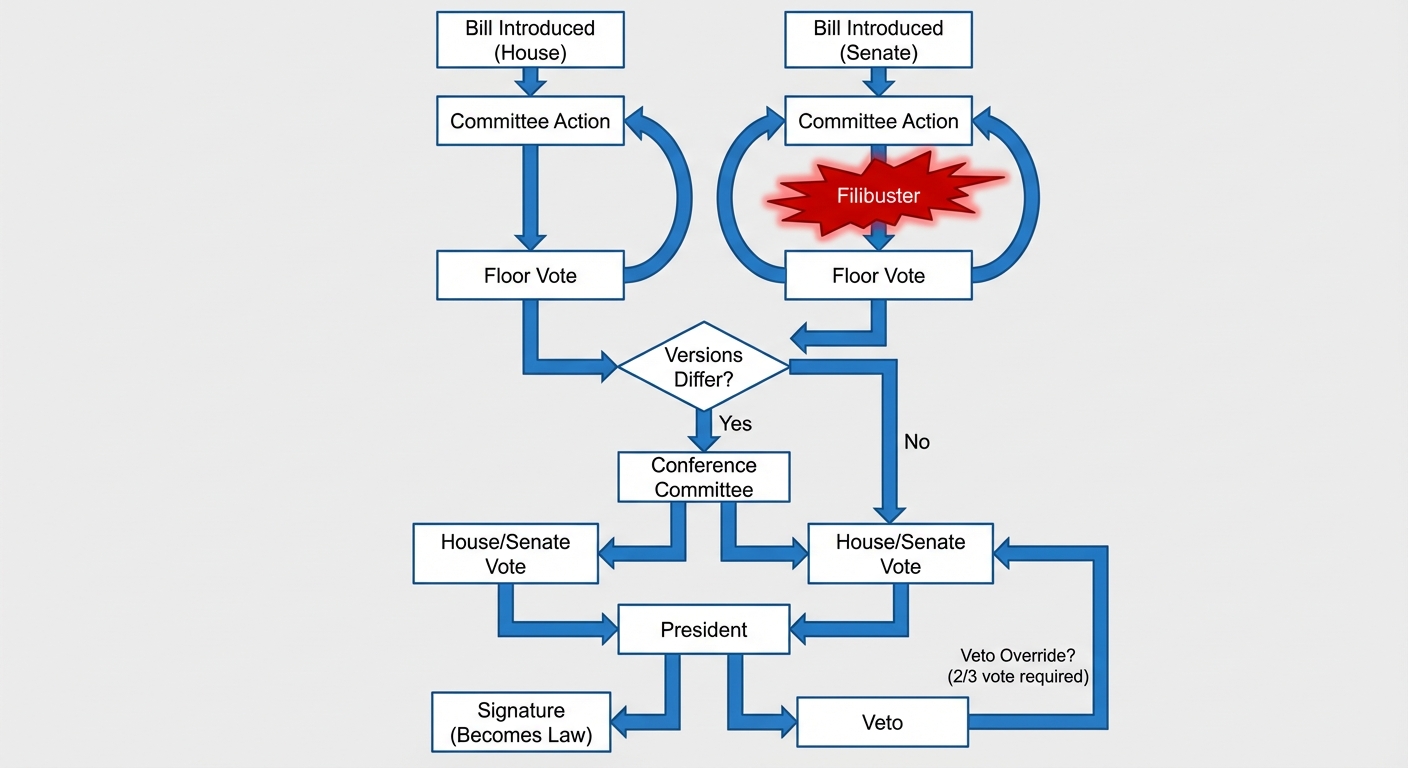
The process is intentionally slow and complicated to prevent rash decision-making and force compromise.
Role of Committees
Most work is done in committees rather than on the floor.
- Standing Committees: Permanent committees that handle legislation in specific policy areas (e.g., House Ways and Means, Senate Judiciary).
- Conference Committees: Temporary joint committees created to reconcile differences between House and Senate versions of the same bill.
- Committee Chairs: Usually senior members of the majority party; they control the agenda.
- Discharge Petition: A rare mechanism in the House to force a bill out of a generic committee to the floor for a vote.
Procedures Differences
The House:
- House Rules Committee: The "traffic cop" of the House. It sets rules for debate (time limits, whether amendments are allowed). A Closed Rule severely limits debate.
- Germaneness: Amendments must be relevant to the bill.
The Senate:
- Filibuster: A tactic to delay a vote (talking a bill to death).
- Cloture (Rule 22): Requires 60 votes (3/5 supermajority) to end a filibuster.
- Holds: A senator informs leadership they object to a bill, effectively delaying it.
- Unanimous Consent: Used to speed up routine business; one objection halts it.
Congressional Behavior Models
How do members decide how to vote?
- Delegate Model: Voting exactly as constituents wish, regardless of personal opinion.
- Trustee Model: Voting based on their own judgment/conscience, acting in the best interest of the people even if unpopular.
- Politico Model: A mix of both; acting as a delegate on high-profile issues and a trustee on complex/obscure issues.
The Executive Branch: The Presidency
Presidential Power and Structure
Federalist No. 70
- Author: Alexander Hamilton.
- Argument: Justifies a single executive (president).
- Key Reasoning: A single person can act with "energy," decision, and dispatch (speed) during crises. Multiple executives would lead to infighting, inaction, and a lack of accountability.
Formal (Enumerated) Powers
Found in Article II:
- Commander in Chief: Head of the armed forces (though Congress declares war).
- Veto Power: The ability to reject legislation.
- Pocket Veto: If the President does not sign a bill within 10 days and Congress goes out of session, the bill dies.
- Treaties: Negotiates treaties (requires 2/3 Senate ratification).
- Appointments: Appoints judges, cabinet members, and ambassadors (requires Senate confirmation).
Informal (Implied) Powers
Expanded over time to meet modern challenges:
- Executive Orders: Directives to the bureaucracy that have the force of law. Used to manage the federal government without Congressional approval.
- Executive Agreements: Agreements with foreign heads of state. unlike treaties, they do not require Senate ratification but only last as long as the presidents agree.
- Signing Statements: Written comments issued by a President when signing a bill, essentially stating how they interpret (or will ignore) parts of the law.
Presidential Communication
- Bully Pulpit: The President's ability to use the visibility of the office to communicate directly with the American people to pressure Congress.
- State of the Union: A constitutional requirement used to set the policy agenda.
- New Media: Use of social media and rapid response technologies to bypass traditional press and reach constituents.
Checks on the President
- Senate Advice and Consent: The Senate can block judicial and cabinet appointments or reject treaties.
- Congress' Power of the Purse: Cutting funding for executive programs.
- 22nd Amendment: Limits the President to two terms.
- War Powers Resolution (1973): Requires the President to notify Congress within 48 hours of deploying troops and withdraw them within 60-90 days unless Congress declares war. (Note: Presidents often view this as unconstitutional, but it remains law).
- Impeachment: House charges (majority vote), Senate tries and removes (2/3 vote).
The Judicial Branch
Foundations of the Judiciary
Federalist No. 78
- Author: Alexander Hamilton.
- Argument: The judiciary is the "least dangerous branch" because it lacks the power of the purse (Congress) and the sword (Executive).
- Key Concepts: Argues for Life Tenure to ensure independence from political pressure and establishes the necessity of Judicial Review to protect the Constitution.
Article III and Independence
- Justices are appointed by the President and confirmed by the Senate.
- They serve for life (during "good behavior") to insulate them from public opinion and reelection pressures.
Judicial Power
- Marbury v. Madison (1803)
- Holding: Established the principle of Judicial Review.
- Reasoning: The Constitution is the supreme law of the land; if a law conflicts with the Constitution, the Court must declare it void.
- Significance: massively expanded the power of the Supreme Court, making it co-equal to the other branches.
Decision Making
- Precedent (Stare Decisis): "Let the decision stand." Rulings predominantly rely on previous court decisions to ensure legal stability.
- Judicial Activism: The philosophy that courts should use their power to correct social injustices and create policy, often interpreting the Constitution broadly.
- Judicial Restraint: The philosophy that courts should defer to the democratically elected branches (legislature) and only strike down laws that are clearly unconstitutional.
Checks on the Judiciary
Since the Court has no police force to enforce rulings (e.g., Brown v. Board was initially ignored by the South), it relies on legitimacy.
- Constitutional Amendments: Can overturn a Court decision (e.g., 16th Amendment allowed income tax after Court struck it down).
- Appointments: Presidents alter the ideological balance of the Court via new nominations.
- Jurisdiction Stripping: Congress can change the appellate jurisdiction of the Court.
- Lack of Enforcement: The executive branch can execute rulings slowly or lazily.
The Bureaucracy
Structure and Function
The Bureaucracy implements federal laws. It is part of the Executive Branch.
Employment Systems
- Patronage (Spoils System): Giving jobs to political supporters (19th century).
- Pendleton Civil Service Act (1883): Replaced patronage with the Merit System.
- Merit System: Hiring and promotion based on testing, qualifications, and experience rather than political loyalty. This creates a professional, non-partisan workforce.
Types of Agencies
- Cabinet Departments: 15 major departments (e.g., Defense, State, Education) led by Secretaries.
- Independent Regulatory Commissions: Regulate specific economic sectors (e.g., Federal Reserve, FCC, SEC). They are insulated from the President (fixed terms, cannot be easily fired).
- Government Corporations: Businesses run by the government that charge fees (e.g., USPS, Amtrak).
Power of the Bureaucracy
- Discretionary Authority: Congress passes broad laws and leaves the specific details to the experts in the agencies. The agencies decide how to implement the law.
- Rule-Making Authority: Agencies issue regulations that have the force of law.
- Example: Congress passes the Clean Air Act; the EPA defines exactly what chemical levels constitute "pollution."
Influencing Policy
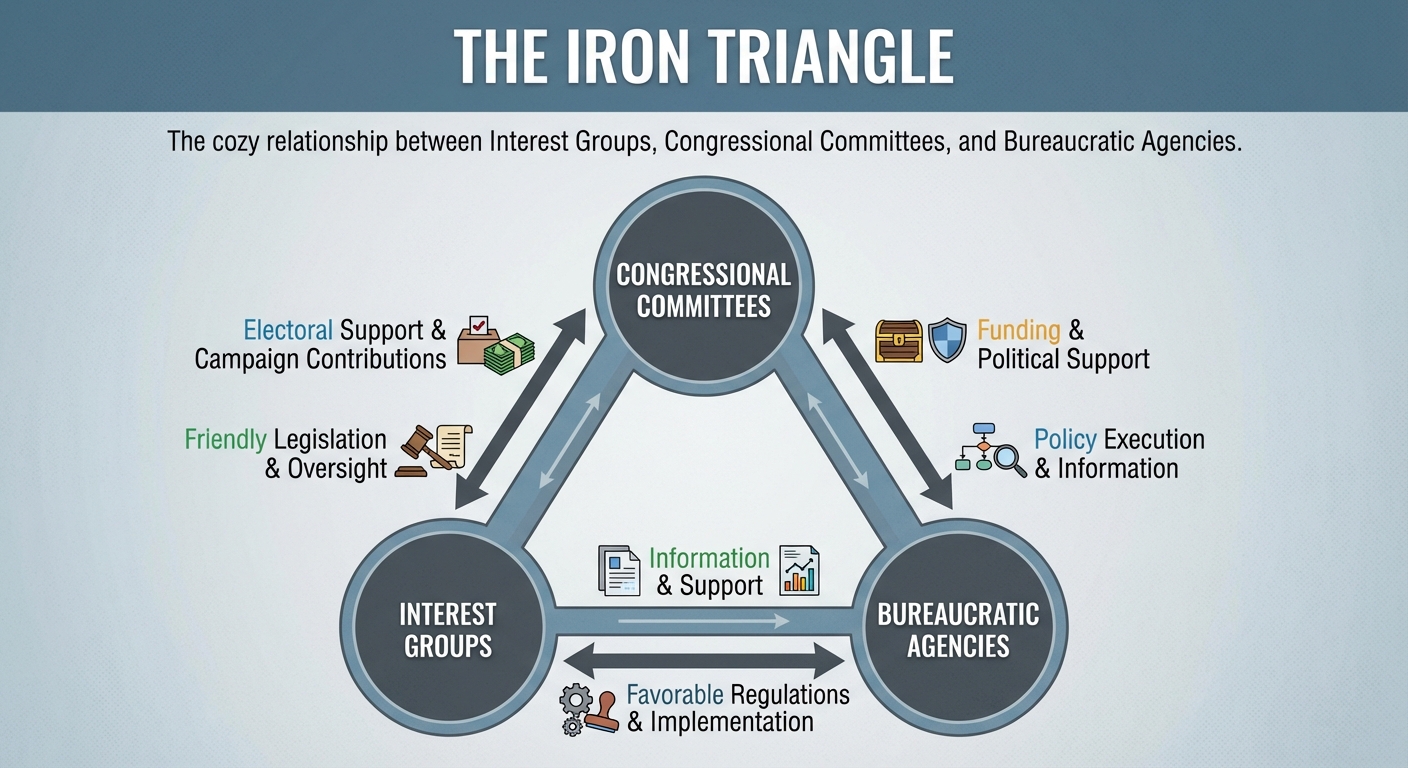
Iron Triangles: A long-standing, mutually beneficial relationship between three groups:
- Bureaucratic Agency (e.g., Dept of Veterans Affairs)
- Congressional Committee (e.g., House Veterans Affairs Committee)
- Interest Group (e.g., The American Legion)
Issue Networks: A wider, more temporary network involving lawyers, academics, media, and consultants debating a specific policy issue. (Unlike Iron Triangles, these are more fluid).
Checks on the Bureaucracy
| Branch | Method of Oversight |
|---|---|
| Congress | Oversight Hearings (investigations), Power of the Purse (cutting budgets), Legislation to limit authority. |
| President | Appointing agency heads, issuing Executive Orders to shift goals, Threatening budget cuts (via OMB). |
| Judiciary | Ruling on whether bureaucracy has overstepped legal authority. |
Common Mistakes
- Mistake: Thinking the President can fire anyone in the bureaucracy.
- Correction: The President can fire appointed Cabinet heads, but not heads of Independent Regulatory Commissions (without cause) or career civil servants (protected by the Merit System).
- Mistake: confusing "Separation of Powers" with "Checks and Balances."
- Correction: Separation of Powers creates distinct creates (Legislative writes law, Executive enforces). Checks and Balances are the specific weapons each has against the other (Veto, Override).
- Mistake: Assuming the Filibuster exists in the Constitution.
- Correction: The Filibuster is a Senate Rule, not a Constitutional power.
- Mistake: Thinking Marbury v. Madison gave the Court the power to enforce laws.
- Correction: It gave them the power to interpret laws (Judicial Review). Enforcement is the Executive's job.