AP Music Theory Unit 4: Principles of Harmony, Functions, and Phrase Structure
Unit 4: Harmony and Voice Leading I
This unit establishes the foundation for SATB (Soprano, Alto, Tenor, Bass) part-writing, also known as four-part harmony. Success in this unit requires mastering the strict "grammar" of Common Practice Period music, specifically regarding how chords move (progression) and how individual melodic lines interact (voice leading).
SATB Texture and Voice Ranges
To write functional harmony, you must treat each voice as an independent melodic line while forming correct vertical chords. The four voices must stay within specific pitch ranges to be historically and acoustically accurate.
Standard Voice Ranges
In AP Music Theory, stick to these general ranges (extended slightly for advanced writing, but keep to these for safety):
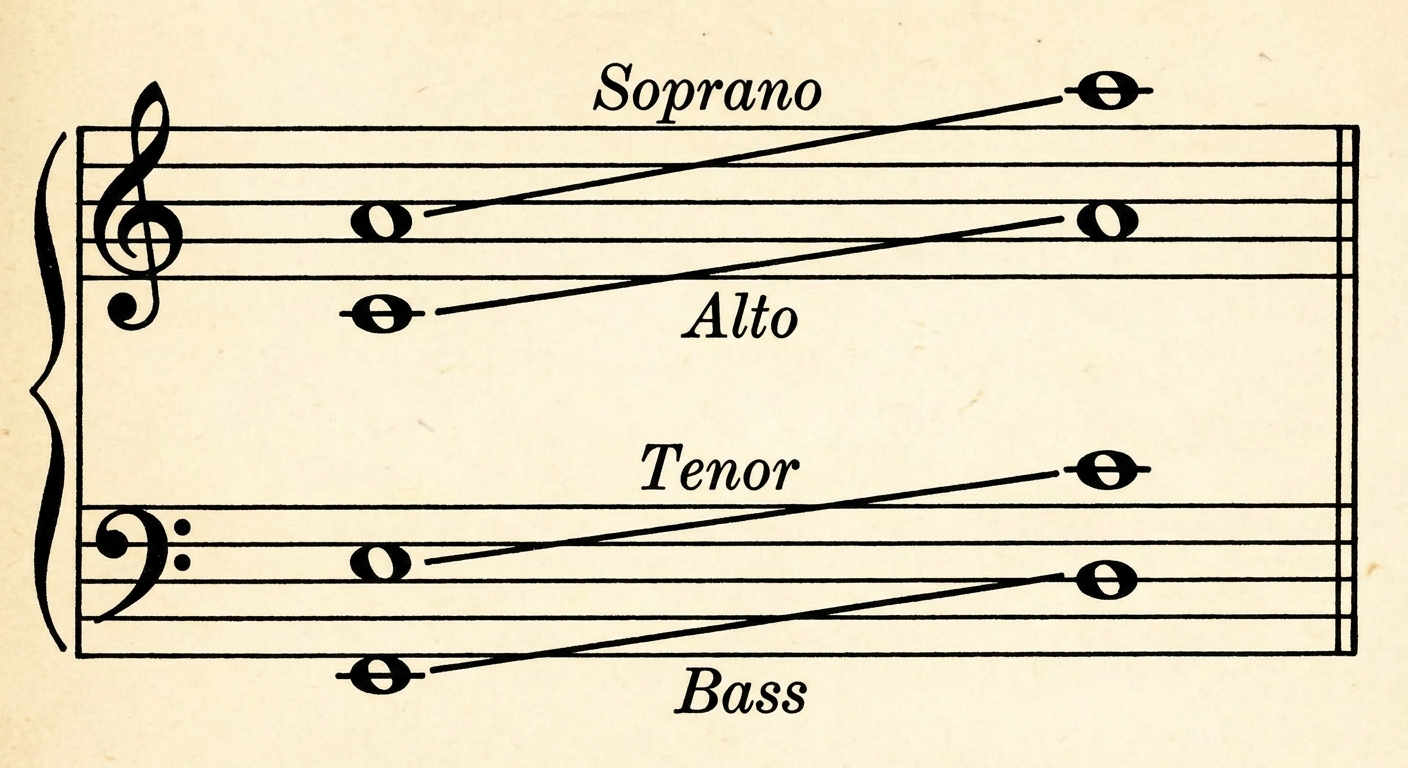
- Soprano (S): Middle C ($C4$) to High G ($G5$)
- Alto (A): Low G ($G3$) to High D ($D5$)
- Tenor (T): Bass C ($C3$) to High G ($G4$)
- Bass (B): Low E ($E2$) to Middle C ($C4$)
Spacing Rules
Open and Closed Positions refer to how widely the upper three voices are distributed.
- Closed Position: The upper three voices (S, A, T) are grouped as close together as possible (within an octave).
- Open Position: The upper voices are spread out, generally spanning more than an octave.
Strict Spacing Rules:
- Soprano $\leftrightarrow$ Alto: Max interval of an octave.
- Alto $\leftrightarrow$ Tenor: Max interval of an octave.
- Tenor $\leftrightarrow$ Bass: Can be more than an octave (often necessary for root position chords).
Melodic Motion and Contour
Voice leading is the art of arranging voices to create smooth, logical progressions. The relationship between the Bass and the Soprano (the outer voices) is the most critical.
Types of Motion
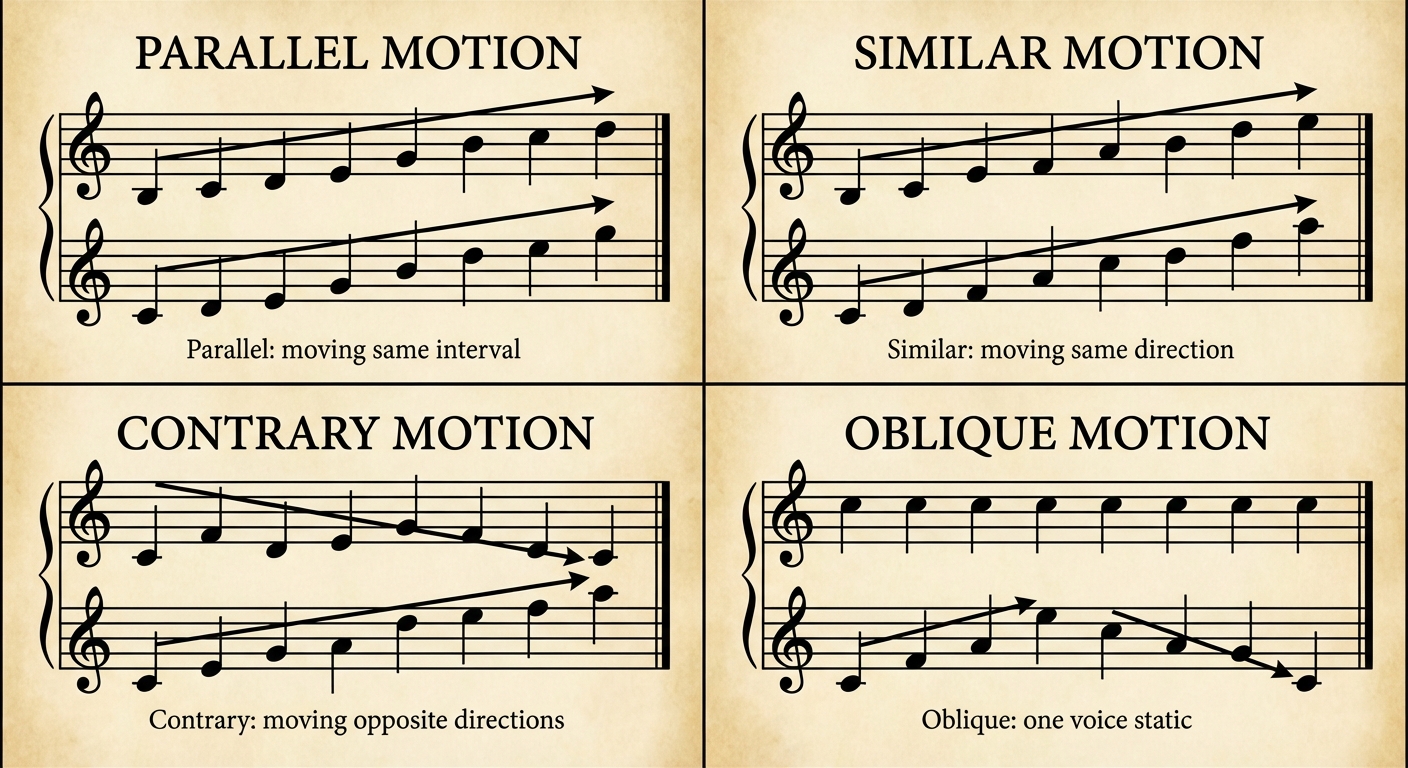
- Parallel Motion: Both voices move in the same direction by the same harmonic interval (e.g., both move up by a Major 3rd).
- Warning: Parallel motion is dangerous regarding perfect intervals ($P5$, $P8$).
- Similar Motion: Both voices move in the same direction but by different intervals.
- Example: Bass moves up by step; Soprano leaps up by a third.
- Contrary Motion: Voices move in opposite directions. This is the strongest and most preferred motion for outer voices as it confirms voice independence.
- Oblique Motion: One voice remains on the same pitch (common tone) whilst the other creates motion.
Strict Voice Leading Rules (The "Don'ts")
The AP exam is rigorous about these errors. Committing them in the Free Response Questions (FRQs) results in significant point deductions.
1. Forbidden Parallels
- Parallel Fifths: moving from one Perfect 5th ($P5$) directly to another $P5$ between the same two voices.
- Parallel Octaves: moving from one Perfect Octave ($P8$) directly to another $P8$ between the same two voices.
- Note: Avoid these in similar motion as well. If the bass and soprano move in the same direction into a $P5$ or $P8$ with a leap in the soprano, it is called a Direct (or Hidden) Fifth/Octave and is incorrect.
2. Voice Crossing and Overlapping
- Voice Crossing: When a lower voice sings a pitch higher than the upper voice's immediately simultaneous pitch (e.g., the Tenor sings a G4 while the Alto sings an E4 in the same chord).
- Voice Overlapping: When a voice moves to a pitch that crosses the previous pitch of an adjacent voice (e.g., the Bass jumps up to a note higher than the Tenor's previous note).
3. Melodic Errors
- Avoid leaps larger than a 5th (except for the octave).
- Never leap by a dissonant interval (augmented 2nd, tritone, 7th) within a single voice line.
- If a voice leaps large (perfect 4th or higher), it should usually move step-wise in the opposite direction afterwards to "fill the gap."
Common Mistakes Checklist
- Did you write parallel 5ths? (Check every beat).
- Is there more than an octave between Alto and Tenor?
- Did you double the leading tone? (Never do this).
Chord Functions, Progressions, and Syntax
Not all chords can move to all other chords. Music of the Common Practice Period generally follows a Tonic $\to$ Predominant $\to$ Dominant $\to$ Tonic syntax.
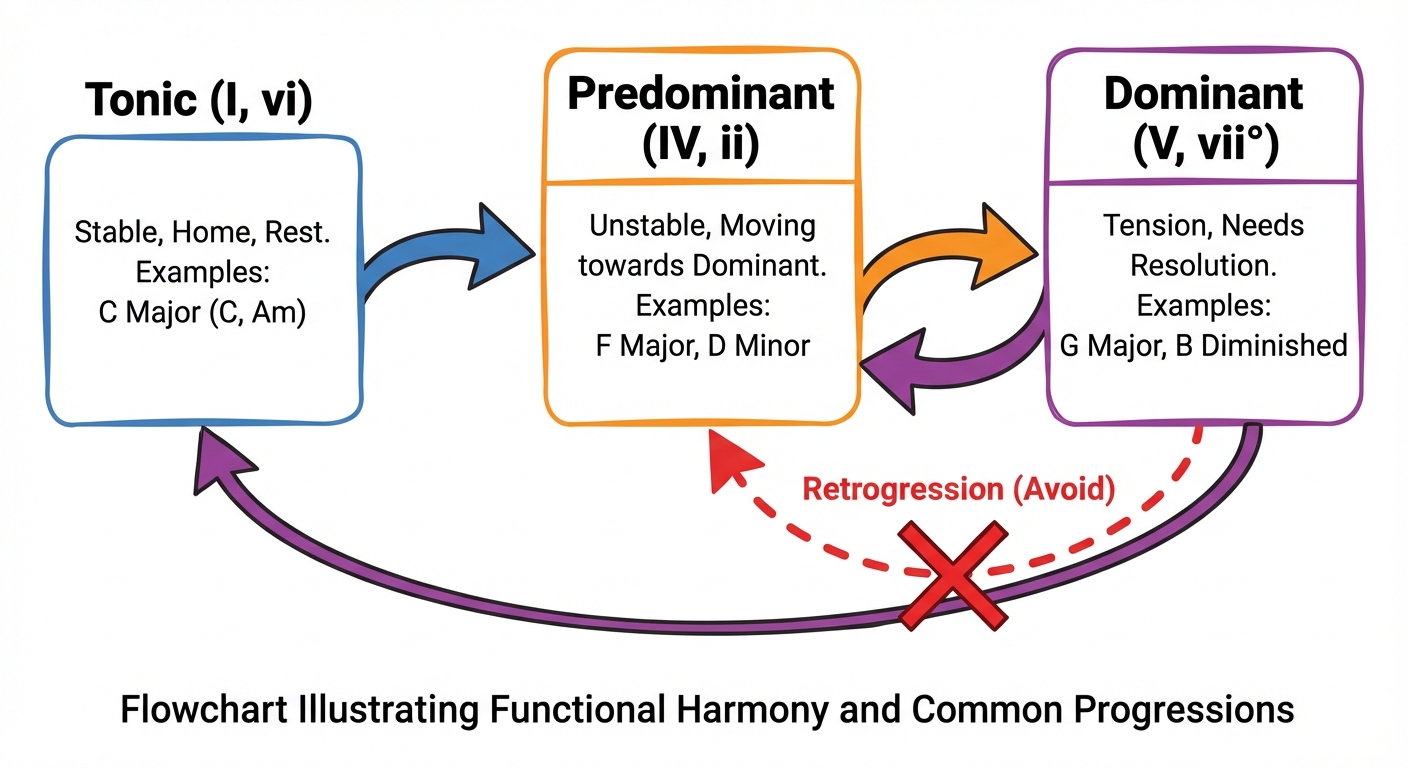
Functional Categories
- Tonic Area (T): Stability. The home base.
- Primary: $I$ (Major) or $i$ (Minor)
- Substitutes: $vi$ or $VI$ (Deceptive resolution)
- Predominant Area (PD): Sets up the dominant.
- Primary: $IV$ or $iv$, $ii$ or $ii^\circ$
- The $ii$ chord is stronger than $IV$.
- Dominant Area (D): Harmony that requires resolution back to stability.
- Primary: $V$ and $V^7$
- Substitute: $vii^\circ$ (Leading tone chord)
The Circle of Fifths Progression
The strongest root movements descend by 5ths (or up by 4ths). A complete functional cycle often looks like:
Retrogression
Avoid moving "backwards" functionally.
- Avoid: $V \to IV$ (Dominant to Predominant).
- Exception: $V \to IV^6$ is sometimes accepted as a voice-leading interpolation, but $V \to IV$ in root position is generally a stylistic error in this style.
Cadences
A cadence is a harmonic goalpost—it brings a musical phrase to a close. Identifying cadences requires looking at the last two chords of a phrase.
| Cadence Name | Symbol | Progression | Description | strength |
|---|---|---|---|---|
| Perfect Authentic | PAC | $V \to I$ | Both chords in root position; Soprano ends on $\hat{1}$ (Tonic). | Strongest |
| Imperfect Authentic | IAC | $V \to I$ | Either chord inverted OR Soprano is not on $\hat{1}$ (on $\hat{3}$ or $\hat{5}$). | Medium |
| Half Cadence | HC | $? \to V$ | Ends on the Dominant. Feels unresolved/ "To be continued…" | Weaker |
| Phrygian Half | PHC | $iv^6 \to V$ | Specific to Minor Keys. Bass moves half-step down (${le} \to \hat{sol}$. | Distinctive |
| Plagal Cadence | PC | $IV \to I$ | The "Amen" cadence. Usually follows a PAC as an extension. | Gentle |
| Deceptive Cadence | DC | $V \to vi$ | The ear expects $I$, but gets $vi$ (or $VI$). A surprise ending. | Avoiding |
Realization (Part-Writing) Rules
When writing chords, you must decide which note to double (since you have 3 triad notes but 4 voices).
Doubling Rules
- Root Position Triads: Double the ROOT. (Most stable).
- First Inversion ($^6$) Triads: Is it a tonal chord ($I^6, IV^6, V^6$)? usually double the Soprano or stick to the Root.
- Exception: In $ii^6$, double the BASS (the third of the chord) because it is a strong functional bass note.
- Exception: In diminished triads ($vii^{\circ 6}$ or $ii^{\circ 6}$), always double the BASS (the third).
- Second Inversion ($^6_4$) Triads: Always double the BASS (which is the 5th of the chord). These are unstable and mostly used as passing or cadential chords.
- NEVER Double:
- Tendency Tones: Never double the Leading Tone ($\hat{7}$) or the Chordal 7th. These notes have strict resolution strictures; doubling them would force parallel octaves when they resolve.
Tendency Tone Resolutions
Specific notes in the scale have magnetic pulls toward other notes:
- The Leading Tone ($\hat{7}$): Must resolve UP by step to the Tonic ($\hat{1}$), especially when in the soprano or bass voice (Outer voices).
- The Chordal Seventh: If you have a $V^7$ chord, the 7th of the chord (which is scale degree $\hat{4}$) must resolve DOWN by step to the 3rd of the next chord (scale degree $\hat{3}$).
The Cadential $6/4$ Chord
A specific decoration of the dominant.
- Notation: $I^64 - V - I$ (or in analysis: $V^{6-5}{4-3}$).
- Function: Even though it looks like a Tonic chord, it functions as a Dominant.
- The $6^{th}$ above the bass resolves down to the $5^{th}$.
- The $4^{th}$ above the bass resolves down to the $3^{rd}$.
- Always occurs on a strong beat.
Harmonic Rhythm
Harmonic Rhythm is the rate at which chords change.
- It should generally speed up toward the cadence.
- Metric Placement: Changes of harmony usually coincide with the strong beats of the meter (Beat 1, and Beat 3 in 4/4 time).
- Agogic Accent: Longer notes in the bass usually imply a change of harmony or a strong structural chord.
Tips for Voice Leading FRQs
- Roman Numerals First: Analyze the bass line and figures before writing notes. Establish your key and progression.
- Identify Cadences: Find the end of the phrase first. Is it a PAC? HC? Write the final chords first to establish your goal.
- Work Outside-In: Write a good Soprano melody (counterpoint) against the Bass before filling in the Alto and Tenor. This minimizes errors.
- Check Tendency Tones: Circle every leading tone and every $V^7$. Draw an arrow to ensure they resolve correctly immediately.
- Scan for Parallels: Do a final vertical specific check between Bass/Tenor and Soprano/Alto for parallel 5ths/8ves.