Comprehensive Study Guide: The Transatlantic Trade, Resistance, and Abolition (c. 1500–1865)
Unit 2 Overview: Freedom, Enslavement, and Resistance
This unit explores the experiences of African peoples from the beginnings of Atlantic contact through the American Civil War. It covers the Transatlantic Slave Trade, the development of American chattel slavery, the creation of distinct African American cultures, and the persistent resistance to enslavement.
2.1 African Exploration and Presence in the Early Americas
Before the dominance of British chattel slavery, Africans were present in the Americas as explorers, soldiers, and intermediaries.
Key Terms & Concepts
- Ladinos: Latinized Blacks who were born or raised in the Iberian Peninsula (Spain/Portugal) or familiar with Iberian culture, religion (Catholicism), and language. They often served as intermediaries.
- Atlantic Creoles: A generation of Africans with cultural roots in Africa, Europe, and the Americas, often possessing linguistic skills that allowed them social mobility.
Notable Figures
- Juan Garrido (c. 1480–c. 1550):
- Born in the Kingdom of Kongo; became a conquistador.
- First known free African to traverse North America.
- Participated in the expeditions of Ponce de León (Florida, 1513) and Hernán Cortés (Mexico).
- Unlike later enslaved laborers, he sought military spoils and social status.
- Estevanico (Esteban de Dorantes):
- Enslaved Moroccan healer and explorer.
- One of four survivors of the Narváez expedition.
- Traversed the American Southwest (Texas/New Mexico) in the 1530s acting as a guide, translator, and healer with Indigenous peoples.
2.2 & 2.3 The Transatlantic Slave Trade and the Middle Passage
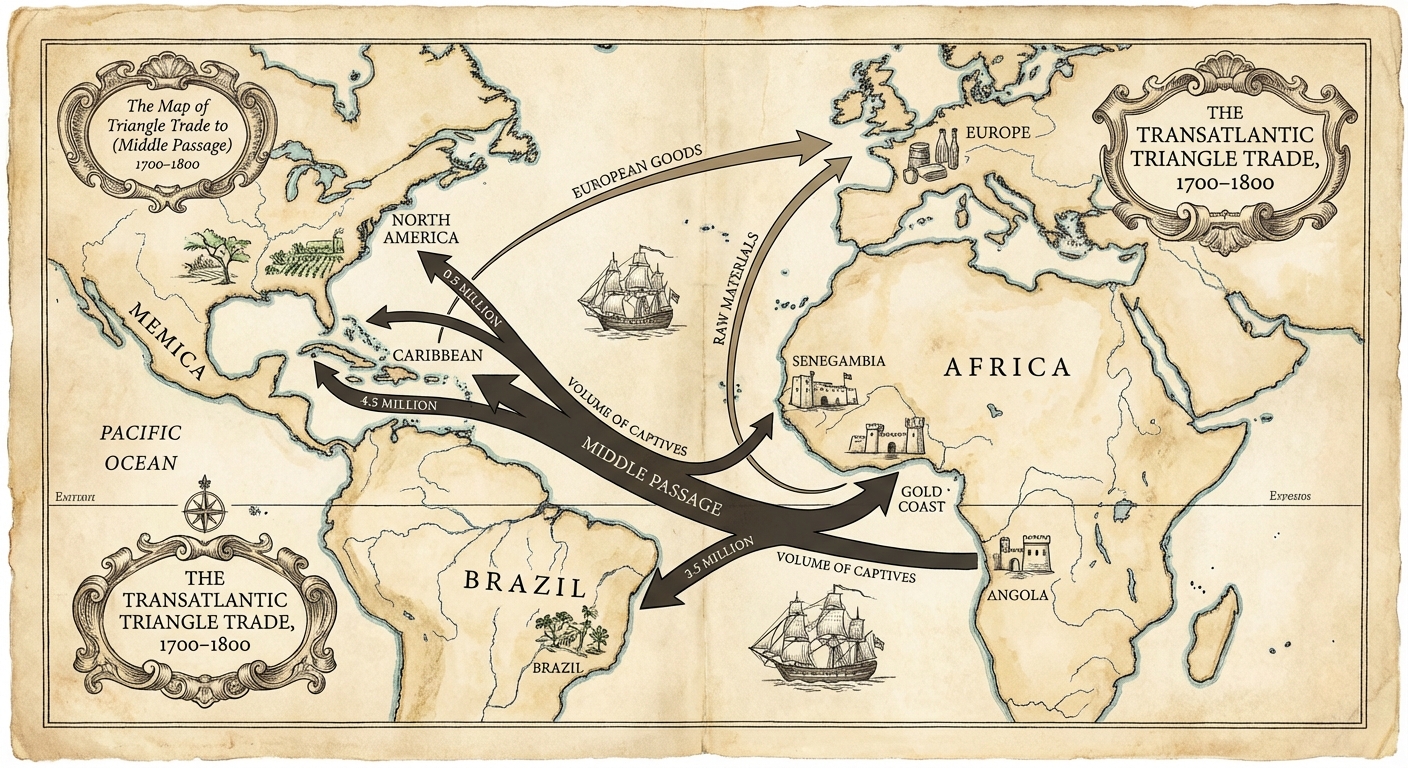
The Scope of the Trade
- Duration: ~350 years (16th–19th centuries).
- Volume: Over 12.5 million Africans forcibly embarked; ~10.7 million survived the crossing.
- Destination: Only ~5% came directly to North America (British Colonies/US). The vast majority went to Brazil (Portugal) and the Caribbean (sugar colonies).
- Major Departure Zones: Senegambia, Sierra Leone, Gold Coast (Ghana), Bight of Benin/Biafra (Nigeria), and West Central Africa (Angola/Kongo).
- Note: Over half of Africans arriving in North America originated from West Central Africa (Angola/Kongo) and Senegambia.
The Middle Passage
This was the second leg of the "Triangular Trade."
- Capture: War captives, kidnapping victims, or joydicial punishment subjects marched to the coast.
- The Crossing (Middle Passage): Lasted 1–3 months. Characteristics included:
- Extreme overcrowding (loose pack vs. tight pack theories).
- Dysentery (the "bloody flux"), smallpox, and malnutrition.
- Insanitary conditions causing high mortality (approx. 15% death rate).
- Arrival: Quarantine, sale, and the "seasoning" process (forced acclimation to labor).
Impact on West Africa
- Destabilization: Increased warfare to acquire captives for European firearms (the Gun-Slave Cycle).
- Economic Shift: Coastal states became wealthy; interior states suffered depopulation.
- Demographic Imbalance: loss of young men and women disrupted kinship networks and production.
2.4 Resistance on the Water: Slave Ship Mutinies
Resistance began immediately upon capture. It made the trade risky and expensive for European powers.
Forms of Resistance
- Hunger Strikes: Refusing to eat to deny enslavers profit.
- Jump-overs: Choosing death by drowning over enslavement.
- Insurrection: Violent takeover of ships.
The Amistad Rebellion (1839)
- Leader: Sengbe Pieh (Joseph Cinqué).
- Event: Mende captives from Sierra Leone revolted on the Spanish schooner La Amistad off the coast of Cuba, attempting to sail back to Africa.
- Outcome: The ship was seized by the US Navy. In United States v. The Amistad (1841), the Supreme Court ruled the captives were free because the international slave trade had been banned, making their capture illegal.
2.5 The Domestic Slave Trade & The Cotton Economy
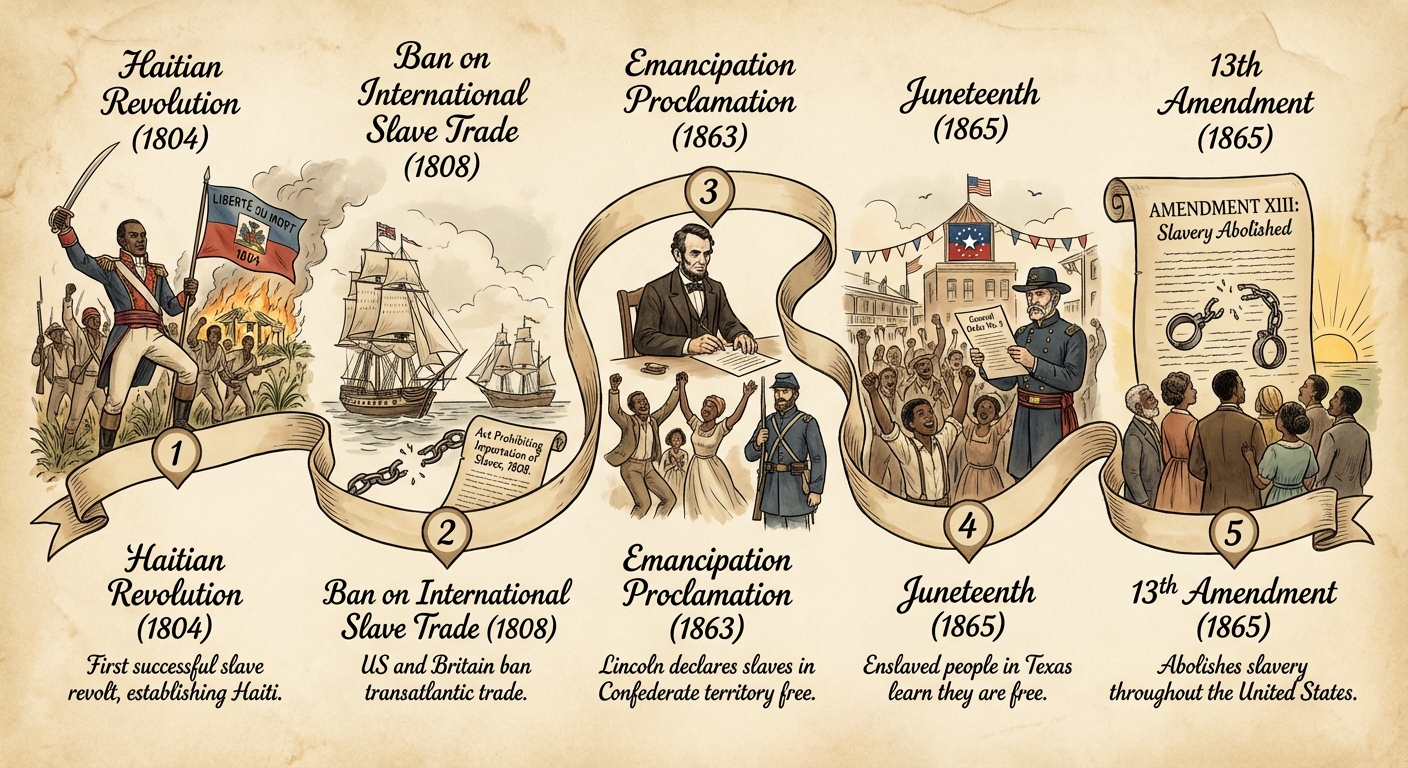
Following the US ban on the International Slave Trade (1808), the domestic trade exploded.
The Second Middle Passage
- Definition: The forced migration of approx. 1 million enslaved people from the Upper South (VA, MD) to the Deep South (GA, AL, MS, LA) between 1790 and 1860.
- Driver: The invention of the Cotton Gin (Eli Whitney, 1793) made short-staple cotton highly profitable.
- Impact:
- Destruction of families (selling children away from parents).
- Growth of slave auctions (New Orleans became the largest slave market).
- Cotton became the primary US export ("King Cotton").
2.6 Labor Systems and Culture
Enslaved people worked in various capacities, but agricultural labor was dominant. The type of crop determined the labor system.
The Gang System vs. The Task System
| Feature | Gang System | Task System |
|---|---|---|
| Crops | Cotton, Tobacco, Sugar | Rice, Indigo |
| Region | Deep South, Chesapeake | SC/GA Lowcountry (Sea Islands) |
| Structure | Work sun-up to sun-down in groups under an overseer. | Assigned a specific daily task; free time upon completion. |
| Cultural Impact | High surveillance; brutal pace. | Allowed more autonomy; preserved Africanisms (see Gullah Geechee). |
Skilled Labor
Enslaved people were also blacksmiths, carpenters, coopers, and healers. This often allowed them to be "hired out," where they might keep a fraction of their earnings, sometimes purchasing freedom.
2.7 & 2.8 Law, Race, and the Status of the Child
The legal framework was constructed to ensure slavery was permanent, inheritable, and racialized.
Partus Sequitur Ventrem (1662)
- Meaning: "The child follows the womb."
- Significance: Status is inherited from the mother, not the father. This reversed English common law. It ensured that children born to enslaved women—even if fathered by free white men (often through rape)—remained enslaved property.
Slave Codes
Laws enacted to control the enslaved population, particularly after rebellions.
- Prohibitions: No reading/writing, no gathering in large groups, no firearms, no testifying against whites.
- Code Noir (French Louisiana): Regulated treatment of slaves but also expelled Jews and restricted free blacks.
Dred Scott v. Sandford (1857)
- Ruling: Chief Justice Roger Taney declared that Black people (enslaved or free) were not citizens under the US Constitution and had "no rights which the white man was bound to respect."
Social Construction of Race
- One-Drop Rule: Customs (and later laws) classifying anyone with African ancestry as Black.
- This prevented a "buffer class" of mixed-race people (Mulattoes) from gaining power, unlike in Brazil or the Caribbean.
2.9 & 2.10 Creating Culture and Identity
The Gullah Geechee
- Location: Sea Islands of SC, GA, FL.
- Language: A creole language blending English and West African languages (Krio, Mende, Wolof).
- Significance: Due to isolation and the Task System, they retained the highest retention of African cultural elements (basket weaving, ring shouts, diet).
Spirituals
- Double Entendre: Songs that expressed religious faith but also coded messages.
- Example: "Steal Away" or "Wade in the Water" (instructions for escaping/hiding scent from dogs).
- They evolved into Gospel and Blues.
2.11 - 2.15 Resistance, Revolts, and Marronage
Resistance was a spectrum from "silent sabotage" to armed rebellion.
Day-to-Day Resistance
- Breaking tools, feigning illness, slowing down work pace, poisoning food.
Armed Rebellions
- Stono Rebellion (1739):
- SC slaves led by Cato attempted to march to Spanish Florida (where freedom was promised).
- Result: Violent suppression and the Negro Act of 1740 (harsher slave codes).
- German Coast Uprising (1811):
- Led by Charles Deslondes in Louisiana.
- Largest slave revolt in US history; aimed to capture New Orleans.
- Nat Turner’s Rebellion (1831):
- Virginia violent insurrection based on religious visions.
- Result: Profound fear across the South; prohibition of black literacy and assembly.
Marronage
- Maroons: Communities of escaped slaves living in swamps or mountains.
- Geography: The Great Dismal Swamp (VA/NC) and the Florida Everglades.
- Fort Mose: Established in 1738 near St. Augustine, FL (Spanish territory). The first free Black town in what is now the US. Runaways from British colonies found asylum here if they converted to Catholicism.
2.16 & 2.17 Global Context: Brazil & Indigenous Interactions
Brazil vs. USA
- Brazil received the most captives of any nation.
- Malê Revolt (1835): An uprising of Muslim enslaved people in Bahia, Brazil. Demonstrated the retention of Islamic identity.
- Abolition: Brazil was the vast country to abolish slavery (1888).
Indigenous Relations
- Solidarity: Maroons often joined Seminoles in Florida (Black Seminoles) to fight the US Army (Second Seminole War).
- Complicity: The "Five Civilized Tribes" (Cherokee, Creek, Choctaw, Chickasaw, Seminole) adopted chattel slavery and took enslaved Blacks with them on the Trail of Tears.
2.18 - 2.20 Abolitionism, Emigration, and The Underground Railroad
Two Schools of Thought
- Emigration/Colonization: Believed Blacks could never be equal in the US.
- American Colonization Society (ACS): Founded Liberia.
- Paul Cuffe: Early proponent of "Back to Africa."
- Abolitionism/Integration: Demanded immediate end to slavery and full citizenship.
- Frederick Douglass: Escaped slave, orator; rejected colonization.
- William Lloyd Garrison: Published The Liberator.
The Underground Railroad
- A clandestine network of safe houses and secret routes.
- Harriet Tubman: The "Moses of her people." Escaped slavery and returned ~19 times to rescue others. Later served as a Union spy.
Black Women’s Activism
- Maria Stewart: First American woman to give public political speeches to mixed audiences. Addressed race and gender (Intersectionality).
2.22 - 2.24 The Civil War and Freedom
Gender and Narratives
- Harriet Jacobs (Incidents in the Life of a Slave Girl): Highlighted the specific sexual exploitation of enslaved women and the "loophole of retreat" (hiding in an attic for 7 years).
The Civil War (1861–1865)
- Confiscation Acts: Allowed Union forces to seize "contraband of war" (enslaved people).
- Emancipation Proclamation (1863): Declared slaves in rebelling territories free. Strategically shifted the war to a moral crusade, preventing British intervention.
- USCT (United States Colored Troops): Over 180,000 Black men served in the Union Army (e.g., 54th Massachusetts).
Freedom Days
- Juneteenth (June 19, 1865): Union General conquest forces arrived in Galveston, TX, to enforce the Emancipation Proclamation (General Order No. 3).
- 13th Amendment (1865): Constitutionally abolished slavery (except as punishment for a crime).
Common Mistakes & Pitfalls
- Mistake: Thinking the Underground Railroad was a subway or physical train.
- Correction: It was a metaphorical name for a network of people and safe houses.
- Mistake: Believing slavery only existed in the South.
- Correction: Slavery existed in all 13 colonies and Northern states (like NY and NJ) well into the 19th century, though it ended there earlier.
- Mistake: Confusing the Emancipation Proclamation with the 13th Amendment.
- Correction: The Proclamation was a wartime military order (1863) that didn't free slaves in border states; the 13th Amendment (1865) changed the Constitution to end slavery everywhere.
- Mistake: Assuming all African Americans were enslaved.
- Correction: There was a significant population of Free People of Color (approx. 500k by 1860) who owned businesses, formed churches, and sometimes even owned slaves themselves.