Unit 3 Mastery: Beauty and Aesthetics in the Francophone World
Visual and Performing Arts (Les Arts Visuels et du Spectacle)
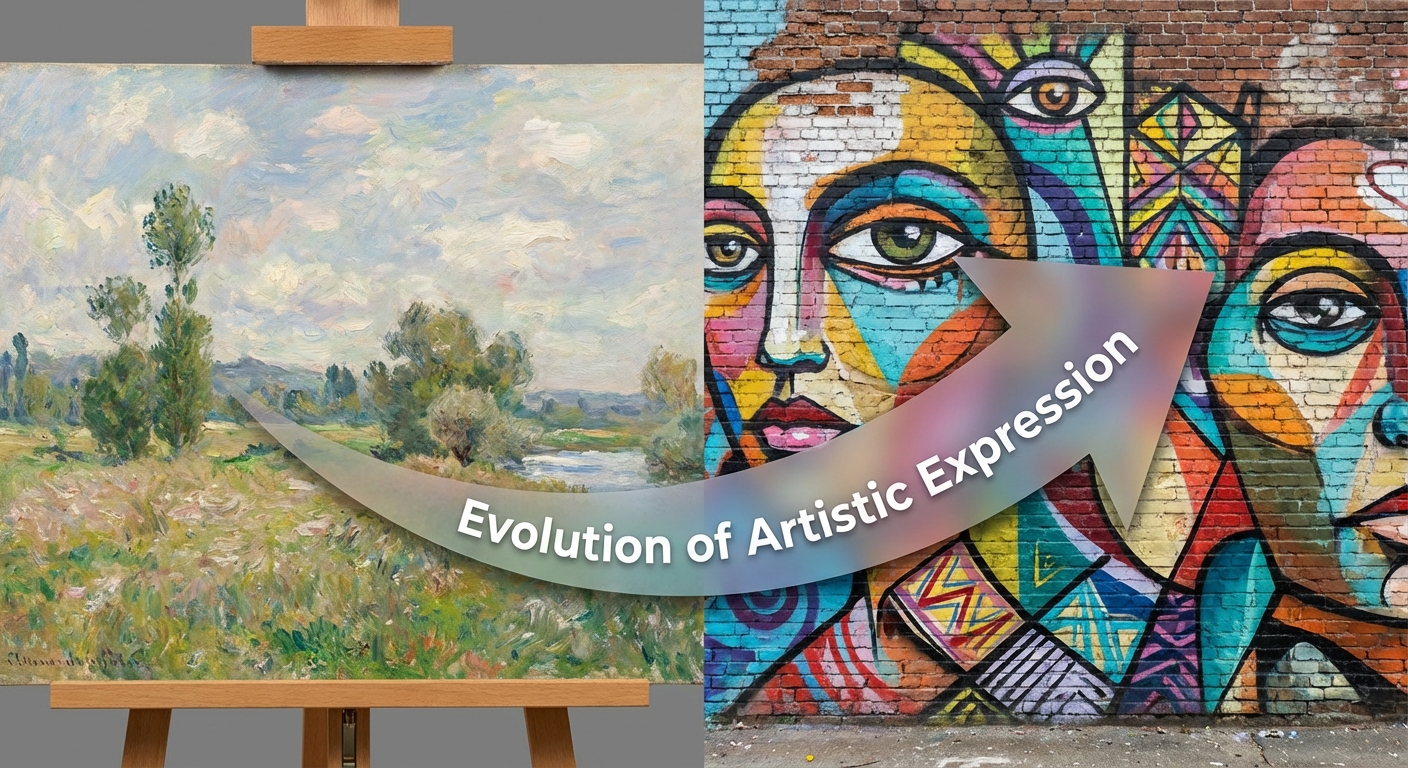
In the context of the AP French exam, Arts and Aesthetics (L'Esthétique) goes beyond just liking a painting. It involves understanding how art reflects history, identity, and social values.
Definitions & Key Concepts
- Les Beaux-Arts (Fine Arts): A traditional category of art forms created primarily for aesthetic purposes, including painting, sculpture, architecture, music, and poetry.
- Le Patrimoine (Heritage): This is a crucial AP concept. It refers to the legacy of physical artifacts (monuments, art) and intangible attributes (traditions, performing arts) of a group or society.
- L'Architecture: The Francophone world is renowned for diverse architectural styles, from the Haussmannian buildings of Paris to the mud-brick Great Mosque of Djenné in Mali.
The Place of "La Bande Dessinée" (The Comic Strip)
Unlike in many Anglophone cultures where comics are often seen as pop culture for youth, in France and Belgium, the Bande Dessinée (BD) is respected as the Ninth Art (le neuvième art).
- Cultural Significance: Hardcover, artistic albums read by adults and children alike.
- Famous Examples: Tintin (Hergé, Belgium), Astérix (Goscinny & Uderzo, France).
- Modern Context: Graphic novels often tackle serious political and historical themes (e.g., Persepolis by Marjane Satrapi).
Cinema: The Seventh Art
France is the birthplace of cinema (The Lumière Brothers). The concept of Le Cinéma d'Auteur is vital here.
- Le Cinéma d'auteur: A style where the director (le réalisateur) is considered the primary author of the film, imparting a unique personal vision, distinct from the commercial "studio system."
- La Nouvelle Vague (The New Wave): An art film movement from the late 1950s that rejected traditional filmmaking conventions in favor of experimentation and iconoclasm (e.g., François Truffaut, Jean-Luc Godard).
Important Vocabulary for Describing Art
| Refined Term | Meaning | Usage Example |
|---|---|---|
| Le chef-d'œuvre | Masterpiece | La Joconde est un chef-d'œuvre du Louvre. |
| La nature morte | Still life | Cézanne est célèbre pour ses natures mortes de fruits. |
| L'arrière-plan | Background | On voit une montagne à l'arrière-plan. |
| L'exposition (f) | Exhibition | Je vais au vernissage de l'exposition. |
| Émouvant(e) | Moving/Touching | Ce film est vraiment émouvant. |
Literature and Literary Movements
French literature is analyzed not just by plot, but by the movement (le courant littéraire) the author belongs to. You must be able to link authors to their historical context.
Major Movements
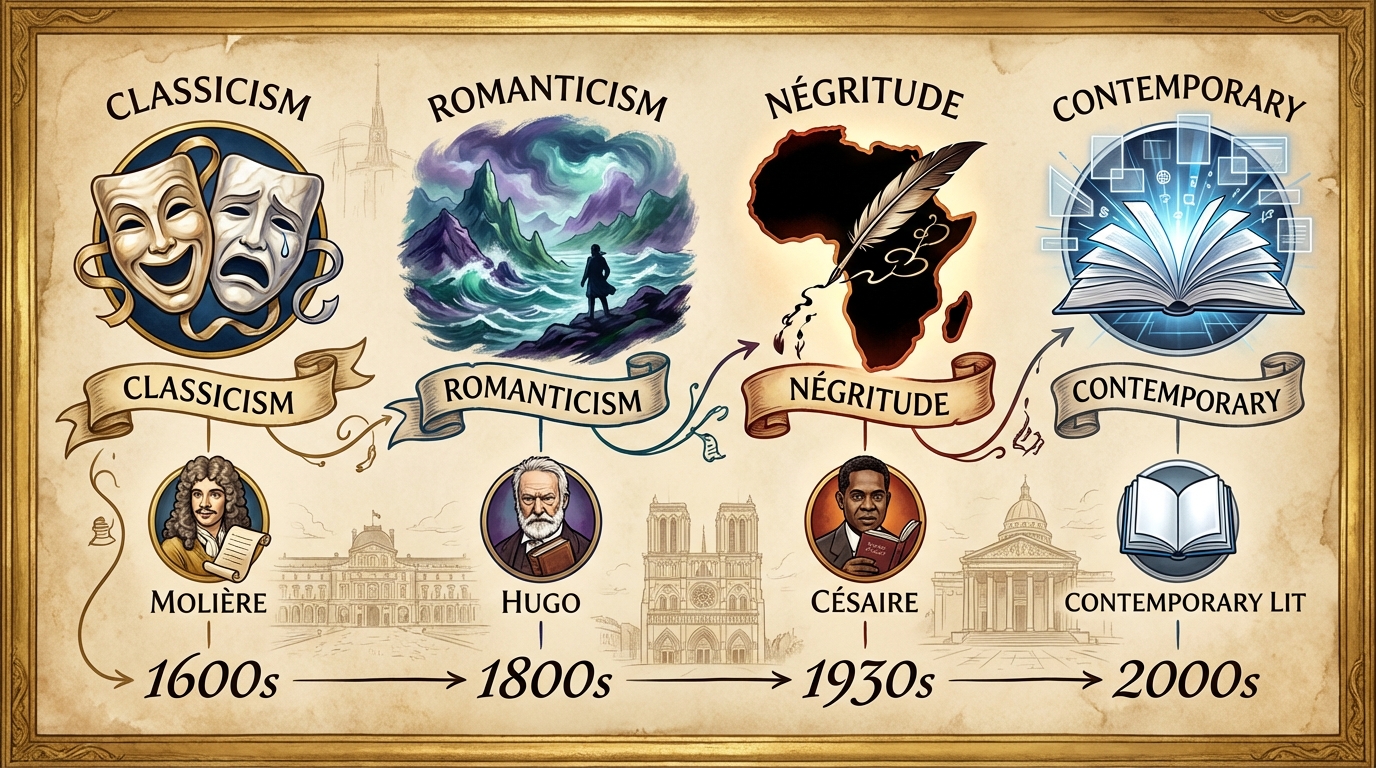
- Le Classicisme (17th Century): Defined by order, clarity, moral purpose, and strict rules.
- Key Figure: Molière (Playwright/Theater). emphasizes human vices through comedy.
- Le Romantisme (19th Century): Emphasized emotion, nature, individualism, and the rejection of classical rules.
- Key Figure: Victor Hugo (Les Misérables, Notre-Dame de Paris).
- L'Existentialisme (20th Century): Philosophy arguing that humans define their own meaning in an irrational universe.
- Key Figures: Jean-Paul Sartre, Albert Camus (L'Étranger).
La Négritude
This is a critical topic for the AP Exam regarding Francophone diversity.
- Definition: A literary and political movement developed in the 1930s by Francophone black intellectuals to reject colonial racism and cultivate pride in African heritage.
- Founders:
- Léopold Sédar Senghor (Senegal) — Also the first president of Senegal.
- Aimé Césaire (Martinique).
- Themes: Identity, roots, anti-colonialism, and the beauty of African culture.
Mnemonics for Analysis
When analyzing a literary text excerpt on the exam, remember T.A.P.:
- Thème (What is the central idea?)
- Atmosphère (What is the tone? Melancholy? Satirical?)
- Personnages (Who are they and what do they represent socially?)
Ideals of Beauty Across Cultures
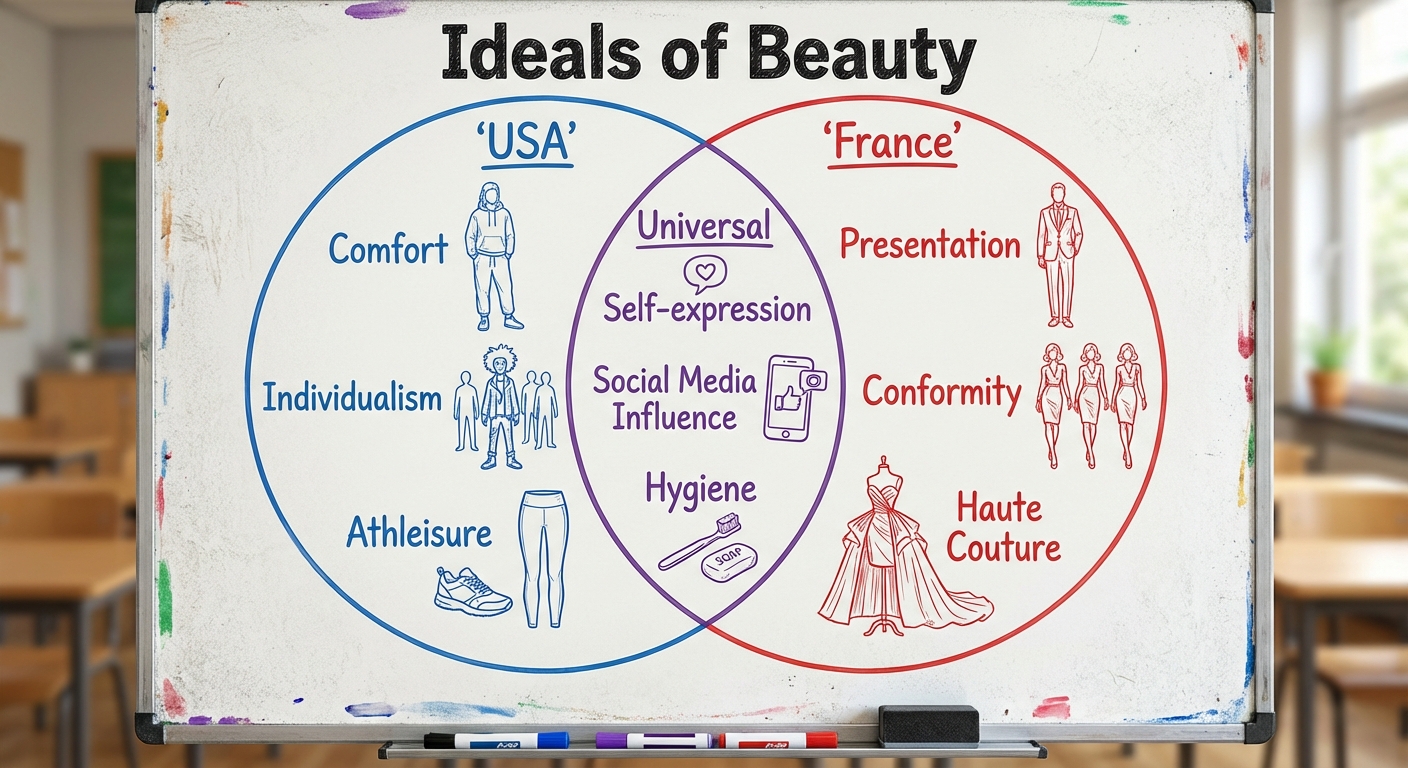
This section relates directly to the Cultural Comparison task. How do Francophones define beauty compared to your own culture?
Fashion and Appearance
France, particularly Paris, is often viewed as the capital of fashion (La Mode).
Haute Couture vs. Prêt-à-porter:
- Haute Couture: High-end, custom-fitted clothing. Protected by law in France; considers fashion as art forms.
- Prêt-à-porter: Ready-to-wear clothing sold in standard sizes.
The "Look":
- In general, French culture places a higher emphasis on conformity and presentation in public spaces than American culture. For example, wearing pajamas or athletic wear to the grocery store is rare and culturally frowned upon in France.
- Cultural Insight: To be "bien mis(e)" (well-dressed) is a sign of respect for others.
Traditional Francophone Clothing:
- Le Boubou: A flowing, wide-sleeved robe worn by men and women in much of West Africa (Senegal, Mali).
- Le Pagne: A colorful piece of fabric wrapped around the body, used in various ways across Central and West Africa. The patterns often communicate social messages or proverbs.
Architecture and Public Spaces
Beauty in the Francophone world is often tied to symmetry and preservation.
- Urbanism: Many French cities prioritize aesthetic uniformity (laws on building height and color) over individual expression in architecture.
- Les Villes Fleuries: A competition in France where towns are rated on their floral displays and green spaces, emphasizing that beauty is a communal responsibility.
Contemporary Debates
- Body Image: Like in the US, the Francophone world struggles with unrealistic beauty standards promoted by social media and advertising.
- Diversity: There is an ongoing dialogue about the representation of different body types and ethnicities in French media and fashion.
Common Mistakes & Pitfalls
Confusing "Une pièce" vs. "Un morceau":
- Une pièce refers to a play (theater) or a room.
- Un morceau refers to a piece of music or a physical piece (of cake).
- Incorrect: "J'ai écouté une pièce de musique." → Correct: "J'ai écouté un morceau de musique."
Misusing Know vs. Know (Savoir vs. Connaître):
- Use Connaître for art, artists, and places.
- Incorrect: "Je sais le musée du Louvre." → Correct: "Je connais le musée du Louvre."
Genre Confusion with "Critique":
- Un critique (masculine) is the person (the critic).
- Une critique (feminine) is the review (the article).
Stereotyping Beauty:
- Avoid generalising that "All French people wear berets" or "All African art is tribal masks." The Francophone world is modern and diverse. Always look for nuance.