AP African American Studies: Unit 3 - The Practice of Freedom (1865–1940s)
Unit Overview
Unit 3: The Practice of Freedom covers the transformative era from the end of the Civil War through the Great Migration and the Harlem Renaissance. This period is defined by the transition from enslavement to citizenship, the violent backlash of the Jim Crow era, and the resilient cultural, intellectual, and economic rebuilding of African American communities.
TOPIC 3.1 The Reconstruction Amendments & Citizenship
The Reconstruction Era (1865–1877)
Reconstruction was the period immediately following the Civil War during which the federal government attempted to reintegrate Confederate states and establish rights for formerly enslaved people.
The Civil War Amendments
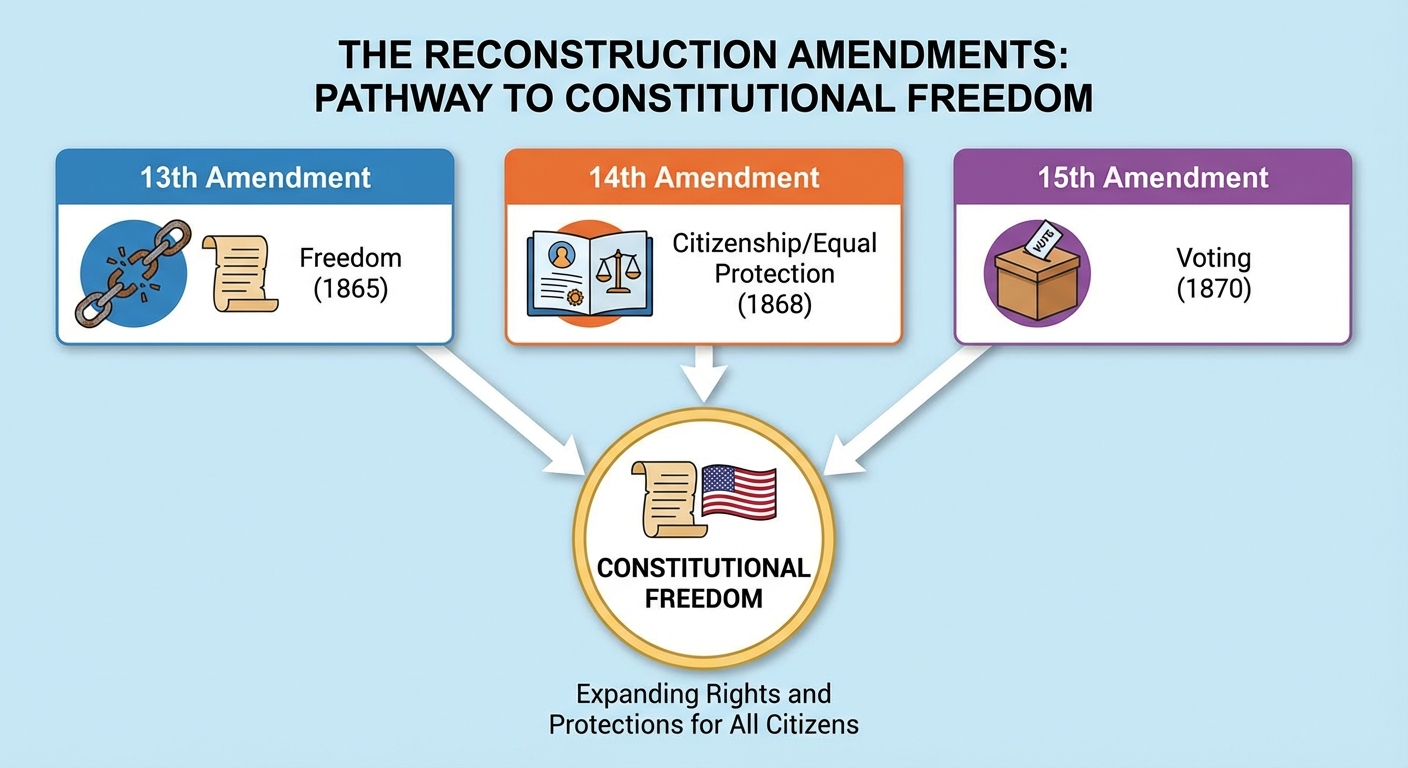
To secure freedom legally, three critical amendments were passed. A common mnemonic to remember these is "Free, Citizens, Vote" (13, 14, 15).
13th Amendment (1865)
- Definition: Abolished slavery and involuntary servitude in the United States.
- The "Exception" Clause: Slavery remained legal as "a punishment for crime whereof the party shall have been duly convicted." This loophole later facilitated the convict leasing system.
14th Amendment (1868)
- Birthright Citizenship: Defined anyone born or naturalized in the U.S. as a citizen (overturning the 1857 Dred Scott v. Sandford decision).
- Equal Protection Clause: Guaranteed equal protection under the law for all citizens.
- Due Process: States cannot deprive any person of life, liberty, or property without due process.
15th Amendment (1870)
- Voting Rights: Prohibited the federal and state governments from denying the right to vote based on "race, color, or previous condition of servitude."
- Limitations: It did not prohibit denial based on gender (igniting conflict with women's suffragists) or based on literacy/wealth (leading to poll taxes later).
Political Participation
- Black Officeholders: During Reconstruction, approximately 2,000 Black men served in public office, from local school boards to the U.S. Senate (e.g., Hiram Revels and Blanche K. Bruce).
TOPIC 3.2 The Freedmen’s Bureau & Social Rebuilding
The Freedmen’s Bureau (1865–1872)
Formally known as the Bureau of Refugees, Freedmen, and Abandoned Lands.
- Role: An agency of the War Department set up to assist formerly enslaved people (and poor whites) in the transition to freedom.
- Key Achievements: provided food/clothing, negotiated labor contracts, and most significantly, established schools.
- Challenges: Severely underfunded and obstructed by President Andrew Johnson and Southern resistance.
Reuniting Families
- The Search for Kin: Formerly enslaved people walked hundreds of miles, placed newspaper ads ("Information Wanted"), and used the Freedmen's Bureau to find spouses and children utilized during the domestic slave trade.
- Legitimizing Marriage: Couples rushed to have their unions legally consecrated to establish inheritance rights and social stability.
TOPIC 3.3 Land, Labor, and Black Codes
Black Codes (1865–1866)
Restrictive laws passed by Southern states immediately after the Civil War to control Black labor and behavior.
- Intent: To replicate the social and economic structure of slavery without the legal title.
- Restrictions: Vagrancy laws (illegal to be unemployed), prohibition on owning guns, and strict curfews.
The Land Question
- Special Field Orders No. 15: Issued by General William T. Sherman (1865). It reserved 400,000 acres of coastal land (SC to FL) for Black families ("40 acres and a mule").
- The Betrayal: President Andrew Johnson revoked the order, returning the land to growing Confederate owners and evicting the Black settlers.
New Systems of Exploitation
With no land, freedpeople were forced into exploitative labor systems.
| System | Definition |
|---|---|
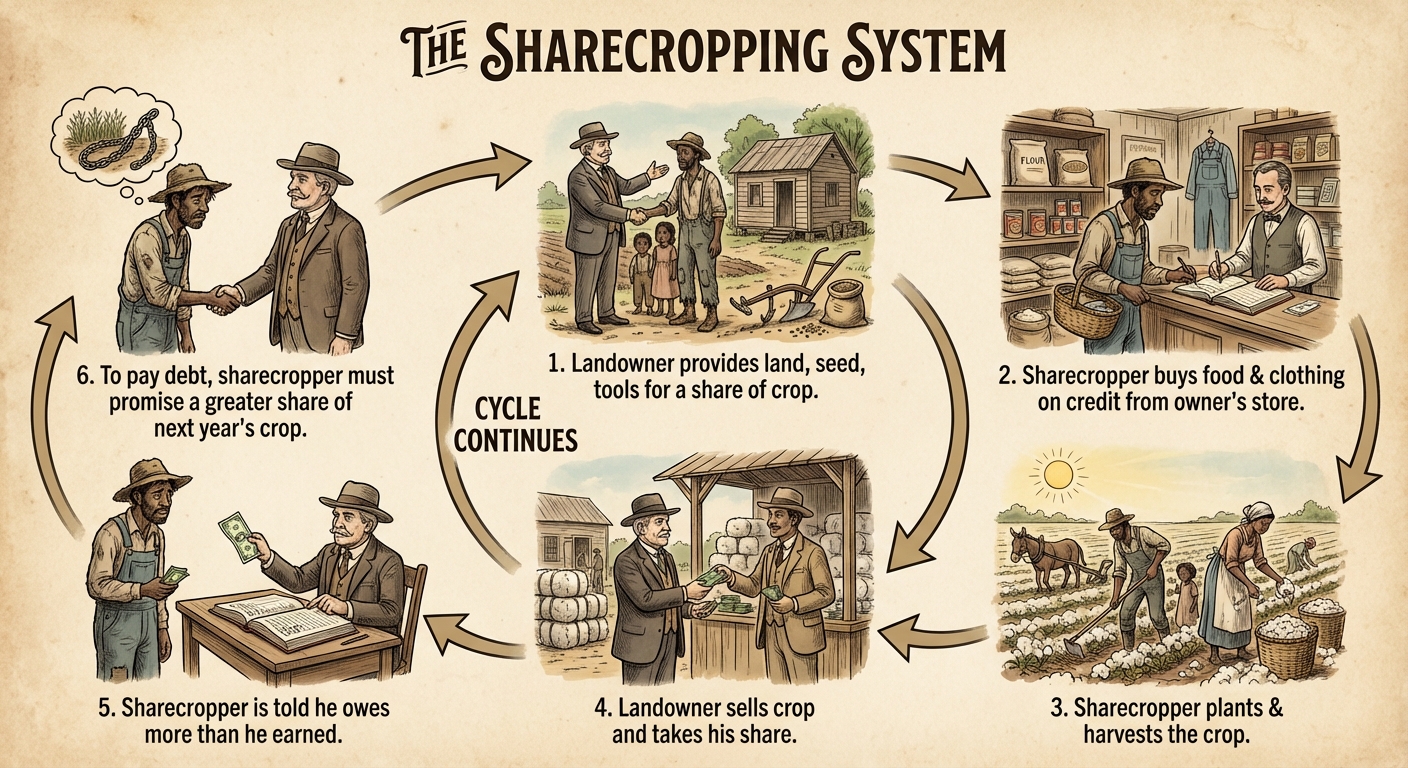
| Sharecropping | Landowners provided land/tools; farmers worked it for a share of the crop (usually 50%). High interest rates at plantation stores created cycles of debt. |
| Crop Lien System | Farmers obtained supplies on credit against future crops. If the harvest failed or prices dropped, debt accumulated (peonage). |
| Convict Leasing | Southern states leased prisoners (mostly Black men arrested on trivial charges like vagrancy) to private companies (mines, railroads). Conditions were often deadly, as companies had no financial incentive to keep leased workers alive. |
TOPIC 3.4 The Defeat of Reconstruction
The Reactionary Rolling Back of Rights
- Ku Klux Klan (KKK): Founded in 1866 as a terrorist organization to suppress Black voting and Republican power through violence.
- The Compromise of 1877: The informal deal that settled the disputed 1876 presidential election. Rutherford B. Hayes (Republican) became President in exchange for removing federal troops from the South. This signaled the official end of Reconstruction.
Common Mistakes
Mistake: Assuming Reconstruction failed because Black politicians were incompetent.
Correction: Reconstruction was dismantled due to violent white supremacist terrorism, waning Northern political will, and the withdrawal of federal protection (Compromise of 1877).
TOPIC 3.5 The Nadir of Race Relations & Jim Crow
The Nadir (approx. 1877–1920)
Historians call this the "lowest point" in American race relations.
- Jim Crow Laws: State and local laws enforcing racial segregation in the South. Segregation applied to schools, transportation, cemeteries, and parks.
- Plessy v. Ferguson (1896):
- Case: Homer Plessy challenged Louisiana's Separate Car Act.
- Ruling: The Supreme Court upheld segregation under the doctrine "Separate but Equal."
- Impact: Legitimized legal segregation for the next 60 years.
Disenfranchisement Methods
To bypass the 15th Amendment, states used:
- Poll Taxes: A fee to vote (disproportionately affecting poor Blacks).
- Literacy Tests: Impossible exams administered subjectively by white registrars.
- Grandfather Clauses: Exempted voters from taxes/tests if their grandfather could vote before 1867 (protecting poor whites while excluding Blacks).
TOPIC 3.6 Racial Violence and Resistance
Lynching and Mob Violence
- Lynching: Extrajudicial public murders used to terrorize Black communities and maintain white supremacy. Often justified by false accusations of crimes against white women.
- Ida B. Wells: Pioneering journalist who investigated lynching. She exposed that lynching was actually a tool to punish Black economic success and suppress political power, not a response to crime. Published The Red Record.
The Red Summer (1919)
- Context: Following WWI, Black veterans returned expecting rights they fought for abroad.
- Event: A series of white supremacist race riots in over three dozen cities (e.g., Chicago, Washington D.C.) driven by competition for jobs and housing.
Tulsa Race Massacre (1921)
- White mobs, aided by city officials, destroyed the Greenwood District (known as "Black Wall Street") in Tulsa, Oklahoma. It decimated Black generational wealth.
TOPIC 3.7 & 3.8 Uplift Ideologies: Washington vs. Du Bois
Two dominant intellectual streams emerged to address the "Negro Problem."
Booker T. Washington
- Stance: Accomodationism and Industrial Education.
- Key Text: Atlanta Compromise Speech (1895).
- Philosophy: "Cast down your bucket where you are." Argued Black people should focus on vocational skills (farming, mechanics) and economic self-sufficiency before seeking social equality or voting rights.
- Institution: Tuskegee Institute.
W.E.B. Du Bois
- Stance: Civil Rights and Higher Education.
- Key Text: The Souls of Black Folk (1903).
- Key Concepts:
- The Talented Tenth: The top 10% of Black society must be educated in liberal arts to lead the race.
- Double Consciousness: The psychological challenge of having two identities: "an American, a Negro; two souls, two thoughts…"
- Organization: Helped found the NAACP (1909).
Black Women's Club Movement
- Motto: "Lifting as we climb."
- National Association of Colored Women (NACW): Founded in 1896. Leaders like Mary Church Terrell and Nannie Helen Burroughs advocated for women's suffrage, anti-lynching laws, and community aid.
TOPIC 3.9 & 3.10 Institutions: The Pillar of Community
The Black Church
- The most independent Black institution. It served as a religious center, political meeting hall, school, and social safety net.
- Key Denominations: AME (African Methodist Episcopal) and National Baptist Convention.
HBCUs (Historically Black Colleges and Universities)
- Origins: Founded because African Americans were barred from white institutions.
- Second Morrill Act (1890): Mandated states provide land-grants for Black colleges if they discriminated in their white colleges.
- Examples: Howard (Law/Medicine), Fisk (Liberal Arts), Tuskegee (Vocational).
- Impact: Created the Black professional class (doctors, lawyers, teachers).
TOPIC 3.16 & 3.17 The Great Migration
The Great Migration (1910–1970)
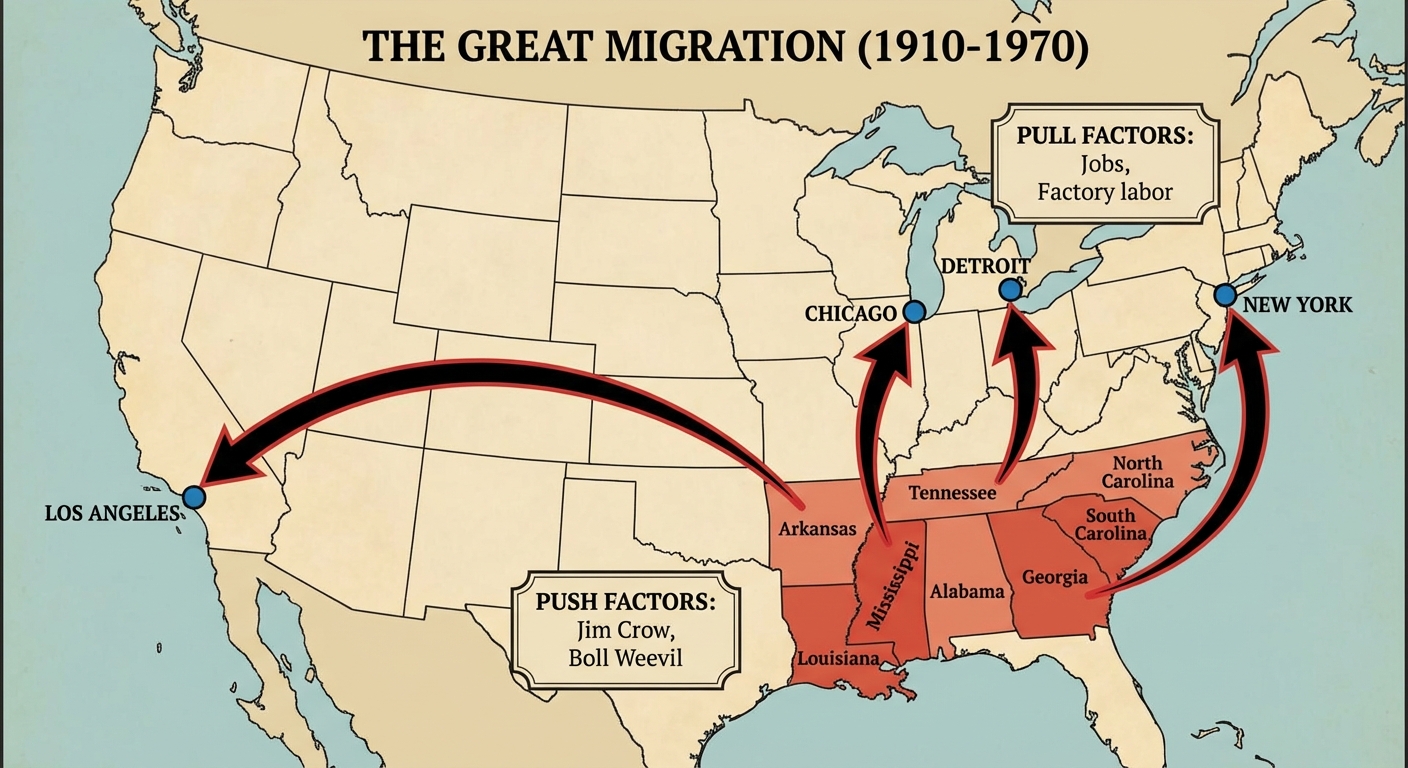
The massive movement of 6 million African Americans from the rural South to the urban North and West.
| Push Factors (Why leave?) | Pull Factors (Why go?) |
|---|---|
| Jim Crow segregation & racial violence (lynching). | Industrial jobs (WWI labor shortages). |
| Sharecropping debt. | Better wages and (perceived) more rights. |
| The Boll Weevil infestation (destroyed cotton crops). | The influence of the Black Press (e.g., Chicago Defender) urging migration. |
Afro-Caribbean Migration
- Simultaneous migration from Jamaica, Bahamas, and Barbados to cities like New York (Harlem) and Miami.
- Context: Economic decline in the Caribbean and labor needs for projects like the Panama Canal.
- Impact: Infused Black American culture with radical politics and distinct cultural traditions.
TOPIC 3.18 Marcus Garvey and the UNIA
Pan-Africanism
- The UNIA: Universal Negro Improvement Association, founded by Jamaican-born Marcus Garvey.
- Philosophy: Black Nationalism. Garvey advocated for racial pride, economic independence (Black-owned businesses), and the separation of Black and White societies.
- Key Projects:
- Black Star Line: A shipping company designed to facilitate trade among Black people globally and allow for repatriation to Africa.
- "Africa for the Africans": Anti-colonial stance.
Conflict
Garvey clashed with Du Bois and the NAACP who favored integration. The federal government eventually targeted Garvey, leading to his deportation.
TOPIC 3.11 - 3.14 The Harlem Renaissance (The New Negro Movement)
Overview
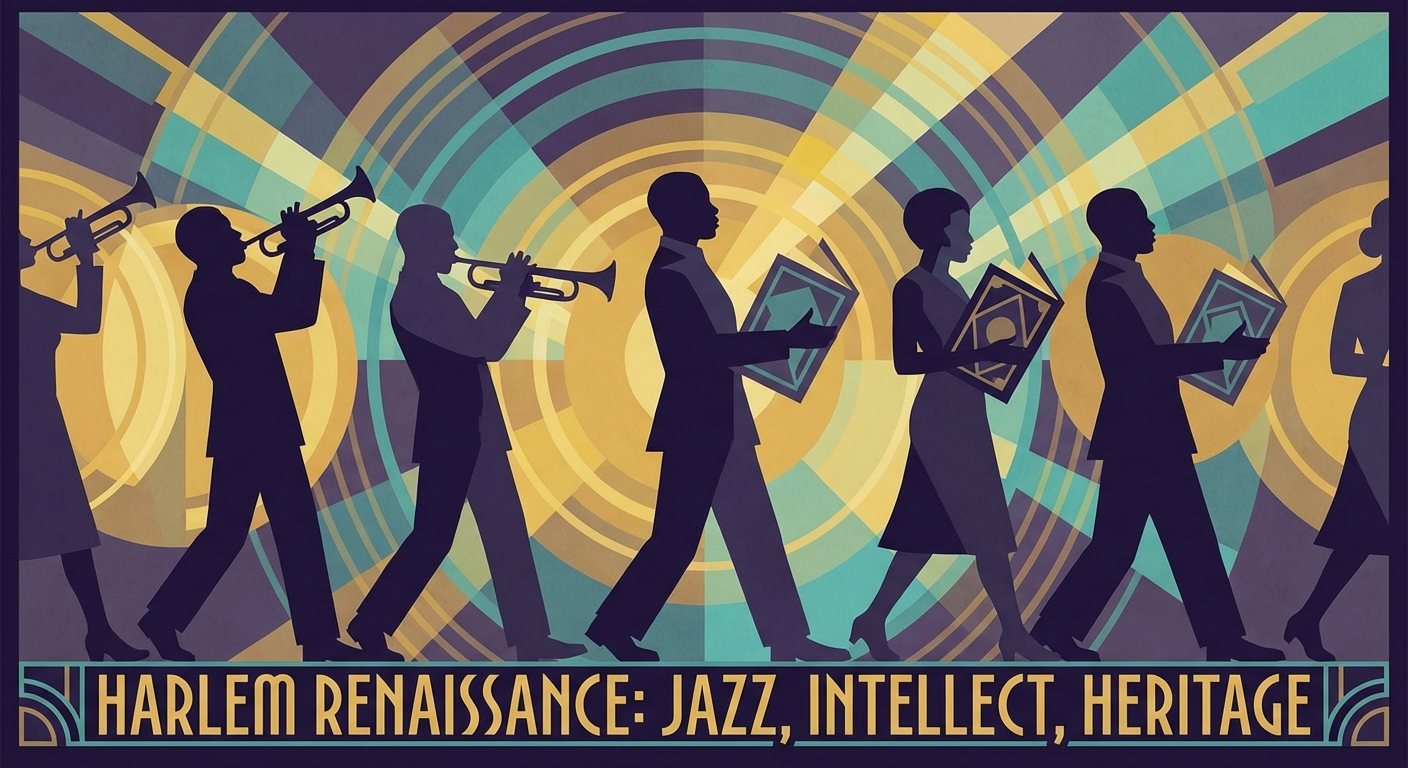
A flourishing of Black intellectual, artistic, and literary life centered in Harlem, NY, spanning the 1920s and 30s.
The "New Negro"
- Term popularized by Alain Locke.
- Refusal to submit to Jim Crow laws; a spirit of self-determination, pride, and militancy.
Key Figures & Contributions
Literature
- Langston Hughes: Used "jazz poetry" to portray the everyday lives of working-class Blacks.
- Zora Neale Hurston: Anthropologist and author (Their Eyes Were Watching God) who celebrated rural Southern Black folk culture.
- Claude McKay: Jamaican poet wrote "If We Must Die," a defiant response to the Red Summer violence.
Visual Arts
- Aaron Douglas: Often called the "Father of Black American Art." Used geometric styles and silhouettes to link African heritage with modern Black life.
- Photography: James Van Der Zee captured the dignity and sophistication of the Black middle class in Harlem, countering racists stereotypes.
Music
- Jazz: Born in New Orleans, spread North during the Migration. Characterized by improvisation and syncopation (e.g., Duke Ellington, Louis Armstrong).
- Blues: Rooted in Southern spirituals and work songs, expressing hardship and resilience (e.g., Bessie Smith).
Black History Education
- Carter G. Woodson: The "Father of Black History." Founded the Association for the Study of Negro Life and History (ASNLH) in 1915 and established Negro History Week (now Black History Month) to ensure Black contributions were not erased from education.
Common Mistakes to Avoid
- Confusing the Amendments: Remember: 13 (Freedom), 14 (Citizenship), 15 (Voting). Don't swap them.
- Geographic Hallucinations: Not all African Americans moved North during the Great Migration. The majority actually remained in the South, continuing to fight for rights there.
- Monolith Myth: Black leaders did not all agree. Washington and Du Bois had fierce public debates about the best path forward (Economics vs. Civil Rights). Garvey and Du Bois also disliked each other's methods.